Iron: History and Discovery
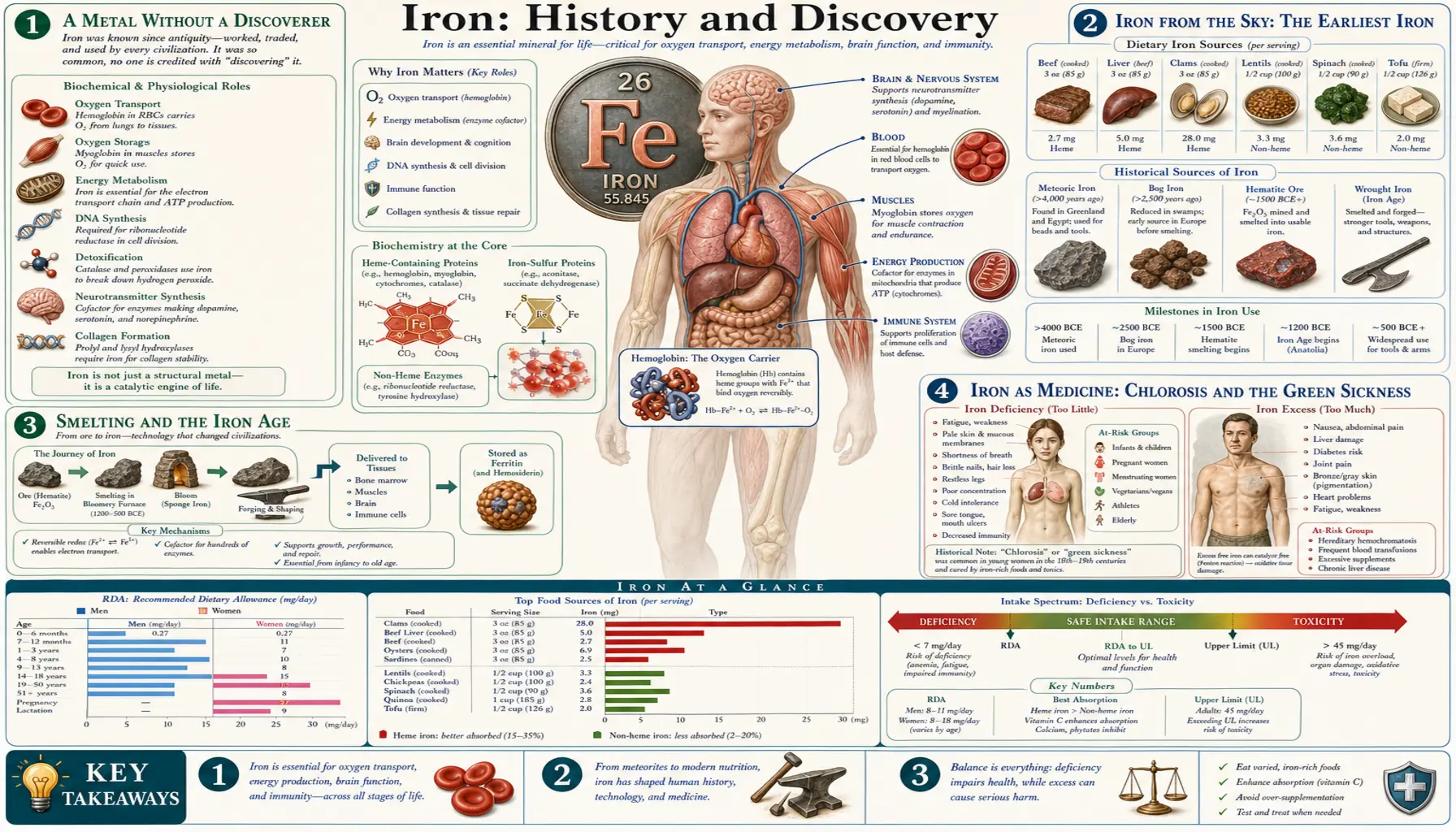
Unlike most of the minerals we depend on, iron has no single discoverer and no first-isolation date — it is one of the oldest materials in human hands, worked from fallen meteorites before anyone knew how to smelt it from rock, and it gave its name to an entire age of history. Yet the story of iron as a nutrient — the realisation that this metal of swords and ploughs is also the very thing that makes our blood red and carries the breath of life through our bodies — is much more recent, and it can be traced to named people and datable discoveries. This article keeps the two threads separate and honest: the ancient, authorless history of iron the material, and the modern, well-documented discovery of iron the essential element of life — from a green-skinned "disease of virgins" and an Italian physician with a magnet, to a Nobel Prize for the structure of blood's oxygen-carrier and the recent unmasking of the hormone that governs iron in the body. Where the record is firm we say so; where a date is approximate or a claim is disputed, we say that too.
Table of Contents
- A Metal Without a Discoverer
- Iron from the Sky: The Earliest Iron
- Smelting and the Iron Age
- Iron as Medicine: Chlorosis and the Green Sickness
- Iron in the Blood: Menghini's Magnet (1746)
- Iron Becomes a Nutrient: Stockman and the Scientific Basis
- The Molecule of Breath: Hemoglobin and a Nobel Prize
- The Body's Iron Thermostat: Hepcidin (2000–2001)
- Research Papers and References
- Connections
- Featured Videos
A Metal Without a Discoverer
It is tempting to ask, "Who discovered iron?" — but for iron the question has no clean answer, and saying so plainly is the honest place to begin. Iron is one of the seven metals of antiquity, the small group of elements (alongside gold, silver, copper, tin, lead, and mercury) that humans knew, worked, and named long before chemistry existed as a science. There was no single moment of discovery, no laboratory, no first chemist to point to. Iron entered human life gradually, across many cultures, over thousands of years.
This makes iron different from most of the other minerals essential to our health. Phosphorus has a discoverer and a date (Hennig Brand, 1669); so do iodine (Bernard Courtois, 1811) and magnesium as a metal (Humphry Davy, 1808). Iron has neither. What iron does have is a documented arc of two quite separate stories: the ancient history of iron the material — meteoric metal, then smelted metal, then the Iron Age — and the far more recent history of iron the nutrient, the discovery that this same element is woven into our blood and is needed for life itself. The sections that follow trace both, and take care to mark where the dates are solid and where they are approximate or argued over.
One more point of honesty about names: the chemical symbol for iron, Fe, comes not from any modern discoverer but from the Latin word ferrum. The English word "iron" descends from older Germanic roots. These names are themselves a record of how deeply and how anciently iron is embedded in human language — a metal so old that its names predate the very idea of a chemical element.
Iron from the Sky: The Earliest Iron
The oldest worked iron in the archaeological record did not come from the ground at all — it fell from the sky. Long before anyone could smelt iron from ore, people collected and hammered meteoric iron, a naturally occurring iron–nickel alloy that arrives on Earth in meteorites and needs no smelting to be used. Because it was rare and came from the heavens, this metal was treated as precious.
The clearest example is also one of the oldest. Nine small iron beads from Gerzeh in northern Egypt, dated to roughly 3200 BC, were shown by Thilo Rehren and colleagues in a 2013 study to be made of meteoritic iron, shaped by careful hammering and rolling rather than by the stone-working methods used on the other beads in the same burial. The beads had been strung alongside gold, lapis lazuli, and carnelian — placing meteoric iron, in the eyes of those who buried them, among the most precious materials known. Egyptian texts later referred to iron with a term meaning roughly "metal of the sky," a phrase that fits this origin remarkably well.
The most famous object of this kind belonged to a pharaoh. The iron dagger buried with Tutankhamun (who reigned in the fourteenth century BC) was confirmed by Daniela Comelli and colleagues in a 2016 analysis to have a blade of meteoritic origin, identified by its high nickel content (about 11 percent) together with cobalt — a composition characteristic of iron meteorites rather than smelted ore. These finds tell us something important about iron's beginnings: humanity's first relationship with the metal was with a rare gift from the sky, valued like jewellery, centuries before iron became the common, world-changing material of tools and weapons.
Smelting and the Iron Age
The transformation of iron from a precious curiosity into the metal that reshaped civilisation came with smelting — extracting metallic iron from common iron-ore rock. The earliest furnaces were bloomeries: charcoal-fired hearths in which forced air helped the burning charcoal pull oxygen away from the iron oxide in the ore, leaving behind a spongy mass of metal called a "bloom" that was then hammered into usable iron. Crucially, the bloomery never got hot enough to melt iron fully, so early ironworking was a craft of repeated heating and hammering.
The widespread adoption of smelted iron marks what archaeologists call the Iron Age, which began in the Near East and Anatolia around 1200 BC and spread at different times to different regions — reaching Central Europe centuries later and China later still. Because iron ore is far more abundant and widely distributed than the copper and tin needed for bronze, iron eventually democratised metal: tools, weapons, and implements that had once been scarce became, over generations, far more common.
A word of caution about a popular claim. It is often said that the Hittites of Anatolia invented or monopolised iron smelting in the second millennium BC. Anatolia does preserve unusually rich early textual evidence about iron, but the idea of a strict Hittite "monopoly" is no longer accepted in mainstream scholarship, because the supporting archaeological evidence is thin and comparable early iron objects turn up elsewhere. The careful statement is that ironworking technology emerged in the ancient Near East in the late second millennium BC and spread from there — not that any single people owned its secret. For our purposes, the key point is simply this: long before anyone knew iron was inside their own blood, iron had already remade farming, warfare, and daily life.
Iron as Medicine: Chlorosis and the Green Sickness
The thread now shifts from the forge to the sickbed. For centuries, European medicine recognised a condition called chlorosis, or the "green sickness" — named for the pale, greenish tinge of the skin seen in affected young women, who were also tired, breathless, and weak. It was common enough to dominate medical writing from the sixteenth century into the early twentieth, and went by vivid names such as morbus virgineus, the "disease of virgins." With the benefit of modern hindsight, much of what was called chlorosis was almost certainly iron-deficiency anaemia, often driven by menstrual blood loss and a poor diet — but that understanding lay far in the future.
What is genuinely striking is that an effective treatment was stumbled upon long before the reason it worked was understood. The English physician Thomas Sydenham — one of the most influential clinicians of the seventeenth century — is credited with describing, in the 1680s, the use of iron filings steeped in wine to treat the green sickness. He wrote in the language of his day that iron gave "a spur or fillip" to "worn out or languid blood." Sydenham could not have known about haemoglobin or iron metabolism; his was an empirical observation that giving iron made these patients better. He was, in effect, treating iron-deficiency anaemia with iron more than two hundred years before anyone could explain the mechanism — a reminder that good clinical observation often runs ahead of theory.
Iron in the Blood: Menghini's Magnet (1746)
If Sydenham showed that iron could heal the blood, the next great step was to show that iron was actually in the blood. That demonstration belongs to the Italian physician Vincenzo Menghini (1704–1759), working in Bologna in the 1740s. Building on earlier observations by his colleague Domenico Galeazzi, Menghini set out to prove the point with a simple, almost theatrical method.
He burned blood — and other tissues — to a dry ash, then passed a magnetised blade through the ash and watched iron-containing particles cling to it. By testing the blood of many animals as well as humans, he showed that the red part of the blood was the part richest in iron, pointing to the red corpuscles (what we now call red blood cells) as the chief seat of iron in the body. He went further, feeding iron preparations to animals and finding that their blood then contained still more iron. His findings were reported through the Academy of Sciences of Bologna around 1746.
This is a real, named, datable milestone in iron's biological story: the moment iron stopped being only a metal that helped the blood and became a substance demonstrably present in it. Menghini did not yet know how iron carried oxygen — oxygen itself would not be identified until decades later — but he had put iron firmly inside the human body, where the next two centuries of discovery would unfold.
Iron Becomes a Nutrient: Stockman and the Scientific Basis
Knowing that iron was in the blood, and that iron treated chlorosis, still left a long-running argument: why did it work? Through the nineteenth century, physicians disagreed sharply over whether the iron in medicines was truly absorbed and built into the blood, or whether it helped only indirectly. Iron tonics were enormously popular, but their mode of action was, in the honest words of the period, controversial.
The figure usually credited with putting the matter on a sound footing is the Scottish pharmacologist and physician Ralph Stockman, whose work in the 1890s — including his 1893 paper "The Treatment of Chlorosis by Iron and some Other Drugs" in the British Medical Journal — argued from careful study that chlorosis was caused by a deficiency of iron (linked to blood loss and inadequate diet) and that ingested inorganic iron was genuinely absorbed and used to make haemoglobin. In other words, iron was a nutrient the body required, and chlorosis was a disease of not having enough of it.
It is worth being candid that Stockman's correct conclusion was not immediately or universally accepted; the deficiency explanation of chlorosis took time to win out, and the disease itself eventually faded from medical attention as nutrition and diagnosis improved. But his work is the hinge on which the modern view turns — the point at which iron was understood not merely as a medicine that happened to help, but as an essential dietary element whose lack causes a specific, treatable disease. The full clinical picture of that disease is covered on the dedicated Iron Deficiency Anemia page.
The Molecule of Breath: Hemoglobin and a Nobel Prize
By the twentieth century, scientists knew iron lived in the red blood cells and was essential to carrying oxygen — but the actual machine that did the carrying, the protein haemoglobin, remained a black box. Understanding exactly how iron grips and releases oxygen meant working out the three-dimensional shape of one of the most important molecules in the body, and that turned out to be one of the great scientific challenges of the century.
The breakthrough came from the Austrian-born British scientist Max Perutz, who spent more than two decades at Cambridge using X-ray crystallography to attack the structure of haemoglobin, finally solving it around 1959. He showed that haemoglobin is built from four protein chains, each cradling an iron-bearing heme group, and that the molecule physically changes shape as it takes up and gives off oxygen — the mechanism behind every breath we take. His colleague John Kendrew solved the structure of the related muscle protein myoglobin in the same period, the first protein structure ever determined.
For this work, Perutz and Kendrew were awarded the Nobel Prize in Chemistry in 1962, with the official citation "for their studies of the structures of globular proteins." The prize marks the moment iron's biological role was understood not just chemically but structurally — we could finally see, atom by atom, how a single iron atom at the heart of a heme group is what lets blood carry oxygen from the lungs to every living cell. It was the culmination of a journey that had begun with a green-skinned illness and a physician's magnet.
The Body's Iron Thermostat: Hepcidin (2000–2001)
There is a final chapter, and it is recent enough that many people alive today watched it unfold. The body faces a delicate problem with iron: it is essential, but in excess it is toxic, and — unusually — humans have no controlled way to excrete surplus iron. The amount of iron in the body must therefore be governed almost entirely at the point of absorption. For a long time, how the body sensed and controlled its iron levels was a deep mystery.
The answer arrived around the turn of the millennium with the discovery of a small liver-made hormone called hepcidin. Its identification came from several independent directions in 2000 and 2001: a group led by Krause first isolated the peptide from human blood (calling it LEAP-1); the laboratory of Tomas Ganz isolated it from urine and gave it the name hepcidin — from the liver (hep-) and its antibacterial action (-cidin); Pigeon and colleagues found that the gene was switched on by iron; and Sophie Vaulont's group, through Nicolas and colleagues, showed using genetically modified mice that hepcidin actually controls body iron. Hepcidin works by shutting down ferroportin, the channel that lets iron out of gut cells and storage cells into the blood — so more hepcidin means less iron entering the circulation, and less hepcidin means more.
This discovery reorganised the entire field of iron medicine. It explained why inflammation and chronic disease cause anaemia (inflammation drives hepcidin up, locking iron away), and why hereditary haemochromatosis causes iron overload (too little hepcidin, so iron floods in unchecked). More than 250 years after Menghini found iron in the blood, hepcidin revealed the master switch that decides how much iron we keep — the most important advance in understanding iron balance in modern times, and an active area of research and drug development today.
Research Papers and References
The list below gathers key peer-reviewed and authoritative sources for the historical and scientific claims made above, together with curated PubMed topic-search links into the history-of-iron literature. Historical figures and primary observations (Thomas Sydenham's seventeenth-century writings; ancient Egyptian use of meteoric iron) are named in the article as historical sources. Author names, titles, and journals are given as plain text; only the stable DOI, PMID, or archive link is hyperlinked, and each opens in a new tab.
- Poskitt EME. Early history of iron deficiency. British Journal of Haematology. 2003;122(4):554-562. — PMID: 12899710
- Busacchi V. [Vincenzo Menghini and the discovery of iron in the blood]. Bullettino delle Scienze Mediche (Bologna). 1958;130(2):202-205. [Article in Italian] — PMID: 13573175
- Stockman R. The Treatment of Chlorosis by Iron and some Other Drugs. British Medical Journal. 1893;1(1687):881-885. — PMID: 20754182
- Rehren T, Belgya T, Jambon A, et al. 5,000 years old Egyptian iron beads made from hammered meteoritic iron. Journal of Archaeological Science. 2013;40(12):4785-4792. — doi:10.1016/j.jas.2013.06.002
- Comelli D, D'Orazio M, Folco L, et al. The meteoritic origin of Tutankhamun's iron dagger blade. Meteoritics & Planetary Science. 2016;51(7):1301-1309. — doi:10.1111/maps.12664
- Park CH, Valore EV, Waring AJ, Ganz T. Hepcidin, a urinary antimicrobial peptide synthesized in the liver. Journal of Biological Chemistry. 2001;276(11):7806-7810. — doi:10.1074/jbc.M008922200
- Nemeth E, Ganz T. The role of hepcidin in iron metabolism. Acta Haematologica. 2009;122(2-3):78-86. — doi:10.1159/000243791
- History of iron in medicine and nutrition — PubMed: history of iron deficiency and chlorosis
- Discovery and history of hepcidin — PubMed: hepcidin discovery and iron regulation
External Authoritative Resources
- NobelPrize.org — The Nobel Prize in Chemistry 1962 (Perutz and Kendrew)
- NIH Office of Dietary Supplements — Iron Fact Sheet
- PubMed — All research on the history of iron metabolism
Connections
- All Minerals
- Iron
- Iron Benefits
- Iron Deficiency Anemia
- Anemia
- Hemochromatosis
- Copper
- Vitamin C
- Complete Blood Count