Calcium: History and Discovery
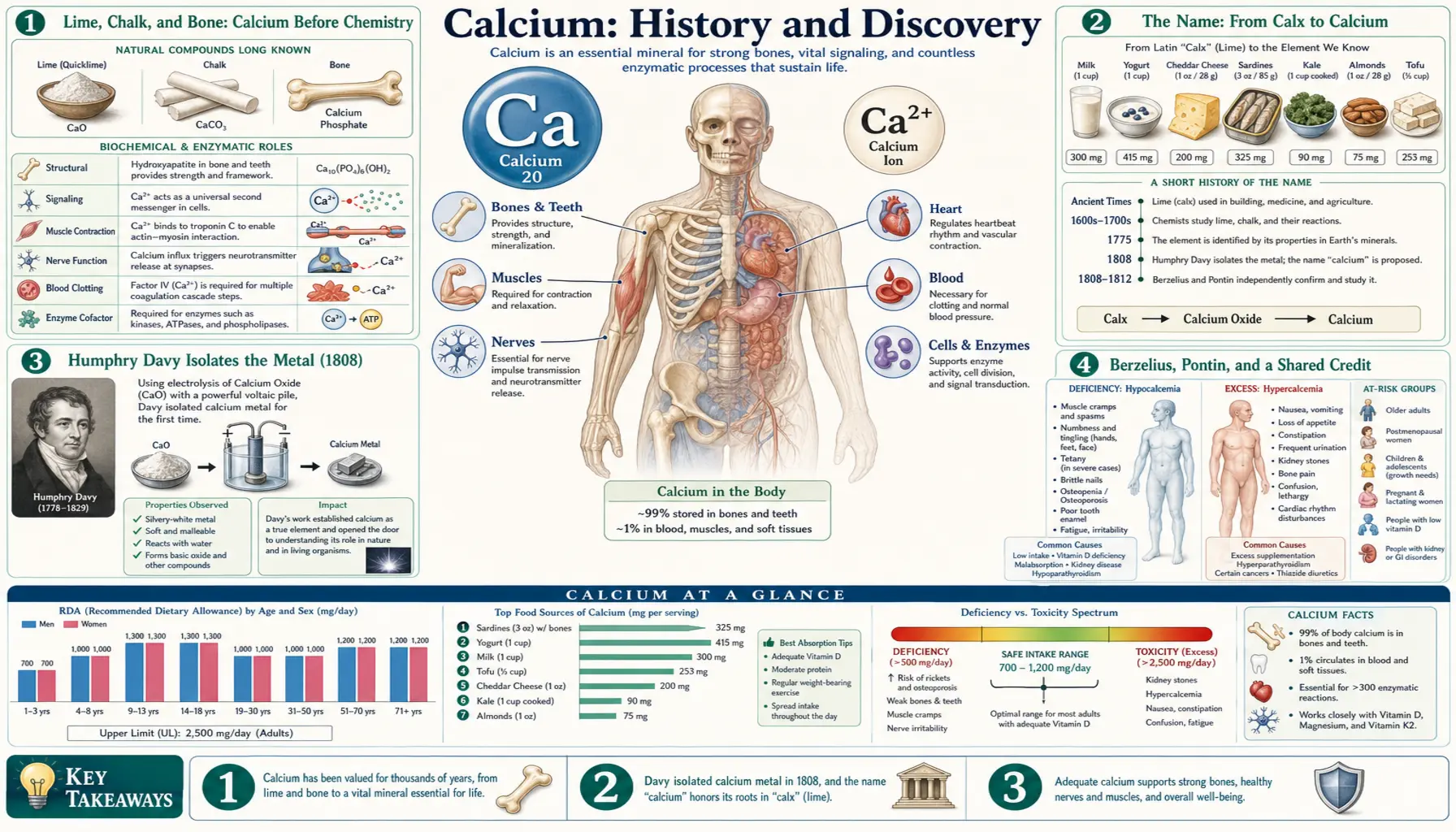
Humanity used calcium long before anyone knew it was an element. The lime in ancient mortar, the chalk on a cliff face, the shell of an egg, and the bones in our own bodies are all calcium compounds — yet the metal itself was not isolated until 1808, when the English chemist Sir Humphry Davy tore it out of lime with the new tool of his age, electricity. Calcium therefore has the two-part story common to the essential mineral nutrients: first the discovery of the element by chemists, and then, decades later, the slow discovery of its biological role — how a single ion keeps the heart beating, the nerves firing, the blood clotting, and the skeleton standing. This article follows both threads. Where a name, a date, or a "first" is firmly documented we state it plainly; where the record is layered or shared between rivals we say so.
Table of Contents
- Lime, Chalk, and Bone: Calcium Before Chemistry
- The Name: From Calx to Calcium
- Humphry Davy Isolates the Metal (1808)
- Berzelius, Pontin, and a Shared Credit
- Sydney Ringer and the Beating Heart (1880s)
- The Parathyroid Puzzle: Calcium as a Nutrient
- Calcitonin and the Calcium-Sensing Receptor
- Bone, Diet, and the Modern Picture
- Research Papers and References
- Connections
- Featured Videos
Lime, Chalk, and Bone: Calcium Before Chemistry
Calcium is one of those elements people handled for thousands of years without having any idea what it was. It is the fifth most abundant element in the Earth's crust, and it almost never occurs as the free metal in nature — it is far too reactive for that. Instead it turns up locked inside familiar compounds: limestone and marble and chalk (calcium carbonate), gypsum (calcium sulfate), and the calcium phosphate that makes up bone and tooth. Wherever there is shell, coral, eggshell, or skeleton, there is calcium.
The most consequential of the old uses was lime. When limestone is heated strongly it gives off carbon dioxide and leaves behind quicklime (calcium oxide); add water and it becomes slaked lime, which slowly hardens back into a stone-like solid as it reabsorbs carbon dioxide from the air. This simple chemistry, discovered empirically, gave the ancient world its mortar and plaster. Builders in Mesopotamia, Egypt, Greece, and above all Rome used lime mortar to bind stone and brick, and the Romans turned it into a structural art — the durable concretes of Roman harbours and the Pantheon's dome rest on lime chemistry. Plaster of Paris, made by gently heating gypsum, takes its name from the large gypsum deposits beneath the Paris basin.
None of these craftsmen knew they were working with a metal's compounds; the very idea that lime might contain a hidden metal came much later. For most of history calcium was, in effect, invisible — present everywhere, recognised nowhere. That is the gap Humphry Davy would close.
The Name: From Calx to Calcium
The element's name records this deep history of lime. Calcium comes from the Latin word calx (genitive calcis), meaning "lime" — the same root that gives English "calcify," "calculus" (originally a small stone or pebble), and "chalk." When Davy needed names for the new metals he drew from lime he had isolated, he followed the convention of the day and built them from the names of the substances they came from. Calcium is, quite literally, "the metal of lime."
It is worth noting that calcium is not the only element whose name preserves an ancient craft material in this way; the naming reflects an era when chemists were systematically pulling new elements out of long-familiar earths and salts. The chemical symbol, Ca, and the modern understanding of calcium as element number 20 — an alkaline-earth metal — came later, as the periodic system was worked out across the nineteenth century. But the word itself carries us straight back to the lime kiln.
Humphry Davy Isolates the Metal (1808)
The isolation of calcium belongs to one of the most productive episodes in the history of chemistry. In the first decade of the nineteenth century, the English chemist Sir Humphry Davy (1778–1829), working at the Royal Institution in London, used the newly invented voltaic pile — the first electric battery — to do something no one had managed before: pull apart compounds that had resisted every chemical method, by brute electrical force. With this technique, called electrolysis, Davy had already isolated potassium and sodium in 1807. In 1808 he turned the same approach on the alkaline earths.
On 30 June 1808, Davy reported to the Royal Society that he had obtained four new metals, which he named calcium, barium, strontium, and magnium (the last later renamed magnesium). Calcium was the most stubborn of the group. Davy could not simply electrolyse dry lime, so he worked with a moist mixture of lime and mercuric oxide and used a mercury electrode; the calcium that was freed dissolved into the mercury as an amalgam, and the mercury could then be driven off to leave the metal behind — impure, but unmistakably a new, light, reactive metal. Davy himself described how difficult these alkaline-earth metals were to obtain in any quantity, and the calcium he isolated was small and contaminated. Still, the essential point stands and is well documented: Davy was the first person to isolate metallic calcium and to recognise it as an element, in 1808.
Berzelius, Pontin, and a Shared Credit
Davy's achievement was real, but it was not a solo performance, and honest history gives the other players their due. The crucial method — using a mercury electrode so that the freed alkaline-earth metal could be captured as an amalgam — came from Sweden. The great chemist Jöns Jacob Berzelius (1779–1848), working with the physician Magnus Martin af Pontin (1781–1858), had shown that electrolysing lime over mercury produced a calcium-mercury amalgam. Davy learned of this approach — by the usual account, through correspondence from Berzelius — and applied it to obtain the metal itself.
So the credit is layered rather than disputed: Berzelius and Pontin supplied the amalgam technique, and Davy used it to isolate and name the new element. Many historians add that Berzelius, one of the towering figures of the age, would very likely have reached the metal himself had Davy not got there first. This is a good example of how a scientific "first" is often a relay rather than a single sprint — and of why it is fairer to name everyone in the chain than to hand all the laurels to one man.
Sydney Ringer and the Beating Heart (1880s)
Knowing that calcium was an element told no one what it did in living things. That second discovery began, almost by accident, in a London laboratory in the early 1880s. The English physician and physiologist Sydney Ringer (1835–1910) was trying to keep an isolated frog heart beating outside the body in an artificial fluid. He found that a heart bathed in a solution made with ordinary distilled water soon stopped — but a heart bathed in solution made with London tap water kept beating beautifully. The difference, he eventually traced, was the calcium (and other salts) naturally present in the hard tap water.
In a series of papers around 1882–1883, Ringer worked out the precise blend of sodium, potassium, and calcium salts needed to sustain a beating heart — the recipe still known as Ringer's solution, an ancestor of the intravenous fluids used in hospitals today. More importantly for our story, this was the first clear demonstration that extracellular calcium is essential for muscle contraction. It was the opening chapter of a vast field: we now know calcium to be one of the most universal signalling ions in biology, but the trail begins with Ringer's frog hearts and his hard London water. His preparation was so reliable that it later allowed Otto Loewi and Henry Dale to demonstrate chemical nerve transmission, work recognised with the 1936 Nobel Prize in Physiology or Medicine.
The Parathyroid Puzzle: Calcium as a Nutrient
The discovery of calcium's role as an essential nutrient — something the body must keep in careful balance — came through a different door: the study of a tiny, easily overlooked pair of glands. Surgeons in the late nineteenth century had noticed that removing the thyroid sometimes triggered violent muscle spasms called tetany, and the cause was eventually traced not to the thyroid itself but to the four rice-grain-sized parathyroid glands beside it. (The glands themselves had first been described anatomically by Sir Richard Owen in 1852, in a rhinoceros.)
The decisive nutritional insight came in 1908, when William G. MacCallum and Carl Voegtlin at Johns Hopkins showed that the tetany following removal of the parathyroids was caused by a fall in blood calcium — and could be relieved by giving calcium. For the first time, a specific disease was tied directly to calcium balance. The story was completed in 1925, when the biochemist James Bertram Collip — already famous for his part in purifying insulin — prepared an extract of the parathyroid glands (now called parathyroid hormone, or PTH) and showed it could correct the low blood calcium and abolish the tetany. Calcium was no longer just a building material; it was revealed as a tightly regulated ion under hormonal control, with its own dedicated endocrine system.
Calcitonin and the Calcium-Sensing Receptor
If a hormone raised blood calcium, was there one that lowered it? The answer arrived in 1961–1962, when the Canadian physiologist Douglas Harold Copp (1915–1998), at the University of British Columbia, found a hormone that reduced blood calcium and named it calcitonin — from "calcium" and a Greek root meaning to tone or lower. Copp at first thought it came from the parathyroids; further work, notably by Iain MacIntyre's group in London, showed that calcitonin is actually made by the parafollicular C cells of the thyroid gland. In adult humans calcitonin turns out to play only a modest day-to-day role in calcium balance, but its discovery filled in the picture of an opposing pair of hormones, with PTH and active vitamin D pushing calcium up and calcitonin nudging it down.
The final major piece came in 1993, when Edward M. Brown, Steven C. Hebert, and colleagues cloned the calcium-sensing receptor (CaSR) from bovine parathyroid tissue, reporting it in the journal Nature. This receptor is, in effect, the body's calcium thermostat: it sits on parathyroid and kidney cells and constantly measures the calcium concentration in the blood, telling the parathyroids when to release more PTH. Its discovery explained at the molecular level how the body senses calcium in the first place — and it has since become the target of real medicines for parathyroid and kidney-related calcium disorders.
Bone, Diet, and the Modern Picture
Once the regulating hormones were understood, twentieth-century nutrition science set about answering a practical question: how much calcium does a person actually need, and what happens to the skeleton when they do not get it? The classic tool was the calcium balance study — carefully measuring how much calcium a person takes in against how much they lose — and from many such studies came the dietary intake recommendations that public-health bodies still issue today. The thread connecting low calcium intake (or poor absorption) to reduced bone mass and, ultimately, to osteoporosis was drawn over decades of this work.
The modern understanding also clarified calcium's partners. Calcium does not act alone: vitamin D is required to absorb it from the gut, vitamin K helps direct it into bone rather than soft tissue, and magnesium and phosphorus are woven into the same regulatory and structural systems. The detailed physiology — how calcium drives muscle, nerve, clotting, and cell signalling, and how the PTH–vitamin D–calcitonin loop holds blood calcium within a razor-thin range — is covered on the main Calcium page and across the Calcium Benefits articles. The point of this history is narrower: to show how a substance hidden inside lime and bone for all of prehistory became, within two centuries, one of the most thoroughly mapped elements in human biology — first as a metal, then as the ion of life.
Research Papers and References
The list below combines peer-reviewed historical and review articles with curated PubMed topic-search links into the history of calcium chemistry and calcium physiology. Primary historical documents — Davy's 1808 report to the Royal Society and the original 1908 paper by MacCallum and Voegtlin — are named in the article as historical sources. Author names, titles, and journals are given as plain text; only the stable DOI, PMID, or archive link is hyperlinked, and each opens in a new tab.
- Miller DJ. Sydney Ringer; physiological saline, calcium and the contraction of the heart. The Journal of Physiology. 2004;555(Pt 3):585-587. — doi:10.1113/jphysiol.2004.060731 · PMID: 14742734
- MacCallum WG, Voegtlin C. On the relation of the parathyroid to calcium metabolism and the nature of tetany. Originally Bulletin of the Johns Hopkins Hospital. 1908;19:91-92. Reprinted in Nutrition Reviews. 1976;34(7):212-213. — PMID: 781563
- Kalra S, Baruah MP, Sahay R, Sawhney K. The history of parathyroid endocrinology. Indian Journal of Endocrinology and Metabolism. 2013;17(2):320-322. — doi:10.4103/2230-8210.109703 · PMID: 23776911
- Copp DH. Calcitonin: discovery, development, and clinical application. Clinical and Investigative Medicine. 1994;17(3):268-277. — PMID: 7924003
- Brown EM, Gamba G, Riccardi D, Lombardi M, Butters R, Kifor O, Sun A, Hediger MA, Lytton J, Hebert SC. Cloning and characterization of an extracellular Ca2+-sensing receptor from bovine parathyroid. Nature. 1993;366(6455):575-580. — doi:10.1038/366575a0
- History of calcium chemistry and Humphry Davy — PubMed: history of calcium discovery
- History of calcium homeostasis and bone metabolism — PubMed: history of calcium homeostasis
External Authoritative Resources
- NIH Office of Dietary Supplements — Calcium
- National Academies — Overview of Calcium (Dietary Reference Intakes)
- PubMed — All research on calcium history and physiology