Turmeric / Curcumin Bioavailability and Forms
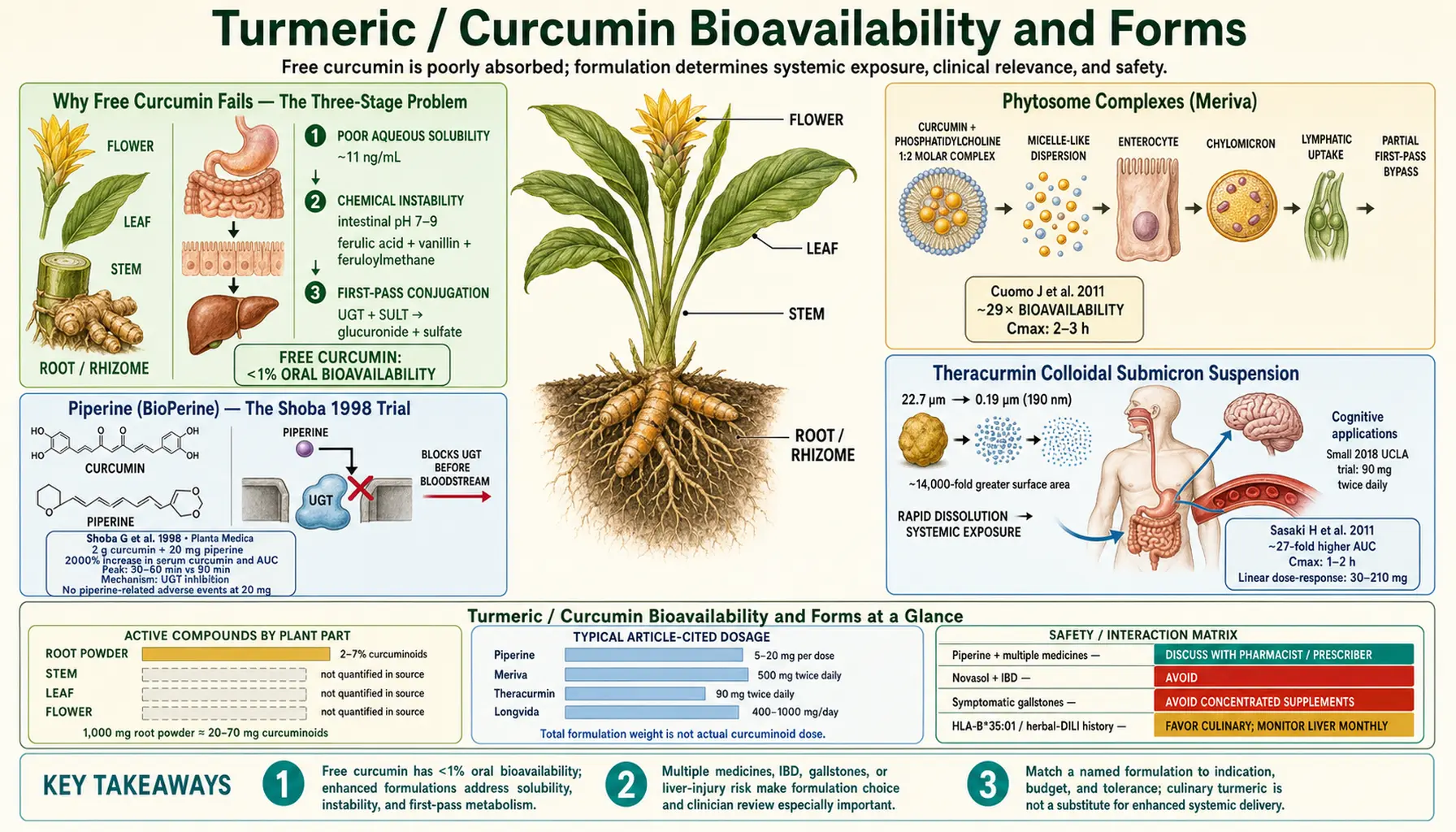
This is the single most important page on the site for anyone buying turmeric or curcumin. Free curcumin has less than 1% oral bioavailability. A teaspoon of turmeric powder in milk, a curry meal, or an unenhanced 500 mg curcumin capsule produces blood curcumin concentrations far too low to drive any of the anti-inflammatory, hepatic, or cognitive effects documented in clinical trials. The bioavailability problem has been the central practical issue in curcumin therapeutics since the 1970s, and the solutions developed in the past two decades are why the modern clinical-trial evidence base has become so robust. The five working approaches: (1) piperine co-administration (the active compound in black pepper, sold as BioPerine) blocks hepatic and intestinal glucuronidation and boosts absorption ~2000% per the Shoba 1998 trial; (2) phytosome complexes like Meriva combine curcumin with phosphatidylcholine in a 1:2 molecular complex achieving ~29x bioavailability; (3) colloidal submicron-particle suspensions like Theracurmin reduce particle size from typical 22.7 micrometers to 0.19 micrometers, achieving ~27x bioavailability; (4) solid lipid curcumin particles (SLCP) like Longvida produce free unconjugated curcumin in plasma rather than glucuronide-conjugated metabolites, with up to ~285x relative bioavailability in some assays and superior blood-brain barrier penetration; (5) liquid micelle formulations like Novasol achieve ~185x bioavailability through self-assembling micelle delivery. Pick a formulation matched to your indication and budget.
Table of Contents
- Why Free Curcumin Fails — The Three-Stage Problem
- Piperine (BioPerine) — The Shoba 1998 Trial
- Phytosome Complexes (Meriva)
- Theracurmin Colloidal Submicron Suspension
- Longvida SLCP (Solid Lipid Curcumin Particle)
- Novasol Liquid Micelle
- BCM-95 / Curcugreen (Turmeric Oil Self-Emulsifying)
- Cyclodextrin Inclusion Complexes (Cavacurmin)
- Nanocurcumin and Polymeric Nanoparticles
- Side-by-Side Comparison Table
- Why Standard Turmeric Tea Has Minimal Systemic Effect
- How to Choose a Formulation for Your Indication
- Reading Curcumin Supplement Labels Honestly
- Key Research Papers
- Connections
- Featured Videos
Why Free Curcumin Fails — The Three-Stage Problem
Free curcumin is a hydrophobic polyphenol with terrible drug-like properties from a pharmacokinetics standpoint. There are three sequential barriers between an ingested curcumin molecule and the bloodstream:
- Poor aqueous solubility — curcumin is essentially insoluble in water at physiologic pH (solubility roughly 11 ng/mL). The crystalline curcumin in a typical supplement capsule does not dissolve well in gastric or intestinal fluid, so most of it passes through the gut unabsorbed. The maximum theoretical absorption from a 1000 mg dose of crystalline curcumin is limited by solubility to perhaps 1–3 mg actually entering the enterocyte.
- Chemical instability at intestinal pH — the curcumin that does dissolve undergoes pH-dependent degradation. At neutral-to-alkaline intestinal pH (7–9), curcumin breaks down to ferulic acid, vanillin, and feruloylmethane within minutes. So the fraction that reaches the absorptive enterocytes is further reduced.
- Aggressive Phase II conjugation in the gut and liver (first-pass metabolism) — the small amount of curcumin that crosses the enterocyte membrane is immediately conjugated to glucuronide (by UGT1A6, UGT1A8, UGT1A9, UGT1A10 in enterocytes) and sulfate (by SULT1A1 and SULT1A3). The conjugated metabolites enter the portal vein, pass through the liver where additional UGT/SULT conjugation occurs, and arrive in systemic circulation almost entirely as curcumin-glucuronide and curcumin-sulfate rather than free curcumin.
The net result: oral administration of 4–8 grams of unformulated 95% curcuminoid extract to healthy volunteers produces peak plasma total curcuminoid concentrations of perhaps 0.5–2 micromolar, with free unconjugated curcumin at maybe 1% of that — nanomolar concentrations that are below the in vitro IC50 for most of curcumin's documented molecular targets. This is why historical pure-extract trials produced inconsistent results: the dose was high but the systemic exposure was inadequate.
Every bioavailability-enhancing strategy addresses one or more of these three barriers. Piperine inhibits the UGT enzymes (barrier 3). Phytosomes improve aqueous dispersion and protect against acid degradation (barriers 1 and 2). Submicron particles improve dissolution rate (barrier 1). Solid lipid particles deliver curcumin in a non-conjugatable form past first-pass metabolism (barrier 3). Liquid micelles solve both dissolution and partition into intestinal lipid micelles (barriers 1 and 2).
Piperine (BioPerine) — The Shoba 1998 Trial
The Shoba G et al. 1998 study in Planta Medica is the foundational reference for curcumin-plus-piperine pharmacokinetics. The investigators administered 2 grams of curcumin to healthy human volunteers, alone or with 20 mg of piperine (the active alkaloid in Piper nigrum, black pepper, and Piper longum, long pepper). Plasma curcumin was measured serially over 4 hours.
Findings:
- Curcumin alone produced barely detectable plasma curcumin (most volunteers had levels below the assay limit of quantification)
- Curcumin plus 20 mg piperine produced a 2000% increase in serum curcumin concentration and a 2000% increase in bioavailability measured as area under the curve (AUC)
- Peak concentration occurred at 30–60 minutes with curcumin + piperine, compared to 90 minutes for curcumin alone
- No piperine-related adverse events at the 20 mg dose
The mechanism is inhibition of hepatic and intestinal UDP-glucuronosyltransferase (UGT) enzymes by piperine. With UGT inhibited, less of the absorbed curcumin is glucuronidated during first-pass metabolism, and more reaches systemic circulation as free curcumin. Piperine also has some inhibitory effect on intestinal P-glycoprotein efflux and on CYP3A4 oxidative metabolism, both of which contribute marginally to the absorption-enhancing effect.
BioPerine (Sabinsa Corporation's standardized 95% piperine extract from black pepper) is the most commercialized form of piperine for supplement enhancement. The standard dose in curcumin combination products is 5–20 mg piperine per dose. Higher piperine doses are not better — they begin to produce GI upset and to inhibit metabolism of other drugs unnecessarily.
The major caveat: piperine's CYP3A4 and UGT inhibition is not specific to curcumin. Piperine elevates blood levels of many co-administered medications including some statins, calcium channel blockers, beta-blockers, anticonvulsants, and immunosuppressants. Patients on multiple prescription medications should discuss curcumin-with-piperine products with their pharmacist or prescriber before starting them, because the drug-interaction profile is broader than just the curcumin itself.
Phytosome Complexes (Meriva)
Meriva (Indena S.p.A.) is the curcumin-phosphatidylcholine phytosome complex that has come to dominate the European clinical-trial literature. The formulation is a 1:2 molar complex of curcumin with phosphatidylcholine (the principal phospholipid in cell membranes and lecithin), produced by a proprietary process that creates non-covalent hydrogen bonds between curcumin and the phospholipid's polar head group.
The phospholipid solves two problems simultaneously. First, it dramatically improves aqueous dispersibility — the phytosome forms micelle-like structures in water rather than crystallizing out. Second, the phospholipid envelope protects curcumin from rapid degradation in the alkaline duodenum and ileum. The phytosome dissociates progressively in the enterocyte and the absorbed curcumin enters the lymphatic system in chylomicrons rather than going directly to the portal vein, partially bypassing first-pass hepatic glucuronidation.
Pharmacokinetics from the Cuomo J et al. 2011 head-to-head comparison published in the Journal of Natural Products:
- Meriva produced approximately 29-fold higher curcuminoid bioavailability than unformulated 95% curcuminoid extract
- The increase was particularly pronounced for the minor curcuminoids demethoxycurcumin and bisdemethoxycurcumin
- Maximum plasma concentration (Cmax) was reached at 2–3 hours
Meriva is the formulation in most of the major European randomized trials cited on the joint-health and liver-health pages — the Belcaro 2010 and 2014 OA studies, the Rahmani 2016 NAFLD trial, the Panahi 2017 NASH trial, and many others. The typical clinical-trial dose is 500 mg twice daily of the Meriva complex, delivering approximately 100 mg of actual curcuminoids per dose (the Meriva complex is roughly 20% curcuminoid by weight; the rest is phosphatidylcholine and microcrystalline cellulose carrier).
Commercial Meriva-format products: Thorne Research Meriva, Nature's Way Curamin (with Meriva component), Pure Encapsulations Curcumin 500 with Bioperine (this one is NOT Meriva — piperine-enhanced rather than phytosome), Indena's own retail products. Look for the "Meriva" or "Meriva-SF" trademark on the label to confirm authentic Indena material rather than a generic phospholipid blend.
Theracurmin Colloidal Submicron Suspension
Theracurmin (Theravalues Corporation, Japan) takes a different physical-chemistry approach: rather than complex curcumin with a phospholipid, it physically reduces particle size from the typical 22.7 micrometers of crude curcumin powder to approximately 0.19 micrometers (190 nanometers) using a wet-milling process with gum ghatti as a stabilizing colloid.
The bioavailability improvement comes from the Noyes-Whitney dissolution equation: dissolution rate is proportional to particle surface area, and reducing particle diameter from 22.7 to 0.19 micrometers increases surface area by approximately 14,000-fold. The submicron particles dissolve almost instantaneously in gastrointestinal fluid rather than passing through the gut as undissolved solids.
Pharmacokinetics from the Sasaki H et al. 2011 paper in Biological & Pharmaceutical Bulletin:
- Theracurmin produced approximately 27-fold higher AUC than unformulated curcumin powder at the same dose
- Linear dose-response across the studied dose range (30–210 mg curcumin)
- Maximum plasma concentration achieved at 1–2 hours
Theracurmin was used in the Small 2018 UCLA cognitive trial discussed on the brain-health page, at a dose of 90 mg curcumin twice daily. It is the most-cited formulation for cognitive applications and is widely available in Japan and the United States. The Theracurmin trademark identifies authentic Theravalues material.
Commercial Theracurmin products: Integrative Therapeutics Theracurmin HP, Natural Factors CurcuminRich Theracurmin, Theravalues own retail brands. Theracurmin is sold either as a liquid suspension or as a capsule containing the dried submicron-particle powder.
Longvida SLCP (Solid Lipid Curcumin Particle)
Longvida (Verdure Sciences) is engineered for a specific pharmacokinetic goal: producing free unconjugated curcumin in systemic circulation rather than curcumin-glucuronide or curcumin-sulfate metabolites. This matters because most of curcumin's in vitro molecular activity is from the free unconjugated form, and because free curcumin has substantially better blood-brain barrier penetration than the conjugated metabolites.
The Longvida formulation embeds curcumin in a solid lipid matrix using a proprietary process developed by R.K. Sharma at UCLA. The lipid particles protect curcumin from gastric degradation, deliver it to the small intestine for absorption, and — critically — the absorbed curcumin enters the lymphatic system via the chylomicron pathway rather than the portal vein. This routing partially bypasses the heavy first-pass glucuronidation that converts most absorbed curcumin to inactive metabolites.
The Gota VS et al. 2010 paper in the Journal of Agricultural and Food Chemistry compared Longvida to unformulated curcumin in healthy human volunteers:
- Longvida produced detectable free unconjugated curcumin in plasma; unformulated curcumin produced essentially none
- Free curcumin AUC was up to 285-fold higher with Longvida than with unformulated 95% curcuminoid extract
- Total curcuminoid (free + conjugated) AUC was substantially higher but the free fraction was the dramatic difference
Longvida is the formulation favored for cognitive applications based on this free-curcumin profile and the corresponding BBB penetration advantage. The Cox 2015 cognitive trial used Longvida and showed improvements in working memory and mood in healthy older adults at 400 mg/day. The typical Longvida dose for cognitive applications is 400–1000 mg/day.
Commercial Longvida products: NOW Foods CurcuBrain (Longvida), Onnit Total Strength + Performance Curcumin (Longvida), Verdure Sciences own retail brand. The "Longvida" trademark identifies authentic Verdure Sciences material.
Novasol Liquid Micelle
Novasol (Aquanova AG, Germany) uses a self-assembling micelle delivery system based on Tween-80 (polysorbate-80) emulsifier. The curcumin is dissolved in the liquid micelle matrix, which spontaneously forms nanoscale micelles when diluted in gastrointestinal fluid. The micelles partition curcumin into the same intestinal mixed-micelle phase that carries dietary fats, vitamins A, D, E, K, and other lipophilic compounds across the enterocyte brush border.
The Schiborr C et al. 2014 pharmacokinetic comparison in Molecular Nutrition & Food Research:
- Novasol micelle curcumin produced approximately 185-fold higher total curcuminoid bioavailability than unformulated curcumin
- The increase was robust across multiple dose levels
- The formulation is a liquid concentrate, typically delivered in soft-gel capsules
Novasol is widely used in European studies of curcumin in metabolic, cardiovascular, and cognitive applications. It has the advantage of high bioavailability but the disadvantage that the Tween-80 emulsifier has been shown in some animal studies to alter gut microbiota composition with chronic high-dose exposure — a concern that has been raised for other Tween-80-containing pharmaceutical formulations. For most users at typical supplement doses the emulsifier exposure is small, but patients with established gut dysbiosis or inflammatory bowel disease may prefer a non-Tween formulation like Meriva, Theracurmin, or Longvida.
Commercial Novasol products: various European brands including LifeExtension and others.
BCM-95 / Curcugreen (Turmeric Oil Self-Emulsifying)
BCM-95 (also marketed as Curcugreen, manufactured by Arjuna Natural Extracts, India) combines curcuminoids with the natural turmeric essential oil fraction containing ar-turmerone and other sesquiterpene ketones. The turmeric oil acts as a natural self-emulsifying agent that improves curcumin dissolution and absorption, and the ar-turmerone itself has independent anti-inflammatory and neuroactive properties.
The Antony B et al. 2008 paper showed BCM-95 produced approximately 7-fold higher bioavailability than unformulated 95% curcuminoid extract, lower than the more-engineered formulations like Meriva or Longvida but with the advantage of being a "whole turmeric extract" rather than an engineered delivery system. BCM-95 is the formulation used in the Sanmukhani 2014 and Lopresti 2014 depression trials, the Chandran 2012 rheumatoid arthritis trial, and the Madhu 2013 osteoarthritis trial.
Commercial BCM-95/Curcugreen products: EuroPharma Curaphen, Terry Naturally CuraMed (BCM-95), various Arjuna Natural brand products. The lower bioavailability per milligram is offset by lower cost per dose and the cleaner "single-source" extract profile.
Cyclodextrin Inclusion Complexes (Cavacurmin)
Cavacurmin (Wacker Chemie AG) uses gamma-cyclodextrin as a complexing agent. Cyclodextrins are cyclic oligosaccharides with a hydrophobic interior cavity and hydrophilic exterior. Curcumin sits inside the cavity, where it is shielded from acid degradation, while the cyclodextrin exterior provides aqueous solubility. The complex dissociates in the intestinal fluid, releasing curcumin in a dissolved form for absorption.
Cavacurmin produces approximately 40-fold higher bioavailability than unformulated curcumin per the Purpura M et al. 2018 paper. It is less common in US retail than Meriva, Theracurmin, or Longvida but is well represented in European products and in some specialized sports-medicine applications. Hydroxypropyl-beta-cyclodextrin (Captisol) is another cyclodextrin platform sometimes used.
Nanocurcumin and Polymeric Nanoparticles
A research-grade family of curcumin delivery systems uses polymeric nanoparticles — PLGA (poly-lactic-co-glycolic acid), chitosan, dendrimers, and various synthetic polymer matrices — to encapsulate curcumin in 50–200 nanometer particles. These can produce extraordinary bioavailability improvements (some reports of 100x to 1000x) in animal pharmacokinetic studies, and they have been investigated for targeted delivery to tumors, atherosclerotic plaques, and the brain.
For consumer supplements, most of the "nanocurcumin" products on the market are not true polymeric nanoparticles but are submicron suspensions similar to Theracurmin or micellar systems similar to Novasol, repackaged with "nano" marketing language. True polymeric nanoparticle curcumin remains primarily a research and clinical-trial tool. If a label claims "nanocurcumin" without specifying the underlying delivery system (cyclodextrin, micelle, phytosome, or polymer), it is reasonable to be skeptical of the marketing claim.
Side-by-Side Comparison Table
Comparison of the major curcumin formulations:
| Formulation | Mechanism | Relative Bioavailability | Best For |
|---|---|---|---|
| Plain turmeric powder | None | 1x (baseline, ~<1% absorbed) | Culinary use only |
| 95% curcuminoid extract | Higher dose of free curcumin | ~3–5x (still poor) | Combination with piperine |
| Curcumin + 5-20 mg piperine | UGT inhibition | ~20x (per Shoba 1998) | Budget-conscious general use |
| BCM-95 / Curcugreen | Turmeric oil self-emulsification | ~7x | "Whole-turmeric" preference; depression studies |
| Meriva (phytosome) | Curcumin-phosphatidylcholine complex; lymphatic uptake | ~29x | Joint health, liver health; most clinical-trial data |
| Theracurmin | Submicron particle suspension | ~27x | Cognitive; matches Small 2018 trial |
| Cavacurmin (cyclodextrin) | Gamma-cyclodextrin inclusion | ~40x | European market alternative |
| Novasol (micelle) | Tween-80 liquid micelle | ~185x | High systemic exposure; avoid in IBD |
| Longvida SLCP | Solid lipid particle; lymphatic delivery; free curcumin | ~285x (free curcumin) | Cognitive (BBB penetration); free-curcumin applications |
Note that "relative bioavailability" numbers are not directly comparable across studies — different research groups use different analytical methods, different reference comparators, and different ways of integrating the plasma concentration curve. The numbers should be read as order-of-magnitude indicators rather than precise rankings. What is consistent is that all of the enhanced formulations are dramatically better than plain curcumin, and that the magnitude of improvement is large enough to matter clinically.
Why Standard Turmeric Tea Has Minimal Systemic Effect
"Golden milk" — a traditional Indian and Ayurvedic preparation of turmeric powder simmered in milk with black pepper and warming spices — has been promoted online as a daily anti-inflammatory tonic. The traditional preparation has cultural and culinary value and may have local gut-soothing effects from the warm fat-soluble vehicle, but it does not produce the systemic curcumin blood levels that drive the clinical effects described on the other deep-dive pages.
The arithmetic: one teaspoon of dried turmeric powder weighs approximately 3 grams. At 2–7% curcuminoid content (typical for culinary turmeric, with some high-curcumin varieties reaching higher), that delivers 60–210 mg of curcuminoids per teaspoon. Without the bioavailability enhancement of piperine or phytosome formulation, less than 1% of that is absorbed and most of what is absorbed is rapidly glucuronidated. The systemic free curcumin from a cup of golden milk is in the low-nanomolar range — orders of magnitude below the IC50 for the molecular targets discussed on the other deep-dive pages.
The traditional preparation does include black pepper, which has piperine. A typical pinch of black pepper provides perhaps 0.5–1 mg of piperine, less than the 5–20 mg used in commercial formulations but enough to produce some bioavailability enhancement. Even with the piperine boost, the systemic curcumin from a daily cup of golden milk remains modest compared to a 1000 mg/day Meriva regimen.
This does not mean turmeric tea is useless. Local effects on the gastric and intestinal mucosa, the cholagogue effect on bile flow, the warming and comforting psychological effect of the ritual, and the modest cumulative exposure over decades all have value. But anyone hoping to address documented inflammatory joint pain, NAFLD, or cognitive decline should expect modest-to-no measurable benefit from turmeric tea alone and should use a bioavailability-enhanced formulation in parallel with culinary turmeric use, not as a substitute for it.
How to Choose a Formulation for Your Indication
Practical guidance:
- Knee or hand osteoarthritis — Meriva 500 mg twice daily, or BCM-95 500 mg twice daily, or curcumin 1000–1500 mg/day + 5–20 mg piperine. Allow 4–8 weeks.
- Rheumatoid arthritis (mild, or as adjunct to DMARD) — Meriva 500 mg twice daily, or BCM-95 500 mg twice daily.
- NAFLD / NASH — Meriva 500 mg twice daily (matches Rahmani 2016). Monitor liver enzymes.
- Mild depression or mood support — BCM-95 500 mg twice daily (matches Lopresti 2014). Allow 6–8 weeks.
- Cognitive support / Alzheimer's risk reduction — Longvida 400–1000 mg/day (best BBB penetration) or Theracurmin 90 mg twice daily (matches Small 2018). Allow 6–18 months for measurable change.
- General anti-inflammatory / cardiometabolic support — any of the enhanced formulations at standard dose. Match to budget and tolerance.
- Sensitive GI tract or IBD — Meriva or Theracurmin (avoid Novasol Tween-80 in this population).
- Multiple drug regimen with CYP3A4 substrates — favor non-piperine formulations (Meriva, Theracurmin, Longvida) to avoid the broad CYP3A4 inhibition that piperine produces.
- Gallstones (asymptomatic) — use the lowest effective dose and monitor for any biliary symptoms.
- Gallstones (symptomatic) — avoid concentrated curcumin supplements.
- HLA-B*35:01 carrier or personal history of herbal-DILI — favor culinary turmeric over concentrated supplements; if supplementing, monitor liver enzymes monthly.
For acute episodes of inflammation, curcumin is not a rescue medication — it takes weeks to build to steady-state systemic effect. NSAIDs remain the appropriate choice for acute analgesic and anti-inflammatory needs (with the appropriate caveats about gastric and cardiovascular toxicity). Curcumin's role is as a chronic-use anti-inflammatory and disease-modification adjunct.
Reading Curcumin Supplement Labels Honestly
The supplement market is full of marketing language that obscures rather than illuminates the bioavailability question. Practical label-reading tips:
- "Turmeric extract" vs "curcumin extract" vs "95% curcuminoids" — these are not interchangeable. "Turmeric extract" can mean almost anything; "curcumin extract" usually implies higher curcuminoid content; "95% curcuminoids" means the active fraction is standardized.
- The total milligram weight on the label is not the curcumin dose — a 500 mg Meriva capsule contains about 100 mg actual curcuminoids and 400 mg of carrier phospholipid and excipients. A 1000 mg "turmeric root powder" capsule contains about 20–70 mg of curcuminoids. Look for the explicit curcuminoid content.
- Look for the named branded ingredients — Meriva, Theracurmin, Longvida, Novasol, BCM-95, Curcugreen, Cavacurmin, BioPerine. These trademarks indicate the formulation has been characterized in pharmacokinetic studies and you can look up the underlying mechanism.
- "Enhanced bioavailability" without a named branded ingredient is meaningless marketing — ask what the enhancement mechanism is. If the label cannot answer, treat the product as plain curcumin powder for pricing purposes.
- Liquid extracts and tinctures — even in oil-based tinctures, the absorption is modest. Concentrated liquid extracts in propylene glycol or ethanol are not equivalent to phytosome or micelle formulations.
- "Organic" and "non-GMO" claims are about ingredient sourcing and have no bearing on bioavailability. A bioavailability-enhanced organic product is fine; an organic plain-powder product still has <1% absorption.
- Watch for adulteration — some imported turmeric powder has been adulterated with lead chromate (a bright yellow pigment) for color enhancement. ConsumerLab and USP-verified products are tested for heavy metal contamination.
Key Research Papers
- Shoba G et al. (1998). Influence of piperine on the pharmacokinetics of curcumin in animals and human volunteers. Planta Medica. — PubMed
- Cuomo J et al. (2011). Comparative absorption of a standardized curcuminoid mixture and its lecithin formulation. Journal of Natural Products. — PubMed
- Sasaki H et al. (2011). Innovative preparation of curcumin for improved oral bioavailability. Biological & Pharmaceutical Bulletin. — PubMed
- Gota VS et al. (2010). Safety and pharmacokinetics of a solid lipid curcumin particle formulation in osteosarcoma patients and healthy volunteers. Journal of Agricultural and Food Chemistry. — PubMed
- Schiborr C et al. (2014). The oral bioavailability of curcumin from micronized powder and liquid micelles is significantly increased in healthy humans and differs between sexes. Molecular Nutrition & Food Research. — PubMed
- Antony B et al. (2008). A pilot cross-over study to evaluate human oral bioavailability of BCM-95CG (Biocurcumax). Indian Journal of Pharmaceutical Sciences. — PubMed
- Anand P et al. (2007). Bioavailability of curcumin: Problems and promises. Molecular Pharmaceutics. — PubMed
- Jamwal R (2018). Bioavailable curcumin formulations: A review of pharmacokinetic studies in healthy volunteers. Journal of Integrative Medicine. — PubMed
- Purpura M et al. (2018). Analysis of different innovative formulations of curcumin for improved relative oral bioavailability in human subjects. European Journal of Nutrition. — PubMed
- Nelson KM et al. (2017). The essential medicinal chemistry of curcumin. Journal of Medicinal Chemistry. — PubMed
- Heger M et al. (2014). The molecular basis for the pharmacokinetics and pharmacodynamics of curcumin and its metabolites in relation to cancer. Pharmacological Reviews. — PubMed
- Prasad S et al. (2014). Recent developments in delivery, bioavailability, absorption and metabolism of curcumin: The golden pigment from golden spice. Cancer Research and Treatment. — PubMed
PubMed Topic Searches
- PubMed: Curcumin bioavailability formulations
- PubMed: Meriva phytosome
- PubMed: Theracurmin pharmacokinetics
- PubMed: Longvida SLCP
- PubMed: Piperine curcumin absorption
- PubMed: Curcumin nanoparticle delivery
- PubMed: Curcumin glucuronide metabolism
Connections
- All Herbs
- Turmeric Benefits Hub
- Turmeric Overview
- Turmeric for Joint Health
- Turmeric for Liver Health
- Turmeric for Brain Health
- Black Pepper (Piperine)
- Ginger
- Boswellia
- Milk Thistle
- Anti-Inflammatory Diet
- CRP (Inflammation Marker)
- Arthritis
- NAFLD
- Alzheimer's Disease