Turmeric — Benefits Deep Dive
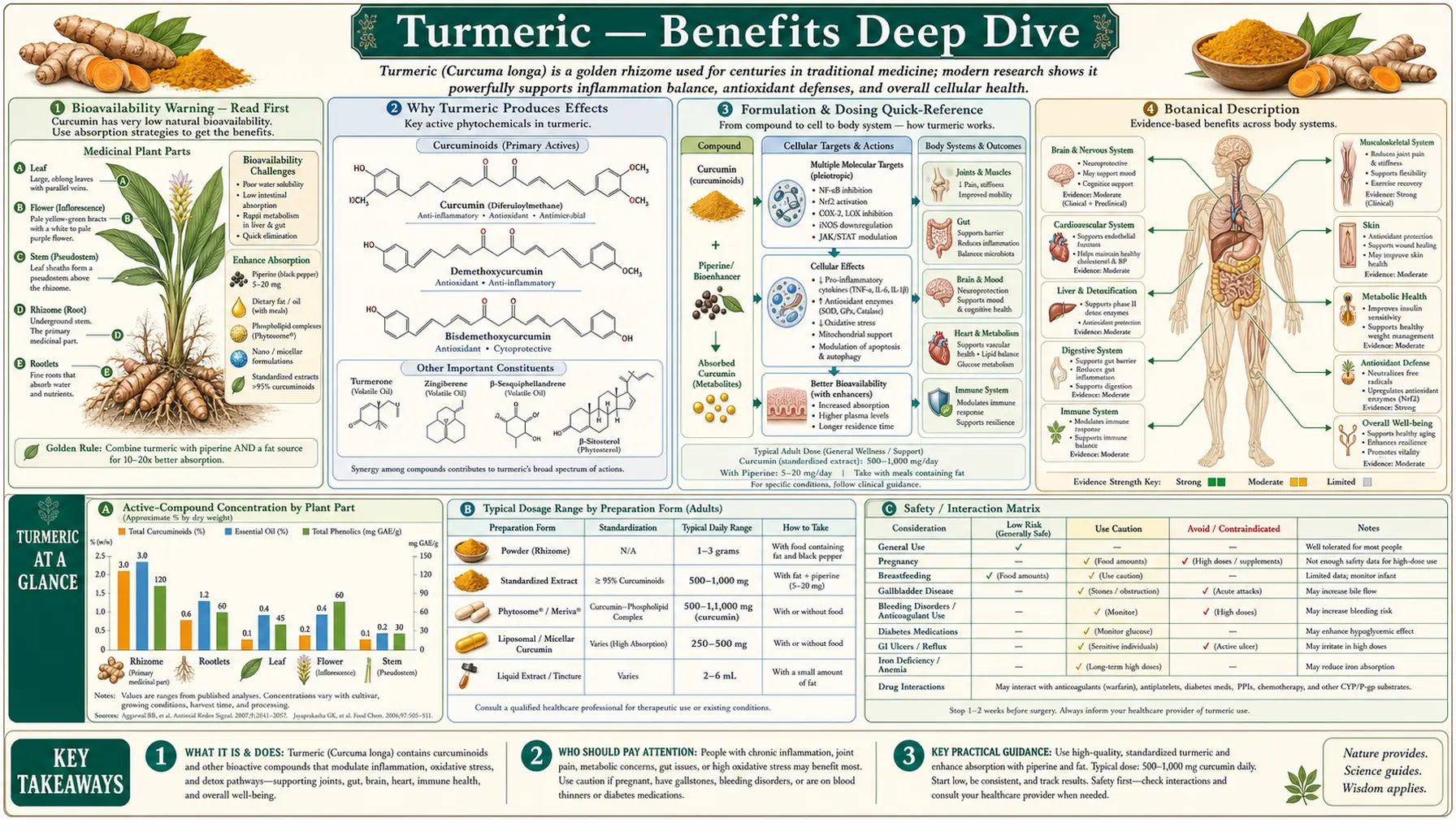
Turmeric (Curcuma longa) is the dried, ground rhizome of a tropical Asian plant in the ginger family. Its principal bioactive is curcumin, the bright-yellow polyphenolic curcuminoid that comprises only 2–7% of the dried root by weight. Curcumin is among the most-researched single herbal compounds in modern medicine — more than 10,000 indexed peer-reviewed papers and several hundred completed human clinical trials — yet the central practical issue for anyone using turmeric is not whether it works but whether it gets absorbed. Free curcumin has less than 1% oral bioavailability. Pure turmeric powder taken without an absorption enhancer is largely excreted in the stool unchanged. Piperine (BioPerine, the active compound in black pepper) boosts curcumin absorption by approximately 2000%. Phospholipid complexes (Meriva), submicron emulsions (Theracurmin), solid lipid particles (Longvida SLCP), and liquid micelle formulations (Novasol) increase systemic exposure 7–30 fold over standard curcumin. Turmeric powder in tea or curry produces minimal systemic curcumin levels — the four deep-dive pages below walk through the anti-inflammatory, hepatoprotective, and cognitive evidence base, and the fourth is dedicated entirely to the bioavailability question that determines whether any of the other three apply to you.
Deep-Dive Articles
Anti-Inflammatory & Joint Health
The strongest curcumin evidence base. The Daily 2016 RCT meta-analysis (8 trials, n=606) and the Henrotin 2013 review converge on a finding that has changed orthopedic practice in some settings — curcumin extracts are roughly comparable to ibuprofen and diclofenac for knee osteoarthritis pain, with fewer gastrointestinal side effects. Multi-target mechanism: COX-2 inhibition, NF-kB blockade, suppression of TNF-alpha and IL-6, and downregulation of MMP-3 and MMP-13 cartilage-degrading enzymes. Practical dosing with Meriva (curcumin phytosome) and standardized 95% curcuminoid extracts.
Liver Health & Detox
Curcumin is a potent Nrf2 activator, inducing Phase II detoxification enzymes (glutathione S-transferase, NAD(P)H quinone dehydrogenase 1, heme oxygenase 1) that conjugate and clear xenobiotics, environmental toxins, and reactive metabolites. The Rahmani 2016 NAFLD trial showed measurable ALT/AST reductions and liver fat clearance. Hepatoprotection in chemotherapy-induced and acetaminophen-induced liver injury (animal-model). Classical cholagogue effect on bile flow. Important caveat: rare cases of drug-induced liver injury (DILI) reported with high-dose bioavailability-enhanced curcumin products.
Brain Health & Cognition
The Small 2018 UCLA 18-month randomized trial of Theracurmin in 40 older adults with mild memory complaints showed improvements on both verbal and visual memory testing plus reductions in amyloid-beta and tau on FDDNP-PET imaging of the amygdala and hypothalamus. Indian dementia epidemiology has long shown markedly lower Alzheimer's prevalence in turmeric-consuming populations. Mechanism: BDNF upregulation, neuroinflammation suppression (TNF-alpha, IL-1beta, microglial activation), and amyloid disaggregation. Curcumin crosses the blood-brain barrier — one of the few polyphenols that does so meaningfully.
Bioavailability & Forms (CRITICAL)
The single most important page for anyone buying turmeric or curcumin. Free curcumin has <1% oral bioavailability. Piperine (BioPerine) boosts absorption ~2000% by inhibiting hepatic and intestinal glucuronidation. Meriva phytosome (curcumin-phosphatidylcholine complex) achieves ~29x bioavailability. Theracurmin (submicron-particle suspension) ~27x. Longvida SLCP (solid lipid curcumin particles) ~285x in some assays. Novasol micelle ~185x. Standard turmeric tea produces minimal systemic effect. Detailed product comparison and dosing equivalence table.
Table of Contents
- Deep-Dive Articles
- Bioavailability Warning — Read First
- Why Turmeric Produces Effects
- Formulation & Dosing Quick-Reference
- Key Research Papers
- External Authoritative Resources
- Connections
- Featured Videos
Bioavailability Warning — Read First
Critical practical issue: Most published clinical trials of turmeric/curcumin use one of four bioavailability-enhanced formulations — Meriva (Indena curcumin-phosphatidylcholine phytosome), Theracurmin (Theravalues colloidal submicron suspension), Longvida (Verdure Sciences solid lipid curcumin particles, SLCP), or Novasol (Aquanova liquid micelle). Standard turmeric powder — whether in food, tea, or unenhanced capsules — has <1% oral bioavailability and produces effectively zero systemic curcumin levels. The clinical effects described on the four sub-articles below should not be expected from a teaspoon of turmeric in milk or a curry. They require either (1) a bioavailability-enhanced commercial extract, (2) standard turmeric paired with piperine (5–20 mg from black pepper or BioPerine, which boosts absorption ~2000%), or (3) very high doses of pure 95%-curcuminoid extract (which still absorb poorly but reach therapeutic blood levels at gram-scale daily intake). Turmeric powder is not curcumin supplement. Full details on the Bioavailability and Forms page.
Why Turmeric Produces Effects
Turmeric is unusual among medicinal plants in that one chemical compound — curcumin — accounts for the great majority of its documented biological activity. (Minor curcuminoids demethoxycurcumin and bisdemethoxycurcumin contribute, and the essential oil fraction containing turmerones has some independent activity, but standardized 95%-curcuminoid extracts produce most of what turmeric-the-spice does.) What is unusual about curcumin is that it is a pleiotropic multi-target compound — it modulates dozens of distinct molecular targets rather than acting through one specific receptor or enzyme.
The principal mechanism pathways, each of which contributes to one or more of the deep-dive topics below:
- NF-kB transcription factor inhibition — NF-kB is the master regulator of inflammatory gene transcription. Curcumin inhibits NF-kB nuclear translocation, blocking transcription of TNF-alpha, IL-1beta, IL-6, COX-2, iNOS, and dozens of other inflammatory genes. This single mechanism explains a large fraction of the anti-inflammatory and joint effects.
- COX-2 and LOX (lipoxygenase) inhibition — direct enzyme inhibition reduces production of prostaglandin and leukotriene mediators of pain and inflammation. Mechanistically similar to NSAIDs but without the gastric mucosal toxicity (curcumin actually protects gastric mucosa in animal models).
- Nrf2 / ARE pathway activation — curcumin is a potent activator of nuclear factor erythroid 2-related factor 2 (Nrf2), which translocates to the nucleus and binds antioxidant response elements (ARE) to induce Phase II detoxification enzymes — glutathione S-transferase, NAD(P)H quinone dehydrogenase 1, heme oxygenase 1, and gamma-glutamylcysteine ligase.
- STAT3 inhibition — signal transducer and activator of transcription 3 is constitutively activated in many cancers and in chronic inflammation. Curcumin inhibition is one of the mechanistic bases for the extensive oncology literature.
- BDNF upregulation — brain-derived neurotrophic factor supports neuronal survival and synaptic plasticity. Curcumin's BDNF effect contributes to the cognitive and mood applications.
- Amyloid-beta disaggregation — curcumin binds amyloid-beta peptide and inhibits both aggregation and fibril formation in vitro and in animal models of Alzheimer's disease.
- Direct antioxidant scavenging — the conjugated double-bond system in the curcumin molecule directly scavenges reactive oxygen species, though plasma concentrations achievable in vivo limit how much this contributes versus the gene-induction mechanisms above.
This multi-target pleiotropic action is also what frustrates pharmaceutical development — curcumin is a "promiscuous" drug-discovery target that does too many things at once for tidy single-mechanism trials. The pragmatic clinical observation, validated across hundreds of human studies, is that the multi-target action produces real if modest effects on multiple inflammatory conditions in real patients, with an unusually favorable safety profile.
Formulation & Dosing Quick-Reference
The four most-studied bioavailability-enhanced curcumin formulations, with typical clinical-trial doses and relative bioavailability versus unformulated 95% curcuminoid extract:
- Meriva (curcumin-phosphatidylcholine phytosome, Indena) — approximately 29x bioavailability. Typical trial dose: 500 mg twice daily (delivering ~100 mg curcuminoids). Used in most of the osteoarthritis literature including the Belcaro 2010 and 2014 long-term studies.
- Theracurmin (Theravalues, colloidal submicron-particle suspension) — approximately 27x bioavailability. Typical dose: 90 mg curcumin twice daily. Used in the Small 2018 UCLA cognitive trial.
- Longvida (SLCP, Verdure Sciences solid lipid curcumin particles) — up to ~285x bioavailability per the Gota 2010 PK comparison. Typical dose: 400–1000 mg/day. Free unconjugated curcumin in plasma.
- Novasol (Aquanova liquid micelle) — approximately 185x bioavailability. Typical dose: 80–200 mg/day. Liquid formulation in soft-gel capsules.
- Standard 95%-curcuminoid extract + 5–20 mg piperine (BioPerine) — the Shoba 1998 trial showed piperine boosts absorption ~2000%. Typical dose: 500–1000 mg curcuminoids with 5–20 mg piperine, two to three times daily.
- Plain turmeric powder — for culinary use, immune support tradition, and gentle digestive stimulation. Negligible systemic curcumin. Do not expect anti-inflammatory blood-level effects from this form.
Choice of formulation depends on cost, label transparency about formulation, and personal response. For most clinical applications discussed in the four sub-articles, Meriva and Theracurmin have the most published human trial data. Longvida is favored for cognitive applications because of higher free-curcumin brain penetration. See the Bioavailability and Forms page for a detailed product comparison.
Key Research Papers
- Aggarwal BS, Harikumar KB (2009). Potential therapeutic effects of curcumin, the anti-inflammatory agent, against neurodegenerative, cardiovascular, pulmonary, metabolic, autoimmune and neoplastic diseases. International Journal of Biochemistry & Cell Biology. — PubMed
- Hewlings SJ, Kalman DS (2017). Curcumin: A review of its effects on human health. Foods. — PubMed
- Shoba G et al. (1998). Influence of piperine on the pharmacokinetics of curcumin in animals and human volunteers. Planta Medica. — PubMed
- Daily JW et al. (2016). Efficacy of turmeric extracts and curcumin for alleviating the symptoms of joint arthritis: A systematic review and meta-analysis of randomized clinical trials. Journal of Medicinal Food. — PubMed
- Small GW et al. (2018). Memory and brain amyloid and tau effects of a bioavailable form of curcumin in non-demented adults: A double-blind, placebo-controlled 18-month trial. American Journal of Geriatric Psychiatry. — PubMed
External Authoritative Resources
- Linus Pauling Institute — Curcumin Micronutrient Information Center — the most authoritative scientific summary of curcumin biology and bioavailability
- NCCIH (National Center for Complementary and Integrative Health) — Turmeric Fact Sheet
- MedlinePlus — Turmeric / Curcumin
- Drugs.com — Turmeric / Curcumin Monograph
- PubMed — All research on curcumin / turmeric (~10,000+ papers)
Connections
- All Herbs
- Turmeric (Main Page)
- Turmeric for Joint Health
- Turmeric for Liver Health
- Turmeric for Brain Health
- Bioavailability & Forms
- Ginger
- Boswellia
- Black Pepper (Piperine)
- Milk Thistle (Liver)
- Arthritis
- Rheumatoid Arthritis
- NAFLD (Fatty Liver)
- Alzheimer's Disease
- Anti-Inflammatory Diet