Tongkat Ali: Product Quality, Contamination and Adulteration
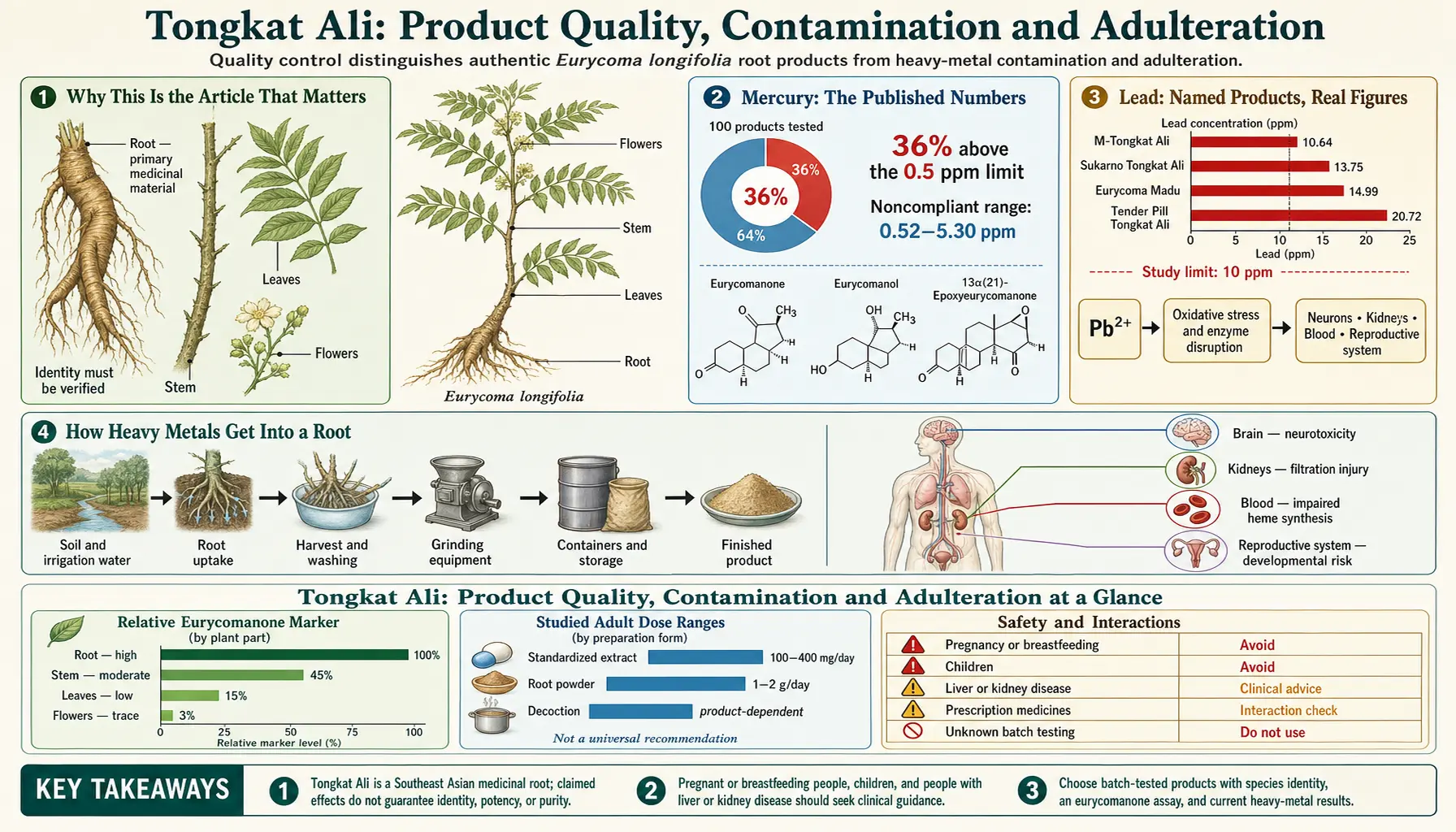
Almost every page written about tongkat ali argues about whether it works. That argument assumes something that repeated published surveys show cannot be assumed: that the capsule contains tongkat ali, and nothing else.
The published record says otherwise, with numbers. Mercury above the Malaysian legal limit in 36 of 100 sampled tongkat ali products. Lead above the limit in eight products, all of them tongkat ali brands, one of them officially registered. Sildenafil analogues detected in Eurycoma products bought over the internet. DNA barcoding that authenticated only 37% of tested herbal products — and found a product that passed the DNA test yet contained none of the marker compound.
This is not a theoretical risk profile assembled from general worries about supplements. Every figure above comes from a peer-reviewed paper about this specific plant. If you take one thing from all four of these articles, take this: with tongkat ali, sourcing is a bigger safety question than dosing, and a bigger efficacy question too.
Table of Contents
- Why This Is the Article That Matters
- Mercury: The Published Numbers
- Lead: Named Products, Real Figures
- How Heavy Metals Get Into a Root
- What Mercury and Lead Actually Do
- Pharmaceutical Adulteration: Sildenafil and Its Analogues
- Why an Adulterated Capsule Can Be Lethal
- “Tongkat Ali Hitam” Is a Different Plant Family
- Is It Even Tongkat Ali? What DNA Barcoding Found
- What Standardisation Actually Means on a Label
- Why the Supply Chain Is Like This
- What a Buyer Can Actually Check
- How to Read a Certificate of Analysis
- Red Flags
- Cautions and Contraindications
- Key Research Papers
- Connections
Why This Is the Article That Matters
Consider what an adulterated or contaminated product does to every other question about this herb.
If a capsule contains a sildenafil analogue, a man will experience a real, obvious effect on erectile function — and conclude that tongkat ali works. He will tell people. He may write a five-star review. He has not tested the herb; he has taken an unlabelled, unmeasured dose of a prescription drug with a known interaction that can kill people on nitrates.
If a capsule contains mercury at 5 ppm and he takes it daily for a year, no acute event occurs. Heavy-metal exposure at these levels is cumulative and quiet, and the harm it does is not the kind you notice and attribute.
If a capsule contains a different plant altogether — the “black” grade, which is a different botanical family — then every trial result, every dose recommendation and every safety study on this site is about something he is not taking.
All three of those scenarios are documented in the literature for this specific product category. That is why this article exists, and why it is longer than the ones about efficacy.
Mercury: The Published Numbers
The core work here was done by Ang Hooi Hoon and colleagues at the School of Pharmaceutical Sciences, Universiti Sains Malaysia, as part of a long programme auditing the Malaysian traditional-medicines market after the Drug Control Authority introduced phase-three registration in January 1992.
The 2004 survey: 36 of 100 products failed
Method. One hundred products in various pharmaceutical dosage forms containing tongkat ali, bought on the Malaysian market, analysed for mercury by cold-vapour atomic absorption spectrophotometry.
Result. Thirty-six of the hundred products contained 0.52 to 5.30 ppm of mercury and therefore did not comply with the Malaysian quality requirement for traditional medicines, which permits not more than 0.5 ppm.
The detail that matters most. Of those 36 failing products, five were already registered with the Drug Control Authority and contained 1.05 to 4.41 ppm — between two and nearly nine times the legal limit. Registration with a national regulator did not guarantee compliance. The remaining 31 were unregistered.
The authors added a warning that is easy to skim past and is the single most useful sentence in the paper: the 64% of products that passed “cannot be assumed safe from mercury contamination because of batch-to-batch inconsistency”. A brand that tested clean in one lot is not a brand that is clean. This is precisely why a lot-specific certificate of analysis matters and a general brand reputation does not.
The 2006 survey: the “black” grade
Method. One hundred products containing tongkat ali hitam — the “black” market grade — single or combined preparations, selected by simple random sampling and analysed by atomic absorption spectrophotometry.
Result. Twenty-six of the hundred contained 0.53 to 2.35 ppm of mercury, again against a limit of 0.5 ppm. Four of the 26 were already registered with the Drug Control Authority.
This is the survey worth pausing on, because of what “hitam” actually means — see the section below. The grade sold at a premium on the folk belief that black is stronger is generally not Eurycoma longifolia at all, and it is the grade in which a quarter of sampled products exceeded the mercury limit.
Lead: Named Products, Real Figures
The same group's 2003 lead survey in Human and Experimental Toxicology analysed 100 herbal products by atomic absorption spectrophotometry.
Eight products failed the Malaysian quality requirement, containing 10.64 to 20.72 ppm of lead. What makes this survey unusually pointed is that the paper names them, and every single failing product was a tongkat ali preparation: M-Tongkat Ali (10.64 ppm, and already registered with the Drug Control Authority), plus Sukarno Tongkat Ali, Eurycoma Madu, Super Pill Tongkat Ali, Force Pill Tongkat Ali, Tender Pill Tongkat Ali, Super Pill Tongkat Ali Plus and Great Pill Tongkat Ali Plus, all unregistered, at 12.24 to 20.72 ppm.
The authors repeated their batch-to-batch caveat: the 92 products that passed cannot be assumed safe either.
| Survey | Products tested | Failed | Range found | Limit |
|---|---|---|---|---|
| Mercury in tongkat ali (2004) | 100 | 36 (36%) | 0.52–5.30 ppm | 0.5 ppm |
| Mercury in tongkat ali hitam (2006) | 100 | 26 (26%) | 0.53–2.35 ppm | 0.5 ppm |
| Lead in herbal preparations (2003) | 100 | 8 (8%) — all tongkat ali brands | 10.64–20.72 ppm | Malaysian requirement exceeded |
A note on the age of this evidence. These surveys are from 2003–2006, and it is fair to ask whether the market has improved since. Malaysia has invested heavily in cultivation, standardised extraction and export-grade quality control in the two decades since, and a reputable modern extract from a company that publishes lot-specific testing is a genuinely different product from a market-stall pill bought in 2003. But nothing has repealed the economics that produced the problem, the unregulated end of the market still exists and now sells globally through online marketplaces, and no comparably large independent survey has been published showing the problem resolved. Treat the old numbers as establishing that the risk is real and specific to this product category, not as a current market share.
How Heavy Metals Get Into a Root
Mercury is not a plant metabolite. A tree does not manufacture it. There are four realistic routes into a finished herbal product, and they call for different responses.
- Contaminated soil and water. Roots concentrate what is in the ground around them, and a taproot spending four to ten years in soil downstream of mining, smelting or industrial activity accumulates accordingly. Artisanal gold mining, which uses mercury amalgamation, is a well-recognised regional source of mercury in soil and waterways across parts of Southeast Asia.
- Processing and equipment. Grinding, drying and packaging can introduce metals from machinery, and pigments or fillers used in tablet manufacture have historically been a source.
- Deliberate addition as filler, weighting agent or colourant. Adulterating expensive powdered botanicals with cheap dense mineral material is an old fraud, and it is a plausible explanation for the highest readings.
- Traditional formulation. Some traditional preparations across South and Southeast Asia deliberately include processed mineral and metal ingredients as part of the recipe. That is a documented phenomenon in Ayurvedic rasa shastra preparations in particular. It means “contamination” is sometimes not contamination at all but an intended ingredient — which is worse, because it will be consistent rather than sporadic.
The practical consequence: heavy-metal content is a property of the batch, not the brand, unless the manufacturer controls the soil, the process and the supply chain and tests every lot. That is exactly what a lot-specific certificate of analysis demonstrates and what a marketing badge does not.
What Mercury and Lead Actually Do
These are not abstract regulatory failures. Both metals cause specific, documented harm, and both accumulate.
Mercury. Inorganic mercury, the form likely in these preparations, is nephrotoxic — it damages the kidney tubules — and neurotoxic at sufficient exposure. Chronic exposure can produce tremor, irritability, memory difficulty, insomnia, and a characteristic peripheral neuropathy; it can also cause an immune-mediated kidney disease. Mercury crosses the placenta and is toxic to the developing nervous system, which is why pregnancy is an absolute contraindication for any product with an unverified metal profile.
Lead. Lead has no known safe level of exposure. In adults, chronic exposure raises blood pressure, damages kidneys, causes anaemia by interfering with haem synthesis, and impairs cognition and peripheral nerve function. It is stored in bone with a half-life measured in decades, which means it is released slowly for years after exposure ends — and released faster during pregnancy and in later-life bone loss. In children it causes irreversible cognitive impairment at levels once considered acceptable.
The dose arithmetic. A product at 5 ppm mercury contains 5 micrograms per gram. That sounds trivial. But the exposure is daily, indefinite, on top of dietary background, in a person who has no idea it is happening and no reason to have their blood metals checked. Cumulative low-dose exposure to a nephrotoxic and neurotoxic metal, taken deliberately by someone trying to improve their health, is a bad trade at any efficacy.
If you have taken an unverified tongkat ali product long-term and are worried, blood lead and blood or urine mercury are ordinary laboratory tests your doctor can order. Bring the bottle.
Pharmaceutical Adulteration: Sildenafil and Its Analogues
Products sold for sexual performance are, in every jurisdiction that has looked, the herbal category most often spiked with real pharmaceuticals. Tongkat ali sits at the centre of that category.
Detected in Eurycoma products specifically
Said and colleagues at the UCL School of Pharmacy developed a two-tier near-infrared spectroscopic screening procedure explicitly because sildenafil analogues were appearing in Eurycoma longifolia products. They obtained diffuse-reflectance spectra of ten commercial herbal products containing E. longifolia. Two of them — both purchased via the internet — produced spectra significantly different from the reputable reference products and closely matching the spectrum of sildenafil citrate, indicating the presence of a sildenafil analogue. Principal-component analysis clustered those two products separately at the 5% significance level.
Ten products is a small sample and a methodological demonstration rather than a market survey. But the finding is specific, published, and about this plant — and the two failures came from the online channel through which most people outside Malaysia now buy.
The scale of the category problem
The best measure of how common this is comes from a decade of United States regulatory data. Tucker and colleagues at the California Department of Public Health analysed the FDA's Tainted Products Marketed as Dietary Supplements database for 2007 through 2016.
- 776 adulterated dietary supplements were identified, implicating 146 different companies.
- 353 of them (45.5%) were marketed for sexual enhancement — the largest single category, ahead of weight loss (317) and muscle building (92).
- Sildenafil was found in 166 of those 353 sexual-enhancement products — 47.0%.
- 157 products (20.2%) contained more than one undeclared pharmaceutical ingredient.
- Twenty-eight products were named in two or three separate FDA warnings — meaning the adulteration continued after the first warning.
Nearly half of the adulterated sexual-enhancement supplements the FDA flagged over a decade contained an undeclared erectile-dysfunction drug. Tongkat ali is one of the flagship botanicals of that shelf.
Why analogues rather than the drug itself
Manufacturers who spike products rarely add plain sildenafil. They add structural analogues — molecules modified just enough to escape routine screening while retaining phosphodiesterase-5 inhibition. Reviews of the analytical problem describe a continuing cycle: laboratories develop a method, adulterators modify the molecule, the method stops detecting it.
This has three consequences for a buyer:
- The dose is unknown and uncontrolled. Prescription sildenafil comes in defined strengths. A spiked capsule contains whatever the manufacturer put in, unevenly distributed through a batch.
- The safety profile is unknown. An analogue has not been through toxicology or clinical trials. Its potency, duration and metabolism may differ substantially from the studied drug.
- Detection is hard even for laboratories. If specialist analytical chemists have to keep inventing methods, a consumer has no chance of identifying an adulterated product by inspection.
Why an Adulterated Capsule Can Be Lethal
This is the part that turns a quality problem into a safety emergency, and it deserves to be stated without hedging.
Phosphodiesterase-5 inhibitors and nitrates must not be combined. Nitrates — nitroglycerin (glyceryl trinitrate) for angina, isosorbide mononitrate and dinitrate, and amyl nitrite — work by donating nitric oxide, which relaxes blood vessels. PDE-5 inhibitors work downstream in the same pathway, preventing the breakdown of the second messenger that nitric oxide triggers. Given together, the two amplify each other and can cause a precipitous, unresponsive fall in blood pressure, with the risk of myocardial infarction, stroke and death. This is an absolute contraindication in prescribing, not a caution.
Now consider who buys herbal sexual-performance products. Disproportionately, men in their fifties, sixties and seventies. That is also the population most likely to have coronary artery disease and to carry a nitrate spray. Erectile dysfunction is itself an early marker of endothelial disease and often precedes a cardiac diagnosis by years.
The scenario that kills someone is entirely ordinary: a man with angina prefers “something natural” to asking his cardiologist for a prescription, buys a tongkat ali product online, does not know it contains a sildenafil analogue, and uses his nitrate spray for chest pain. He has taken the exact combination his doctor would never have prescribed, without the conversation that would have prevented it.
The irony is complete: the man who asks his cardiologist gets a controlled dose of a studied drug with the interaction explicitly checked. Many men with stable coronary disease can safely be prescribed a PDE-5 inhibitor if they are not on nitrates. The man who avoids the conversation gets an unknown dose of an untested analogue with nobody checking anything.
If you take nitrates in any form, do not take unverified herbal sexual-performance products. And if you have taken one and develop severe dizziness, fainting or chest pain, treat it as an emergency and tell the clinicians exactly what you took — bring the bottle.
“Tongkat Ali Hitam” Is a Different Plant Family
In the Malaysian market, “tongkat ali” is sold in colour grades. They are not grades of one plant.
- Tongkat ali putih or kuning (“white” or “yellow”) is Eurycoma longifolia Jack, family Simaroubaceae. This is the real thing. Every clinical trial discussed anywhere on this site studied this plant.
- Tongkat ali hitam (“black”) is generally Polyalthia bullata, family Annonaceae — the soursop and custard-apple family. Different genus, different family, different order of chemistry. It is sold at a premium on the folk belief that black is stronger.
- Tongkat ali merah (“red”) is a third market grade whose botanical identity is inconsistent between vendors.
How different is different? Simaroubaceae is the quassia family, defined by intensely bitter degraded triterpenes — the quassinoids, including eurycomanone, the marker compound for tongkat ali. Annonaceae is characterised by an entirely different chemistry, notably the acetogenins and various alkaloids. Sharing a market name does not make two plants pharmacologically related, any more than sea horses and horses are related.
What is known about Polyalthia bullata. Very little, clinically. It is a genuine medicinal plant in regional use and it has attracted some laboratory attention — a 2020 study, for instance, established callus tissue culture from it and evaluated antioxidant activity, which is the kind of work done on plants at a very early research stage. There is no clinical trial literature for it comparable to the randomised trials of Eurycoma longifolia. The plant is also slow-growing and hard to propagate, which is why researchers are working on tissue culture in the first place — and scarcity is exactly what drives substitution.
And it was the grade in the worse mercury survey. The 2006 study finding mercury in 26% of products was specifically a survey of tongkat ali hitam preparations. The premium grade, the one with no clinical evidence, is also the one with a documented contamination problem of its own.
The rule that follows: if the label does not print the binomial Eurycoma longifolia, you do not know which plant you have bought. That is not pedantry. It is the difference between a substance with several randomised controlled trials and a substance with none.
Is It Even Tongkat Ali? What DNA Barcoding Found
Chemical testing can tell you whether a marker compound is present. DNA barcoding can tell you what species is actually in the powder, which is a different and in some ways more fundamental question.
Abubakar 2018: 37% authentic
Researchers at Universiti Teknologi Malaysia assessed adulteration of E. longifolia herbal medicinal products using two barcode regions — the chloroplast rbcL gene and the nuclear ITS2 region — comparing recovered sequences against GenBank, and validating with HPLC for the eurycomanone marker.
Result: 37% of the tested products were authentic. 27% were adulterated. The ITS2 region proved the better marker.
The remainder could not be conclusively identified — a common outcome with heavily processed extracts, where DNA is degraded by heat and solvent. That is itself informative: for a large fraction of products on sale, a specialist laboratory using two genetic markers could not confirm what plant was in the bottle.
The finding that should change how you read labels
The paper reports a case in which a product was identified as the correct species by DNA barcoding but was found not to contain the expected chemical compound on HPLC analysis.
Think about what that means. The right plant was in the product, and the active marker was not. Possible explanations include the wrong plant part (stem or leaf rather than taproot), immature roots harvested years early, material already extracted once and resold as raw powder, or heavy dilution with inert filler. Correct botanical identity is necessary but not sufficient. This is why the authors recommend DNA barcoding as a first screening step integrated with chemical analysis — and why a serious manufacturer's certificate of analysis reports both identity and marker content.
Fadzil 2018: faster screening
A companion study from the same institution applied Bar-HRM — DNA barcoding combined with high-resolution melting analysis — as a fast, sensitive method for detecting adulterants in E. longifolia commercial herbal products, targeting the chloroplast rbcL region. The fact that multiple research groups have built dedicated authentication methods for this specific plant is itself a comment on how much substitution there is.
What Standardisation Actually Means on a Label
Three kinds of number appear on tongkat ali labels. They are not equally meaningful.
1. The extract ratio (“100:1”, “200:1”)
Nearly meaningless as printed. A ratio claims that some quantity of raw root was reduced to one part of finished extract. It tells you nothing about how much of anything active survived, and manufacturers calculate ratios differently — some from fresh weight, some from dry, some by methods they do not disclose. There is no standard, no verification and no consequence for exaggeration. A “200:1” claim is not twice as good as “100:1”; both are unverifiable assertions about a process.
2. A stated eurycomanone percentage
More meaningful, because it is measurable in the finished product. Eurycomanone is the principal quassinoid of E. longifolia and the marker compound used for standardisation; commercial extracts commonly state something in the region of 1–2%. Validated analytical methods exist — researchers have published HPLC-UV procedures determining canthin-6-one alkaloids, quassinoids and scopoletin simultaneously in Eurycoma species — so a manufacturer's claim is testable by a third party.
But note the honest caveat. Eurycomanone is a marker, not necessarily the active principle. One leading hypothesis attributes the hormonal effects to the eurypeptide fraction of a hot-water extract rather than to the quassinoids. If that hypothesis is right, a high-eurycomanone extract could be chemically further from the tested clinical preparations than a plain water extract is. Nobody has resolved this. A stated eurycomanone percentage tells you the manufacturer is measuring something real; it does not guarantee the effect.
3. A named, characterised extract
The most informative label of all. Almost all the positive clinical trials used a specific standardised freeze-dried water extract sold under a trade name. If you want the product the trials studied, the label should identify the actual extract used in those trials, not merely gesture at “standardised extract”. This is the same logic that applies to any botanical with a clinical literature: the evidence belongs to the extract, not to the plant name.
Why the Supply Chain Is Like This
Contamination and substitution are not random misfortune. They follow directly from the economics of the root.
- Harvest destroys the tree. The medicinal part is the taproot, which plunges vertically into the soil. Getting it out means digging up the whole plant. There is no sustainable annual yield from a standing tree, as there is with a leaf or bark crop.
- A useful root takes years. Estimates commonly cited run from about four years at the earliest to eight or ten for a root of good size. Capital tied up for a decade, in a slow-growing understory tree, in a species that has been harvested from the wild under heavy pressure for generations.
- Demand is global and marketing-driven. A worldwide supplement market wants a Southeast Asian forest root in industrial quantities.
Expensive, slow-growing raw material plus enormous demand plus a product sold as an anonymous brown powder equals overwhelming pressure to dilute, substitute and spike. The powder cannot be identified by eye, by taste (bitterness is easy to fake and easy to lose), or by any consumer-accessible test.
Malaysia's response has been serious: government-backed plantation cultivation, standardised extraction, national research grants and export-grade quality programmes, precisely to escape the wild-harvest trap. That is why a properly documented modern extract exists at all. It is also why it costs what it costs.
What a Buyer Can Actually Check
Five things, in order of importance. The first four are the ones that matter.
- The binomial Eurycoma longifolia printed on the label. Not “tongkat ali” alone, which is a market name shared with an unrelated plant family. Not “longjack”, which is a trade coinage. If the Latin name is absent, stop there.
- A lot-specific third-party certificate of analysis for heavy metals. Tied to the batch number on your bottle, from an independent laboratory, giving actual figures in parts per million for lead, mercury, arsenic and cadmium. Not a “quality tested” badge; not a generic company statement; not a certificate for a different lot from two years ago.
- A stated standardisation you can point at. A named eurycomanone percentage, or explicit identification of a characterised water extract. “Tongkat ali root extract 500 mg” with no further information is a black box.
- An identifiable manufacturer and country of manufacture with a functioning regulator. A company you can contact, in a jurisdiction with an inspectorate. Anonymous marketplace sellers are exactly where the adulterated Eurycoma products were purchased.
- For anyone drug-tested: third-party sport certification. Informed Sport, NSF Certified for Sport or equivalent, which batch-tests for prohibited substances. See the exercise article for why this is not optional.
The root chips exception. Buying dried, sliced root for decoction — the traditional form — has one genuine advantage: you can see that you have bought woody root rather than powder of unknown composition. It does nothing about heavy metals, which are in the root itself, and nothing about species substitution unless you can identify the material. But it does make pharmaceutical spiking essentially impossible, because there is nowhere to hide a tablet in a bag of wood chips.
How to Read a Certificate of Analysis
A certificate of analysis is only useful if you read it. Four checks:
- Does the lot number on the certificate match the lot number on your bottle? This is the check that catches most theatrical certificates. A certificate for an unrelated batch proves nothing about what you are holding, and companies know that almost nobody looks.
- Who did the testing? An independent, accredited laboratory named on the document, or the manufacturer's own quality department? In-house testing is not worthless, but it is not third-party verification.
- Are there actual numbers? A real report gives measured values with units — “lead: 0.08 ppm” — and a specification limit alongside. “Pass”, “compliant” or “below limit” without figures tells you nothing about margin.
- What was tested for? Heavy metals should cover lead, mercury, arsenic and cadmium as a minimum. Microbiological testing and identity testing are good signs. For a product in this category, screening for undeclared pharmaceuticals is a strong sign of a serious manufacturer.
A company that will not produce a lot-specific certificate on request has told you what you need to know.
Red Flags
- The product works immediately and unmistakably for erections. No plausible mechanism for a herb produces a rapid, reliable, drug-like erectile effect. If it feels like a PDE-5 inhibitor, the most likely explanation is that it contains one. Stop taking it, and if you are on nitrates treat that as urgent.
- Sold as a coffee or drink sachet by an unknown brand. Instant coffee and canned drink formats are enormously popular across Malaysia, Singapore and Indonesia, and they are historically the formats most associated with pharmaceutical adulteration — sweetened coffee masks both the root's bitterness and the taste of anything else added.
- “Black tongkat ali” or “tongkat ali hitam” sold at a premium. A different plant family, no clinical evidence, and a documented mercury problem of its own.
- No binomial, no standardisation figure, no manufacturer address. Three absences that usually travel together.
- Extraordinary ratio claims with nothing else. “400:1 super-concentrated” with no eurycomanone figure and no certificate is marketing arithmetic.
- A proprietary blend that hides the tongkat ali dose. If the label lists a 2,000 mg “male vitality blend” without per-ingredient amounts, you do not know whether you are getting 400 mg or 4 mg.
- Anonymous marketplace listings with thousands of glowing reviews. The 2019 analysis of top-rated online testosterone boosters found that after filtering untrustworthy reviews, reports of increased libido dropped by 91%.
Cautions and Contraindications
If you take nitrates, do not take unverified herbal sexual-performance products. This is the highest-consequence interaction on this page. Nitroglycerin, isosorbide mononitrate or dinitrate, amyl nitrite — combined with an undeclared PDE-5 inhibitor, the result can be a catastrophic drop in blood pressure.
Pregnancy and breastfeeding: absolute avoidance. Beyond the herb's own unstudied status, mercury crosses the placenta and is toxic to the developing nervous system, and lead is mobilised from maternal bone during pregnancy. A product category with documented mercury and lead exceedances has no place in pregnancy under any circumstances.
Children and adolescents. Avoid. Lead is more harmful in children than adults, and a testosterone-marketed product has no business near a developing endocrine system.
Kidney disease. Mercury is nephrotoxic and lead damages the kidney. Anyone with existing renal impairment should be especially unwilling to take a product with an unverified metal profile, because the organ that would clear it is the organ at risk.
Hormone-sensitive conditions. Prostate cancer or a history of it, rising PSA, symptomatic benign prostatic hyperplasia, or current testosterone replacement therapy — discuss with a clinician before taking any testosterone-marketed supplement. Both oestrogenic and anti-oestrogenic activities have been reported for Eurycoma constituents in laboratory work, so women with hormone-sensitive breast or uterine disease should avoid it.
Immunosuppressant therapy. Immunostimulant activity has been reported for several constituents, and one 24-week human trial found a significant rise in lymphocyte count in the active group. Avoid after transplant or on immunosuppressive therapy for autoimmune disease.
Liver. Animal toxicity studies of Eurycoma preparations, including a tongkat ali-infused coffee and a combined Eurycoma–Labisia pumila formulation, have generally not shown liver damage at ordinary doses. A 2024 case report nonetheless describes liver injury attributed to a tongkat ali product. In a category where a quarter to a third of sampled products have failed a purity test, the herb is not the only suspect — which is an argument for verified sourcing, not for complacency. Stop and seek medical advice for dark urine, pale stools, right-upper-abdominal pain, or yellowing of the eyes or skin.
Other drug interactions. Formal human interaction studies are lacking. Caution with anticoagulants and antiplatelet drugs, antidiabetic drugs, antihypertensives, and propranolol (reduced absorption reported).
If you have been taking an unverified product long-term and are concerned, blood lead and blood or urine mercury are routine tests. Take the bottle to the appointment; the lot number matters.
Key Research Papers
Every identifier below was verified live against NCBI E-utilities — first author, title, journal and year all matched before the PMID was printed.
Heavy-metal surveys of tongkat ali products
- Ang HH, Lee EL, Cheang HS. Determination of mercury by cold vapor atomic absorption spectrophotometer in Tongkat Ali preparations obtained in Malaysia. International Journal of Toxicology. 2004;23(1):65–71. 36 of 100 products at 0.52–5.30 ppm mercury; five already registered with the regulator.
- Ang HH, Lee KL. Contamination of mercury in tongkat Ali hitam herbal preparations. Food and Chemical Toxicology. 2006;44(8):1245–1250. 26 of 100 “black”-grade products at 0.53–2.35 ppm; limit 0.5 ppm.
- Ang HH, Lee EL, Matsumoto K. Analysis of lead content in herbal preparations in Malaysia. Human and Experimental Toxicology. 2003;22(8):445–451. Eight failing products at 10.64–20.72 ppm lead — all tongkat ali brands, one of them registered.
Pharmaceutical adulteration
- Said MM, Gibbons S, Moffat AC, Zloh M. Rapid detection of sildenafil analogue in Eurycoma longifolia products using a new two-tier procedure of the near infrared (NIR) spectra database. Food Chemistry. 2014;158:296–301. Two of ten commercial E. longifolia products, both bought online, matched sildenafil citrate spectra.
- Tucker J, Fischer T, Upjohn L, et al. Unapproved pharmaceutical ingredients included in dietary supplements associated with US Food and Drug Administration warnings. JAMA Network Open. 2018;1(6):e183337. 776 adulterated products; 353 sexual-enhancement; sildenafil in 47.0% of those.
- Patel DN, Li L, Kee CL, et al. Screening of synthetic PDE-5 inhibitors and their analogues as adulterants: analytical techniques and challenges. Journal of Pharmaceutical and Biomedical Analysis. 2014;87:176–190.
- Rocha T, Amaral JS, Oliveira MBPP. Adulteration of dietary supplements by the illegal addition of synthetic drugs: a review. Comprehensive Reviews in Food Science and Food Safety. 2016;15(1):43–62.
- Martínez-Sanz JM, Sospedra I, Ortiz CM, et al. Intended or unintended doping? A review of the presence of doping substances in dietary supplements used in sports. Nutrients. 2017;9(10):1093.
Species authentication and standardisation
- Abubakar BM, Salleh FM, Shamsir Omar MS, Wagiran A. Assessing product adulteration of Eurycoma longifolia (Tongkat Ali) herbal medicinal product using DNA barcoding and HPLC analysis. Pharmaceutical Biology. 2018;56(1):368–377. 37% authentic, 27% adulterated; one correctly identified product contained no eurycomanone.
- Fadzil NF, Wagiran A, Mohd Salleh F, et al. Authenticity testing and detection of Eurycoma longifolia in commercial herbal products using Bar-High Resolution Melting analysis. Genes (Basel). 2018;9(8):408.
- Chaingam J, Juengwatanatrakul T, Yusakul G, Kanchanapoom T. HPLC-UV-based simultaneous determination of canthin-6-one alkaloids, quassinoids, and scopoletin: the active ingredients in Eurycoma longifolia Jack and Eurycoma harmandiana Pierre, and their anti-inflammatory activities. Journal of AOAC International. 2021;104(3):802–810.
- Kamarul Zaman MA, Azzeme AM, Ramle IK, et al. Induction, multiplication, and evaluation of antioxidant activity of Polyalthia bullata callus, a woody medicinal plant. Plants (Basel). 2020;9(12):1772. The “black tongkat ali” species — laboratory-stage research, no clinical trials.
Safety and general reviews
- Rehman SU, Choe K, Yoo HH. Review on a traditional herbal medicine, Eurycoma longifolia Jack (Tongkat Ali): its traditional uses, chemistry, evidence-based pharmacology and toxicology. Molecules. 2016;21(3):331.
- Bhat R, Karim AA. Tongkat Ali (Eurycoma longifolia Jack): a review on its ethnobotany and pharmacological importance. Fitoterapia. 2010;81(7):669–679.
- Ahmad N, Teh BP, Halim SZ, et al. Eurycoma longifolia-infused coffee — an oral toxicity study. Nutrients. 2020;12(10):3125.
- Teh BP, Ahmad N, Ibnu Rasid EN, et al. Herbal-based formulation containing Eurycoma longifolia and Labisia pumila aqueous extracts: safe for consumption? Pharmaceuticals (Basel). 2021;14(2):142.
- Kaliounji A, Shadid G, Saba H, Ahlawat S. A rare case of Tongkat Ali-induced liver injury: a case report. Cureus. 2024;16(3):e56639.
- Balasubramanian A, Thirumavalavan N, Srivatsav A, et al. Testosterone imposters: an analysis of popular online testosterone boosting supplements. Journal of Sexual Medicine. 2019;16(2):203–212. Reports of increased libido fell 91% after filtering untrustworthy reviews.
Live PubMed Searches
- Tongkat ali and mercury contamination
- Lead and arsenic in Malaysian herbal preparations
- Sildenafil analogues in herbal supplements
- Eurycoma longifolia DNA barcoding
- Polyalthia bullata — “black tongkat ali”
- Eurycomanone quantification methods
- PDE-5 inhibitors and nitrates
- Inorganic mercury nephrotoxicity
- Chronic lead exposure in adults
- FDA warnings on adulterated supplements
- Metals in traditional medicine preparations
- Eurycoma longifolia cultivation and sustainability
Connections
- All Herbs
- Tongkat Ali Benefits — the hub, with the full evidence map and the four-point buying check.
- Tongkat Ali (Eurycoma longifolia) — botany, names and colour grades, traditional use, compounds, forms and dosage.
- Testosterone and Male Fertility — why an adulterated product produces a convincing false positive.
- Exercise Performance and Body Composition — the anti-doping consequences of the same contamination problem.
- Stress, Cortisol and Mood
- Kacip Fatimah (Labisia pumila) — frequently co-formulated with tongkat ali, and subject to the same market pressures.
- Ginseng — another high-value root with a long history of substitution and grade confusion.
- Ashwagandha — the closest comparator among adaptogens marketed for the same outcomes.
- Maca — another root sold in colour grades whose distinctions are often overstated.