Tongkat Ali for Exercise Performance and Body Composition
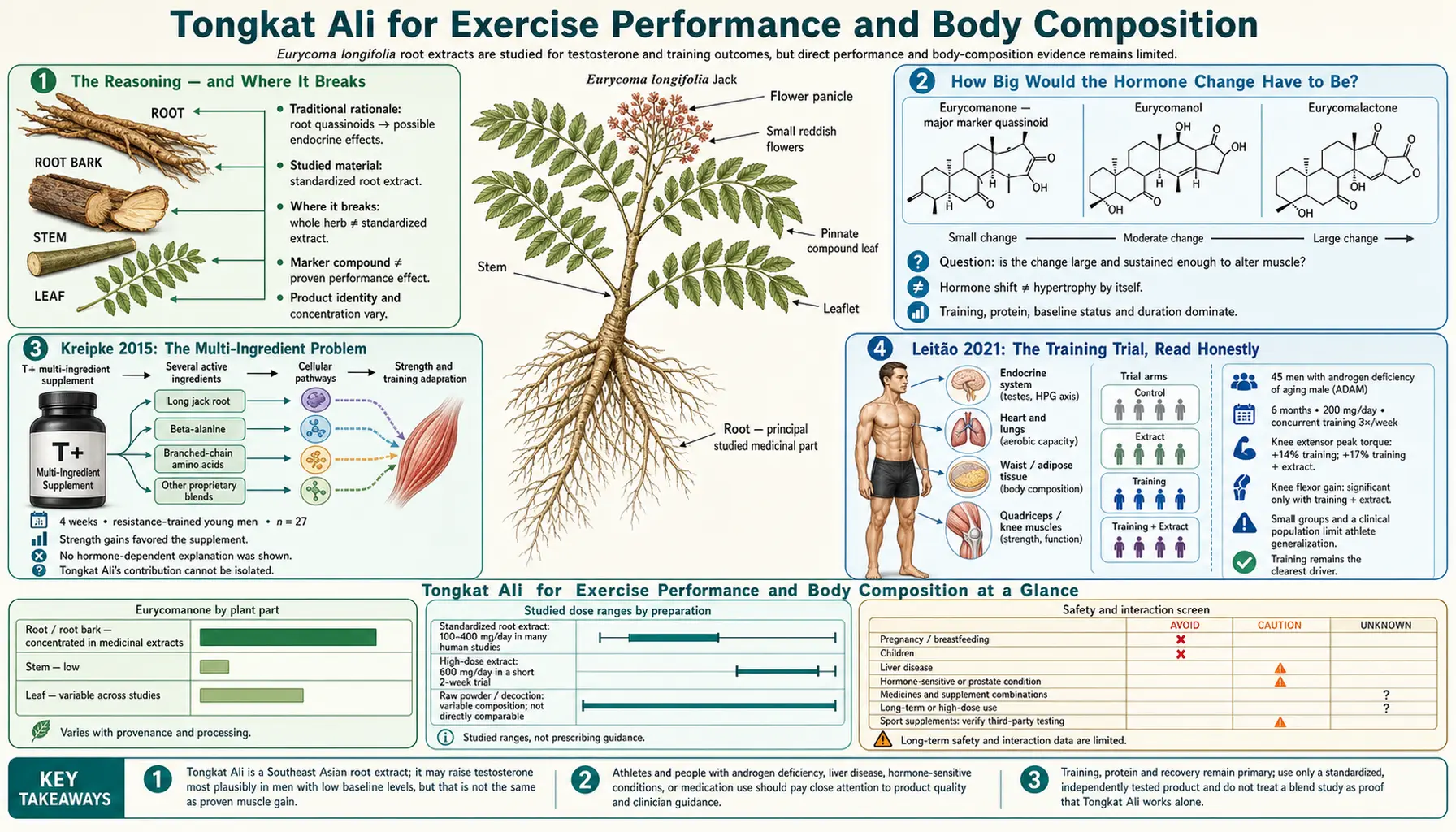
Tongkat ali appears in a large share of pre-workout powders, “natural anabolic” stacks and testosterone-support blends. The reasoning is simple and superficially sound: testosterone drives muscle protein synthesis, tongkat ali may raise testosterone, therefore tongkat ali should build muscle.
This is the weakest of the herb's three main claims and the most heavily marketed. There is no trial in which tongkat ali alone, against placebo, produced a meaningful gain in strength or lean mass as a pre-specified primary endpoint. What exists instead is a multi-ingredient supplement trial that cannot isolate the herb, a six-month exercise trial in which the exercise did most of the work, an uncontrolled pilot in seniors, and a small crossover study that found no change in the urinary testosterone ratio at all.
There is also a specific hazard for anyone who competes under anti-doping rules, and it has nothing to do with the plant.
Table of Contents
- The Reasoning — and Where It Breaks
- How Big Would the Hormone Change Have to Be?
- Kreipke 2015: The Multi-Ingredient Problem
- Leitão 2021: The Training Trial, Read Honestly
- Henkel 2014: Handgrip Strength in Seniors
- Chen 2014: No Change in the Urinary Testosterone Ratio
- Young Trained Men: Two Weeks Is Not an Answer
- Body Composition and Fat Mass
- The Anti-Doping Problem
- What Actually Builds Muscle
- If You Are Going to Try It Anyway
- Cautions and Contraindications
- Key Research Papers
- Connections
The Reasoning — and Where It Breaks
The syllogism is: testosterone is anabolic; tongkat ali raises testosterone; therefore tongkat ali is anabolic. Each step deserves examination.
Step one is true, with a caveat. Testosterone is genuinely anabolic. Administered at supraphysiological doses it increases muscle mass and strength even in men who do not train — a finding established in controlled studies of testosterone enanthate. This is why anabolic steroids work and why they are banned.
Step two is partly supported, in a specific population. As covered in the testosterone article, a meta-analysis of five randomised trials found a significant increase in total testosterone, most robustly in hypogonadal men. It did not establish an effect in young men with normal levels, and the largest properly controlled trial found no between-group change in free testosterone — the fraction that actually reaches receptors.
Step three does not follow. This is where the argument collapses, and the reason is dose–response.
How Big Would the Hormone Change Have to Be?
Testosterone's effect on muscle is dose-dependent, and the dose required for meaningful hypertrophy is far above the physiological range. That single fact does more to settle this question than any tongkat ali trial.
Consider the scale of the interventions involved:
- An anabolic steroid cycle typically produces testosterone levels several times the upper limit of the normal male range, sustained for weeks. That produces visible, measurable, rapid muscle gain.
- Clinical testosterone replacement therapy aims to restore a hypogonadal man to the middle of the normal range. It improves symptoms, lean mass and strength — modestly, over months, in men who were deficient.
- A herbal extract that moves total testosterone within the normal range, in men whose levels were low to begin with, sits far below even that. And if free testosterone — the fraction that binds receptors — does not change, the anabolic signal at the muscle may not change at all.
Put concretely: a man whose testosterone rises from 280 to 380 ng/dL has moved from “low” to “low-normal”. That may well make him feel better, and it may improve fatigue and drive, both of which have some trial support. It is not remotely the same stimulus as a steroid cycle, and expecting a comparable physical result is a category error.
Anyone whose mental model is “natural steroid” has the wrong model. The effect sizes are not in the same universe, and no honest reading of the literature suggests otherwise.
Kreipke 2015: The Multi-Ingredient Problem
This trial, from Florida State University, is the one most often cited for tongkat ali and strength, and it illustrates exactly why multi-ingredient supplement research answers a different question than the one buyers are asking.
Design. Randomised, placebo-controlled, four weeks, registered on ClinicalTrials.gov. Participants: 27 resistance-trained young men, mean age 21 — 14 on the supplement, 13 on an isocaloric placebo. Both groups completed a progressive four-week high-intensity resistance training programme. Intervention: a commercial multi-ingredient performance supplement containing long jack root (tongkat ali), beta-alanine, branched-chain amino acids and other proprietary blends.
Results. The supplement group had significantly greater increases in bench press and total weight lifted, plus significant increases in deadlift strength relative to body mass and to lean mass. The authors' summary sentence is the important one: supplementation “enhanced resistance training adaptations independent of hormonal status”.
Why this cannot support a tongkat ali claim.
- The product contained multiple active ingredients. Beta-alanine has its own substantial evidence base for high-intensity performance, principally through muscle carnosine buffering. Branched-chain amino acids have their own literature. If the product worked, the most parsimonious explanation involves the ingredients with established ergogenic mechanisms — not the one with the weakest.
- “Independent of hormonal status” means the hormones did not change. The anabolic hormone measurements did not show the differences that the tongkat ali hypothesis predicts. Whatever produced the strength gains, it was apparently not a testosterone effect.
- Four weeks, 27 men, and both groups were training hard. Early strength gains in a new programme are dominated by neural adaptation — learning the lift — rather than by tissue growth.
Verdict: a reasonable trial of a commercial product, and no evidence at all about tongkat ali specifically.
Leitão 2021: The Training Trial, Read Honestly
The Brazilian six-month trial is the longest study of this herb and one of the few with no supplement-industry authorship, which makes it worth reading carefully — including for what it shows about exercise.
Design. Six months, randomised, double-blind, placebo-controlled, four arms. Participants: 45 men with androgen deficiency of the ageing male, mean age 47. Arms: control + placebo; control + E. longifolia 200 mg/day; concurrent training + placebo; concurrent training + E. longifolia. Training was three sessions weekly, 60 minutes, at progressive intensity. Outcomes: erectile function, an ageing-male symptom scale, and total testosterone.
Results. Improvements appeared in both intervention types, with the strongest result in the combined training-plus-supplement group.
What to take from it.
- Forty-five men across four arms is roughly eleven per group. Estimates from eleven people carry very wide uncertainty, and the trial was not powered to separate a supplement effect from a training effect with confidence.
- The outcomes were sexual and hormonal, not muscular. This trial did not measure strength, lean mass, power or performance. It cannot support an ergogenic claim in either direction.
- The clearest signal is the one nobody sells. Six months of structured concurrent training improved erectile function and hormonal status in middle-aged men with androgen deficiency. That is a robust, repeatedly demonstrated finding in the wider literature, and it is free.
The fair summary: this trial is evidence that exercise works, with a suggestion that the supplement may add something on top. It is not evidence that the supplement builds muscle.
Henkel 2014: Handgrip Strength in Seniors
This pilot study is the closest thing in the literature to a direct strength finding for tongkat ali on its own, and its design limits how far it can go.
Design. An open-label supplementation study — no placebo group, no randomisation, no blinding. Participants: 13 physically active male and 12 physically active female seniors, aged 57–72. Intervention: 400 mg of tongkat ali extract daily for five weeks. Outcomes: haematology, total and free testosterone, DHEA, cortisol, IGF-1, SHBG, urea nitrogen, creatine kinase, and muscle strength by a simple handgrip test.
Results. Total and free testosterone rose significantly in both sexes, as did muscular force. In women the free testosterone rise was attributed to a fall in SHBG. The authors concluded the study “affirms the ergogenic benefit” of the extract.
Why that conclusion outruns the design.
- There was no control group. Every number is a before-and-after comparison in the same people, which cannot distinguish the supplement from expectation, from the effect of being enrolled and measured, or from ordinary variation.
- Handgrip strength improves with practice. It is a learned effort task; repeat testing produces higher numbers in untrained testers. Without a control arm doing the same tests, a practice effect and a drug effect are indistinguishable.
- Twenty-five participants over five weeks is a pilot, and the paper says so in its title.
- The SHBG finding conflicts with the larger controlled trial, which measured SHBG in 105 men over 12 weeks and found no significant change.
Verdict: a legitimate pilot that justifies a controlled trial. That controlled trial has not been done.
Chen 2014: No Change in the Urinary Testosterone Ratio
This small study is the most concrete piece of evidence in this article, and it points away from the anabolic claim.
Design. Double-blind, placebo-controlled crossover — each participant serves as his own control, which is a strong design for small samples. Participants: 13 healthy male recreational athletes. Intervention: 400 mg/day of the standardised Physta water extract, or placebo, for six weeks; a three-week washout; then the other arm for six weeks. Primary outcome: the urinary testosterone:epitestosterone (T:E) ratio, plus liver and renal function.
Result: the T:E ratio did not change significantly on the extract compared with baseline or with placebo. Liver and renal function tests were also unchanged.
What the T:E ratio is. Epitestosterone is an inactive isomer of testosterone excreted in urine at roughly the same rate. Anti-doping laboratories use the ratio between them because taking exogenous testosterone raises testosterone excretion without raising epitestosterone, pushing the ratio up. It is the screening test that flags possible testosterone doping.
Two conclusions follow, and both are useful.
- Reassurance for tested athletes about the herb itself. At 400 mg/day for six weeks, the extract did not shift the marker that anti-doping screening looks at. The authors' stated purpose was exactly this. (It says nothing about contaminated products — see below.)
- An argument against the anabolic claim. A compound producing a testosterone effect large enough to matter for muscle growth would be expected to leave a detectable footprint in androgen excretion. Six weeks at a dose at the top of the usual range produced none.
Thirteen participants is small. But a crossover design in which each man is his own control is more informative per participant than a parallel-group study of the same size, and the finding is a clean null.
Young Trained Men: Two Weeks Is Not an Answer
The one placebo-controlled hormone study in healthy young men — 32 men, mean age 24, 600 mg/day for two weeks — found increases in total testosterone, free testosterone and estradiol, with no change in LH, FSH or SHBG. Its authors ended with the suggestion that raised testosterone “could benefit muscle and strength gain in young adults”.
That is a speculation in a discussion section, not a finding. The study measured hormones. It did not measure strength, power, lean mass, or any performance outcome whatsoever. Two weeks is also far too short to observe muscular adaptation, which requires weeks to months of training stimulus.
The estradiol rise deserves a mention here too. Testosterone is converted to estradiol by the aromatase enzyme, and raising the substrate raises the product. Marketing that promises a testosterone increase rarely mentions that the trial in young men also recorded an oestrogen increase.
Body Composition and Fat Mass
The body-composition claim is thinner still, and rests on a subgroup.
The 109-man, 12-week trial of 300 mg of the water extract reported that participants with a BMI at or above 25 showed significantly greater fat mass loss than placebo. That is one secondary finding, in one subgroup of one trial, in a study that measured a large number of outcomes.
Meanwhile the multi-ingredient four-week trial measured body composition directly and found no significant between-group differences beyond the strength measures. The six-month training trial did not report body composition as an outcome.
The honest position: there is no reliable evidence that tongkat ali changes body fat or lean mass. If a modest hormonal shift produced a modest metabolic effect over long periods, current studies are far too small and short to detect it. Nothing rules it out; nothing supports it.
The Anti-Doping Problem
This section matters more than everything above it for anyone subject to testing — competitive athletes, tested amateurs, military personnel, and workers in safety-critical roles with substance testing.
Tongkat ali is not itself a prohibited substance, and the crossover study described above found it did not move the urinary T:E ratio at 400 mg/day. The plant is not the problem.
The problem is the shelf it sits on. Sports and sexual-performance supplements are the most heavily adulterated categories in the industry. An analysis of a decade of US Food and Drug Administration warnings identified 776 adulterated dietary supplements between 2007 and 2016. Of these, 92 (11.9%) were marketed for muscle building, and 82 of those 92 — 89.1% — contained synthetic steroids or steroid-like ingredients. Sexual-enhancement products were the single largest category at 353 products, and 47% of those contained sildenafil.
A broader review of doping substances in sports supplements reached a comparable conclusion: undeclared prohibited substances turn up in products that make no mention of them on the label, and the contamination can be either deliberate spiking or carry-over from shared manufacturing equipment.
Why this is not a small risk. Anti-doping operates on strict liability. An athlete is responsible for what is in their body regardless of how it got there. “It was in my supplement and the label did not say so” has not, in general, prevented sanctions. Careers have ended over exactly this.
The practical rules for anyone tested:
- Use only products certified under a third-party sport programme — Informed Sport, NSF Certified for Sport, or an equivalent that batch-tests for prohibited substances. General “GMP” or “quality tested” claims are not this.
- Never buy from an anonymous online marketplace seller. That is precisely where the adulterated Eurycoma products described in the product quality article were purchased.
- Keep the bottle and the batch number. If a test is contested, a retained sample of the actual product is the only physical evidence you will have.
- Consider whether the potential benefit justifies the risk at all. On the evidence in this article, the ergogenic upside for a healthy trained athlete is unproven at best. The downside is a ban.
What Actually Builds Muscle
For balance, here is where the effect sizes actually are — interventions with evidence bases orders of magnitude larger than anything in this article:
- Progressive resistance training. The only intervention that reliably builds muscle. Everything else modifies its effect at the margin.
- Adequate protein intake, roughly 1.6 g per kilogram of body weight per day for people training for hypertrophy, with diminishing returns above that.
- Creatine monohydrate. The most thoroughly studied ergogenic supplement in existence, with hundreds of trials, a clear mechanism, a trivial cost and a strong safety record. If you want one supplement for strength, this is the evidence-based answer — not a testosterone booster.
- Sleep. Muscle protein synthesis, growth hormone release and roughly half of daily testosterone output are tied to sleep. Chronic restriction lowers testosterone measurably within a week.
- Sufficient total energy intake. You cannot build tissue in a substantial deficit.
A person doing all five and then adding tongkat ali is making a small, optional bet. A person doing none of them and buying tongkat ali is buying an expensive distraction.
If You Are Going to Try It Anyway
- Have a realistic expectation. On current evidence the defensible targets are fatigue, drive and general well-being — not hypertrophy or performance.
- Form and dose: a standardised water extract at 200–400 mg/day, which is the range every trial used. There is no evidence more is better; the crossover study that found nothing used 400 mg.
- Timing: morning. Insomnia and restlessness are the commonest side effects, and sleep is worth more to your training than any supplement.
- Duration: a defined 8–12 week block with measurements at both ends — a training log with actual loads, and body composition if you have access to a consistent method. Do not change your programme, protein intake and supplement in the same week; you will learn nothing.
- If you are tested, use a certified product or none.
- Sourcing: read the product quality article first. It matters more than anything on this page.
Cautions and Contraindications
Adulteration is the leading risk in this category, and it is worse for sports products than for the herb generally: 89.1% of FDA-flagged muscle-building supplements contained synthetic steroids or steroid-like compounds. Undeclared anabolic agents can cause liver injury, cholesterol changes, suppression of your own testosterone production, gynaecomastia and, for tested athletes, a sanction. Buy certified or do not buy.
Hormone-sensitive conditions. Men with prostate cancer, a history of it, a rising PSA or symptomatic benign prostatic hyperplasia should not take a testosterone-marketed supplement without urological involvement. Men already on prescribed testosterone replacement should not add it — you cannot monitor a hormone protocol with an unquantified hormone-active herb in the mix. Because both oestrogenic and anti-oestrogenic activities have been reported for Eurycoma constituents in laboratory work, women with hormone-sensitive breast or uterine conditions should avoid it.
Immunosuppressant therapy. Immunostimulant activity has been reported in laboratory work, and one 24-week trial found a significant rise in lymphocyte count in the active group. Avoid if you take immunosuppressive medication after a transplant or for autoimmune disease.
Pregnancy and breastfeeding. Avoid entirely — unstudied in human pregnancy, quassinoids are biologically active in reproductive tissue in animals, and the contamination risk is disqualifying on its own.
Children and adolescents. Avoid. No safety data, and a testosterone-marketed product has no place near a developing endocrine system. This matters in sport, where supplement use among young athletes is common.
Drug interactions. Formal human interaction studies are lacking. Caution with anticoagulants and antiplatelet drugs, antidiabetic drugs (animal hypoglycaemic effects reported), antihypertensives, and propranolol (reduced absorption reported). Any product adulterated with a sildenafil analogue interacts dangerously with nitrates.
Liver and kidney. The six-week crossover study specifically measured liver and renal function at 400 mg/day and found no adverse changes, and animal toxicity work has generally been reassuring. Against that, a 2024 case report describes liver injury attributed to a tongkat ali product — and in a category this adulterated, the herb may not be the culprit. Stop and seek advice for dark urine, pale stools, right-upper-abdominal pain, or yellowing of the eyes or skin.
Reported side effects. Insomnia and restlessness, irritability, gastrointestinal upset; some users report increased body odour.
Key Research Papers
Every identifier below was verified live against NCBI E-utilities — first author, title, journal and year all matched before the PMID was printed.
Performance, strength and body composition
- Kreipke VC, Allman BR, Kinsey AW, et al. Impact of four weeks of a multi-ingredient performance supplement on muscular strength, body composition, and anabolic hormones in resistance-trained young men. Journal of Strength and Conditioning Research. 2015;29(12):3453–3465. Multi-ingredient product; gains occurred independent of hormonal status.
- Henkel RR, Wang R, Bassett SH, et al. Tongkat Ali as a potential herbal supplement for physically active male and female seniors — a pilot study. Phytotherapy Research. 2014;28(4):544–550. 25 seniors, 400 mg, 5 weeks, no placebo group.
- Leitão AE, Vieira MCS, Pelegrini A, et al. A 6-month, double-blind, placebo-controlled, randomized trial to evaluate the effect of Eurycoma longifolia (Tongkat Ali) and concurrent training on erectile function and testosterone levels in androgen deficiency of aging males (ADAM). Maturitas. 2021;145:78–85. n=45 across four arms; no muscular outcomes measured.
- Ismail SB, Wan Mohammad WM, George A, et al. Randomized clinical trial on the use of PHYSTA freeze-dried water extract of Eurycoma longifolia for the improvement of quality of life and sexual well-being in men. Evidence-Based Complementary and Alternative Medicine. 2012;2012:429268. Fat-mass loss in the BMI ≥25 subgroup only.
Hormonal and doping-marker studies
- Chen CK, Mohamad WM, Ooi FK, et al. Supplementation of Eurycoma longifolia Jack extract for 6 weeks does not affect urinary testosterone:epitestosterone ratio, liver and renal functions in male recreational athletes. International Journal of Preventive Medicine. 2014;5(6):728–733. n=13 crossover, 400 mg/day; null result.
- Chan KQ, Stewart C, Chester N, et al. The effect of Eurycoma longifolia on the regulation of reproductive hormones in young males. Andrologia. 2021;53(4):e14001. n=32, 600 mg, 2 weeks; hormones only, no performance outcomes.
- Leisegang K, Finelli R, Sikka SC, Panner Selvam MK. Eurycoma longifolia (Jack) improves serum total testosterone in men: a systematic review and meta-analysis of clinical trials. Medicina (Kaunas). 2022;58(8):1047.
Supplement contamination and anti-doping
- Tucker J, Fischer T, Upjohn L, et al. Unapproved pharmaceutical ingredients included in dietary supplements associated with US Food and Drug Administration warnings. JAMA Network Open. 2018;1(6):e183337. 776 adulterated products; 89.1% of muscle-building products contained synthetic steroids or steroid-like ingredients.
- Martínez-Sanz JM, Sospedra I, Ortiz CM, et al. Intended or unintended doping? A review of the presence of doping substances in dietary supplements used in sports. Nutrients. 2017;9(10):1093.
- Rocha T, Amaral JS, Oliveira MBPP. Adulteration of dietary supplements by the illegal addition of synthetic drugs: a review. Comprehensive Reviews in Food Science and Food Safety. 2016;15(1):43–62.
- Balasubramanian A, Thirumavalavan N, Srivatsav A, et al. Testosterone imposters: an analysis of popular online testosterone boosting supplements. Journal of Sexual Medicine. 2019;16(2):203–212. Of 37 human studies of the commonest ingredients, 46% found no effect.
Safety
- Rehman SU, Choe K, Yoo HH. Review on a traditional herbal medicine, Eurycoma longifolia Jack (Tongkat Ali): its traditional uses, chemistry, evidence-based pharmacology and toxicology. Molecules. 2016;21(3):331.
- Ahmad N, Teh BP, Halim SZ, et al. Eurycoma longifolia-infused coffee — an oral toxicity study. Nutrients. 2020;12(10):3125. Animal toxicology.
- Kaliounji A, Shadid G, Saba H, Ahlawat S. A rare case of Tongkat Ali-induced liver injury: a case report. Cureus. 2024;16(3):e56639.
Live PubMed Searches
- Eurycoma longifolia and exercise performance
- Eurycoma longifolia and muscle strength
- Testosterone:epitestosterone ratio in doping control
- Supplement contamination with anabolic steroids
- Testosterone dose–response and muscle mass
- Creatine monohydrate and resistance training
- Beta-alanine and performance
- Protein intake and hypertrophy
- Multi-ingredient pre-workout trials
- Sleep restriction and testosterone
Connections
- All Herbs
- Tongkat Ali Benefits — the hub, with the full evidence map.
- Tongkat Ali (Eurycoma longifolia) — botany, traditional use, compounds, forms and dosage.
- Testosterone and Male Fertility — the hormone claim this article depends on.
- Product Quality, Contamination and Adulteration — essential reading for anyone who is drug tested.
- Stress, Cortisol and Mood — where the more defensible claims sit.
- Ashwagandha — the other adaptogen with strength and recovery claims, and a larger trial base.
- Ginseng — the original “ergogenic” root, with its own mixed literature.
- Maca — marketed for energy and endurance on similarly thin performance data.
- Kacip Fatimah (Labisia pumila) — the Malaysian counterpart herb.