Tongkat Ali Benefits
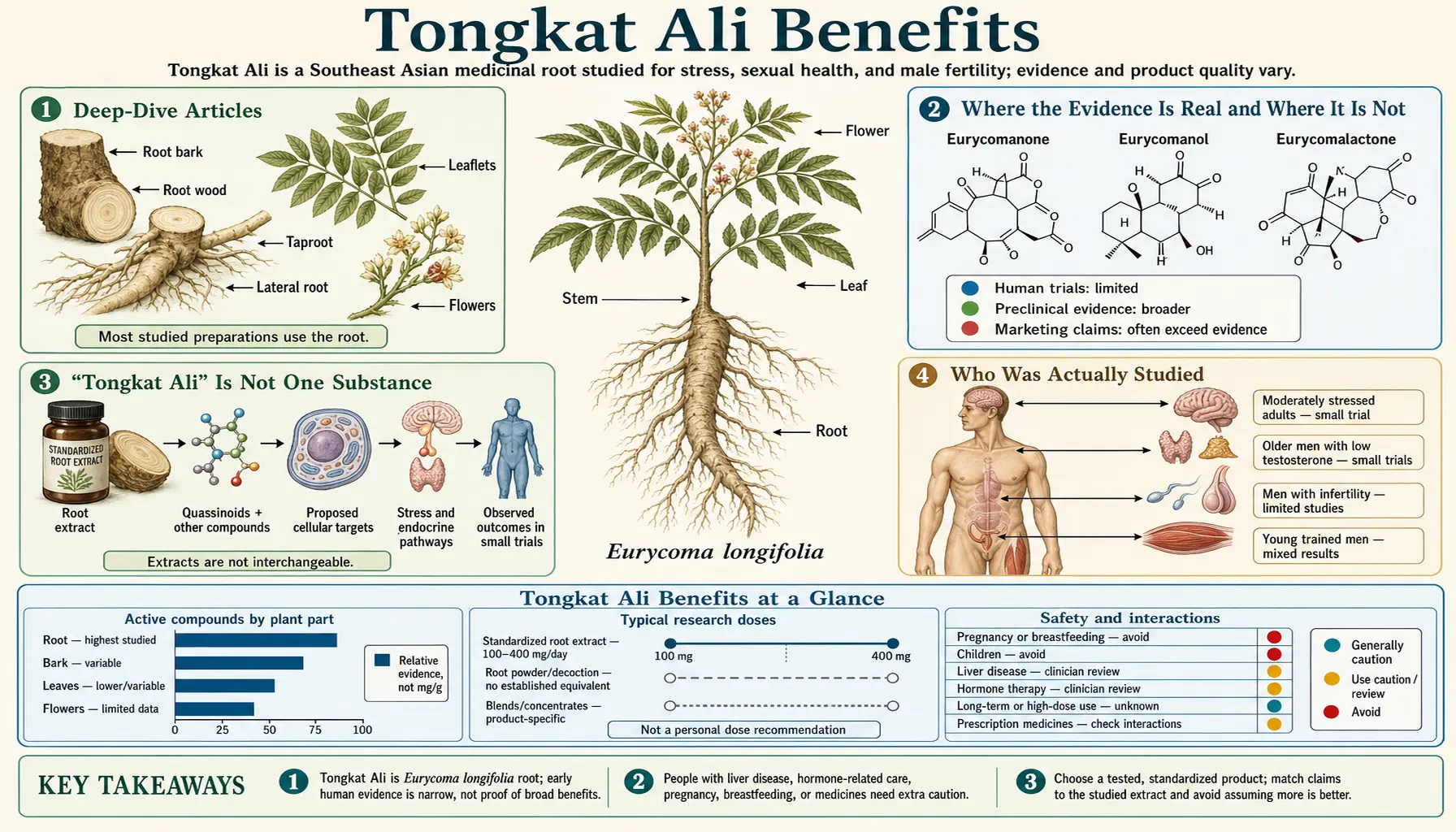
Tongkat ali — the taproot of Eurycoma longifolia Jack, family Simaroubaceae — sits in an unusual position among herbal supplements. It is simultaneously one of the most oversold products on the market and one of the few in its category with genuine randomised human trials behind it. Most “testosterone boosters” have neither. Tongkat ali has both a marketing machine that vastly outruns the data and a real, if small, clinical literature that deserves to be read carefully rather than dismissed.
These four articles try to hold both of those facts at once. They go trial by trial rather than saying “studies show”, because the trials differ so much from each other that pooling them in a sentence destroys the information. For every study named here you will find the number of participants, how long it ran, which extract at what dose, whether there was a placebo group at all, and who paid for it. Several of the most-cited results turn out to be uncontrolled before-and-after studies. Several were funded by the company that manufactures the extract being tested. Neither fact makes a result false. Both change how much weight it can carry.
And one practical warning belongs above all the efficacy questions: what is actually inside a tongkat ali capsule is, in a measurable proportion of products, not what the label says. Mercury above the Malaysian legal limit in 36% of one hundred sampled products. Lead above the limit in named tongkat ali brands. Sildenafil analogues in products bought over the internet. DNA barcoding that authenticated only 37% of tested products. If you read only one of these four articles, read the fourth.
Table of Contents
- Deep-Dive Articles
- Where the Evidence Is Real and Where It Is Not
- “Tongkat Ali” Is Not One Substance
- Who Was Actually Studied
- The Industry-Funding Question, Handled Honestly
- A Four-Point Check Before You Buy
- Low Testosterone Deserves a Diagnosis, Not a Supplement
- Key Research Papers
- External Resources
- Connections
Deep-Dive Articles
Four articles, in rough order of how much evidence exists behind each claim — except the last, which is first in practical importance.
Testosterone and Male Fertility
The central claim, taken apart trial by trial: the 2022 meta-analysis and its five inputs, why the erectile-function meta-analysis was null, which studies had no placebo group, and what a 350-patient fertility study with 75 completers can and cannot support.
Stress, Cortisol and Mood
The adaptogen claim. A 63-person four-week trial reporting a 16% cortisol drop, a 93-person 24-week trial that missed its primary endpoint, and why the cortisol story may be the mechanism behind the hormone story rather than a separate benefit.
Exercise Performance and Body Composition
The weakest of the three efficacy claims and the most heavily marketed. Multi-ingredient trials that cannot isolate the herb, a 13-person crossover that found no change in the urinary testosterone ratio, and the anti-doping problem that has nothing to do with the plant.
Product Quality, Contamination and Adulteration
The article that matters most. Published mercury and lead surveys with real percentages, sildenafil analogues in Eurycoma products, why “tongkat ali hitam” is a different plant family altogether, and exactly what to demand on a label.
Where the Evidence Is Real and Where It Is Not
Tongkat ali is usually sold as though every claim on the bottle rests on the same footing. They do not. Here is the honest ranking, with the label each finding deserves.
| Claim | Best available human evidence | Honest verdict |
|---|---|---|
| Raises serum total testosterone in men with low levels | Meta-analysis of five RCTs (Leisegang 2022); a 105-man 12-week placebo-controlled trial (Chinnappan 2021) | The strongest claim. Probably a real effect in hypogonadal and older men, size uncertain |
| Raises free testosterone / lowers SHBG | The largest placebo-controlled trial found no between-group difference in free testosterone and no change in SHBG | The popular mechanism story is not supported by the best trial's own data |
| Improves erectile function | Meta-analysis of 2 RCTs, n=139: no significant overall difference (Kotirum 2015) | Null overall; a subgroup with poor baseline function improved |
| Lowers cortisol / improves mood under stress | One 63-person, 4-week placebo-controlled trial (Talbott 2013) | Suggestive and unreplicated |
| Improves semen parameters in infertile men | One uncontrolled study, 350 enrolled, 75 completed a 3-month cycle (Tambi 2010) | Interesting, not evidence — no placebo group |
| Increases muscle strength or lean mass on its own | No trial has tested the herb alone against placebo with strength as a primary endpoint | Unsupported |
| Benefits in women | One uncontrolled senior pilot; a 150-woman menopause trial published only as a protocol in 2023 | Results pending — the trial exists, the answer does not yet |
| “Natural steroid” effects | A 13-person crossover found no change in the urinary testosterone:epitestosterone ratio at 400 mg/day | Actively contradicted |
“Tongkat Ali” Is Not One Substance
This is the single most important idea for reading anything about this herb. When a trial reports a result, the result belongs to a specific extract, not to a plant name. The gap between them is enormous.
- Almost every positive trial used a standardised freeze-dried water extract. Most used one particular commercial preparation, sold as Physta and made by Biotropics Malaysia Berhad. When you read “tongkat ali increased testosterone”, the accurate sentence is usually “this specific water extract, at 100–400 mg/day, increased testosterone in this specific population”.
- A root powder capsule is a different product. Milled root is not a concentrated water extract. Nothing about a trial of the latter transfers automatically to the former.
- An alcohol tincture is a third product. Ethanol pulls a different constituent profile out of the root than boiling water does; the quassinoid-to-peptide balance is not the same.
- A high-eurycomanone extract may be further from the tested material, not closer. Eurycomanone is the marker quassinoid used for standardisation, and a 2% eurycomanone extract sounds more potent than a plain water extract. But if the hormonal effects come from the peptide fraction of a water decoction — which is one of the leading hypotheses — then concentrating the quassinoids does not concentrate the active principle. Nobody has resolved this.
The practical version: an extract ratio such as “100:1” on a label tells you almost nothing. It describes how much raw root the manufacturer says went in, calculated by a method the manufacturer chooses. A stated eurycomanone percentage is a more meaningful number because it is measurable in the finished product — but it is a marker, not a guarantee of effect.
Who Was Actually Studied
The positive literature is concentrated in a narrow group of people, and the concentration is not accidental.
- Older men with measured low testosterone. The Chinnappan trial required a screening testosterone below 300 ng/dL in men aged 50–70. The Tambi study recruited men diagnosed with late-onset hypogonadism. The Leitão trial recruited men with androgen deficiency of the ageing male.
- Moderately stressed adults. The Talbott trial screened for existing stress rather than recruiting healthy volunteers — a design choice that makes an effect easier to detect, and a sensible one.
- Sub-fertile men. The fertility work was done in male partners of couples with idiopathic infertility.
The pattern is that a substance which helps a struggling system may do very little in a healthy one. A 25-year-old with normal testosterone who buys tongkat ali at a gym is not the person these trials studied. The one placebo-controlled study in healthy young men — 32 participants, 600 mg/day for two weeks — did report increases in total and free testosterone, but it also reported a rise in estradiol and no change in luteinising hormone, and two weeks is not a duration from which anyone should extrapolate.
The Industry-Funding Question, Handled Honestly
A large share of the positive tongkat ali literature was funded by, or co-authored by employees of, the Malaysian company that manufactures the standardised extract being tested. That is disclosed openly in the papers — it is printed in the conflict-of-interest statements, not hidden — and it deserves a proportionate response rather than either dismissal or denial.
What industry funding does not mean. It does not mean the data are fabricated. It does not mean the trials were badly run; several are properly randomised, double-blinded and placebo-controlled, and one is registered on a public trials registry. Malaysia has invested in this plant as a national agricultural and export commodity, and a consequence is that serious money went into studying it — which is more than most herbs get.
What it does mean. Industry-funded trials across all of medicine are, on average, more likely to report positive results than independently funded trials of the same intervention. That is a statistical regularity, not an accusation. It means the honest position is “this needs independent replication before it is treated as established”, and that is exactly where tongkat ali sits. The counterweight worth noticing is that the studies with no industry involvement — the Brazilian six-month exercise trial, the erectile-function meta-analysis, the doping-ratio crossover — produced the most muted results in the whole literature.
A Four-Point Check Before You Buy
Sourcing matters more for this herb than dosing does. Four things, in order:
- The binomial on the label. It must say Eurycoma longifolia. “Tongkat ali” alone is a market name shared with at least one botanically unrelated plant — Polyalthia bullata, the “black” grade, which belongs to a completely different family and has no clinical literature.
- A lot-specific third-party certificate of analysis for heavy metals. Not a “quality tested” badge. An actual report, tied to the batch number on your bottle, giving parts per million for lead, mercury, arsenic and cadmium.
- A stated standardisation. A named eurycomanone percentage, or an explicit statement that the product is a water extract at a stated ratio. A capsule labelled only “tongkat ali root, 500 mg” is a black box.
- A manufacturer and country you can identify. Anonymous marketplace sellers are where the sildenafil analogues were found.
A product satisfying all four costs noticeably more than one that does not. This is one of the few places in the supplement aisle where paying more genuinely buys something measurable.
Low Testosterone Deserves a Diagnosis, Not a Supplement
This has to be said plainly, because it is the most common way people get hurt by this product — not by toxicity, but by delay.
Fatigue, low libido, poor mood, weight gain and loss of morning erections are the symptoms tongkat ali is marketed for. They are also the symptoms of obstructive sleep apnoea, type 2 diabetes, thyroid disease, depression, iron deficiency, chronic kidney disease, opioid use, obesity, alcohol excess and pituitary tumours. Several of those are common, several are serious, and all of them are more treatable than they are guessable.
Genuinely low testosterone is also a finding with a cause, and finding the cause changes what happens next. A raised prolactin points to the pituitary. A low LH and FSH alongside low testosterone means the signal from the brain is failing, not the testis. A high LH with low testosterone means the opposite. None of that can be inferred from how you feel, and none of it is addressed by a capsule.
The sequence that helps: a morning blood draw for total testosterone, repeated on a second morning to confirm, plus LH, FSH, prolactin and SHBG; a conversation about sleep, alcohol, weight and medication; then a decision. If after all that you still want to try a standardised extract for eight to twelve weeks with a repeat panel at the end, that is a defensible thing to do. Doing it instead of the workup is how a treatable pituitary adenoma goes unnoticed for two years.
Key Research Papers
Every identifier below was checked live against NCBI E-utilities — first author, title, journal and year all had to match before a PMID was printed.
Testosterone: the trials and the pooled analysis
- Leisegang K, Finelli R, Sikka SC, et al. Eurycoma longifolia (Jack) improves serum total testosterone in men: a systematic review and meta-analysis of clinical trials. Medicina (Kaunas). 2022;58(8):1047. Nine studies reviewed, five pooled; standardised mean difference 1.352 (95% CI 0.565–2.138).
- Chinnappan SM, George A, Pandey P, et al. Effect of Eurycoma longifolia standardised aqueous root extract–Physta on testosterone levels and quality of life in ageing male subjects: a randomised, double-blind, placebo-controlled multicentre study. Food and Nutrition Research. 2021;65. n=105, 12 weeks, 100 or 200 mg; manufacturer-funded.
- Tambi MI, Imran MK, Henkel RR. Standardised water-soluble extract of Eurycoma longifolia, Tongkat ali, as testosterone booster for managing men with late-onset hypogonadism? Andrologia. 2012;44 Suppl 1:226–230. 76 of 320 patients, 200 mg, one month, no placebo group.
- Chan KQ, Stewart C, Chester N, et al. The effect of Eurycoma longifolia on the regulation of reproductive hormones in young males. Andrologia. 2021;53(4):e14001. n=32 healthy young men, 600 mg/day, two weeks.
Sexual function and fertility
- Kotirum S, Ismail SB, Chaiyakunapruk N. Efficacy of Tongkat Ali (Eurycoma longifolia) on erectile function improvement: systematic review and meta-analysis of randomized controlled trials. Complementary Therapies in Medicine. 2015;23(5):693–698. Two trials, n=139; no significant overall effect.
- Ismail SB, Wan Mohammad WM, George A, et al. Randomized clinical trial on the use of PHYSTA freeze-dried water extract of Eurycoma longifolia for the improvement of quality of life and sexual well-being in men. Evidence-Based Complementary and Alternative Medicine. 2012;2012:429268. n=109, 12 weeks, 300 mg.
- Tambi MI, Imran MK. Eurycoma longifolia Jack in managing idiopathic male infertility. Asian Journal of Andrology. 2010;12(3):376–380. 350 enrolled, 75 completed a 3-month cycle, uncontrolled.
Stress, mood and quality of life
- Talbott SM, Talbott JA, George A, Pugh M. Effect of Tongkat Ali on stress hormones and psychological mood state in moderately stressed subjects. Journal of the International Society of Sports Nutrition. 2013;10(1):28. n=63 (32 men, 31 women), four weeks.
- George A, Udani J, Abidin NZ, Yusof A. Efficacy and safety of Eurycoma longifolia (Physta) water extract plus multivitamins on quality of life, mood and stress: a randomized placebo-controlled and parallel study. Food and Nutrition Research. 2018;62. n=93, 24 weeks; no significant between-group differences.
- Muniandy S, Yahya HM, Shahar S, et al. Effects of Eurycoma longifolia Jack standardised water extract (Physta) on well-being of perimenopausal and postmenopausal women: protocol for a randomised, double-blinded, placebo-controlled, parallel group study. BMJ Open. 2023;13(11):e073323. A protocol — 150 women planned, results not yet reported here.
Exercise, body composition and doping
- Leitão AE, Vieira MCS, Pelegrini A, et al. A 6-month, double-blind, placebo-controlled, randomized trial to evaluate the effect of Eurycoma longifolia (Tongkat Ali) and concurrent training on erectile function and testosterone levels in androgen deficiency of aging males (ADAM). Maturitas. 2021;145:78–85. n=45 across four arms, 200 mg.
- Chen CK, Mohamad WM, Ooi FK, et al. Supplementation of Eurycoma longifolia Jack extract for 6 weeks does not affect urinary testosterone:epitestosterone ratio, liver and renal functions in male recreational athletes. International Journal of Preventive Medicine. 2014;5(6):728–733. n=13 crossover, 400 mg/day.
- Kreipke VC, Allman BR, Kinsey AW, et al. Impact of four weeks of a multi-ingredient performance supplement on muscular strength, body composition, and anabolic hormones in resistance-trained young men. Journal of Strength and Conditioning Research. 2015;29(12):3453–3465. Multi-ingredient; strength gains occurred without hormonal change.
Product quality, contamination and adulteration
- Ang HH, Lee EL, Cheang HS. Determination of mercury by cold vapor atomic absorption spectrophotometer in Tongkat Ali preparations obtained in Malaysia. International Journal of Toxicology. 2004;23(1):65–71. 36 of 100 products contained 0.52–5.30 ppm mercury.
- Ang HH, Lee KL. Contamination of mercury in tongkat Ali hitam herbal preparations. Food and Chemical Toxicology. 2006;44(8):1245–1250. 26 of 100 “black”-grade products contained 0.53–2.35 ppm mercury.
- Ang HH, Lee EL, Matsumoto K. Analysis of lead content in herbal preparations in Malaysia. Human and Experimental Toxicology. 2003;22(8):445–451. Eight failing products, 10.64–20.72 ppm lead — all of them tongkat ali brands.
- Abubakar BM, Salleh FM, Shamsir Omar MS, Wagiran A. Assessing product adulteration of Eurycoma longifolia (Tongkat Ali) herbal medicinal product using DNA barcoding and HPLC analysis. Pharmaceutical Biology. 2018;56(1):368–377. 37% authentic, 27% adulterated.
- Tucker J, Fischer T, Upjohn L, et al. Unapproved pharmaceutical ingredients included in dietary supplements associated with US Food and Drug Administration warnings. JAMA Network Open. 2018;1(6):e183337. Sexual-enhancement products were the largest adulterated category; sildenafil in 47% of them.
Chemistry, pharmacology and safety
- Rehman SU, Choe K, Yoo HH. Review on a traditional herbal medicine, Eurycoma longifolia Jack (Tongkat Ali): its traditional uses, chemistry, evidence-based pharmacology and toxicology. Molecules. 2016;21(3):331.
- Bhat R, Karim AA. Tongkat Ali (Eurycoma longifolia Jack): a review on its ethnobotany and pharmacological importance. Fitoterapia. 2010;81(7):669–679.
- Kaliounji A, Shadid G, Saba H, Ahlawat S. A rare case of Tongkat Ali-induced liver injury: a case report. Cureus. 2024;16(3):e56639.
Live PubMed Searches
- Eurycoma longifolia RCTs
- Eurycoma longifolia and testosterone
- Eurycomanone
- Tongkat ali and heavy metals
- Herbal adulteration with sildenafil
- Eurycoma longifolia and semen quality
- Eurycoma longifolia and cortisol
- Polyalthia bullata
- Eurycoma longifolia toxicity
- Testosterone-booster supplements
- DNA barcoding authentication
- Late-onset hypogonadism — diagnosis
External Resources
- FDA — Tainted Sexual Enhancement and Energy Products database
- NCCIH — Herbs at a Glance
- LiverTox — NIH database of drug and herbal liver injury
- PubChem — eurycomanone compound record
- Plants of the World Online — Eurycoma longifolia Jack
- ClinicalTrials.gov — registered Eurycoma trials
- NIH Office of Dietary Supplements — fact sheets
- USADA Supplement 411 — risk guidance for tested athletes
Connections
- All Herbs
- Tongkat Ali (Eurycoma longifolia) — the main article: botany, traditional use, compounds, forms and dosage.
- Testosterone and Male Fertility
- Stress, Cortisol and Mood
- Exercise Performance and Body Composition
- Product Quality, Contamination and Adulteration
- Kacip Fatimah (Labisia pumila) — Malaysia's women's-health counterpart, often formulated alongside tongkat ali.
- Ginseng — the region's other great root tonic, with a far larger clinical literature.
- Ashwagandha — overlapping cortisol and testosterone claims, and generally stronger stress evidence.
- Maca — the Andean root whose trials suggest a libido effect without a hormone change.