Tongkat Ali for Testosterone and Male Fertility
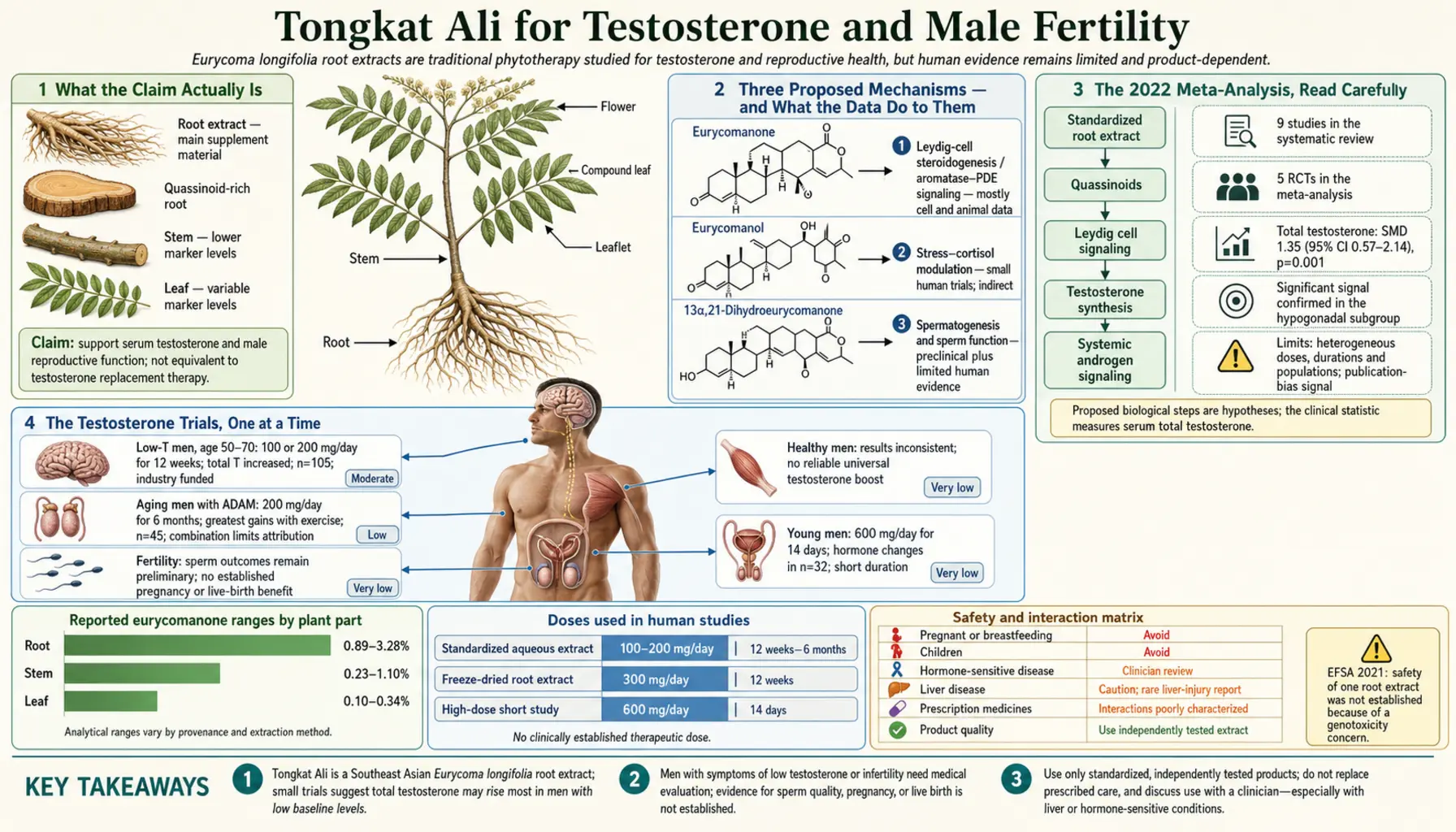
This is the claim that built the industry. Search for tongkat ali and you will be told, in confident language, that it raises testosterone, frees testosterone from its carrier protein, restores libido and improves fertility. Some of that has genuine randomised evidence behind it. Some of it has evidence pointing the other way. And the difference between the two is not visible from a product page.
What follows is every human trial that matters, one at a time, with its actual size, duration, extract, dose, design and funding. Not “studies show”. The studies here differ so much from one another that averaging them into a sentence throws away most of what you need to decide anything.
Table of Contents
- What the Claim Actually Is
- Three Proposed Mechanisms — and What the Data Do to Them
- The 2022 Meta-Analysis, Read Carefully
- The Testosterone Trials, One at a Time
- Healthy Young Men Are a Different Question
- Erectile Function: The Null Result Nobody Quotes
- Male Fertility and Semen Quality
- What the Animal and Laboratory Work Adds
- The Wider Testosterone-Booster Context
- Dose, Duration and How to Tell If It Worked
- Get Diagnosed First — This Is Not Optional Advice
- Cautions and Contraindications
- Key Research Papers
- Connections
What the Claim Actually Is
Strip away the marketing and there are four separate claims being made, which stand or fall independently:
- Tongkat ali raises serum total testosterone. This one has the most support.
- It raises free testosterone by lowering sex hormone-binding globulin. This is the mechanism story you will read everywhere. It is the least well supported.
- It improves erectile function. Pooled across randomised trials, this one came out null.
- It improves semen parameters and fertility. This rests on a single uncontrolled study.
Products routinely present all four as though they were one established fact. They are four different questions with four different answers.
Three Proposed Mechanisms — and What the Data Do to Them
Understanding what is supposed to be happening makes the trial results much easier to read.
Mechanism one: releasing bound testosterone. Most of the testosterone circulating in your blood is not available to your tissues. Roughly 40–60% is bound tightly to sex hormone-binding globulin (SHBG), a carrier protein made by the liver, and most of the rest is bound loosely to albumin. Only about 1–3% floats free. The analogy people use is a locked savings account: the money exists, but you cannot spend it. If a substance lowered SHBG, free testosterone would rise without the testes producing a single extra molecule.
What the data say about it. This is the mechanism most often repeated and least well supported. The largest placebo-controlled trial of a standardised extract — 105 men aged 50–70, 12 weeks — measured SHBG directly and found no significant change. It also found no significant between-group difference in free testosterone, only within-group increases that a placebo group exists precisely to rule out. If tongkat ali works, this is probably not how.
The one place SHBG did move was an uncontrolled pilot in physically active seniors, where free testosterone rose in the women and the authors attributed it to a fall in SHBG. That is a hypothesis generated from a study with no control group, in 12 women, over five weeks.
Mechanism two: supporting production in the testis. Testosterone is made in the Leydig cells of the testis, under instruction from luteinising hormone (LH) released by the pituitary. If a compound increased steroidogenic enzyme activity in those cells, or increased LH, production itself would rise.
What the data say about it. Rodent work supports it. In humans, the picture is odd: the trial in young men found testosterone rose while LH and FSH did not move at all. The authors' own reading was that the hypothalamic–pituitary–gonadal axis was not being activated, and that the extra testosterone might be coming from somewhere else — possibly the adrenal glands, via a different axis.
Mechanism three: lowering cortisol. Cortisol and testosterone are, in a rough sense, opposing hormones; sustained stress suppresses gonadal output. If tongkat ali dampens cortisol, testosterone might rise as a downstream consequence rather than a direct one. The 105-man trial did report a significant fall in cortisol in the 200 mg group, and a four-week stress trial reported a 16% reduction in salivary cortisol alongside a 37% rise in salivary testosterone. This is covered in detail in the stress and cortisol article.
The honest summary of mechanism: nobody knows. The most popular explanation is contradicted by the best trial's own SHBG data. The second is contradicted by the unchanged LH. The third is plausible and is the one the evidence currently fits best — which would make tongkat ali a stress-buffering herb whose hormonal effects are secondary, not a testosterone drug.
The 2022 Meta-Analysis, Read Carefully
Leisegang and colleagues at the University of the Western Cape, with co-authors at Tulane, published the pooled analysis that everything else now cites. It is worth reading precisely rather than as a headline.
What it did. A PRISMA-guided systematic review searching six databases for randomised trials of E. longifolia as a sole intervention. Nine studies met inclusion for the review; five were poolable in the meta-analysis.
What it found. A significant increase in total testosterone, with a standardised mean difference of 1.352 (95% CI 0.565 to 2.138, p = 0.001) under a random-effects model, confirmed in a hypogonadal subgroup. The authors concluded the review “supports the possible use of E. longifolia supplementation for enhancing testosterone production” while stating explicitly that “more research is required before its use in clinical practice”. The stated conflict of interest was none.
What to hold in mind.
- Five trials is a small pool. Meta-analysis is not alchemy; it inherits every weakness of its inputs and adds heterogeneity as a new one.
- A standardised mean difference is not a testosterone number. An SMD of 1.35 says the average treated participant scored above roughly the 91st percentile of the placebo distribution — it does not say “testosterone rose by X ng/dL”, and it cannot be translated back into one without the underlying spread.
- The confidence interval is wide. 0.565 to 2.138 spans “modest” to “implausibly large”. Wide intervals are what small pooled samples produce.
- The inputs are heterogeneous in the ways that matter most: different extracts, doses from 100 to 600 mg/day, durations from two weeks to six months, and populations ranging from hypogonadal 60-year-olds to healthy 24-year-olds.
- The pooled outcome was total testosterone, not symptoms. A blood number moving is not the same as a person feeling different.
The Testosterone Trials, One at a Time
Chinnappan 2021 — the largest properly controlled trial
Design: randomised, double-blind, placebo-controlled, multicentre, conducted in India and registered on the Indian clinical trials registry. Participants: 105 men aged 50–70 with a screening testosterone below 300 ng/dL and BMI between 18 and 30. Intervention: a standardised aqueous root extract (Physta) at 100 mg or 200 mg daily, versus placebo, for 12 weeks. Funding: Biotropics Malaysia Berhad, the manufacturer; two authors are company employees, disclosed in the paper.
Results: total testosterone rose significantly versus placebo at week 12 in the 100 mg group, and at weeks 4, 8 and 12 in the 200 mg group. Ageing Male Symptoms and Fatigue Severity Scale scores improved both within and between groups at all time points. Cortisol fell significantly in the 200 mg group. Muscle strength increased within groups. Safety bloods were unremarkable.
The parts that get left out of summaries: there were no significant between-group differences in free testosterone — only within-group changes — and no significant change in SHBG at all. The muscle-strength and DHEA findings were also within-group. Within-group change in a placebo-controlled trial is the weakest form of evidence the trial produces, because it is exactly what placebo, regression to the mean and repeated measurement generate on their own.
Verdict: a real, reasonably sized, properly designed trial supporting a total-testosterone effect at 200 mg/day in older men with low readings. Manufacturer-funded, awaiting independent replication.
Tambi 2012 — the famous one, and it had no placebo group
Design: an open-label treatment series. Participants: 76 of 320 patients attending a Kuala Lumpur men's clinic with late-onset hypogonadism. Intervention: 200 mg of a standardised water-soluble extract for one month. Outcome: before treatment, 10.5% of patients had no complaints on the Ageing Males' Symptoms scale and 35.5% had normal testosterone; after treatment, 71.7% and 90.8% respectively.
Those numbers are spectacular and they are quoted constantly. They also come from a study with no control group, no blinding and no randomisation. A one-month before-and-after series in men who have come to a clinic seeking help for exactly these symptoms is the design most vulnerable to placebo response, regression to the mean and observer expectation. The paper's own title ends in a question mark. It is a hypothesis-generating study that has been cited as if it were a definitive one.
Leitão 2021 — the longest trial, and the most independent
Design: six-month, randomised, double-blind, placebo-controlled, four-arm, conducted in Brazil by university researchers with no supplement-industry authorship. Participants: 45 men, mean age 47. Arms: control + placebo; control + E. longifolia; concurrent training + placebo; concurrent training + E. longifolia. Intervention: 200 mg/day; training three times weekly, 60 minutes, progressive intensity.
Results: erectile function improved with both interventions, with the largest effect in the combined training-plus-supplement group; the authors concluded the combination improved erectile function and increased total testosterone.
The size problem. Forty-five men across four arms is roughly eleven per group. That is a pilot-scale allocation, and effects estimated from eleven people carry enormous uncertainty. The six-month duration is a genuine strength — it is the longest anyone has run — and the absence of industry involvement is another. But this trial cannot settle anything on its own, and the most reliable signal in it is the one nobody is selling: six months of structured exercise improves erectile function in middle-aged men.
Ismail 2012 — sexual well-being and quality of life
Design: randomised, double-blind, placebo-controlled, parallel-group, 12 weeks, run at Universiti Sains Malaysia. Participants: 109 men aged 30–55. Intervention: 300 mg of the Physta water extract versus placebo.
Results: the treated group improved significantly versus placebo on the Physical Functioning domain of the SF-36 quality-of-life questionnaire, and scored higher on the overall Erectile Function domain of the IIEF. Reported libido rose 14% by week 12, sperm motility reached 44.4% and semen volume rose 18.2%. Men with BMI at or above 25 lost significantly more fat mass. Safety parameters matched placebo.
Caveats: the extract is the manufacturer's product and a company author is on the paper. The study measured a large number of outcomes across three questionnaires plus semen analysis plus body composition; when many outcomes are tested, some will reach significance by chance unless the analysis corrects for it. The positive findings are scattered across domains rather than concentrated in one pre-specified primary endpoint.
Udani 2014 — small, and not a single-herb trial
Design: randomised, double-blind, placebo-controlled, 12 weeks, in men aged 40–65. Intervention: 300 mg of a combination of Physta and Polygonum minus. Completers: 12 in the active group and 14 on placebo.
Significant improvements were reported on the Sexual Intercourse Attempt diary, Erection Hardness Scale, Sexual Health Inventory for Men and Ageing Male Symptom scale. But twelve people is a very small active group, and because the product contained a second botanical, the trial cannot attribute anything to tongkat ali specifically. Authors included both a contract research organisation and the manufacturer.
Healthy Young Men Are a Different Question
Chan and colleagues, working across Tunku Abdul Rahman University College, Liverpool John Moores University and the University of Malaya, ran the only placebo-controlled study in healthy young men. 32 men, mean age 24, given 600 mg/day or placebo for two weeks in a matched-pair, double-blind design.
What rose: total testosterone, free testosterone and estradiol. What did not: luteinising hormone, follicle-stimulating hormone and SHBG.
Three things follow. First, this is a positive result in healthy young men, and it is fair to say so. Second, the estradiol rise is real and is almost never mentioned in marketing — testosterone is converted to estradiol by aromatase, and if you raise the substrate you raise the product. Third, the unchanged LH and FSH mean the pituitary was not driving the increase, which is why the authors themselves proposed an adrenal rather than gonadal route.
Set against that: 32 participants, two weeks, and a dose of 600 mg/day that is well above the 100–300 mg used in most of the older-male trials. Two weeks tells you nothing about whether an effect persists, adapts away or becomes a problem.
Erectile Function: The Null Result Nobody Quotes
In 2015 Kotirum, Ismail and Chaiyakunapruk — the middle author being the lead investigator of one of the positive trials, which makes this unusually credible — published a systematic review and meta-analysis of randomised trials of tongkat ali for erectile function.
Of 342 articles identified, two randomised controlled trials with a combined 139 participants met inclusion. The pooled weighted mean difference in the five-item International Index of Erectile Function at week 12 was 0.91 (95% CI −1.50 to 3.33), with statistical heterogeneity of I² = 89.5%.
That confidence interval crosses zero. The pooled result was not statistically significant. A subgroup analysis of men with worse erectile function at baseline did find a significant improvement of 2.15 points (95% CI 1.03–3.27), while men with better baseline function showed nothing. Subgroup findings are hypothesis-generating, not conclusions.
Two honest readings coexist. The generous one: in men who actually have a problem, there may be a modest effect, and only two trials existed to pool. The sceptical one: the headline analysis of the best-designed evidence for the herb's most famous use found nothing, and heterogeneity of 89.5% means the two trials substantially disagreed with each other. Both readings are in the paper. Only the generous one appears in advertising.
For scale: the effect of a phosphodiesterase-5 inhibitor such as sildenafil on IIEF scores is several times larger, has been demonstrated in tens of thousands of participants, and is available on prescription.
Male Fertility and Semen Quality
The fertility claim rests almost entirely on Tambi and Imran's 2010 paper in the Asian Journal of Andrology, and its design needs stating clearly.
350 male partners of sub-fertile couples with idiopathic infertility were given 200 mg of the standardised extract daily, with semen analyses every three months for up to nine months. Of the 350, only 75 completed one full three-month cycle. In those 75, all semen parameters improved significantly, and 11 spontaneous pregnancies (14.7%) occurred.
There was no placebo group. That single fact governs everything else, for reasons specific to semen analysis:
- Semen parameters swing enormously within the same man. A fever six weeks ago, a hot bath, a stressful month, illness, or simply the abstinence interval before the sample can move concentration and motility by large fractions. Sperm take roughly 74 days to make, so today's sample reflects conditions two to three months ago.
- Regression to the mean is guaranteed. These men were enrolled because their samples were poor. Repeat testing of anyone selected for an extreme value tends to produce a better second value with no treatment at all.
- Only 21% of enrolled patients completed a cycle. If men who felt nothing dropped out and men who saw improvement stayed, the analysed group is not the enrolled group.
- A 14.7% spontaneous pregnancy rate over months in couples still trying is not obviously above the background rate for couples with unexplained sub-fertility, who do conceive without intervention at a meaningful rate.
None of this means the result is wrong. It means it is the kind of result that generates a trial, not the kind that ends one. A properly powered randomised placebo-controlled fertility trial has not been done.
A separate laboratory study by Erasmus and colleagues exposed human sperm to E. longifolia extract in vitro and examined motility and viability. That is a dish experiment. It tells you about direct contact between extract and sperm cells in a laboratory and nothing about what a capsule does after digestion, absorption and metabolism.
What the Animal and Laboratory Work Adds
Rodent studies are consistent and they are the reason the hypothesis is taken seriously at all. Chan and colleagues reported effects on sperm quality in male rats; Low, Das and Chan reported that a standardised quassinoid-rich extract improved spermatogenesis and fertility in male rats, with effects they attributed to the hypothalamic–pituitary–gonadal axis.
How much weight to give this: some, but limited. Rodent reproductive physiology differs from human physiology in ways that matter — different gonadotropin dynamics, dramatically different SHBG biology, different sperm production rates. Doses in animal studies are frequently far above human-equivalent exposures. And the translational failure rate from promising rodent endocrinology to human clinical benefit is high across all of pharmacology, not just herbal medicine.
Animal data justify running human trials. They do not substitute for them, and where human and animal results disagree — as they do here on the LH question — the human data win.
The Wider Testosterone-Booster Context
It helps to see where tongkat ali sits in its market. In 2019, urologists at Baylor College of Medicine analysed the five highest-rated testosterone-boosting supplements on Amazon. Across those five products they identified 19 unique ingredients. Reviewing the literature on the ten most common of them turned up 191 studies — of which only 19% involved human subjects; 53% were animal models and 15% were in vitro.
Among the 37 human studies they found, 30% observed an increase in testosterone, 3% a decrease, 46% no effect and 22% were indeterminate. They also ran the products' customer reviews through filtering software designed to detect untrustworthy reviews: after filtering, reports of increased libido fell by 91% and reports of improved strength or endurance fell by 93%.
Two conclusions follow. First, tongkat ali is genuinely among the better-evidenced ingredients in this category — it has randomised placebo-controlled trials, which most of the shelf does not. Second, the category it sits in is one where the majority of human studies find no effect and where the user testimonials you read are substantially fabricated.
Dose, Duration and How to Tell If It Worked
There is no established therapeutic dose and no adequate dose–response study. What follows describes what trials used.
| Trial | Dose | Duration | Population |
|---|---|---|---|
| Chinnappan 2021 | 100 or 200 mg/day | 12 weeks | Men 50–70, testosterone <300 ng/dL |
| Tambi 2012 | 200 mg/day | 4 weeks | Late-onset hypogonadism (uncontrolled) |
| Leitão 2021 | 200 mg/day | 6 months | Androgen deficiency of ageing males |
| Ismail 2012 | 300 mg/day | 12 weeks | Men 30–55 |
| Henkel 2014 | 400 mg/day | 5 weeks | Active seniors 57–72 (uncontrolled) |
| Chan 2021 | 600 mg/day | 2 weeks | Healthy men, mean age 24 |
Practical points. The cluster is 200–400 mg/day of a standardised water extract, taken in the morning because insomnia and restlessness are the commonest reported side effects. Nothing suggests more is better; the highest dose in the table was used in the shortest study. The widespread “five days on, two days off” cycling advice has no evidence behind it in either direction — it is an industry convention.
How to know whether it did anything. Take it for a defined block of 8–12 weeks with a measurement at each end. That means a morning blood draw for total testosterone before you start and another at the end, ordered by a clinician who knows you are taking it. Symptom tracking helps too — the validated Ageing Males' Symptoms scale is free and takes two minutes.
Without measurement, you are relying on how you feel, over a period during which you probably also changed your sleep, training and diet because you were paying attention to your health. That is precisely the confound a placebo group exists to remove, and you do not have one.
Get Diagnosed First — This Is Not Optional Advice
The most common harm from this product is not toxicity. It is the months or years spent supplementing instead of finding out what is actually wrong.
The symptom cluster tongkat ali is sold for — fatigue, low libido, low mood, poor concentration, weight gain, loss of morning erections — overlaps almost completely with the presentation of obstructive sleep apnoea, type 2 diabetes, thyroid disease, depression, iron deficiency, chronic kidney disease, alcohol excess, opioid therapy, obesity and pituitary adenoma. Sleep apnoea alone is common, badly under-diagnosed, lowers testosterone, and is treatable in a way that changes lives.
And when testosterone genuinely is low, the cause determines the treatment:
- Low testosterone with high LH and FSH means the testes are failing while the brain shouts louder. That is primary hypogonadism.
- Low testosterone with low or normal LH and FSH means the signal from the pituitary is inadequate. That is secondary hypogonadism, and it is the pattern that can indicate a pituitary tumour, haemochromatosis, opioid effect or severe obesity.
- A raised prolactin points squarely at the pituitary and needs imaging.
The minimum workup is a morning total testosterone, confirmed on a second morning sample, with LH, FSH, prolactin and SHBG, plus a look at sleep, weight, alcohol and medications. If you want to try a standardised extract afterwards, that is a defensible personal choice. Doing it beforehand is how a treatable diagnosis gets missed.
Cautions and Contraindications
Product quality is the leading risk, not the plant. Mercury above the Malaysian legal limit has been documented in 36% of one hundred sampled tongkat ali products, lead above the limit in named tongkat ali brands, and sildenafil analogues in Eurycoma products bought online. This is covered fully in the product quality article and should govern your purchase more than any dosing question.
Prostate disease and hormone-sensitive conditions. Anyone with prostate cancer, a history of it, a rising PSA, or symptomatic benign prostatic hyperplasia should not take a supplement marketed to raise testosterone without their urologist's knowledge. Men already on testosterone replacement therapy should not add it: you cannot monitor a prescribed hormone protocol while an unquantified hormone-active herb is also in the system. Because both oestrogenic and anti-oestrogenic activities have been reported for Eurycoma constituents in laboratory work, women with hormone-sensitive breast or uterine disease should avoid it as well.
Fertility, specifically. If you are actively trying to conceive, note that the young-male trial found estradiol rose alongside testosterone. Anything that meaningfully shifts the androgen–oestrogen balance can in principle suppress the gonadotropin signal that drives sperm production — which is exactly how exogenous testosterone acts as a male contraceptive. There is no evidence tongkat ali does this at ordinary doses, but it is a reason not to freelance with hormone-active products during a fertility workup.
Immunosuppressant therapy. Immunostimulant activity has been reported for several Eurycoma constituents in laboratory work, and one clinical trial reported a significant rise in lymphocyte count in the active group. Anyone taking immunosuppressive medication after a transplant or for autoimmune disease should avoid it.
Pregnancy and breastfeeding. Avoid entirely. Quassinoids are biologically active compounds with reported effects on reproductive tissue in animals, human pregnancy safety is unstudied, and the documented heavy-metal contamination is on its own disqualifying.
Children and adolescents. Avoid. No safety data exists, and a product marketed to raise testosterone has no place near a developing endocrine system.
Drug interactions. Formal human interaction studies are lacking. Reasonable caution applies to anticoagulants and antiplatelet drugs, antidiabetic drugs (blood-glucose lowering has been reported in animals), antihypertensives, and propranolol (reduced absorption reported). Any product adulterated with a sildenafil analogue would interact dangerously with nitrates such as nitroglycerin or isosorbide — a further reason to treat sourcing as a safety question.
Liver. Animal toxicity studies, including one of a tongkat ali-infused coffee, have generally not shown liver damage at ordinary doses. However, a 2024 case report describes liver injury attributed to a tongkat ali product. One case report does not establish causation for a herb — and with a product category this heavily adulterated, the herb is not the only candidate culprit — but it is a reason to stop and seek medical advice if you develop dark urine, pale stools, right-upper-abdominal pain, or yellowing of the eyes or skin.
Reported side effects. In trials, adverse events were generally mild and comparable to placebo: insomnia and restlessness, irritability, gastrointestinal upset. Some users report increased body odour. The bitterness of the root itself stops some people.
Key Research Papers
Every identifier below was verified live against NCBI E-utilities — first author, title, journal and year all matched before the PMID was printed.
Pooled analyses
- Leisegang K, Finelli R, Sikka SC, Panner Selvam MK. Eurycoma longifolia (Jack) improves serum total testosterone in men: a systematic review and meta-analysis of clinical trials. Medicina (Kaunas). 2022;58(8):1047.
- Kotirum S, Ismail SB, Chaiyakunapruk N. Efficacy of Tongkat Ali (Eurycoma longifolia) on erectile function improvement: systematic review and meta-analysis of randomized controlled trials. Complementary Therapies in Medicine. 2015;23(5):693–698. Pooled result not significant.
Randomised placebo-controlled trials
- Chinnappan SM, George A, Pandey P, et al. Effect of Eurycoma longifolia standardised aqueous root extract–Physta on testosterone levels and quality of life in ageing male subjects: a randomised, double-blind, placebo-controlled multicentre study. Food and Nutrition Research. 2021;65.
- Leitão AE, Vieira MCS, Pelegrini A, et al. A 6-month, double-blind, placebo-controlled, randomized trial to evaluate the effect of Eurycoma longifolia (Tongkat Ali) and concurrent training on erectile function and testosterone levels in androgen deficiency of aging males (ADAM). Maturitas. 2021;145:78–85.
- Ismail SB, Wan Mohammad WM, George A, et al. Randomized clinical trial on the use of PHYSTA freeze-dried water extract of Eurycoma longifolia for the improvement of quality of life and sexual well-being in men. Evidence-Based Complementary and Alternative Medicine. 2012;2012:429268.
- Udani JK, George AA, Musthapa M, et al. Effects of a proprietary freeze-dried water extract of Eurycoma longifolia (Physta) and Polygonum minus on sexual performance and well-being in men: a randomized, double-blind, placebo-controlled study. Evidence-Based Complementary and Alternative Medicine. 2014;2014:179529. Only 12 active completers.
- Chan KQ, Stewart C, Chester N, et al. The effect of Eurycoma longifolia on the regulation of reproductive hormones in young males. Andrologia. 2021;53(4):e14001.
Uncontrolled and open-label studies
- Tambi MI, Imran MK, Henkel RR. Standardised water-soluble extract of Eurycoma longifolia, Tongkat ali, as testosterone booster for managing men with late-onset hypogonadism? Andrologia. 2012;44 Suppl 1:226–230. No control group.
- Tambi MI, Imran MK. Eurycoma longifolia Jack in managing idiopathic male infertility. Asian Journal of Andrology. 2010;12(3):376–380. No control group; 75 of 350 completed a cycle.
- Henkel RR, Wang R, Bassett SH, et al. Tongkat Ali as a potential herbal supplement for physically active male and female seniors — a pilot study. Phytotherapy Research. 2014;28(4):544–550. 13 men and 12 women, 400 mg, 5 weeks, no placebo.
Mechanism, laboratory and animal work
- George A, Henkel R. Phytoandrogenic properties of Eurycoma longifolia as natural alternative to testosterone replacement therapy. Andrologia. 2014;46(7):708–721. A review; note the second author's involvement in several of the primary trials.
- Low BS, Das PK, Chan KL. Standardized quassinoid-rich Eurycoma longifolia extract improved spermatogenesis and fertility in male rats via the hypothalamic-pituitary-gonadal axis. Journal of Ethnopharmacology. 2013;145(3):706–714. Animal study.
- Chan KL, Low BS, Teh CH, et al. The effect of Eurycoma longifolia on sperm quality of male rats. Natural Product Communications. 2009;4(10):1331–1336. Animal study.
- Erasmus N, Solomon MC, Fortuin KA, Henkel RR. Effect of Eurycoma longifolia Jack (Tongkat ali) extract on human spermatozoa in vitro. Andrologia. 2012;44(5):308–314. Cell-culture study.
Context and safety
- Balasubramanian A, Thirumavalavan N, Srivatsav A, et al. Testosterone imposters: an analysis of popular online testosterone boosting supplements. Journal of Sexual Medicine. 2019;16(2):203–212.
- Kaliounji A, Shadid G, Saba H, Ahlawat S. A rare case of Tongkat Ali-induced liver injury: a case report. Cureus. 2024;16(3):e56639.
- Rehman SU, Choe K, Yoo HH. Review on a traditional herbal medicine, Eurycoma longifolia Jack (Tongkat Ali): its traditional uses, chemistry, evidence-based pharmacology and toxicology. Molecules. 2016;21(3):331.
Live PubMed Searches
- Eurycoma longifolia and testosterone
- Eurycoma longifolia and erectile function
- Eurycoma longifolia and semen quality
- SHBG and free testosterone
- Late-onset hypogonadism guidelines
- Idiopathic male infertility treatment
- Sleep apnoea and testosterone
- Eurycomanone and steroidogenesis
- Semen analysis — within-subject variability
- Industry funding and trial outcomes
Connections
- All Herbs
- Tongkat Ali Benefits — the hub, with the full evidence map.
- Tongkat Ali (Eurycoma longifolia) — botany, traditional use, compounds, forms and dosage.
- Stress, Cortisol and Mood — the cortisol route may be the real mechanism behind the hormone findings.
- Product Quality, Contamination and Adulteration — read before buying anything.
- Exercise Performance and Body Composition — whether a hormone change becomes a strength change.
- Maca — a libido effect reported without a hormone change, which is an instructive contrast.
- Ashwagandha — overlapping claims with a larger trial literature.
- Ginseng — the region's other great tonic root.
- Kacip Fatimah (Labisia pumila) — the Malaysian women's-health counterpart.