Tongkat Ali for Stress, Cortisol and Mood
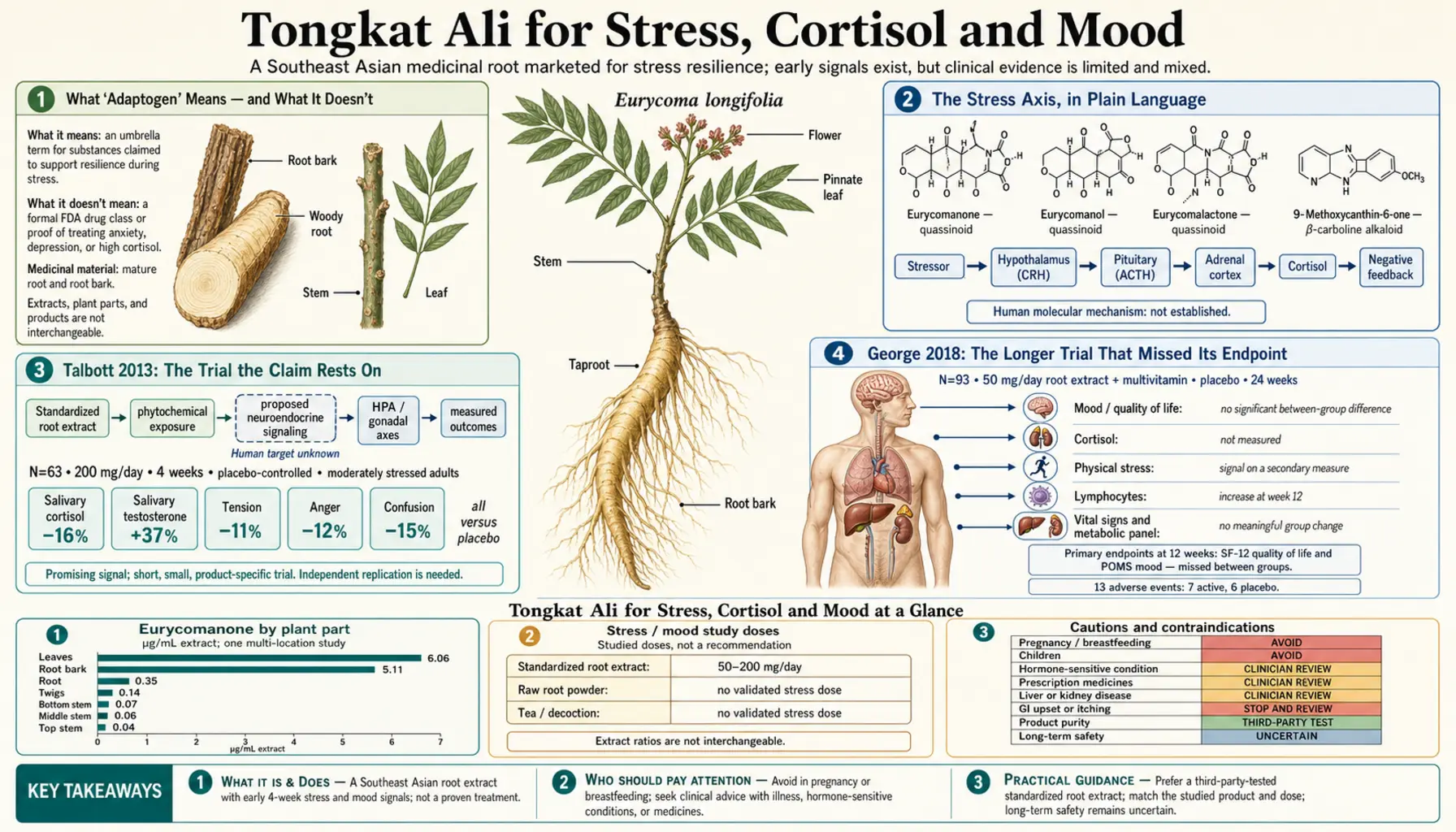
The stress claim is the quieter half of tongkat ali's reputation, and in some ways it is the more interesting one. If the herb does anything at all in humans, the stress axis is a plausible place for it to be acting — and if it acts there, the testosterone findings might be a downstream consequence rather than a separate benefit.
But the evidence base here is thinner than for testosterone, not thicker. There is essentially one placebo-controlled trial with cortisol as a headline outcome, one longer trial of a combination product that missed its primary endpoint, cortisol as a secondary measure in a larger hormone study, and a registered trial in women that has published its protocol but whose results are not in hand. That is what exists. Everything else you will read on this subject is extrapolation from it.
Table of Contents
- What “Adaptogen” Means — and What It Doesn't
- The Stress Axis, in Plain Language
- Talbott 2013: The Trial the Claim Rests On
- George 2018: The Longer Trial That Missed Its Endpoint
- Cortisol in the Larger Hormone Trial
- Fatigue, Vigour and Quality of Life
- Women: One Protocol, No Results Yet
- The Animal Anxiolytic Work
- Putting the Four Studies Together
- What Actually Lowers Chronic Stress
- If You Are Going to Try It
- Cautions and Contraindications
- Key Research Papers
- Connections
What “Adaptogen” Means — and What It Doesn't
Tongkat ali is routinely called an adaptogen. The word deserves unpacking, because it does a lot of work in marketing and very little in medicine.
The origin. “Adaptogen” was coined in the Soviet Union in the mid-twentieth century by the pharmacologist Nikolai Lazarev and developed by Israel Brekhman, initially to describe substances — principally Eleutherococcus and Panax ginseng — that were claimed to increase non-specific resistance to physical, chemical and biological stressors while being essentially non-toxic and not distorting normal physiology. It was a research programme with a definition, not a marketing word.
What it is not. It is not a recognised pharmacological class in the way that beta-blockers or SSRIs are. There is no regulatory definition, no required demonstration, and no threshold a plant must clear to be called one. In practice, in an English-language supplement listing, “adaptogen” usually means “we are claiming a stress benefit without making a medical claim we would have to substantiate”.
Why this matters for tongkat ali specifically. The traditional Malay use of the root was as a broad tonic — for fever, dysentery, malaria, wounds, weakness and general unwellness — not as a stress remedy in the modern psychological sense. Calling it an adaptogen imports a twentieth-century Soviet research category onto a Southeast Asian folk medicine and then imports the resulting phrase into a wellness market. That is three translations away from anything anyone measured.
So read the word as a flag that a stress claim is being made, and then go and look at whether it was tested. For tongkat ali, unusually, it was — a little.
The Stress Axis, in Plain Language
The mechanism story here is about the hypothalamic–pituitary–adrenal axis, usually shortened to HPA axis. It works like a chain of command.
- The hypothalamus, deep in the brain, senses a threat — physical, psychological, or simply the sustained low-grade pressure of a difficult year — and releases corticotropin-releasing hormone.
- That signals the pituitary to release adrenocorticotropic hormone (ACTH) into the bloodstream.
- ACTH reaches the adrenal glands above the kidneys, which release cortisol.
- Cortisol raises blood glucose, mobilises fuel, suppresses non-urgent functions such as digestion, reproduction and parts of the immune response, and sharpens attention. It also feeds back to the hypothalamus and pituitary to switch the signal off — a thermostat.
Acutely, this is a good system. It is what gets you through an emergency. The problem is chronic activation: when the threat never resolves, cortisol stays elevated and the “suppress non-urgent functions” part stops being a temporary trade-off. Sustained cortisol elevation is associated with disturbed sleep, abdominal fat deposition, impaired glucose handling, and suppression of gonadal function — which is the link back to testosterone.
That link is not speculative. Chronic stress lowers testosterone in men through several routes: reduced gonadotropin-releasing hormone pulsatility, direct effects of glucocorticoids on Leydig cells, and the sleep disruption that accompanies it. Roughly half of daily testosterone release happens during sleep, and sleep restriction alone measurably lowers it.
So the proposal for tongkat ali is: if the extract damps the HPA axis and lowers cortisol, the gonadal axis is released from suppression and testosterone drifts up on its own. That single mechanism would explain both the hormone findings and the mood findings, and it would explain why the effects are largest in older, stressed and hypogonadal men rather than in healthy young ones.
It is an elegant hypothesis. It has not been demonstrated.
Talbott 2013: The Trial the Claim Rests On
This is the study behind essentially every stress claim made for tongkat ali, so it is worth reading in full detail.
Design. A placebo-controlled supplementation study published in the Journal of the International Society of Sports Nutrition. Participants: 63 adults — 32 men and 31 women — screened for moderate stress. Intervention: a standardised hot-water extract of tongkat ali root, or placebo, for four weeks. Outcomes: salivary cortisol and testosterone, and mood assessed by a standard mood-state inventory.
Results. Significant improvements in the treated group on three mood subscales: Tension −11%, Anger −12%, Confusion −15%. The stress hormone profile improved, with salivary cortisol down 16% and salivary testosterone up 37%.
What is genuinely good about this trial. Two things, and they are not trivial. First, it recruited people who were actually stressed rather than healthy volunteers with nothing to improve — a screening step that many supplement trials skip, and one that makes a detectable effect more likely if an effect exists. Second, it measured a hormone and a symptom together, which is how you find out whether a biochemical change means anything to a person.
What limits it.
- 63 participants over four weeks is a small, short study. It is a pilot-scale result.
- It has never been independently replicated. More than a decade later, it is still the only trial with cortisol as a headline outcome.
- Salivary rather than serum measurement. Salivary cortisol is a legitimate and widely used measure, but it is sensitive to timing, and cortisol follows a steep daily curve — highest shortly after waking, lowest late at night. A percentage change is only interpretable if sampling times were tightly controlled.
- Author affiliations. The lead author's affiliation is a supplement-industry consultancy, and a co-author is affiliated with the Malaysian manufacturer of the extract. As with the rest of this literature, that is disclosed rather than concealed, and it is a reason to want replication rather than a reason to discard the data.
Verdict: a promising, well-conceived, small, unreplicated trial. It is enough to justify a larger study. It is not enough to justify the confident language used in advertising.
George 2018: The Longer Trial That Missed Its Endpoint
This trial is much less often quoted, which is itself informative — because it is longer, larger and registered, and its primary result was negative.
Design. Randomised, double-blind, placebo-controlled, parallel-group, 24 weeks — by far the longest stress-focused study of this herb. Registered on ClinicalTrials.gov. Participants: 93 moderately stressed healthy adults aged 25–65. Intervention: the Physta water extract combined with multivitamins, versus placebo. Primary endpoints: quality of life (SF-12) and mood (Profile of Mood States). Secondary endpoint: stress, by a multi-modal stress questionnaire. Funding: a Malaysian government NKEA research grant; one author is a manufacturer employee, disclosed.
The headline result, in the authors' own words: “there were no significant between-group differences”.
What the paper reports instead are within-group improvements in the active arm — emotional role limitation, mental component score, emotional well-being, social functioning and vitality at week 12 — plus a 15% decrease in a physical-stress domain versus 0.7% on placebo, an increasing trend in the vigour subscale, and two isolated between-group findings that emerged only after the participants were split by age band (social functioning in the 25–45 group, vigour in the 46–65 group).
Why that is a negative trial. Within-group change — “people got better while taking it” — is precisely what a placebo group exists to interpret. Placebo arms in stress and mood trials improve substantially, because participants are being attended to, measured regularly, and are in a study they hope will help. If the active group improved and the placebo group improved and the difference between them was not significant, the trial did not demonstrate an effect. Age-subgroup findings discovered after the primary analysis fails are hypothesis-generating at best; with enough subgroups, something always reaches significance.
And the design cannot isolate the herb anyway. The product contained tongkat ali and a multivitamin. Even had the primary endpoint been met, no result could have been attributed to the root.
One finding worth carrying forward. Lymphocyte counts rose significantly in the active group. That is a small piece of clinical support for the laboratory reports of immunostimulant activity — and it is the reason the cautions section below tells people on immunosuppressants to avoid this herb.
Cortisol in the Larger Hormone Trial
The 105-man, 12-week placebo-controlled trial discussed in detail in the testosterone article measured cortisol as one of its secondary endpoints, in men aged 50–70 with testosterone below 300 ng/dL.
What it found: cortisol decreased significantly in the 200 mg group. The 100 mg group did not show the same effect. Fatigue Severity Scale scores improved significantly both within and between groups at all time points.
How much weight it carries. This is a secondary endpoint in a trial designed around testosterone, in a population selected for low testosterone rather than for stress. The dose-dependence — effect at 200 mg, none at 100 mg — is the kind of pattern that makes a finding more credible rather than less, because a real pharmacological effect should scale with dose. Against that, it is a single secondary outcome among many measured in a manufacturer-funded trial.
Taken with Talbott 2013, it is the second independent dataset pointing the same direction on cortisol. Two is better than one. It is still two.
Fatigue, Vigour and Quality of Life
Fatigue is the outcome where the tongkat ali literature is most internally consistent, and it may be the most honest way to describe what people actually report.
- The 105-man trial found significant improvements in Fatigue Severity Scale scores at every time point, both within and between groups — a rare between-group finding in this literature.
- The same trial found significant improvement in Ageing Male Symptoms scores, a scale that is heavily weighted toward energy, mood, sleep and drive rather than sexual function alone.
- The 24-week combination trial found an increasing trend in the vigour subscale.
- The four-week stress trial found improvements in tension, anger and confusion — all fatigue-adjacent affective states.
The honest framing: the subjective outcomes that move are energy, drive and irritability. Those are also the outcomes most responsive to placebo, most affected by expectation, and most likely to improve simply because someone enrolled in a study and started paying attention to their health. The one trial where a fatigue measure separated from placebo between groups is the strongest evidence in this section, and it comes from the manufacturer-funded study.
If you are going to try tongkat ali for anything on the strength of the current literature, fatigue and general well-being are the most defensible targets — not because the evidence is strong, but because that is where it is least weak.
Women: One Protocol, No Results Yet
Tongkat ali has an aggressively male marketing identity, which makes the direction of recent research notable. In 2023 a Malaysian group published a protocol in BMJ Open for a randomised, double-blind, placebo-controlled, parallel-group trial of the Physta water extract in perimenopausal and postmenopausal women.
The planned design: 150 women aged 40–55 scoring above 61 on the Menopause-Specific Quality of Life questionnaire, randomised to Physta 50 mg, Physta 100 mg or placebo for 12 weeks, with mood, quality of life, fatigue, sleep quality, sexual function and pain as outcomes.
What a protocol is and is not. Publishing a protocol before results is good scientific practice — it commits the investigators to a primary endpoint and analysis plan in advance, which makes it much harder to fish for a positive finding afterwards. But a protocol contains no results. It is a statement of intent. Anyone citing this paper as evidence that tongkat ali helps menopausal symptoms is citing a plan as though it were a finding.
Note also the doses: 50 and 100 mg, considerably lower than the 200–400 mg used in the male trials.
The only other human data in women comes from the uncontrolled senior pilot — 12 physically active women aged 57–72 taking 400 mg for five weeks, with no placebo group — in which free testosterone and handgrip strength rose. Twelve women, five weeks, no control. That is a pilot, and the authors called it one.
The Animal Anxiolytic Work
Before any human stress trial existed, Ang and Cheang published work in 1999 in the Japanese Journal of Pharmacology on the anxiolytic activity of Eurycoma longifolia root in mice, using standard behavioural models.
How to read this. Rodent anxiety models — elevated plus maze, open field and similar — measure how willing a mouse is to enter an exposed space. They are useful screening tools and they identified most of the drug classes we now use for anxiety. They are also notoriously poor at predicting which novel compounds will work in humans; the translational failure rate from positive rodent anxiolytic screens to effective human treatments is very high.
So this study is a legitimate historical reason to have gone looking in humans. It is not evidence about humans, and a quarter-century later the human evidence remains one four-week trial.
Putting the Four Studies Together
| Study | n | Duration | Design | Result on stress/mood |
|---|---|---|---|---|
| Talbott 2013 | 63 | 4 weeks | Placebo-controlled | Positive — cortisol −16%, mood subscales improved |
| George 2018 | 93 | 24 weeks | RCT, herb + multivitamin | Negative on primary endpoints; within-group changes only |
| Chinnappan 2021 | 105 | 12 weeks | RCT, cortisol secondary | Positive at 200 mg; fatigue improved between groups |
| Muniandy 2023 | 150 planned | 12 weeks | RCT protocol, women | No results yet |
The fair summary: two positive signals on cortisol, one negative trial on mood and quality of life, and one study still running. Two of the three completed trials were funded or co-authored by the extract's manufacturer. Nothing here has been independently replicated. Total participants across all completed stress-relevant trials: fewer than 270 people.
That is a slender base. It is also more than most stress supplements have, which is a statement about the market rather than about tongkat ali.
What Actually Lowers Chronic Stress
It would be dishonest to spend this many words on a herb without naming the interventions that have far better evidence. If chronic stress is your actual problem, these are what work:
- Sleep. Not a lifestyle nicety — the single most powerful lever on both cortisol and testosterone. Sleep restriction measurably raises evening cortisol and lowers testosterone in healthy young men within a week. If you are sleeping five hours and taking a supplement to fix your hormones, the supplement is not the variable.
- Exercise, especially regular aerobic and resistance training. The six-month trial discussed elsewhere on this site is instructive precisely because the training arm did most of the work.
- Cognitive behavioural therapy and structured stress-management programmes. These have a trial literature measured in tens of thousands of participants, not dozens.
- Alcohol reduction. Alcohol disrupts sleep architecture, raises cortisol and lowers testosterone. It is also the most common thing stressed people increase.
- Treating the underlying medical cause. Obstructive sleep apnoea, thyroid disease, depression and anaemia all present as “stress and fatigue” and all have specific treatments.
A herb with one small positive trial can reasonably sit alongside those. It is a poor substitute for any of them.
If You Are Going to Try It
- Form: a standardised water extract, which is what every trial used. Root powder and alcohol tinctures are different products with no stress data.
- Dose: the two studies with positive cortisol findings used a standardised hot-water extract, with the dose-responsive signal appearing at 200 mg/day and not at 100 mg. There is no evidence that going above 200–400 mg helps.
- Timing: morning. Insomnia and restlessness are the most commonly reported side effects, and a supplement taken for stress that costs you sleep is a net loss.
- Duration: a defined block of 8–12 weeks. The positive trials ran 4 and 12 weeks; the 24-week trial did not beat placebo.
- Measure something. Use a free validated scale — the Perceived Stress Scale takes two minutes — at the start and end. Track sleep hours alongside it. Without a baseline you cannot distinguish a herb from a good month.
- Sourcing: non-negotiable. See the product quality article. Mercury and lead above legal limits have been documented repeatedly in this product category.
Cautions and Contraindications
Immunosuppressant therapy — the interaction most relevant to this article. Immunostimulant activity has been reported for Eurycoma constituents in laboratory work, and the 24-week human trial found a significant rise in lymphocyte count in the active group. If you take immunosuppressive medication after a transplant or for an autoimmune disease, avoid this herb. A substance that may push the immune system in the opposite direction to your prescription is not worth the uncertainty, and the prescription is doing something you need.
Do not use it to self-treat a mood disorder. Persistent low mood, loss of interest, hopelessness, disturbed sleep and appetite change lasting more than two weeks describe depression, which is a diagnosable and treatable condition with effective therapies. A four-week trial reporting an 11% change in a tension subscale is not a treatment for depression. If you have thoughts of harming yourself, contact emergency services or a crisis line rather than a supplement shelf.
Do not stop prescribed psychiatric medication to try a herb. Abrupt discontinuation of antidepressants, anxiolytics or mood stabilisers can cause discontinuation syndromes and relapse. Any change belongs with the prescriber.
Hormone-sensitive conditions. Because this herb is hormone-active, men with prostate cancer, a history of it, a rising PSA or symptomatic benign prostatic hyperplasia should not take it without urological involvement. Both oestrogenic and anti-oestrogenic activities have been reported for its constituents in laboratory work, so women with hormone-sensitive breast or uterine conditions should avoid it — a point that matters given the menopause trial now under way.
Pregnancy and breastfeeding. Avoid entirely. Quassinoids are biologically active with reported effects on reproductive tissue in animals, human safety in pregnancy is unstudied, and the documented contamination risk is disqualifying on its own.
Children and adolescents. Avoid. No safety data.
Drug interactions. Formal human interaction studies are lacking. Caution with anticoagulants and antiplatelet drugs, antidiabetic drugs, antihypertensives, and propranolol (reduced absorption reported). Products adulterated with sildenafil analogues would interact dangerously with nitrates.
Liver. Animal toxicity studies at ordinary doses have generally been reassuring, but a 2024 case report describes liver injury attributed to a tongkat ali product. Stop and seek medical advice for dark urine, pale stools, upper-right abdominal pain or yellowing of the eyes or skin.
Reported side effects. Insomnia and restlessness, irritability, gastrointestinal upset; some users report increased body odour. Adverse events in trials were generally mild and comparable to placebo.
Key Research Papers
Every identifier below was verified live against NCBI E-utilities — first author, title, journal and year all matched before the PMID was printed.
Human stress, mood and quality-of-life trials
- Talbott SM, Talbott JA, George A, Pugh M. Effect of Tongkat Ali on stress hormones and psychological mood state in moderately stressed subjects. Journal of the International Society of Sports Nutrition. 2013;10(1):28. n=63, 4 weeks; cortisol −16%, testosterone +37% (salivary).
- George A, Udani J, Abidin NZ, Yusof A. Efficacy and safety of Eurycoma longifolia (Physta) water extract plus multivitamins on quality of life, mood and stress: a randomized placebo-controlled and parallel study. Food and Nutrition Research. 2018;62. n=93, 24 weeks; no significant between-group differences.
- Chinnappan SM, George A, Pandey P, et al. Effect of Eurycoma longifolia standardised aqueous root extract–Physta on testosterone levels and quality of life in ageing male subjects: a randomised, double-blind, placebo-controlled multicentre study. Food and Nutrition Research. 2021;65. Cortisol fell at 200 mg; fatigue improved between groups.
- Muniandy S, Yahya HM, Shahar S, et al. Effects of Eurycoma longifolia Jack standardised water extract (Physta) on well-being of perimenopausal and postmenopausal women: protocol for a randomised, double-blinded, placebo-controlled, parallel group study. BMJ Open. 2023;13(11):e073323. Protocol only — no results.
- Henkel RR, Wang R, Bassett SH, et al. Tongkat Ali as a potential herbal supplement for physically active male and female seniors — a pilot study. Phytotherapy Research. 2014;28(4):544–550. 13 men, 12 women, 5 weeks, uncontrolled.
Animal and mechanistic work
- Ang HH, Cheang HS. Studies on the anxiolytic activity of Eurycoma longifolia Jack roots in mice. Japanese Journal of Pharmacology. 1999;79(4):497–500. Animal study.
- George A, Henkel R. Phytoandrogenic properties of Eurycoma longifolia as natural alternative to testosterone replacement therapy. Andrologia. 2014;46(7):708–721. Review of the proposed HPA/HPG mechanisms.
- Rehman SU, Choe K, Yoo HH. Review on a traditional herbal medicine, Eurycoma longifolia Jack (Tongkat Ali): its traditional uses, chemistry, evidence-based pharmacology and toxicology. Molecules. 2016;21(3):331.
Safety
- Ahmad N, Teh BP, Halim SZ, et al. Eurycoma longifolia-infused coffee — an oral toxicity study. Nutrients. 2020;12(10):3125. Animal toxicology.
- Teh BP, Ahmad N, Ibnu Rasid EN, et al. Herbal-based formulation containing Eurycoma longifolia and Labisia pumila aqueous extracts: safe for consumption? Pharmaceuticals (Basel). 2021;14(2):142.
- Kaliounji A, Shadid G, Saba H, Ahlawat S. A rare case of Tongkat Ali-induced liver injury: a case report. Cureus. 2024;16(3):e56639.
Live PubMed Searches
- Eurycoma longifolia and cortisol
- Eurycoma longifolia, mood and stress
- Adaptogens — definition and evidence
- HPA axis and chronic stress
- Cortisol suppression of testosterone
- Sleep restriction and testosterone
- Salivary cortisol measurement
- Placebo response in stress trials
- Eurycoma longifolia in women
- Eurycoma longifolia and immune effects
Connections
- All Herbs
- Tongkat Ali Benefits — the hub, with the full evidence map.
- Tongkat Ali (Eurycoma longifolia) — botany, traditional use, compounds, forms and dosage.
- Testosterone and Male Fertility — the hormone findings the cortisol story may explain.
- Product Quality, Contamination and Adulteration — read before buying anything.
- Exercise Performance and Body Composition
- Ashwagandha — the Ayurvedic adaptogen with the larger cortisol trial literature; the closest comparator.
- Ginseng — the plant the adaptogen concept was originally built around.
- Maca — another energy-and-mood root with human trials.
- Kacip Fatimah (Labisia pumila) — Malaysia's women's-health counterpart, often co-formulated.