Peppermint for Respiratory & Cough
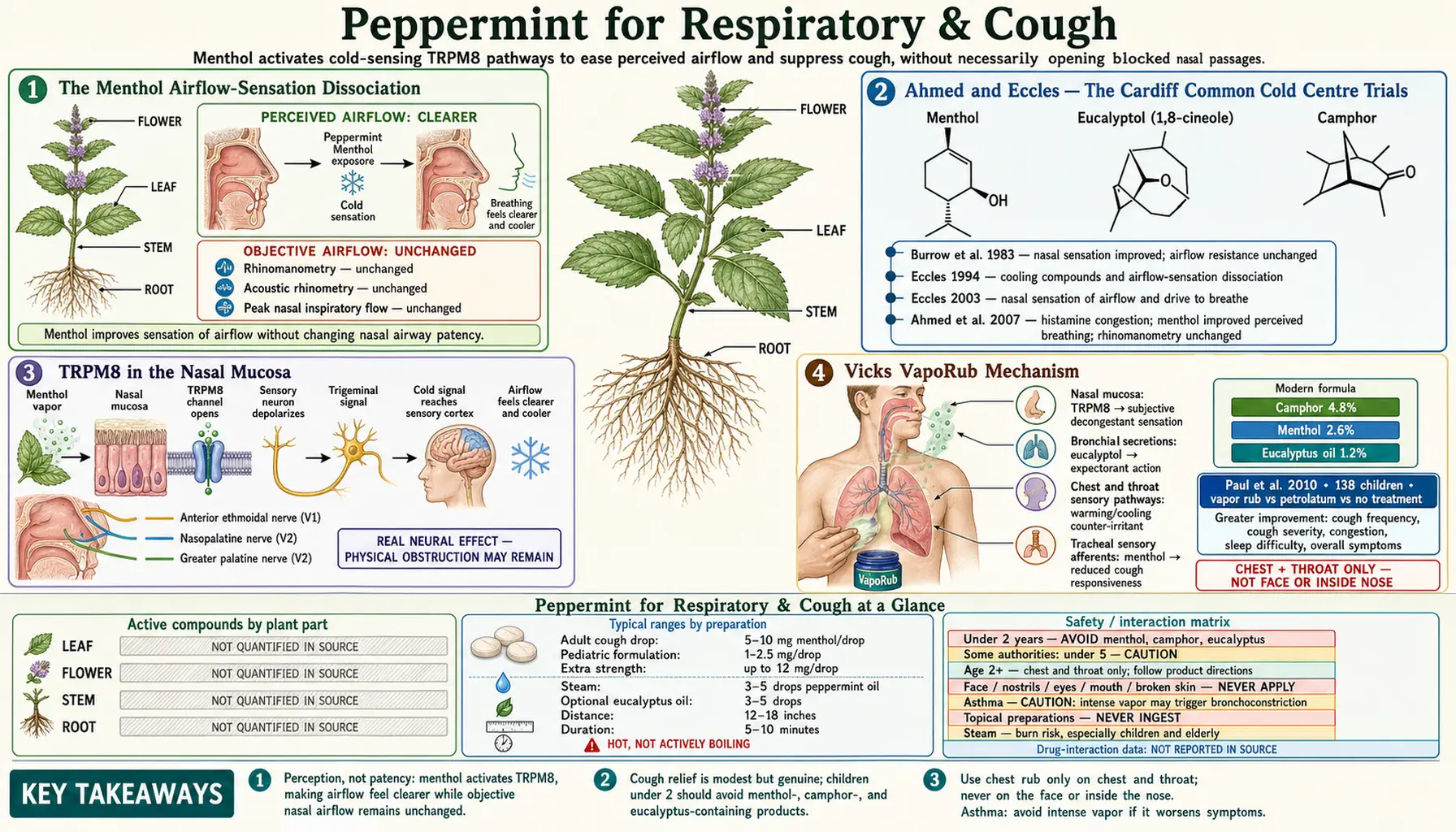
Peppermint and its dominant constituent menthol are the active components of essentially every over-the-counter decongestant rub, cough drop, and steam-inhalation preparation sold globally. The mechanism is paradoxical and instructive: menthol activates the TRPM8 cold-sensing receptor on intranasal sensory neurons, producing a subjective sensation of clearer airflow without actually changing the cross-sectional area of the nasal passages or the objective resistance to airflow. Ronald Eccles at the Common Cold Centre, Cardiff (the world's only research center dedicated to cold and influenza), and Ashfaque Ahmed at the same group published the definitive evidence for this dissociation in the 2000s: menthol reliably reduces patient-reported nasal congestion while spirometry, rhinomanometry, and acoustic rhinometry show no measurable change in airflow. This sounds like a placebo, but it is not — the cold receptor activation produces a genuine afferent signal that the brain interprets as "clear air," and the symptomatic relief is real and reproducible even when the physical obstruction is unchanged. Combined with menthol's genuine antitussive (cough-suppressant) activity through the same TRPM8 mechanism on tracheal sensory neurons, this explains the dominance of menthol-based preparations in OTC respiratory care. This page covers the Ahmed/Eccles dissociation studies, the Vicks VapoRub mechanism, traditional steam inhalation, antitussive activity, and the critical caution against menthol use in infants and very young children.
Table of Contents
- The Menthol Airflow-Sensation Dissociation
- Ahmed and Eccles — The Cardiff Common Cold Centre Trials
- TRPM8 in the Nasal Mucosa
- Vicks VapoRub Mechanism
- Traditional Steam Inhalation
- Antitussive (Cough Suppression) Activity
- Chest Rubs and Pediatric Use
- Cough Drops and Lozenges
- Combination with Eucalyptus and Camphor
- Asthma and Bronchospasm Considerations
- Critical Infant and Young Child Safety
- Key Research Papers
- Connections
- Featured Videos
The Menthol Airflow-Sensation Dissociation
The single most important fact about menthol in respiratory care is that it makes nasal congestion feel better without actually opening the airway. This dissociation between subjective relief and objective airflow has been documented repeatedly across multiple research groups using multiple measurement modalities — rhinomanometry (direct measurement of nasal airflow resistance), acoustic rhinometry (sound-wave measurement of nasal cross-sectional area), and peak nasal inspiratory flow.
The pattern is consistent:
- Patients with naturally occurring or experimentally induced nasal congestion report a clear, immediate, dose-dependent improvement in their sense of nasal airflow after menthol exposure (inhaled vapor, nasal stick, peppermint candy)
- Simultaneous objective measurement of the same patients' nasal airflow shows no change — rhinomanometry remains unchanged, the nasal cavity cross-section remains unchanged, and the actual volume of air moving through the nose per unit time does not increase
- The subjective effect is real (it is not a placebo by the strict definition — it is a real neural effect that is reproducible and dose-dependent) but the objective effect is absent
- Patients prefer menthol-treated air to plain air at indistinguishable physical concentrations, and rate the menthol-treated air as "easier to breathe"
This is the central finding that distinguishes menthol from actual nasal decongestants like pseudoephedrine or oxymetazoline, which work by alpha-1 adrenergic vasoconstriction of nasal mucosal vasculature, physically reducing the swelling and opening the airway. Pseudoephedrine produces both subjective relief and measurable objective improvement in nasal airflow. Menthol produces only subjective relief.
From the patient's perspective, this distinction may not matter much — the symptomatic relief is what they want, and menthol provides it. But the distinction matters for understanding what menthol can and cannot do. Menthol cannot resolve a structural problem like a deviated septum, severe polyposis, or significant mucosal swelling from a sinus infection. It can make any of those feel less bothersome through its central cold-signal effect, but it cannot fix the underlying obstruction.
Ahmed and Eccles — The Cardiff Common Cold Centre Trials
Ronald Eccles and his group at the Common Cold Centre, Cardiff University — the world's only research center dedicated specifically to the rhinology and treatment of common cold and influenza — have produced the bulk of the rigorous mechanistic work on menthol in respiratory symptoms. The key papers:
- Eccles R (1994), "Menthol and related cooling compounds." A foundational review establishing the TRPM8 mechanism and the airflow-sensation dissociation.
- Eccles R (2003), "Menthol: effects on nasal sensation of airflow and the drive to breathe." The definitive review of the menthol-and-airflow literature, summarizing the consistent dissociation between subjective and objective findings.
- Ahmed A et al. (2007), the trial that produced the most-cited single demonstration of the subjective-objective dissociation. Patients with experimentally induced nasal congestion (histamine challenge) were randomized to inhaled menthol vapor or matched placebo. Subjective sense of clearer breathing was significantly greater with menthol; objective nasal airflow measured by rhinomanometry was unchanged.
- Burrow A et al. (1983), the much-earlier study that first demonstrated the same dissociation using different methods and a smaller sample, providing temporal validation that this finding is robust across two decades and multiple research groups.
The Cardiff group has also done substantial work on menthol's effects on cough reflex sensitivity (next section), bronchodilation, and the role of the trigeminal nerve in respiratory sensation. The unifying theme of this body of work is that the sense of breathing is generated centrally from a complex of inputs — chemoreceptors monitoring blood gases, mechanoreceptors in the chest wall, and intranasal/intratracheal sensory neurons — and modifying any one of those inputs (in menthol's case, the intranasal TRPM8-positive neurons) can shift the subjective experience without changing the underlying physiology.
TRPM8 in the Nasal Mucosa
The molecular target for menthol in the nasal cavity is the same TRPM8 (transient receptor potential cation channel subfamily M member 8) that mediates the cooling sensation on skin. TRPM8 is expressed on a subset of trigeminal sensory neurons that innervate the nasal mucosa — specifically the branches of:
- The anterior ethmoidal nerve (a branch of V1 ophthalmic), supplying the anterior superior nasal mucosa
- The nasopalatine nerve (a branch of V2 maxillary), supplying the nasal septum
- The greater palatine nerve (V2), supplying portions of the lateral nasal wall
When menthol vapor reaches these neurons (either through inhalation of menthol-containing air or through topical contact via nasal sticks and rubs), TRPM8 channels open, the neurons depolarize, and the trigeminal sensory cortex receives a signal interpreted as cold. The brain's integration of this cold signal with the existing breath sensation produces the perception of clearer, cooler, more refreshing airflow.
This is the same fundamental mechanism as menthol's effect on skin cooling, oral cavity cooling (mint candy, toothpaste), and the topical headache relief discussed on our Headache Relief page. The receptor is the same; the location is different; the perceptual outcome is different.
Vicks VapoRub Mechanism
Vicks VapoRub — the petroleum-jelly-based chest rub first marketed by Lunsford Richardson in North Carolina in 1905 and continuously sold worldwide since — is the prototypical menthol-based respiratory remedy. The active ingredients in the modern formulation:
- Camphor 4.8% — TRPM8 activator (cooling) and TRPV1 activator (warming), plus mild local anesthetic effects
- Menthol 2.6% — the primary TRPM8 activator and the source of the characteristic cooling/airflow sensation
- Eucalyptus oil 1.2% — primarily eucalyptol (1,8-cineole), which has additional expectorant and mild antimicrobial properties
- Petrolatum base — provides a semisolid carrier that slowly releases the volatile actives through body-temperature vaporization
The intended use is application to the chest and throat (NOT the face or inside the nose). Body heat vaporizes the active components, the vapors rise into the breathing zone, and the menthol/camphor/eucalyptus mixture is inhaled along with normal breathing. The TRPM8 activation in the nasal mucosa produces the subjective decongestant effect, the eucalyptol provides some genuine expectorant action, and the warming/cooling sensation in the chest produces a counter-irritant effect that may distract from chest tightness and cough urge.
The Paul 2010 trial published in Pediatrics compared vapor rub, petrolatum alone, and no treatment in 138 children with upper respiratory infection symptoms. Vapor rub produced significantly greater improvement in cough frequency, cough severity, congestion, sleep difficulty, and overall symptom rating than either control. This is one of the few rigorous controlled trials of any OTC cough remedy in children showing benefit, and supports the continued use of vapor rubs in school-age children. (Cautions for infants are discussed below.)
Traditional Steam Inhalation
Steam inhalation with added peppermint or menthol is a traditional remedy with documented benefit for upper respiratory symptoms. The mechanism combines:
- Heat and humidity — warm humid air directly hydrates the respiratory mucosa, thins mucus secretions, and may transiently relieve some congestion through vasodilation
- Menthol vapor — TRPM8 activation in the nasal cavity provides the subjective airflow improvement
- Eucalyptol from added eucalyptus oil (if used) — mild expectorant and antimicrobial effects
- Bronchodilation — mild bronchodilator effect from the warm humid air, with possible additional contribution from menthol on bronchial smooth muscle
Practical protocol: bring a bowl or large pot of water to a boil, remove from heat, add 3-5 drops of peppermint essential oil (and optionally 3-5 drops of eucalyptus oil), drape a large towel over the head to capture the steam, lean over the bowl at a comfortable distance (typically 12-18 inches), and breathe through the nose for 5-10 minutes. The water should be hot but not actively boiling at the time of inhalation — burns from boiling water in a steam-inhalation setup are a significant injury risk, especially in children and the elderly.
Steam inhalation is one of the few interventions with reasonable evidence for cold and rhinosinusitis symptoms. A 2017 Cochrane review of heated humidified air for the common cold found inconsistent results — some trials showed clear symptom benefit, others showed minimal effect — suggesting individual variation in response. The addition of menthol/peppermint may improve consistency by adding the TRPM8 subjective-airflow component.
For more detailed coverage of sinusitis treatment options, see our Sinusitis page.
Antitussive (Cough Suppression) Activity
Beyond the subjective decongestant effect, menthol has genuine antitussive (cough-suppressant) activity. Cough is a protective reflex initiated by activation of sensory C-fibers and rapidly adapting receptors in the trachea, larynx, and large bronchi. These afferents project through the vagus nerve to the nucleus tractus solitarius in the brainstem, where the cough reflex is coordinated.
Menthol affects cough through several mechanisms:
- TRPM8 activation on tracheal sensory afferents — reduces the responsiveness of cough-initiating sensory neurons to triggering stimuli
- Central effects via trigeminal afferents — inhaled menthol activates trigeminal cold receptors that send afferent signals to the brainstem; these signals modulate the cough-coordinating circuits in the nucleus tractus solitarius
- Mild bronchodilation — menthol produces a small bronchodilator effect through unclear mechanisms (possibly TRPM8-mediated relaxation of bronchial smooth muscle)
- Counter-irritant effect — the cooling sensation in the throat may distract from the cough urge, similar to the headache counter-irritant mechanism
Clinical evidence: the Plevkova 2013 trial showed that inhaled menthol vapor reduced cough frequency and cough sensitivity to citric acid challenge in healthy adults. The Kenia 2008 trial showed menthol inhalation increased ventilation and reduced inspiratory drive in healthy adults, suggesting modulation of respiratory sensation. Multiple older trials of menthol-containing cough drops and lozenges have shown reduced cough frequency compared to placebo lozenges.
The antitussive effect is modest compared to pharmaceutical cough suppressants like dextromethorphan or codeine, but it is reliable, low-risk, and adds to the subjective comfort of common cold and acute bronchitis symptoms.
Chest Rubs and Pediatric Use
Menthol-containing chest rubs (Vicks VapoRub and equivalents) have a longer continuous-use history in children than almost any other OTC respiratory remedy, but the safety profile depends critically on age and application location.
For children 2 years and older, application to the chest and throat at standard product directions is generally considered safe and is supported by the Paul 2010 randomized trial showing benefit on cough, congestion, and sleep difficulty. The rubs should not be applied to:
- The face or inside the nostrils (irritation, possible aspiration of vapor)
- Broken or irritated skin (chemical irritation)
- The eyes or near the eyes (severe irritation)
- The mouth (oral toxicity from camphor at higher doses)
For children under 2 years old, the consensus pediatric guidance is to avoid menthol-containing products entirely. The American Academy of Pediatrics and the FDA have advised against menthol, camphor, and eucalyptus exposure in infants under 2 due to reports of paradoxical mucus hypersecretion, laryngospasm, and rare respiratory failure. This caution is detailed in the dedicated infant safety section below.
Cough Drops and Lozenges
Menthol cough drops (Hall's, Ricola, Luden's, Vicks, store brands) are among the most widely used OTC respiratory products globally. The mechanism for cough drops combines:
- Oromucosal menthol delivery — menthol is released as the lozenge dissolves, providing sustained low-dose oral and pharyngeal exposure
- Increased salivation — sucking on the lozenge stimulates saliva production, which lubricates the throat and reduces the sensation of dryness that can trigger cough
- Throat coating — the sugar, glycerin, or other base ingredients in the lozenge form a thin film that physically coats and soothes irritated pharyngeal tissue
- Distraction — the act of sucking on the lozenge is itself a behavioral counter to the cough impulse
Standard adult cough drops contain 5-10 mg of menthol per drop. Pediatric formulations typically contain 1-2.5 mg. Higher-potency "extra strength" cough drops (Hall's Mentho-Lyptus) may contain up to 12 mg per drop. These doses are well below the threshold for systemic adverse effects in adults.
For a sore throat without significant cough, plain menthol cough drops are generally as effective as more expensive pharmacological lozenges containing benzocaine or dyclonine. The throat-soothing benefit comes mostly from the lozenge mechanics rather than from any specific active ingredient at typical OTC doses.
Combination with Eucalyptus and Camphor
Peppermint/menthol is commonly combined with eucalyptus and camphor in respiratory preparations because the three actives produce complementary effects:
- Menthol (from peppermint or as isolated compound): primary TRPM8 cold-receptor activator; subjective airflow improvement; antitussive activity
- Eucalyptol (1,8-cineole, the main component of eucalyptus oil): genuine expectorant action through stimulation of bronchial secretion; mild antimicrobial activity; modest anti-inflammatory effect
- Camphor: dual TRPM8 and TRPV1 activation producing simultaneous cooling and warming sensations; mild local anesthetic effect; counter-irritant chest sensation
The combination of all three produces a fuller respiratory-symptom relief profile than any single component alone. The intense cold-warmth sensation that characterizes vapor rubs is the camphor and menthol combination working through both TRPM8 (cold) and TRPV1 (warm) at the same time. Eucalyptus oil adds the actual mucus-thinning expectorant effect that menthol alone does not provide.
For more on eucalyptus specifically, see our Eucalyptus page.
Asthma and Bronchospasm Considerations
The relationship between menthol and asthma is more complex than the relationship between menthol and uncomplicated upper respiratory infection. Two competing effects exist:
- Mild bronchodilation — menthol produces a modest direct bronchodilator effect in some studies, with possible benefit for mild bronchospasm and chest tightness
- Irritant bronchoconstriction — in some asthma patients, intense menthol vapor (such as from heavily mentholated chest rubs or steam inhalation) can act as a direct airway irritant, triggering bronchoconstriction rather than relieving it
The clinical implication: asthma patients should use menthol-containing products cautiously, observe whether symptoms improve or worsen, and avoid intense vapor exposure (steam inhalation with high concentrations of essential oils, prolonged enclosed-space exposure to vapor rubs) if their asthma is sensitive to airway irritants.
Menthol cigarettes are a separate issue with significant public-health relevance. The menthol additive reduces the throat irritation of tobacco smoke, allowing deeper and more frequent inhalation, and has been independently associated with greater nicotine addiction and worse cessation outcomes. The FDA finalized a rule in 2022 to ban menthol cigarettes (implementation delayed by litigation as of this writing). The mechanism of menthol's adverse role in tobacco use is the same TRPM8-mediated "cooler smoke" sensation that makes deeper inhalation tolerable.
Critical Infant and Young Child Safety
Do not apply menthol-containing products to the face, chest, or under the nose of infants and children under 2 years of age. Some authorities extend this caution to children under 5.
The risk in young children is multifold:
- Laryngospasm — rare but documented cases of severe laryngospasm after menthol exposure to the face or oropharynx of infants. The exact mechanism is unclear but may involve hyper-responsive trigeminal-vagal reflexes in the immature airway.
- Paradoxical mucus hypersecretion — an Abanses et al. study demonstrated that vapor rub application can paradoxically increase mucus production and inflammation in the immature airways of young children, worsening rather than improving congestion.
- Camphor toxicity — the camphor that typically accompanies menthol in chest rubs is potently toxic if ingested in significant quantity. Infants and toddlers who put rubs into their mouths can ingest enough camphor to cause seizures, respiratory depression, or coma. Even seemingly small amounts can be dangerous.
- Apnea — rare reports of menthol-vapor-associated apnea in infants, particularly when products are applied directly under the nostrils
The FDA, the American Academy of Pediatrics, and Vicks VapoRub's own product labeling all carry warnings against use in children under 2 years old (under 6 years for some Asian markets). The risk-benefit balance in this age group is poor — the modest symptomatic benefits are not worth the rare but real safety risks.
For infants and young children with respiratory infection symptoms, the safe alternatives are: cool-mist humidifiers (humidify the room air without volatile oils), saline nasal drops or sprays (thin secretions without pharmacological exposure), nasal aspiration (mechanical removal of secretions), elevated head positioning during sleep, and adequate fluid intake. Pharmacological approaches in this age group should be guided by a pediatrician.
For older children and adults, the standard precautions still apply: never apply to the eyes, never apply inside the nostrils, never ingest topical preparations, and observe for skin irritation or unusual respiratory symptoms.
Key Research Papers
- Burrow A, Eccles R, Jones AS (1983). The effects of camphor, eucalyptus and menthol vapour on nasal resistance to airflow and nasal sensation. Acta Otolaryngologica. — PubMed
- Eccles R (1994). Menthol and related cooling compounds. Journal of Pharmacy and Pharmacology. — PubMed
- Eccles R (2003). Menthol: effects on nasal sensation of airflow and the drive to breathe. Current Allergy and Asthma Reports. — PubMed
- Ahmed A et al. (2007). The mechanism by which menthol affects nasal sensation of airflow and the perceived ease of breathing. Acta Otorhinolaryngologica. — PubMed
- Paul IM et al. (2010). Vapor rub, petrolatum, and no treatment for children with nocturnal cough and cold symptoms. Pediatrics. — PubMed
- Plevkova J et al. (2013). The effects of inhalation of menthol on cough reflex sensitivity in healthy adults. Physiological Research. — PubMed
- Kenia P et al. (2008). Does inhaling menthol affect nasal patency or cough? Pediatric Pulmonology. — PubMed
- Abanses JC, Arima S, Rubin BK (2009). Vicks VapoRub induces mucin secretion, decreases ciliary beat frequency, and increases tracheal mucus transport in the ferret trachea. Chest. — PubMed
- Tatar M et al. (2009). Mechanisms of inhibition of cough by menthol. Cough. — PubMed
- Wright CE et al. (1997). Cough, antitussives, and other airway diseases. Respiratory Medicine (menthol review context). — PubMed
- Buchbauer G et al. (1993). Aromatherapy: evidence for sedative effects of the essential oil of lavender after inhalation. Z Naturforsch C (peppermint comparison context). — PubMed
- FDA Public Health Advisory (2007-2008). Camphor and menthol toxicity in pediatric use. — PubMed
PubMed Topic Searches
- PubMed: Menthol nasal decongestant TRPM8
- PubMed: Peppermint respiratory inhalation
- PubMed: Vicks VapoRub children
- PubMed: Menthol antitussive
- PubMed: Infant menthol/camphor toxicity
- PubMed: Eucalyptol expectorant
Connections
- All Herbs
- Peppermint Overview
- Peppermint Benefits Hub
- Peppermint for IBS
- Peppermint for Headache
- Peppermint for Cognitive
- Eucalyptus
- Sinusitis
- Pulmonology
- Asthma
- Bronchitis
- ENT
- Thyme
- Mullein
- Steam Inhalation
- Ginger