Peppermint: History and Traditional Use
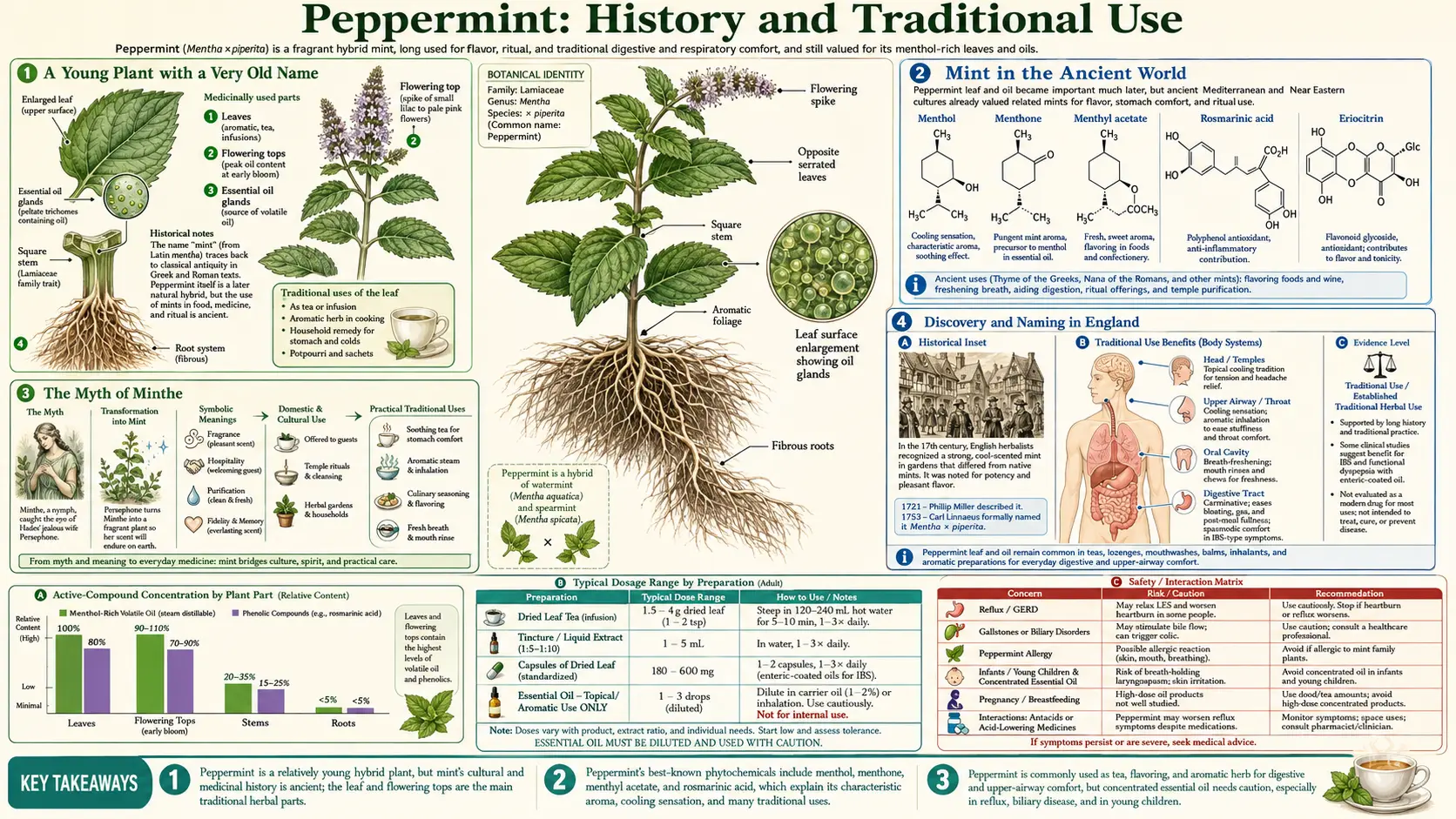
Peppermint feels ancient — the smell alone seems to carry the whole history of herbal medicine. Yet the plant we call peppermint (Mentha × piperita) is one of the younger medicinal herbs in the Western tradition: it is a sterile hybrid that was first written down in England only in the 1690s. The much older story belongs to mint in general — the wild and garden mints that Egyptians, Greeks, and Romans knew and that gave us the myth of the nymph Minthe. This page keeps those two threads honest and separate: where the record is firm history we name it plainly, and where a claim is really folklore, marketing legend, or a tradition told about “mint” rather than peppermint itself, we say so.
Table of Contents
- A Young Plant with a Very Old Name
- Mint in the Ancient World
- The Myth of Minthe
- Discovery and Naming in England
- From Mitcham to the World
- The Isolation of Menthol
- Traditional Medicinal Use
- From Tradition to Modern Research
- Research Papers and References
- Connections
- Featured Videos
A Young Plant with a Very Old Name
The single most important fact for understanding peppermint's history is also the most surprising: peppermint is a hybrid, and a young one. It is the offspring of two other mints — watermint (Mentha aquatica) and spearmint (Mentha spicata) — and because it is a hybrid it is essentially sterile, producing little or no viable seed and spreading instead by runners and cuttings. In practical terms that means nearly every peppermint plant on Earth is a clone, propagated by hand and by root from the same original stock, rather than a wild plant that grows true from seed.
This matters because it tells us peppermint cannot have an ancient pedigree as a distinct plant. The cross only becomes possible — and only gets noticed and propagated — once watermint and spearmint are growing together and someone spots the unusually pungent seedling and keeps it going. The earliest firm written record of that event comes from late-seventeenth-century England (covered below). When older sources speak of “mint” in Egypt, Greece, or Rome, they are describing wild mint, spearmint, watermint, or pennyroyal — the parent and cousin species — not the specific hybrid we now call peppermint. Careful botanical and historical writers make exactly this distinction, and so does this page.
The name itself records the plant's defining trait. The botanical epithet piperita comes from the Latin piper, “pepper,” for the sharp, peppery bite of the hybrid — hotter and more biting than the gentler spearmint — and that same sense survives in the English “pepper-mint.” So while the genus name Mentha reaches back to Greek and Roman antiquity, the species we know is, historically speaking, an early-modern newcomer wearing a classical name.
Mint in the Ancient World
Mint — meaning the wild and garden mints generally, not peppermint specifically — has a genuinely ancient documented history around the Mediterranean and Near East. The most famous early reference is the Ebers Papyrus, an Egyptian medical text usually dated to around 1550 BCE, which is widely cited as listing mint among its remedies, including for soothing the stomach and digestion. It is fair to report that mint appears in this very old record; it is not accurate to claim that “peppermint” was used in ancient Egypt, and the often-repeated story that dried peppermint leaves were “found in the pyramids” circulates mainly on commercial and marketing websites without a clear archaeological source, so we flag it as unverified folklore rather than fact.
The classical Greeks and Romans clearly knew and valued mint. The Roman naturalist Pliny the Elder, in his first-century Natural History, wrote about mint with real enthusiasm — praising its smell, recommending it at the table, and famously observing (in the standard translation) that the very smell of it alone refreshes the spirits while its taste stirs up the appetite. A tradition repeated from antiquity holds that mint was woven into garlands or crowns worn at feasts. The Greek physician and pharmacologist Dioscorides, whose first-century De Materia Medica is the foundation text of Western herbalism, likewise described mint (under its Greek names) and recommended it for digestive and other complaints. These are named here as historical primary sources; what they describe is the mint of the ancient Mediterranean, the soil from which peppermint would much later emerge.
Two themes run through all of this ancient material and never really leave the story: mint as something that settles the stomach and aids digestion, and mint as something fragrant, refreshing, and appetite-stirring. Those are precisely the uses that would later attach themselves to peppermint, the most pungent mint of all, once it appeared.
The Myth of Minthe
The best-known piece of mint folklore is a Greek myth that explains, in story form, both the plant's sweet scent and its lowly, ground-hugging habit. According to the legend, Minthe (also spelled Mintha or Menthe) was a naiad — a water nymph — associated with the underworld river Cocytus, and a lover or companion of Hades, lord of the dead. When Hades took Persephone as his queen, Minthe's jealousy (or her boast that she was the more beautiful) provoked a punishment: she was trampled and transformed into the modest, sweet-smelling herb we call mint. The story is told with variations — in some versions Persephone works the transformation, in others Demeter, Persephone's mother — and a gentler strand holds that Hades, unable to undo the deed, at least gave the crushed plant its lovely fragrance so she would be remembered every time the herb was bruised underfoot.
This is genuinely ancient material, not a modern invention: the myth is recorded by classical authors including the geographer Strabo (in his Geographica, which places a mountain and a shrine of Hades sacred to Minthe near Pylos), the poet Ovid (who alludes to the transformation in the Metamorphoses), and Oppian (in the Halieutica, which preserves the version in which Demeter destroys the nymph). It is, of course, mythology — a story about gods and a nymph, not a botanical record — but it is the reason the whole genus carries the name Mentha, and it shows how deeply mint was woven into the symbolic and everyday life of the ancient world long before peppermint existed as a distinct plant.
Discovery and Naming in England
Peppermint steps into firm, datable history in England in the 1690s. The hybrid was identified growing in Hertfordshire, and the find is associated with a Dr. Eales; the great English naturalist John Ray then published it in 1696, in the second edition of his catalogue of British plants, the Synopsis Methodica Stirpium Britannicarum. This is the moment peppermint enters the written record as a recognized, named plant — a clear, documented “first description,” in contrast to the vaguer ancient references to mint in general.
Recognition by the medical establishment followed quickly. In 1721 peppermint was admitted to the London Pharmacopoeia — the official drug list of the College of Physicians — under the name Mentha piperitis sapore (“mint with the taste of pepper”), formally marking its arrival as an accepted medicine and not merely a kitchen-garden curiosity. A generation later, in 1753, Carl Linnaeus gave the plant its enduring scientific binomial, Mentha piperita, in the second volume of his landmark Species Plantarum. Linnaeus catalogued peppermint as a species in its own right; only later did botanists establish what is now the settled view — that it is in fact a hybrid of watermint and spearmint, which is why the modern name is written with a multiplication sign as Mentha × piperita.
So within roughly sixty years — from Ray's 1696 description, through the 1721 pharmacopoeia, to Linnaeus's 1753 naming — a chance English hybrid went from an unnamed seedling to an officially recognized drug with a scientific name that is still in use today. These dates are well documented and are the backbone of peppermint's real, as opposed to legendary, history.
From Mitcham to the World
Once peppermint was recognized, the next chapter is agricultural: turning a garden plant into a commercial crop grown for its essential oil. The most celebrated early center was Mitcham, in Surrey just south of London, where commercial cultivation of peppermint and other aromatic herbs is generally dated to around the mid-eighteenth century. Mitcham became so closely identified with high-quality peppermint that “Mitcham” peppermint and its distilled oil earned a lasting reputation among apothecaries and the makers of cordials and flavorings, and the name is still used as a byword for a fine, traditional English peppermint type.
From Britain, peppermint farming crossed the Atlantic. The commercial history of peppermint in the United States is generally traced to Wayne County, New York, in the early nineteenth century, from which mint growing spread westward — into Ohio, and then notably into Michigan, where growers in the later nineteenth century found that the region's rich, dark muck soils produced excellent oil. By the early twentieth century the American Midwest, and Michigan in particular, had become a dominant force in world mint-oil production. Over the twentieth century the heart of American peppermint moved again, to the Pacific Northwest — the states of Oregon and Washington — which remain major producers today, alongside other mint-growing regions around the world.
The throughline of this part of the story is economic rather than medical: peppermint became one of the world's great flavor and fragrance crops, the source of the oil and menthol that flavor toothpaste, chewing gum, confectionery, and countless other products. That industrial demand, in turn, is what funded the careful agronomy, distillation, and chemistry that eventually opened the plant up to scientific study.
The Isolation of Menthol
If peppermint has one genuine, well-documented scientific milestone with a real name and date attached, it is the isolation of menthol — the cooling compound that gives peppermint its signature sensation. Menthol is reported to have been first isolated as a pure crystalline substance in 1771 by the German physician and chemist Hieronymus David Gaubius (some sources render the name slightly differently, so we name him with that caution). The method was elegantly simple and is still essentially how natural menthol is obtained: peppermint oil is chilled, and the menthol crystallizes out of it and is filtered off.
The compound did not get its familiar name until much later. The term “menthol” is credited to the chemist F. L. Alphonse Oppenheim, who named it in 1861. The intervening century of work, by various chemists, gradually worked out menthol's structure and confirmed it as the dominant constituent of peppermint oil. This is the point in peppermint's history where the plant crosses from herbalism into modern chemistry — from a fragrant leaf used by feel and tradition to a defined molecule that could be measured, purified, and eventually understood at the level of the nerve receptors it acts on.
That receptor-level understanding came only in our own era: menthol is now known to trigger the cold-sensing receptor TRPM8 on sensory nerves, which is why it produces a feeling of coolness without any actual drop in temperature. But the long road to that modern explanation began with Gaubius's simple act in 1771 of freezing a bottle of peppermint oil and watching the crystals form.
Traditional Medicinal Use
From the eighteenth century onward, as peppermint spread through Europe and the Americas, it inherited and concentrated the digestive reputation that mint had always carried — being the most pungent and aromatic mint, it was the one people increasingly reached for. Its traditional medicinal uses cluster, very consistently, around a handful of themes. The foremost is the digestive system: peppermint tea and preparations were taken for indigestion, stomach upset, gas and bloating, colic, and nausea, valued for the way the herb seems to calm and settle a cramping gut. This is the use that runs unbroken from Pliny and Dioscorides' remarks about mint all the way to the peppermint tea in a modern kitchen cupboard.
A second cluster is cooling, soothing, and refreshing use: peppermint was applied or inhaled for its fresh, opening sensation — rubbed on the temples or forehead for headache, breathed in for stuffy heads and chests, and used to freshen the breath and mouth. A third is simply as a pleasant, warming-then-cooling household tea, a mild remedy gentle enough for everyday use, which is a large part of why it became one of the most popular herbal teas in the world. Peppermint also took its place in the official drug books: beyond its 1721 entry in the London Pharmacopoeia, peppermint leaf and peppermint oil were long listed in pharmacopoeias and formularies as recognized remedies, chiefly as a flavoring and as a carminative (a remedy for gas and digestive cramping).
Honesty requires a clear note here: traditional and historical uses describe what people did and believed, not a modern clinical endorsement. Some of these traditional uses — especially peppermint oil for the symptoms of irritable bowel syndrome — have since been tested in controlled trials and hold up well; others remain comfort-based folk practice. Peppermint also has real cautions (for example, it can worsen acid reflux by relaxing the valve at the top of the stomach, and concentrated peppermint oil must never be put neat on skin or given to infants). The detailed, evidence-based uses, dosing, and safety information live in the companion Peppermint Benefits articles and on the main Peppermint page.
From Tradition to Modern Research
What makes peppermint a satisfying case study is how neatly its long folk reputation lines up with what modern research has found. For centuries mint, and then peppermint, was the herb people trusted to settle the gut — and the strongest modern clinical evidence for peppermint is, fittingly, in exactly that domain: enteric-coated peppermint oil is now an evidence-supported option for the abdominal pain and cramping of irritable bowel syndrome, working largely through menthol's ability to relax intestinal smooth muscle. The traditional “cooling” sensation, likewise, turned out to have a precise molecular explanation in menthol's action on the TRPM8 cold receptor. Tradition asked the questions; chemistry and clinical trials supplied a surprising number of the answers.
The thread that runs through peppermint's history is therefore unusual among famous herbs. It is not a story of an ancient sacred plant handed down unchanged from antiquity — that older story belongs to mint in general, and to the nymph Minthe. Peppermint's own story is shorter, more precise, and in many ways more interesting: a chance English hybrid of the 1690s, named by Linnaeus, grown from Mitcham to Michigan to the Pacific Northwest, and reduced by chemists to a single remarkable molecule, menthol. The genus is as old as Greek myth; the plant is barely three centuries old; and modern science has, gratifyingly often, confirmed what the herbalists suspected all along. The named compounds, the clinical evidence, and the practical dosing are taken up in the Peppermint Benefits deep-dive, while everyday uses and safety are summarized on the main Peppermint page.
Research Papers and References
The list below combines peer-reviewed reviews of Mentha × piperita and menthol with curated PubMed topic-search links into the historical, ethnobotanical, and clinical literature. Historical primary texts (Pliny's Natural History, Dioscorides' De Materia Medica, the Ebers Papyrus, and the classical accounts of the Minthe myth by Strabo, Ovid, and Oppian) are named in the article as historical sources rather than as modern citations. Author names, titles, and journals below are plain text; only the DOI or PubMed link is clickable, and each opens in a new tab.
- McKay DL, Blumberg JB. A review of the bioactivity and potential health benefits of peppermint tea (Mentha piperita L.). Phytotherapy Research. 2006;20(8):619-633. — doi:10.1002/ptr.1936
- Hudz N, Kobylinska L, Pokajewicz K, et al. Mentha piperita: Essential Oil and Extracts, Their Biological Activities, and Perspectives on the Development of New Medicinal and Cosmetic Products. Molecules. 2023;28(21):7444. — doi:10.3390/molecules28217444
- Kamatou GPP, Vermaak I, Viljoen AM, Lawrence BM. Menthol: a simple monoterpene with remarkable biological properties. Phytochemistry. 2013;96:15-25. — doi:10.1016/j.phytochem.2013.08.005
- Khanna R, MacDonald JK, Levesque BG. Peppermint oil for the treatment of irritable bowel syndrome: a systematic review and meta-analysis. Journal of Clinical Gastroenterology. 2014;48(6):505-512. — doi:10.1097/MCG.0b013e3182a88357
- Hirata M, Fornari Laurindo L, Dogani Rodrigues V, et al. Investigating the Health Potential of Mentha Species Against Gastrointestinal Disorders — A Systematic Review of Clinical Evidence. Pharmaceuticals (Basel). 2025;18(5):693. — doi:10.3390/ph18050693
- Mentha × piperita — history, botany, and traditional use — PubMed: peppermint history and traditional use
- Peppermint and menthol — pharmacology and mechanism — PubMed: peppermint menthol pharmacology
External Authoritative Resources
- NCCIH — Peppermint Oil
- MedlinePlus — Herbs and Supplements
- PubMed — All research on Mentha × piperita