Mullein — Benefits Deep Dive
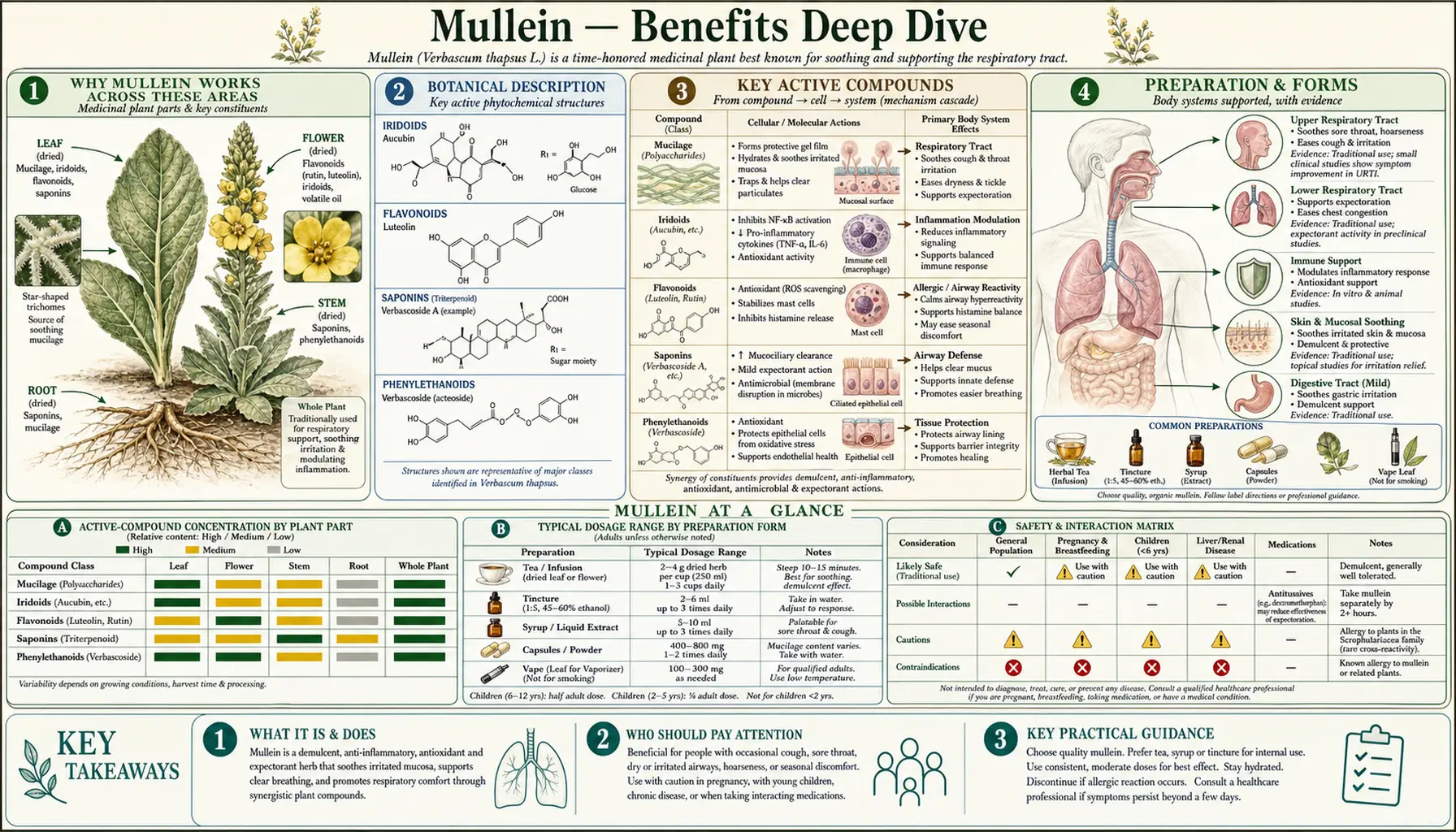
Mullein (Verbascum thapsus) is one of the classic respiratory herbs of Western and Eclectic herbal medicine, and nearly all of its documented benefits trace back to the same small set of constituents — soothing mucilage, expectorant saponins, and the anti-inflammatory, antimicrobial phenylethanoid glycoside verbascoside. Together they give the herb a demulcent (coating and soothing), expectorant (mucus-clearing), anti-inflammatory, and mildly antimicrobial profile. The six deep-dive pages below explore each major application in turn: lung and airway support, coughs and bronchitis, the laboratory antiviral and antibacterial findings, the traditional ear-oil use validated in pediatric otitis-media trials, and topical use for skin, wounds, and inflammation.
Deep-Dive Articles
Respiratory & Lung Health
How mullein's mucilage soothes inflamed airway tissue and its saponins act as an expectorant — the herb's signature use for lung support, dry irritated airways, and chronic respiratory conditions.
Cough, Bronchitis & Congestion
Mullein as a demulcent and expectorant for dry, hacking, and spasmodic coughs, acute and chronic bronchitis, and thinning and clearing stubborn chest congestion.
Antiviral Properties
Laboratory evidence that mullein extracts inhibit several enveloped viruses, the role of verbascoside and related compounds, and how the traditional respiratory use intersects with antiviral activity.
Antibacterial & Antimicrobial Action
Mullein's activity against respiratory and ear-infection bacteria, the antimicrobial constituents involved, and how this underpins its traditional use in ear-drop formulas.
Ear Health & Ear Infections
Mullein flower oil for earache, the naturopathic ear-drop trials in children with acute otitis media, and the critical safety rule about perforated eardrums.
Skin, Wounds & Inflammation
Topical mullein for wounds, hemorrhoids, and inflamed skin — the anti-inflammatory verbascoside, soothing mucilage, and traditional poultice preparations.
Table of Contents
- Deep-Dive Articles
- Why Mullein Works Across These Areas
- Research Papers: Respiratory, Cough & Expectorant
- Research Papers: Antiviral & Antibacterial
- Research Papers: Ear Health & Otitis Media
- Research Papers: Skin, Anti-Inflammatory & Constituents
- External Authoritative Resources
- Connections
- Featured Videos
Why Mullein Works Across These Areas
Unlike herbs whose effects come from a single dominant molecule, mullein's broad traditional repertoire rests on a complementary blend of constituents that act together. Understanding the four main components explains why one plant is used for the lungs, the throat, the ears, and the skin.
- Mucilage (soothing polysaccharides) — mullein leaves are rich in mucilage, which forms a soft, protective film over irritated mucous membranes. This demulcent action is the basis of its use for raw, dry, irritated airways and a scratchy throat, and of its topical use as a softening layer over inflamed skin.
- Saponins (expectorant action) — saponins help loosen and mobilise mucus so it can be cleared more easily, the expectorant action that makes mullein useful for productive coughs, bronchitis, and chest congestion alongside its soothing effect on dry coughs.
- Verbascoside / acteoside (anti-inflammatory & antimicrobial) — this phenylethanoid glycoside is the most-studied mullein compound, with documented anti-inflammatory, antioxidant, and antimicrobial activity. It is the common thread linking the herb's anti-inflammatory skin use, its antibacterial activity, and the phenolic compounds credited with the laboratory antiviral findings.
- Aucubin, flavonoids & other phenolics — iridoid glycosides such as aucubin and a range of flavonoids round out the antioxidant and anti-inflammatory capacity and contribute to the overall profile.
A practical theme runs through all six benefit pages: most of mullein's strongest evidence is traditional and preclinical (long historical use plus laboratory and small clinical studies) rather than large randomized trials — the clearest clinical signal being the naturopathic ear-drop trials for childhood ear pain. The full chemistry behind these constituents is detailed on the main hub's Active Compounds & Pharmacology page, and preparation and safety on Forms, Dosage & Safety.
Research Papers: Respiratory, Cough & Expectorant
- Mullein mucilage and expectorant / demulcent action in respiratory use PubMed: mullein respiratory expectorant
- Turker AU, Gurel E. "Common mullein (Verbascum thapsus L.): recent advances in research." Phytotherapy Research. 2005;19(9):733–739 — doi:10.1002/ptr.1653
- "Health-promoting and disease-mitigating potential of Verbascum thapsus L. (common mullein): A review." Phytotherapy Research — doi:10.1002/ptr.7393
Research Papers: Antiviral & Antibacterial
- McCutcheon AR, et al. "Antiviral screening of British Columbian medicinal plants." J Ethnopharmacol. 1995;49(2):101–110 PubMed: McCutcheon antiviral screening
- "Antiviral effect and mode of action of methanolic extract of Verbascum thapsus L. on pseudorabies virus (strain RC/79)." — PubMed: 21999656
- Mullein (Verbascum thapsus) antibacterial activity PubMed: Verbascum thapsus antibacterial
Research Papers: Ear Health & Otitis Media
- Sarrell EM, Mandelberg A, Cohen HA. "Efficacy of naturopathic extracts in the management of ear pain associated with acute otitis media." Arch Pediatr Adolesc Med. 2001;155(7):796–799 — PubMed: 11434846
- Sarrell EM, Cohen HA, Kahan E. "Naturopathic treatment for ear pain in children." Pediatrics. 2003;111(5):e574–e579 — Search PubMed
- Naturopathic herbal ear drops for acute otitis media in children PubMed: herbal ear drops otitis media
Research Papers: Skin, Anti-Inflammatory & Constituents
- Verbascoside (acteoside): anti-inflammatory and antioxidant pharmacology PubMed: verbascoside pharmacology
- Aucubin and iridoid glycosides of Verbascum species PubMed: aucubin Verbascum iridoids
- Mullein phytochemistry and bioactive constituents PubMed: mullein phytochemistry
External Authoritative Resources
- NCCIH — Herbs at a Glance
- MedlinePlus — Herbs and Supplements
- PubMed — All research on Verbascum thapsus
Connections
- All Herbs
- Mullein (Main Page)
- Mullein for Respiratory & Lung Health
- Mullein for Cough, Bronchitis & Congestion
- Mullein Antiviral Properties
- Mullein Antibacterial & Antimicrobial Action
- Mullein for Ear Health & Ear Infections
- Mullein for Skin, Wounds & Inflammation
- Active Compounds & Pharmacology
- Forms, Dosage & Safety
- Eucalyptus
- Thyme
- Peppermint
- Elderberry
- Licorice
- Echinacea
- Asthma
- COPD
- Pneumonia