Mullein Active Compounds and Pharmacology
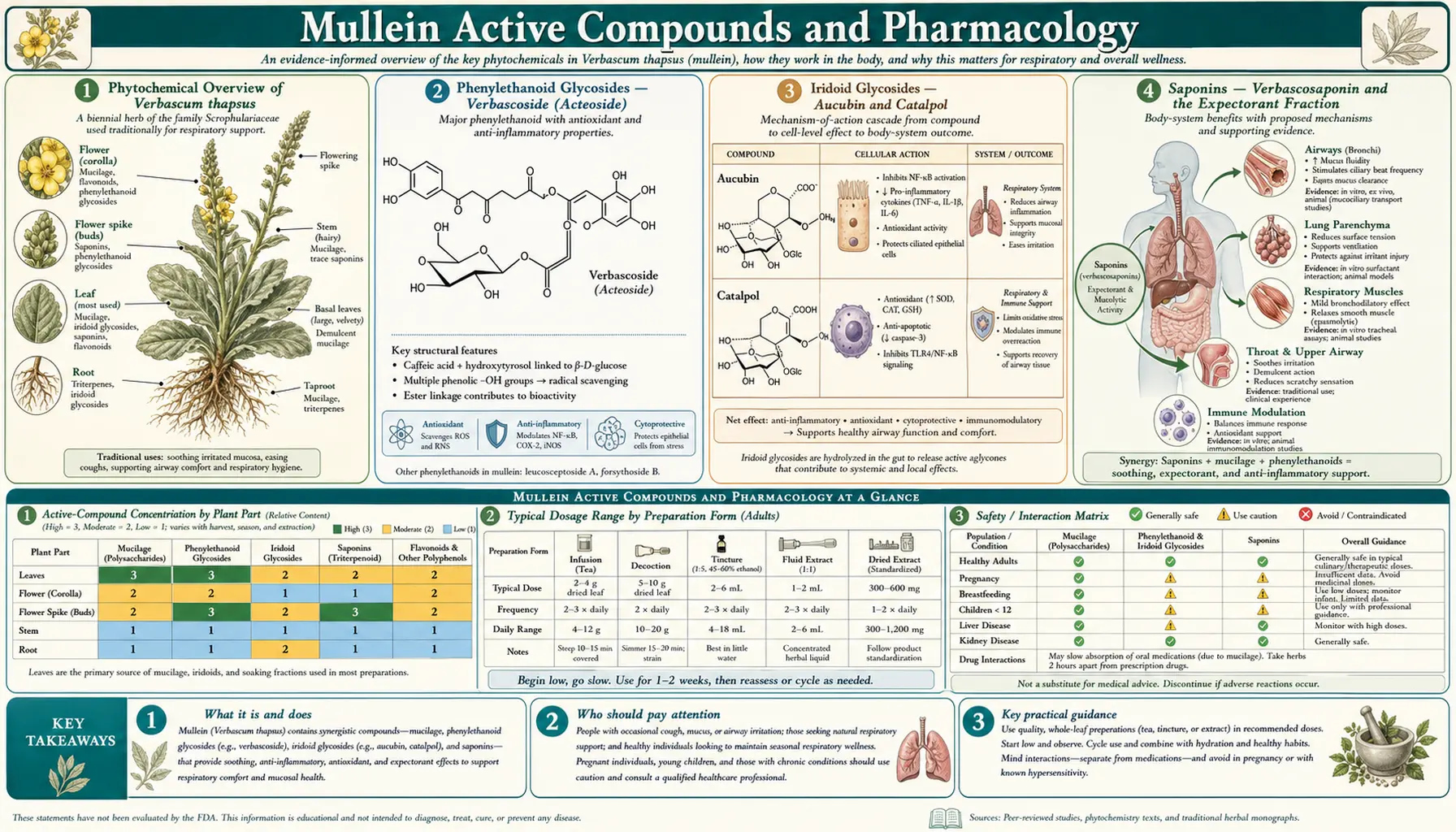
Table of Contents
- Phytochemical Overview of Verbascum thapsus
- Phenylethanoid Glycosides — Verbascoside (Acteoside)
- Iridoid Glycosides — Aucubin and Catalpol
- Saponins — Verbascosaponin and the Expectorant Fraction
- Mucilage Polysaccharides — The Demulcent Fraction
- Flavonoids and Phenolic Acids
- Other Constituents — Sterols, Essential Oil, Minerals
- Structure–Activity Map — Which Compound Drives Which Use
- Extraction and Bioavailability
- Pharmacological Research Summary and Gaps
- Research Papers and References
- Connections
- Featured Videos
Phytochemical Overview of Verbascum thapsus
Common mullein (Verbascum thapsus L.), a member of the figwort family Scrophulariaceae, is one of the most chemically studied medicinal members of its genus. Its therapeutic reputation as a respiratory, antimicrobial, and wound-healing herb is not folklore alone — it rests on a well-characterized chemical inventory spanning at least six structurally distinct classes of constituents. The leaves and flowers are the primary medicinal organs, and they differ in emphasis: flowers are comparatively rich in mucilage and flavonoids, while leaves carry the bulk of the iridoid and phenylethanoid glycosides.
The plant's documented constituents fall into the following families: phenylethanoid glycosides (notably verbascoside/acteoside, the marquee bioactive), iridoid glycosides (aucubin, catalpol, and their esters), triterpenoid saponins (verbascosaponin and relatives), mucilage polysaccharides (a complex of arabinogalactans, xylogalacturonans, and rhamnogalacturonans), flavonoids (luteolin, apigenin, and their glycosides), and a long tail of minor constituents — phenolic acids, phytosterols, fatty acids, vitamins, and trace essential-oil components. The comprehensive review by Turker and Gurel catalogues this inventory and remains the most-cited modern entry point to mullein phytochemistry.
What makes mullein pharmacologically interesting is not any single "magic" molecule but the way the classes complement one another: a soothing physical demulcent layer (mucilage), a chemically active antioxidant and antimicrobial layer (verbascoside and flavonoids), an anti-inflammatory and tissue-repair layer (the iridoids), and a surface-active expectorant layer (the saponins). The sections below treat each class in turn before mapping them back onto the herb's traditional uses.
Phenylethanoid Glycosides — Verbascoside (Acteoside)
Verbascoside — also called acteoside, and historically isolated from Verbascum, which gives it its name — is the single most-studied bioactive in mullein. Structurally it is a caffeoyl phenylethanoid glycoside: a caffeic-acid unit and a hydroxytyrosol unit esterified onto a central rhamnose-glucose disaccharide. That architecture packs two catechol (ortho-dihydroxyphenyl) groups into one molecule, and catechols are potent radical scavengers. This is the chemical basis for verbascoside's strong antioxidant activity, which is consistently among the most reproducible findings in the mullein literature.
Beyond direct radical scavenging, verbascoside has documented anti-inflammatory activity — it inhibits pro-inflammatory enzymes and signaling, including effects on lipoxygenase and on NF-κB-driven cytokine release in cell models — and meaningful antimicrobial activity against a range of bacteria. It is one of the constituents most often credited with mullein's topical and antibacterial reputation. The compound is not unique to mullein (it occurs across the Lamiales, including olive, lemon verbena, and devil's claw), which is fortunate for research because verbascoside isolated from any source behaves the same way, so the broad pharmacology literature applies directly.
Pharmacokinetically, verbascoside is a large, polar ester glycoside, so its oral bioavailability as the intact molecule is modest; gut esterases and microbiota hydrolyze a fraction of it to hydroxytyrosol and caffeic acid, which are themselves bioactive antioxidants. This means that even when little intact verbascoside reaches systemic circulation, its breakdown products contribute antioxidant capacity — while topically and within the gut lumen the intact molecule can act locally at high concentration. For the broader pharmacology of this molecule, see the PubMed topic search linked in the references.
Iridoid Glycosides — Aucubin and Catalpol
Iridoid glycosides are a hallmark of the Scrophulariaceae, and mullein contains a characteristic set led by aucubin and catalpol, along with related esters such as the 6-O-acyl derivatives sometimes reported under the name "verbascosides" in older literature (not to be confused with the phenylethanoid). Iridoids are monoterpene-derived bicyclic compounds carrying a reactive glucose-masked aldehyde; on hydrolysis they release a chemically reactive aglycone, which underlies both their biological activity and their tendency to brown and polymerize in stored plant material.
Aucubin is the best-characterized of the two and carries a substantial independent pharmacology literature: it shows anti-inflammatory activity, hepatoprotective effects (it has been studied for protection against chemically induced liver injury), antioxidant activity, and mild antimicrobial action. Catalpol, its close relative, is studied chiefly for anti-inflammatory and neuroprotective effects in other plants and contributes to the same overall profile in mullein. Together the iridoids are generally credited with part of mullein's soothing, anti-inflammatory effect on irritated mucosa, complementing the purely physical action of the mucilage.
A practical chemistry note: iridoid glycosides are heat- and acid-labile and oxidize readily, so the iridoid content of a mullein preparation depends heavily on how gently the plant was dried and how the extract was made. Harsh or prolonged heat degrades them. This is one reason traditional preparation methods — gentle drying, short infusions rather than hard decoctions for the leaf — matter chemically and not just by tradition.
Saponins — Verbascosaponin and the Expectorant Fraction
Mullein contains triterpenoid saponins, the best known of which is verbascosaponin (and its acidic form, verbascosaponin A). Saponins are amphiphilic molecules — a fat-soluble triterpene aglycone bearing one or more water-soluble sugar chains — which makes them surface-active, like a mild biological detergent. This surfactant property is the conventional pharmacological explanation for mullein's reputation as an expectorant: saponins are thought to act partly by a reflex mechanism (gastric irritation triggering a vagal reflex that increases bronchial secretion) and partly by lowering the surface tension of airway mucus, helping thin tenacious secretions so they can be cleared.
Saponins also contribute to mullein's antimicrobial activity. Their detergent action can disrupt microbial and viral lipid membranes, and saponin-rich fractions of many plants show antibacterial, antifungal, and antiviral effects in vitro. In mullein specifically, the saponin fraction is one of several constituents implicated in the herb's observed activity against respiratory pathogens, working alongside verbascoside and the flavonoids rather than alone.
Because saponins are bitter and mildly irritating in concentrated form, whole-plant preparations contain them at modest, well-tolerated levels — the herb is regarded as gentle precisely because no single fraction dominates. Saponin content, like the iridoids, varies with plant part, growing conditions, and extraction solvent; they are reasonably water-soluble, so they partition into aqueous infusions and hydroalcoholic tinctures alike.
Mucilage Polysaccharides — The Demulcent Fraction
If verbascoside is mullein's chemically active star, mucilage is its physically active workhorse. Mullein flowers and leaves are rich in high-molecular-weight polysaccharides — a complex of arabinogalactans, galacturonic-acid-containing pectic polysaccharides (xylogalacturonans and rhamnogalacturonans), and associated sugars. In water these long, branched chains hydrate and swell into a viscous, slippery gel. That gel is the basis of mullein's classification as a demulcent: it forms a soothing, protective film over inflamed or irritated mucous membranes of the throat and upper respiratory tract.
The mechanism is mechanical rather than chemical. The mucilage coating reduces direct contact between irritated tissue and the stimuli (dry air, particulates, the friction of coughing) that perpetuate a cough, and it provides a moist barrier that allows inflamed epithelium to settle. This is the same principle behind other classic demulcent herbs such as marshmallow root and slippery elm, and it explains why a mullein infusion (which extracts mucilage well into warm — not boiling — water) is traditionally favored for sore throat and dry, irritating cough, while an alcohol tincture, which extracts mucilage poorly, is favored when the goal is the antimicrobial or antiviral constituents instead.
Because mucilage is not appreciably absorbed, its action is confined to the surfaces it touches — the mouth, throat, and gut lumen — which is exactly where a soothing effect is wanted and also why mullein's demulcent benefit does not depend on systemic bioavailability at all.
Flavonoids and Phenolic Acids
Mullein contains a useful complement of flavonoids, principally the flavones luteolin and apigenin together with their glycosides (such as luteolin-7-O-glucoside), plus flavonols and assorted phenolic acids. These compounds are among the most thoroughly studied plant antioxidants and anti-inflammatories in pharmacology generally, so their presence reinforces and overlaps with the activity of verbascoside.
Luteolin and apigenin both scavenge free radicals and modulate inflammatory signaling — they have documented inhibitory effects on pro-inflammatory mediators and enzymes in numerous cell and animal models — and both show antimicrobial activity in vitro. In the context of a respiratory herb, the flavonoid fraction is generally credited with contributing antioxidant protection to inflamed airway tissue and with adding to the herb's overall antimicrobial and anti-inflammatory effect. They are moderately water- and alcohol-soluble; flavonoid glycosides extract readily into infusions, while the less-polar aglycones favor hydroalcoholic extraction.
Because luteolin and apigenin are not unique to mullein and carry large standalone literatures, their contribution to mullein's pharmacology is one of the better-supported parts of the chemical picture — the uncertainty is less about whether these molecules are active and more about how much of each a given mullein preparation actually delivers.
Other Constituents — Sterols, Essential Oil, Minerals
Beyond the four principal active classes, mullein carries a long tail of minor constituents that round out its profile. Reported among these are phytosterols (such as β-sitosterol and stigmasterol), triterpenes, fatty acids, small amounts of essential-oil volatiles, carotenoids, and water-soluble vitamins including vitamin C in the fresh plant. The essential-oil fraction is minor compared with aromatic herbs like thyme or oregano, so mullein is not primarily an aromatic-antimicrobial herb — its volatile content is a contributor, not a centerpiece.
The phytosterols are of mild interest because plant sterols generally exert anti-inflammatory and membrane-stabilizing effects and may contribute marginally to the soothing profile, though they are not present at the concentrations that drive sterol-specific cardiovascular claims in other foods. The carotenoid and ascorbate content reflects the leafy nature of the plant and adds incremental antioxidant capacity to fresh-plant preparations.
Two cautions belong here on the chemistry of the raw material rather than its actives. First, mullein leaf hairs (the dense stellate trichomes that give the leaf its felted texture) are mechanically irritating and are the reason traditional teas are strained through fine cloth or a paper filter — this is a physical, not chemical, concern but a genuinely practical one. Second, some Verbascum material has been reported to contain trace amounts of the iridoid/coumarin-adjacent and seed-borne compounds (mullein seeds contain rotenone- and coumarin-type piscicidal saponins historically used as a fish poison), so the medicinal preparations are made from leaf and flower, not seed.
Structure–Activity Map — Which Compound Drives Which Use
Mullein is an instructive case of a herb whose traditional uses map cleanly onto distinct chemical fractions. Rather than one compound doing everything, each classical indication can be traced to the constituent best suited to it:
- Demulcent / soothing of dry cough and sore throat → mucilage polysaccharides. A purely physical, surface-acting gel; needs warm-water extraction and no systemic absorption to work.
- Expectorant / loosening tenacious phlegm → triterpenoid saponins (verbascosaponin). Surfactant and mild reflex action on bronchial secretions; water- and alcohol-soluble.
- Antioxidant and anti-inflammatory protection of irritated tissue → verbascoside plus the flavonoids (luteolin, apigenin). The catechol-rich phenylethanoid and the flavones overlap heavily here.
- Anti-inflammatory and tissue-repair / wound-healing action → iridoid glycosides (aucubin, catalpol) plus verbascoside. Underpins the topical and skin-soothing tradition.
- Antibacterial / antimicrobial action → verbascoside, saponins, and flavonoids acting together. No single antibiotic-like molecule; a layered, additive effect.
This division of labor explains why preparation method changes the medicine: a warm flower-and-leaf infusion emphasizes the demulcent and water-soluble antioxidant fractions for a dry, irritating cough, whereas a hydroalcoholic tincture concentrates the verbascoside, saponins, and flavonoid aglycones for antimicrobial use, and an infused oil pulls the lipophilic minor constituents for topical and ear-related folk uses. The clinically oriented sibling articles on this site — Respiratory & Lung Health, Antibacterial Action, and Skin, Wounds & Inflammation — build on this structure–activity map.
Extraction and Bioavailability
Because mullein's active classes differ sharply in polarity and heat stability, the choice of solvent and method selectively concentrates different fractions — a point that matters more for mullein than for many herbs:
- Water infusion (warm, steeped, covered). Best for mucilage and for water-soluble flavonoid glycosides, saponins, and a portion of the iridoids and verbascoside. Boiling hard or simmering for long degrades the heat-labile iridoids and can drive off volatiles, so a covered steep is preferred to a rolling decoction for the leaf.
- Hydroalcoholic tincture. Best for verbascoside, saponins, flavonoid aglycones, and the less-polar phenolics; poor for mucilage (alcohol precipitates polysaccharides). This is the preparation to choose when the antimicrobial/antiviral constituents are the target rather than the demulcent effect.
- Infused oil (flower in warm oil). Extracts the lipophilic minor constituents — sterols, fatty acids, some flavone aglycones — for topical and traditional ear-oil use; extracts essentially no mucilage and little verbascoside.
On systemic bioavailability, the picture splits along the same lines. The mucilage acts entirely at the mucosal surface and is not meaningfully absorbed — which is exactly why it works for a throat or gut complaint. Verbascoside, being a large polar ester glycoside, has limited intact oral absorption; gut enzymes and microbiota hydrolyze part of it to absorbable, still-active fragments (hydroxytyrosol, caffeic acid), so its systemic antioxidant contribution comes partly from metabolites. The iridoid glycosides are absorbed to varying degrees and are also subject to gut hydrolysis. The flavonoids follow the well-described pattern of dietary flavonoid absorption — glycosides are deglycosylated and conjugated in the gut and liver. The practical takeaway is that mullein's local actions (demulcent, luminal antimicrobial, topical) are robust and do not depend on absorption, while its systemic actions are more modest and metabolite-mediated.
Pharmacological Research Summary and Gaps
The strongest, most reproducible parts of the mullein evidence base are in vitro and preclinical: the antioxidant activity of verbascoside and the flavonoids, the broad antimicrobial activity of mullein extracts and their isolated constituents, and the anti-inflammatory effects of verbascoside, aucubin, and catalpol are all well supported by laboratory studies, many of them summarized in the comprehensive reviews cited below. The chemistry — what is in the plant and what those molecules do in a test tube — is on solid ground.
The principal gap is the relative scarcity of rigorous human clinical trials of whole mullein preparations. Much of the traditional respiratory use rests on long ethnobotanical experience, plausible mechanisms (demulcent mucilage, expectorant saponins, antioxidant phenolics), and animal and cell data, rather than on large randomized controlled trials. Where mullein appears in human studies it is often as one component of a multi-herb formula (for example, in herbal ear-drop combinations studied for ear pain), which makes it hard to attribute effects to mullein specifically. Standardization is a second gap: because the active fractions vary with plant part, growing conditions, drying, and extraction, two commercial mullein products can differ substantially in their verbascoside, iridoid, saponin, and mucilage content, yet few products are standardized to any marker compound.
For readers and researchers, the sensible posture is that mullein's chemistry and mechanisms are well characterized and biologically credible, its traditional uses are mechanistically coherent, and the outstanding need is for standardized, well-powered clinical trials of defined preparations. The reviews by Turker and Gurel and the more recent comprehensive review of the disease-mitigating potential of Verbascum thapsus (both linked below) are the best starting points for anyone surveying the current state of the evidence.
Research Papers and References
The references below combine two verified review articles with curated PubMed topic searches for the individual compound classes. Each search link opens directly in PubMed at the National Library of Medicine. No DOIs, PMIDs, or author attributions have been fabricated; where a specific paper is not cited, a topic search is provided instead.
- Turker AU, Gurel E. Common mullein (Verbascum thapsus L.): recent advances in research. Phytotherapy Research. 2005;19(9):733–739. — doi:10.1002/ptr.1653
- Health-promoting and disease-mitigating potential of Verbascum thapsus L. (common mullein): A review. Phytotherapy Research. — doi:10.1002/ptr.7393
- Verbascoside / acteoside — pharmacology, antioxidant and anti-inflammatory activity. — PubMed: verbascoside acteoside pharmacology
- Verbascoside antimicrobial and antibacterial activity. — PubMed: verbascoside antimicrobial
- Aucubin — anti-inflammatory and hepatoprotective effects. — PubMed: aucubin anti-inflammatory hepatoprotective
- Catalpol — anti-inflammatory and antioxidant pharmacology. — PubMed: catalpol anti-inflammatory
- Verbascum thapsus saponins — verbascosaponin and expectorant fraction. — PubMed: Verbascum thapsus saponins
- Mullein mucilage and demulcent polysaccharides. — PubMed: Verbascum mucilage polysaccharide
- Luteolin and apigenin — antioxidant and anti-inflammatory flavones. — PubMed: luteolin apigenin antioxidant
- Verbascum thapsus extract — antibacterial and antiviral activity. — PubMed: Verbascum thapsus antibacterial antiviral
- Verbascum thapsus phytochemistry and constituents. — PubMed: Verbascum thapsus phytochemistry
External Authoritative Resources
- NCCIH — Herbs at a Glance
- MedlinePlus — Herbs and Supplements
- PubMed — All research on Verbascum thapsus
Connections
- All Herbs
- Mullein Hub
- Mullein for Respiratory & Lung Health
- Mullein Antiviral Properties
- Mullein Antibacterial Action
- Mullein for Skin, Wounds & Inflammation
- Eucalyptus
- Licorice (Demulcent)
- Oregano
- Olive Leaf (Verbascoside Source)
- Asthma
- Oxidative Stress