Mullein Forms, Dosage, and Safety
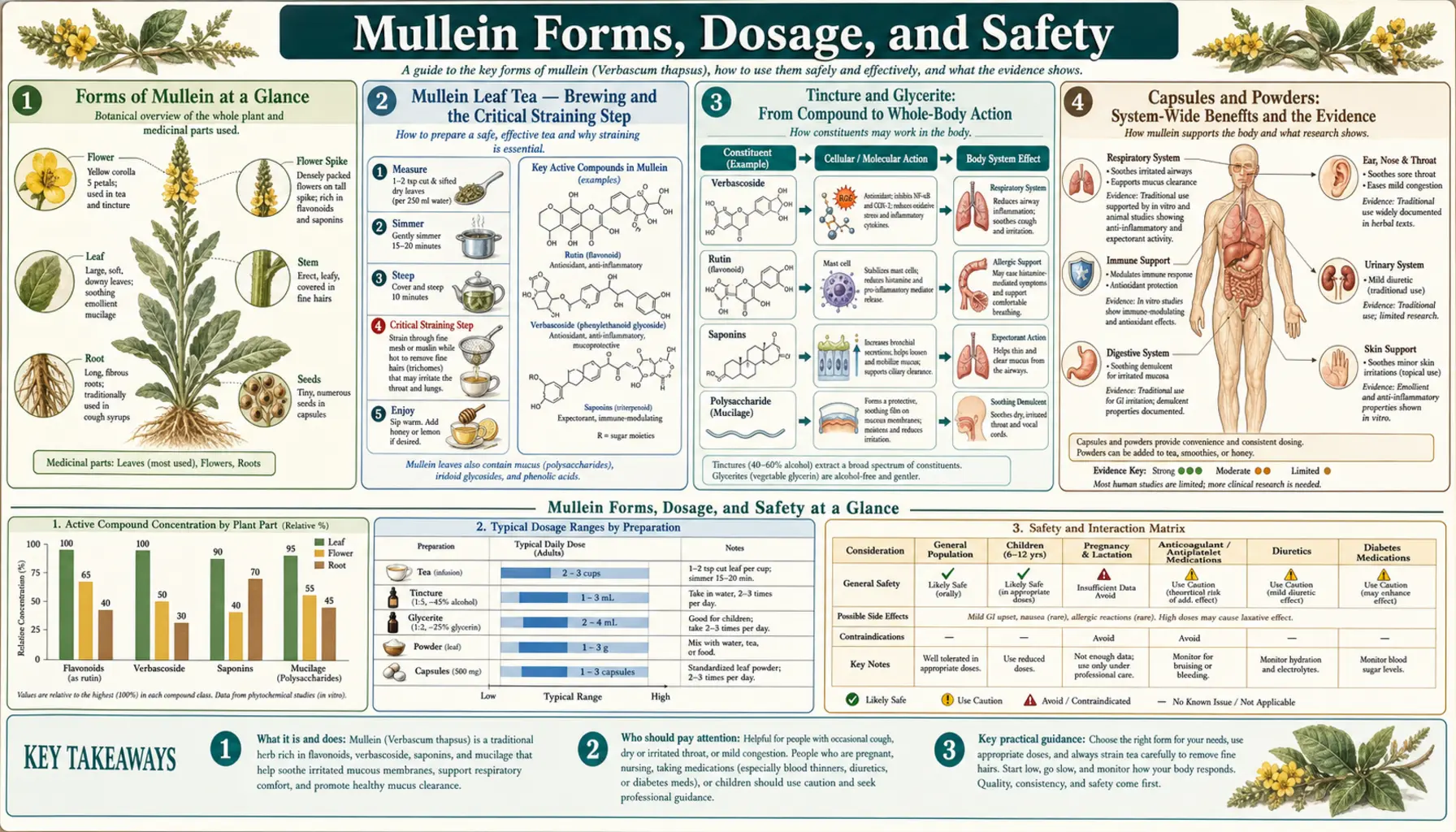
Table of Contents
- Forms of Mullein at a Glance
- Mullein Leaf Tea — Brewing and the Critical Straining Step
- Tincture and Glycerite
- Capsules and Powders
- Mullein Flower Ear Oil
- Smoking and Vapor — Traditional Practice and Its Caveats
- Steam Inhalation
- Typical Dosage Ranges
- Quality, Sourcing, and Sustainability
- Safety, Side Effects, and Toxicity
- Drug Interactions and Special Populations
- Research Papers and References
- Connections
- Featured Videos
Forms of Mullein at a Glance
Mullein (Verbascum thapsus) is one of the most versatile herbs in the Western respiratory tradition, in part because nearly every above-ground part of the plant has a recognized use and each lends itself to a different preparation. The large, soft, felted leaves are the classic source of cough and lung teas and tinctures. The bright yellow flowers, which open only a few at a time up the towering second-year flower spike, are gathered for the famous ear oil and for gentler, sweeter infusions. The choice of preparation is not arbitrary — it determines which constituents you actually extract, how quickly they act, and what safety considerations apply.
The water-soluble mucilage that gives mullein its soothing, demulcent reputation is best captured in a hot-water infusion (tea) or a glycerite, because mucilage polysaccharides dissolve poorly in high-proof alcohol. The saponins and flavonoids, by contrast, extract well into alcohol, which is why a tincture is often chosen when an expectorant or more concentrated action is wanted. Lipophilic compounds from the flowers are drawn out into oil, the basis of the ear preparation. Understanding this is the single most useful idea for choosing a form: match the solvent to the constituent you are after.
At a glance, the common commercial and home forms are: dried cut-and-sifted leaf for tea; dried flowers for tea and oil; alcohol tinctures (typically of leaf, sometimes leaf-and-flower); alcohol-free glycerites; encapsulated leaf powder; flower-infused ear oils; and, in some traditional and herbalist settings, dried leaf used for steam inhalation or, historically, smoking blends. The sections below walk through each, with practical preparation notes and the cautions that matter most.
Mullein Leaf Tea — Brewing and the Critical Straining Step
Mullein leaf tea is the most traditional and widely used preparation, valued as a gentle demulcent and expectorant for dry, irritated coughs and bronchial congestion. To brew it, the commonly cited approach is to pour roughly one cup (about 240 mL) of just-boiled water over one to two teaspoons of dried cut leaf, cover the cup, and steep for ten to fifteen minutes. Covering matters: it keeps volatile aromatic compounds in the cup and lets the leaf hydrate fully so the soothing mucilage is released into the water. The finished tea is pale, faintly grassy, and mild; it can be sweetened with honey, which adds its own throat-coating effect.
The single most important step is one many casual users skip. Mullein leaves and stems are covered in dense, fine, branching hairs (trichomes), and these tiny hairs can break loose into the tea and cause significant throat scratchiness and irritation if swallowed. A standard tea strainer with ordinary-sized holes does not reliably catch them. You should pour the finished tea through a fine cloth, an unbleached paper coffee filter, a nut-milk bag, or a very fine mesh sieve to remove the floating hairs before drinking. This is not folklore — the irritation is a real, mechanical effect of the trichomes on the mucous membranes of the mouth and throat, and proper filtration completely avoids it. If a batch still feels scratchy, filter it a second time.
Many people drink mullein leaf tea one to three times daily during a bout of respiratory irritation. Because it is gentle and primarily soothing, it is generally considered suitable for short-term use over days to a few weeks, though as with any herb the prudent course is to use the lowest amount that helps and to stop if symptoms worsen or fail to improve. Combining mullein with other demulcent or respiratory herbs such as marshmallow root, licorice, or thyme is a long-standing practice in Western herbalism; those blends should still be strained through fine cloth because the mullein hairs remain present.
Tincture and Glycerite
A tincture is an alcohol extract of the herb, usually made from the dried (sometimes fresh) leaf, occasionally combined with flowers. Alcohol is an efficient solvent for mullein's saponins and flavonoids and produces a shelf-stable, concentrated liquid that is dosed by the dropperful. A practical advantage of a tincture is convenience and a long shelf life — years, when stored away from heat and light. A practical disadvantage is that high-proof alcohol extracts the soothing mucilage poorly, so a tincture leans more toward the expectorant and mildly astringent side of mullein's profile than toward the demulcent, coating quality you get from a tea or glycerite. Tinctures are typically taken in a little water or juice, which also dilutes the alcohol.
A glycerite uses food-grade vegetable glycerin in place of, or alongside, a small amount of alcohol as the menstruum. Glycerites are sweet, alcohol-free or low-alcohol, and are often preferred for children, for people who avoid alcohol, and for anyone who finds tinctures harsh. Because glycerin is a better carrier for mucilage and water-soluble compounds than strong alcohol, a glycerite can retain more of mullein's demulcent character. The trade-offs are a shorter shelf life than an alcohol tincture and generally a somewhat lower extraction efficiency for the alcohol-soluble constituents.
Commercial tinctures vary widely in strength, which is expressed as a herb-to-menstruum ratio such as 1:3 or 1:5 (one part dried herb to three or five parts liquid by weight-to-volume). Because there is no standardized, regulated mullein dose, the most reliable practice is to follow the dosing printed on a reputable manufacturer's label for that specific product rather than assuming all tinctures are equivalent. When in doubt, start at the low end of the labeled range.
Capsules and Powders
Encapsulated mullein and loose leaf powder offer convenience and a tasteless way to take the herb for people who dislike the flavor of the tea or the alcohol of a tincture. Capsules are typically filled with dried, milled leaf and are dosed by the capsule according to the label, commonly in the range of a few hundred milligrams to around a gram per capsule, taken one or more times daily.
There are two practical caveats worth understanding. First, swallowing whole dried leaf in a capsule bypasses the hot-water infusion step, so you do not extract and concentrate the water-soluble mucilage the way a tea does; the soothing, throat-coating action that many people seek from mullein is therefore less prominent with capsules than with a properly brewed, strained tea. Second, dry powdered leaf still contains the fine plant hairs, so loose powder should be handled carefully and not inhaled as a dust, and it is generally encapsulated rather than taken by the spoonful for that reason.
As with tinctures, there is no official regulated dose for mullein capsules, and products differ in milligram content and in whether they are plain leaf or a concentrated extract. The dependable approach is to follow the specific product's label, choose a brand with transparent sourcing and testing, and treat any single-herb capsule as a short-term aid rather than an indefinite daily supplement without a clear reason.
Mullein Flower Ear Oil
Mullein flower oil is one of the herb's most famous traditional preparations, made by steeping the fresh or dried yellow flowers in a carrier oil (commonly olive oil) for several weeks, often with gentle warmth, and then straining out the plant material. The resulting golden oil is used in folk and herbalist traditions as a warm (body-temperature, never hot) eardrop for ear discomfort, and it is frequently combined with garlic, which contributes its own traditional antimicrobial reputation. The oil's appeal is that it is soothing and locally applied rather than ingested.
Two safety points are essential and non-negotiable. First, ear oil must never be used if the eardrum may be perforated — if there is ear drainage, sudden severe pain, a known ruptured eardrum, or ear tubes, putting oil into the canal can carry material against or behind the eardrum and cause harm; in those situations the ear should be evaluated by a clinician rather than self-treated. Second, severe ear pain, high fever, hearing loss, drainage, or symptoms in a young child warrant professional medical assessment, because middle-ear infections behind an intact eardrum are not actually reached by anything placed in the outer canal, and untreated ear infections can have serious consequences.
Within those limits, mullein flower ear oil is generally regarded as a low-risk topical comfort measure for mild outer-ear irritation in people with an intact eardrum, and it is the subject of a frequently cited pediatric study of a multi-herb (including mullein) ear-drop preparation for the pain of acute otitis media, discussed in the references below. It should be viewed as supportive comfort care, not a cure, and not a replacement for diagnosis when an infection is suspected.
Smoking and Vapor — Traditional Practice and Its Caveats
Smoking dried mullein leaf is a genuinely old practice, recorded in both European folk medicine and several Indigenous North American traditions, where the broad, soft leaf was dried and smoked alone or in herbal blends with the traditional intention of easing coughs and chest tightness. Mullein is sometimes promoted today as a "lung-friendly" herb to smoke or as a base for tobacco-free herbal smoking blends, and its mildness and lack of nicotine are real points of contrast with tobacco.
That history should not be mistaken for an endorsement of safety. Any inhaled combustion smoke — from any plant, including mullein — delivers particulate matter, carbon monoxide, and a range of pyrolysis byproducts into the airways and lungs. The act of burning organic material and inhaling the smoke is inherently irritating to respiratory tissue, and there is no good evidence that smoking mullein treats or improves any lung condition; the paradox of inhaling smoke to soothe an irritated airway is obvious once stated. People with asthma, COPD, or any chronic respiratory disease are precisely the group for whom inhaled smoke of any kind is most hazardous.
If a person nonetheless wishes to use mullein's traditional respiratory profile, the far safer routes are the strained tea, the tincture or glycerite, and especially steam inhalation, all of which deliver the herb without combustion. Where a herbalist or tradition uses mullein in a smoking context, it is best understood as a cultural and historical practice carrying the same fundamental risks as any smoke inhalation, not as a medical recommendation.
Steam Inhalation
Steam inhalation is a gentle, combustion-free way to bring mullein's soothing qualities to the upper respiratory tract. The traditional method is to place a small handful of dried mullein leaf (and/or flowers) in a heat-safe bowl, pour just-boiled water over it, lean over the bowl at a comfortable distance with a towel draped over the head to trap the rising vapor, and breathe gently through the nose and mouth for several minutes, taking breaks and keeping the eyes closed. The warm, moist air itself helps loosen mucus and soothe irritated nasal and throat passages, and herbalists often combine mullein with thyme, eucalyptus, or chamomile in a steam.
The cautions for steam are mostly about the heat and the water rather than the herb. Keep a safe distance to avoid scalding the face and airways, never let a child do a steam unsupervised, and take care moving a bowl of near-boiling water. People with asthma should be cautious, as very hot or strongly aromatic steam can occasionally trigger airway tightening; starting with plain warm steam and short sessions is sensible. Because the leaf hairs can become airborne, using whole or cut leaf rather than fine powder, and not inhaling any floating debris directly, is the prudent approach.
Typical Dosage Ranges
It is important to state plainly that mullein has no officially established, government-regulated therapeutic dose. The figures below are commonly cited traditional and herbal-practitioner ranges, not validated clinical dosing, and they vary between sources, between products, and with the form and strength of the preparation. They are offered for orientation only, and a reputable product's own label should take precedence.
- Leaf tea (infusion) — roughly 1.5 to 2 grams of dried leaf (about one to two teaspoons of cut leaf) per cup of just-boiled water, steeped covered for 10 to 15 minutes and strained through fine cloth or a coffee filter; commonly taken one to three times daily during a short bout of respiratory irritation.
- Tincture — alcohol extracts are often labeled at ratios such as 1:3 to 1:5; traditional dosing guidance frequently falls in the range of a few milliliters (roughly one to four mL, often given as 20 to 60 drops or one to two dropperfuls) taken two to three times daily in water, but the specific product label should always be followed because concentration varies widely.
- Glycerite — dosed per the manufacturer's label; because glycerites are less concentrated than high-proof tinctures, labeled volumes are often somewhat larger.
- Capsules / powder — dosed per the product label, commonly a few hundred milligrams up to about one gram of dried leaf per capsule, one to a few times daily.
- Ear oil — a small number of warmed (body-temperature) drops in the outer ear canal as directed, only with an intact eardrum; this is topical and not part of any oral dose.
Across all forms, the sensible principles are: start low, use the smallest amount that helps, treat single-herb use as short-term rather than indefinite, and re-evaluate (or seek professional guidance) if symptoms persist beyond a week or two, worsen, or are severe. None of these ranges should be scaled up in the assumption that more is better — that assumption is where most avoidable herbal problems begin.
Quality, Sourcing, and Sustainability
Mullein is a hardy biennial that grows abundantly as a naturalized "weed" across roadsides, fields, and disturbed ground throughout much of North America, Europe, and beyond, so it is neither rare nor under conservation pressure; sustainability concerns are minimal compared with many slow-growing or wild-threatened medicinals. That very abundance, however, creates the most important sourcing issue: because the plant readily grows on roadsides, railway margins, and other contaminated ground, and because its broad, hairy leaves trap dust and pollutants, material gathered from such sites can carry roadside contaminants and heavy metals. Wild-harvesters should collect only from clean, unsprayed sites well away from roads and industry, and buyers should favor cultivated or carefully wild-crafted material.
For commercial products, the markers of quality are the same ones that apply to herbal supplements generally: a clearly identified species (Verbascum thapsus) and plant part (leaf vs. flower), a reputable supplier with transparent growing and harvesting practices, and ideally third-party testing for identity, contaminants (heavy metals, microbial load), and the absence of adulteration. Dietary supplements are not pre-approved for safety or efficacy by regulators in the way drugs are, so the burden of choosing a trustworthy brand falls on the consumer. Good dried leaf should be greyish-green and intact, and properly processed material for tea is cut and sifted rather than powdered, which also helps with the straining problem described earlier.
Safety, Side Effects, and Toxicity
Mullein leaf and flower preparations are widely regarded as generally well tolerated, with a long traditional record of use and relatively few reported adverse effects when the appropriate parts are used appropriately. The most common practical complaint is the throat and skin irritation caused by the plant's fine hairs — the same trichomes that make straining the tea essential. Direct skin contact with the leaves can cause contact dermatitis (an itchy, irritated rash) in sensitive individuals, and the hairs can irritate the eyes and throat, which is why careful handling, fine straining of teas, and avoidance of inhaling the dry powder all matter.
The most important toxicity caution concerns a part of the plant that is not used medicinally: the seeds of mullein contain rotenone and saponins and should never be ingested. This is more than a theoretical worry. Mullein seeds have a documented history of being crushed and thrown into ponds and streams to stun fish so they could be easily caught — an old practice sometimes called "fish poisoning" — precisely because the seed compounds are toxic to fish (and the saponins disrupt gill function). Rotenone is a well-known natural piscicide and insecticide. The clear practical rule that follows is to use only the leaves and flowers, to keep the seeds out of any home preparation, and to be aware that the seed's toxicity is the reason mullein has historically doubled as a fish poison.
Beyond the seeds and the hair-related irritation, reported problems from ordinary leaf and flower use are uncommon, but the absence of large modern safety trials means the cautious default applies: use reputable products, avoid the seeds entirely, discontinue if a rash or new symptoms appear, and do not assume "natural" means risk-free. Anyone with a known sensitivity to plants in general, or who develops a reaction, should stop use and consult a clinician.
Drug Interactions and Special Populations
Documented drug interactions for mullein are limited, and there is no large, well-characterized body of clinical interaction data. The prudent stance is therefore one of theoretical caution rather than a list of confirmed dangerous combinations. Because mullein has traditional diuretic and mild sedative associations and is sometimes taken alongside other respiratory and herbal preparations, it is reasonable to be cautious about combining it with prescription diuretics, sedatives, or lithium (whose levels can be affected by anything altering fluid balance), and to space herbal teas and tinctures away from medications when in doubt. Anyone taking prescription drugs — especially for heart, kidney, blood pressure, or mood conditions — should review herbal additions with a pharmacist or physician.
For pregnancy and breastfeeding, the honest answer is that there is insufficient reliable data to establish safety, so the appropriate guidance is caution and professional guidance: mullein is not established as safe in these populations, and pregnant or nursing individuals should consult a qualified healthcare provider before using it in any form. The same caution applies to giving herbal preparations to young children, where dosing, the risk of the hairs, and the seriousness of conditions like ear infection all argue for clinical involvement rather than self-treatment.
Finally, and most importantly, mullein is a supportive traditional remedy, not a substitute for medical care. Persistent cough, difficulty breathing, high fever, coughing up blood, severe or worsening ear pain, hearing loss, or any symptom that does not improve within a reasonable time needs proper medical evaluation. Used within its limits — correct plant parts, fine-strained teas, intact-eardrum-only ear oil, combustion-free routes, reputable sourcing, and short-term use — mullein is a gentle and historically valued herb; used carelessly, or in place of needed care, it is not.
Research Papers and References
The references below combine a small number of specifically verifiable publications with curated PubMed topic-search entry points into the published literature on Verbascum thapsus (mullein). Each link opens directly at its source. Mullein is a traditionally used herb with a comparatively modest clinical evidence base, so most entries are topic searches rather than single landmark trials, and the safety framing leans on authoritative consumer-health sources (NCCIH, MedlinePlus).
- Turker AU, Gurel E. Common mullein (Verbascum thapsus L.): recent advances in research. Phytotherapy Research. 2005;19(9):733–739. — doi:10.1002/ptr.1653
- Review of Verbascum thapsus phytochemistry and pharmacology. Phytotherapy Research. — doi:10.1002/ptr.7393
- Verbascum thapsus — phytochemistry, traditional uses, and pharmacology (general literature). — PubMed: Verbascum thapsus pharmacology
- Mullein and respiratory / expectorant traditional use. — PubMed: Verbascum thapsus respiratory
- Naturopathic herbal ear drops (including mullein) for ear pain in acute otitis media. — PubMed: herbal ear drops otitis media
- Mullein seeds, rotenone, and saponin toxicity (fish-stunning history). — PubMed: Verbascum thapsus rotenone seeds
- Mullein and contact dermatitis / skin irritation from leaf hairs. — PubMed: mullein contact dermatitis
- Verbascoside and mullein flavonoid constituents. — PubMed: Verbascum verbascoside flavonoids
- Mullein antimicrobial and antiviral activity (in vitro literature). — PubMed: Verbascum thapsus antimicrobial
- Herbal smoking blends and inhaled combustion-smoke exposure. — PubMed: herbal smoking combustion exposure
External Resources
- NCCIH — Herbs at a Glance
- MedlinePlus — Herbs and Supplements
- PubMed — All research on Verbascum thapsus
Connections
- All Herbs
- Mullein Hub
- Mullein for Respiratory & Lung Health
- Cough, Bronchitis & Congestion
- Ear Health & Ear Infections
- Active Compounds and Pharmacology
- Marshmallow Root
- Thyme
- Licorice Root
- Immune Boosting