Mullein for Ear Health and Ear Infections
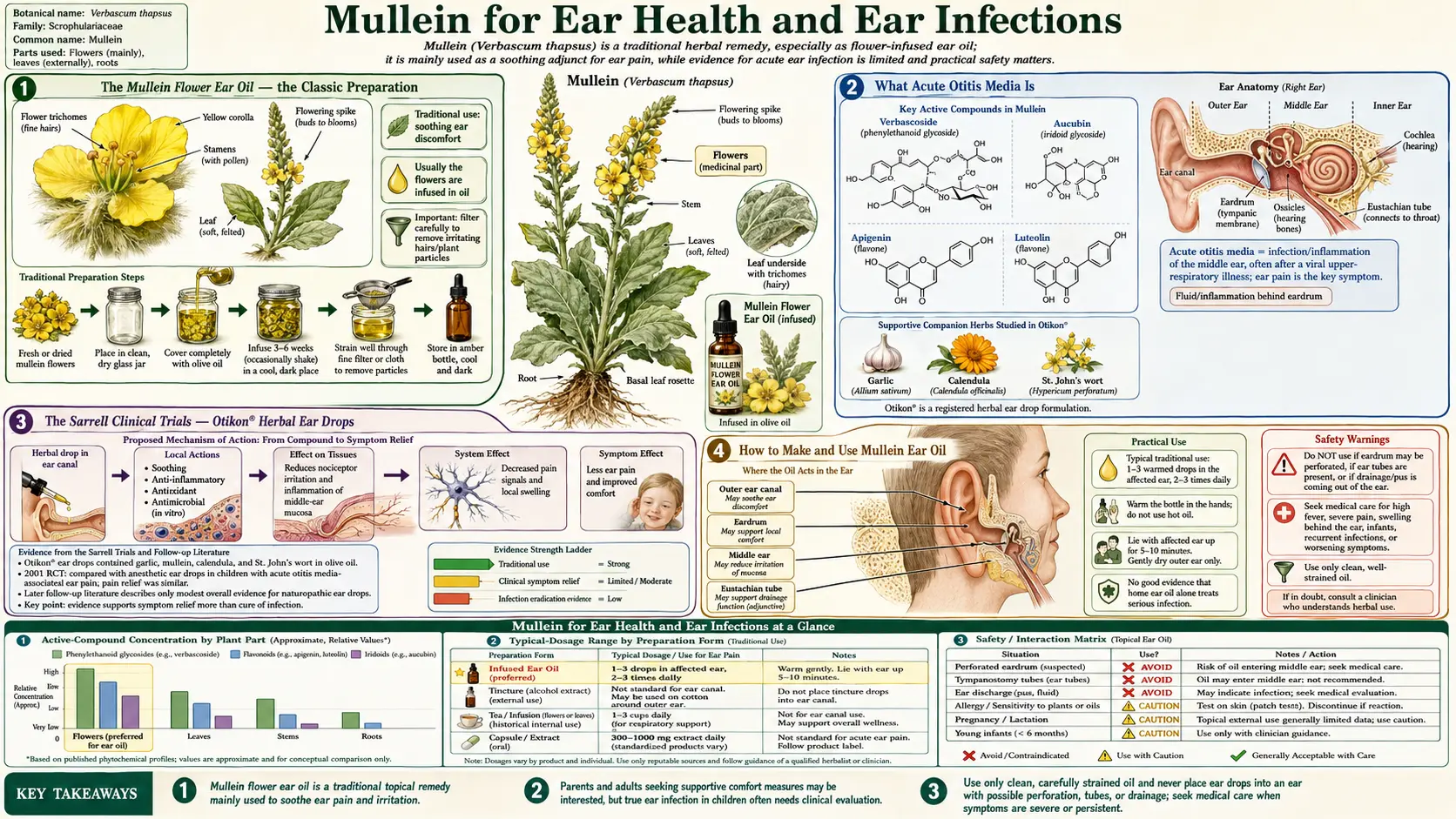
Table of Contents
- Mullein Flower Ear Oil — the Classic Preparation
- What Acute Otitis Media Is
- The Sarrell Clinical Trials — Herbal Olive-Oil Ear Drops
- How to Make and Use Mullein Ear Oil
- Why It May Soothe the Ear
- Critical Safety — Perforated Eardrums, Draining Ears and Warning Signs
- Combining Mullein with Garlic
- Pediatric Considerations and the Limits of the Evidence
- Evidence Summary
- Cautions
- Key Research Papers
- Connections
- Featured Videos
Mullein Flower Ear Oil — the Classic Preparation
Mullein (Verbascum thapsus) is best known in folk medicine for two organ systems: the lungs and the ears. Of these, the use that has filtered most directly into the modern herbal cabinet is mullein flower ear oil — the bright yellow flowers of the plant slowly infused into a warm carrier oil, then strained and dripped into an aching ear. Walk into almost any natural-foods store and you will find a small amber dropper bottle labeled "Mullein Garlic Ear Oil" or "Children's Earache Oil," and mullein is nearly always the headline botanical.
The preparation is genuinely old. Eclectic physicians of the nineteenth century, and the broader European and Appalachian folk traditions before them, used oil infusions of mullein flowers as a topical remedy for the pain of earache. The flowers were valued specifically — not the leaf, which is the part used for cough — because they carry a soothing, demulcent, slightly mucilaginous quality and a set of constituents (flavonoids, iridoid glycosides such as aucubin, and saponins) that the tradition associated with calming inflamed tissue.
It is worth being precise about what mullein ear oil is and is not. It is a symptomatic comfort measure for the pain of an intact-eardrum earache, used while the body's own immune response resolves the underlying problem. It is not an antibiotic, it does not drain a middle-ear effusion that sits behind the eardrum, and — as the safety section below explains — oil poured into an ear with a perforated eardrum passes through into the middle ear. Understanding that distinction is the single most important thing on this page.
What Acute Otitis Media Is
Most childhood earaches are acute otitis media (AOM) — an infection of the middle ear, the small air-filled space that sits behind the eardrum (tympanic membrane) and connects to the back of the nose through the Eustachian tube. AOM typically follows a cold: the virus inflames the lining of the Eustachian tube, the tube stops draining and ventilating properly, fluid accumulates in the middle ear, and bacteria or viruses multiply in that trapped fluid. The result is pressure, a red bulging eardrum, and the sharp, often nighttime pain that sends families to urgent care.
AOM is extraordinarily common in young children, largely because their Eustachian tubes are short, narrow, and nearly horizontal, so they drain poorly. The great majority of episodes resolve on their own. Because of this, the American Academy of Pediatrics (AAP) 2013 AOM guideline, which covers children from 6 months through 12 years of age, starts with treating the pain and allows "watchful waiting" (observation) for some children. Under the guideline, children six months or older with fluid draining from the ear (otorrhea) or severe signs — moderate or severe ear pain, ear pain for at least 48 hours, or a temperature of 39°C (102.2°F) or higher — are given antibiotics; children aged 6–23 months with infection in both ears are given antibiotics even without severe signs; and for children aged 6–23 months with one infected ear, or two years or older, without severe signs, observation or antibiotics are both options. That guideline shift is the reason a safe, effective pain remedy — herbal or pharmaceutical — is clinically valuable: pain relief is often the actual goal, not sterilizing the ear.
It is essential to distinguish AOM (infection and fluid behind an intact eardrum) from two other things people loosely call "an ear infection." Otitis externa (swimmer's ear) is an infection of the outer ear canal itself. A perforated or draining ear means the eardrum has ruptured and pus is escaping — or there is a tube in place. The crucial point for this page: mullein ear oil drops are placed into the ear canal. With an intact eardrum the oil warms and soothes the canal and outer membrane but cannot reach the middle ear. With a perforated eardrum, anything dripped into the canal can pass straight through into the middle ear — which is exactly why a draining ear or a known perforation is treated as an absolute contraindication (a reason not to use a treatment) for ear drops.
The Sarrell Clinical Trials — Herbal Olive-Oil Ear Drops
The strongest clinical evidence for herbal ear drops comes from two randomized trials led by Ephraim Sarrell and colleagues in Israel, both published in mainstream pediatric journals. The 2001 trial tested a four-herb olive-oil ear drop, a commercial product combining Allium sativum (garlic), Verbascum thapsus (mullein), Calendula flores (calendula), and Hypericum perforatum (St John's wort). The 2003 trial's herbal drops contained garlic, mullein, calendula, St John's wort, lavender and vitamin E in olive oil. Mullein is one of several botanicals in each formula, so the trials are best read as evidence for a mullein-containing blend rather than for mullein in isolation.
The first study (Sarrell, Mandelberg & Cohen, Archives of Pediatrics & Adolescent Medicine, 2001) enrolled children aged 6–18 years with ear pain associated with AOM and compared the four-herb olive-oil drops against an anesthetic ear-drop preparation (ametocaine/amethocaine plus phenazone in glycerin). Over the course of treatment, ear pain decreased significantly in both groups, and the herbal extract was statistically comparable to the anesthetic drops for relieving pain — an important result, because it suggested a plant-oil drop could match a conventional topical analgesic for the symptom that matters most to a child at 2 a.m.
The second, larger study (Sarrell, Cohen & Kahan, Pediatrics, 2003) randomized 171 children aged 5–18 years into four groups: herbal drops alone; herbal drops together with a topical anesthetic drop; oral amoxicillin with the herbal drops; or oral amoxicillin with the anesthetic drops. Ear pain improved significantly in every group over the three days, results were better with the herbal drops than in the comparison groups, and — notably — children given ear drops alone did better than children given ear drops together with amoxicillin. The authors also reported that most of the pain relief (about 80%) came with time alone, and that the best-performing group (herbal drops plus anesthetic) accounted for only 7.3% of the total pain reduction. This dovetails with the watchful-waiting philosophy: the authors concluded that when AOM ear pain needs active treatment beyond a simple 2- to 3-day wait, a herbal extract solution may be beneficial, and that antibiotics given alongside apparently did not contribute.
These are the citations to anchor any claim about mullein ear drops. Their limits are equally important and are discussed in the pediatric-evidence section below: the active comparator was a topical anesthetic rather than placebo, the products were multi-herb blends, and the children all had intact eardrums by design.
How to Make and Use Mullein Ear Oil
A traditional mullein ear oil is a simple flower-in-oil infusion. The flowers are the part used — the small, bright-yellow blossoms picked from the tall flowering spike, ideally dried or wilted first so that residual water does not spoil the oil. The classic methods are:
- Slow (solar) infusion — a clean dry jar is packed loosely with dried mullein flowers, covered completely with a stable carrier oil (olive oil is traditional), capped, and left in a warm spot out of direct harsh sun for 2–4 weeks, shaken daily. The oil is then strained thoroughly through cheesecloth so no plant fragments remain.
- Gentle heat infusion — the flowers and oil are warmed together in a double boiler or low oven (kept well below a simmer, roughly 100–110°F / 38–43°C) for several hours, then strained. Faster, but excess heat degrades the delicate constituents, which is why the heat is kept low.
In the traditional use of a finished, strained oil for an intact-eardrum earache, the dropper bottle is first warmed to body temperature — commonly by standing it in a cup of warm (not hot) water for a few minutes and testing a drop on the inside of the wrist. Cold oil in the ear can trigger dizziness because it stimulates the balance organs. The person lies with the sore ear facing up, a few drops are gently dripped in, and they rest in that position for several minutes (a loose cotton ball at the canal opening keeps the oil from running out). A typical folk regimen is a few drops two to four times a day for a day or two while symptoms settle.
Practical cautions for the preparation itself: traditional makers use only well-dried flowers and a clean, dry jar, because water left in the oil invites mold and rancidity, and oil that smells off has spoiled. Some people buy a ready-made oil instead of infusing their own. None of this changes the fact in the next section — even warm, well-made oil dripped into an ear with a perforated or draining eardrum passes into the middle ear.
Why It May Soothe the Ear
Several plausible, overlapping mechanisms explain why a warm mullein-oil drop can ease ear pain, and it is honest to say that the relative contribution of each is not fully pinned down by research.
First, and probably most underrated, is warmth itself. Applying gentle heat to the ear is a time-tested comfort measure, and a body-temperature oil delivers a small, sustained warm compress directly to the inflamed canal and outer eardrum. In the Sarrell trials the anesthetic comparator drops were also oil/glycerin-based and warmed, so part of the benefit in both arms likely came from the vehicle and the warmth, not solely from any pharmacology. The oil also forms an occlusive, lubricating film that may blunt the irritation of an inflamed canal.
Second, mullein flowers carry anti-inflammatory and demulcent constituents. Verbascum thapsus contains flavonoids (such as luteolin derivatives), phenylethanoid glycosides (such as verbascoside, also called acteoside, which was first isolated from mullein), iridoid glycosides including aucubin, mucilage, and saponins. Pharmacological reviews of the genus (for example Turker & Gurel's monograph and a more recent Verbascum thapsus review) describe anti-inflammatory and antioxidant activity for these compounds in laboratory models, consistent with the plant's traditional role in calming irritated mucous membranes.
Third, several of the botanicals traditionally paired with mullein in ear oils — most notably garlic — have measurable antimicrobial activity in vitro. This is the most over-claimed mechanism, because a few drops in an intact ear canal cannot reach bacteria sitting behind the eardrum; any antimicrobial effect is confined to the canal surface. The realistic picture is that warmth plus anti-inflammatory plant oils provide comfort while the immune system clears the actual middle-ear infection, rather than the oil "curing" the infection directly.
Critical Safety — Perforated Eardrums, Draining Ears and Warning Signs
This is the most important section on the page, and it applies to any ear oil, herbal or otherwise.
- Drops pass through a perforated (ruptured) eardrum. If the eardrum has a hole, anything dripped into the canal can pass directly into the middle ear, where it does not belong and can cause harm. A known perforation is an absolute contraindication for ear oil.
- Fluid, pus or blood draining from the ear means the eardrum has ruptured. Drainage out of the canal is the sign that the eardrum has already burst (or that there is another serious problem), so drops put into that ear reach the middle ear. Under the AAP guideline, a child six months or older with a draining ear is among those given antibiotics.
- An ear tube (tympanostomy tube) is an open channel into the middle ear, so drops put into an ear with a tube in place pass straight through, for the same reason.
- Warning signs hospitals treat as urgent: severe or rapidly worsening ear pain, a high fever, swelling or redness of the bone behind the ear, facial weakness, a stiff neck, sudden hearing loss or marked dizziness, and any earache in an infant under about six months (the AAP guideline does not cover infants that young). The StatPearls chapter on acute otitis media lists complications of an inadequately treated ear infection, including hearing loss and balance problems and, rarely, infection of the bone behind the ear (mastoiditis) and meningitis.
- The 48–72 hour mark. In the AAP guideline, as summarized by the American Academy of Family Physicians, a child whose symptoms persist for 48–72 hours has the ear examined again, and if the infection is still present, antibiotics are started or changed — including for children first managed by observation without antibiotics. An untreated bacterial AOM occasionally progresses to complications, and the eardrum can only be seen with an otoscope (the lighted instrument used to look inside the ear).
The reason a clinician's examination matters so much is that you cannot see your own eardrum. The Sarrell trials specifically enrolled children whose eardrums had been examined and found intact; that examination is the safety gate the home user is missing. Pain relief that does not depend on an intact eardrum includes oral pain relievers and a warm compress held against the outside of the ear. The AAP guideline recommends pain relievers for ear pain; the American Academy of Family Physicians summary notes that ibuprofen and acetaminophen (paracetamol) have both been shown to be effective, and their package labels give the dose by the child's weight and age.
Combining Mullein with Garlic
The most common commercial earache oil pairs mullein flowers with garlic (Allium sativum), and the herbal drops in both Sarrell trials included both. The rationale is complementary: mullein contributes the soothing, anti-inflammatory, demulcent character, while garlic contributes the antimicrobial reputation. Garlic's signature compound, allicin, is generated when raw garlic is crushed (the enzyme alliinase converts alliin to allicin) and has well-documented antibacterial and antifungal activity in laboratory testing.
Two honest caveats temper the garlic story. First, allicin is unstable and is not efficiently extracted into, or preserved in, a warm oil — so the allicin content of a homemade garlic oil is variable and often low. Second, as stressed above, any antimicrobial action is limited to the ear-canal surface and cannot reach a middle-ear infection through an intact eardrum. The practical picture is that the garlic–mullein pairing is a traditional comfort blend that was part of the drops in both Sarrell trials — not a documented stand-alone cure for AOM.
A separate, serious safety note applies to garlic oil specifically: garlic infused in oil is a botulism risk if stored improperly. Clostridium botulinum spores from soil on the garlic can germinate and produce toxin in the low-oxygen, low-acid environment of oil held at room temperature. This is well documented for culinary garlic-in-oil and is the reason such oils are kept refrigerated and used quickly or made fresh. For more on garlic's chemistry and uses, see the Garlic page.
Pediatric Considerations and the Limits of the Evidence
Children are the population most affected by earache and the population in which mullein ear oil is most often used, so the evidence's limits deserve a careful, honest read.
The Sarrell trials are genuinely encouraging, but they were designed in a way that constrains the conclusions. The comparator was an active topical anesthetic, not a placebo, so the trials show the herbal drops were not inferior to a conventional analgesic — they do not isolate how much of the relief came from the herbs versus from the warmed oil vehicle and the natural, rapid resolution of most AOM pain. The interventions were multi-herb blends in olive oil (four herbs in 2001; the same four plus lavender and vitamin E in 2003), so the design cannot tell you how much mullein specifically contributed. And the enrolled children were 6–18 years old (first trial) and 5–18 years old (second trial) with confirmed intact eardrums, which does not directly establish safety or efficacy in infants and toddlers, the group most prone to AOM and least able to report a worsening course.
Pediatric practicalities follow from this. Infants under six months fall outside the AAP guideline, and an earache in an infant is one of the signs hospitals treat as urgent. For older children with a non-severe earache and an intact eardrum, warmed herbal ear oil is used as a comfort measure alongside oral pain relievers and watchful waiting. The warning signs listed in the safety section apply to children too, and under the AAP guideline symptoms that persist past 48–72 hours lead to a second examination. Mullein ear oil is used for comfort; it does not diagnose the problem or reach an infection behind an intact eardrum.
Evidence Summary
Pulling the threads together:
- What the trials found: Mullein-containing herbal ear drops in olive oil (garlic, mullein, calendula and St John's wort in 2001; the same four herbs plus lavender and vitamin E in 2003) eased the pain of acute otitis media in two randomized pediatric trials — about as well as a conventional anesthetic ear drop in 2001, and in 2003 children given ear drops alone did better than children given ear drops with oral amoxicillin. The 2003 authors attributed most of the pain relief (about 80%) to time alone.
- What is plausible but not proven for mullein alone: The anti-inflammatory and demulcent constituents of Verbascum thapsus flowers likely contribute to the soothing effect, but the trials used a blend, so mullein's isolated contribution is not quantified.
- What is over-claimed: The idea that drops "cure" a middle-ear infection. With an intact eardrum, drops cannot reach the middle ear; the realistic role is symptomatic comfort (warmth, lubrication, anti-inflammatory action) while the infection resolves on its own.
- The safety boundary: Drops put into an ear with a perforated eardrum, a draining ear or an ear tube pass into the middle ear; high fever, swelling behind the ear, facial weakness, stiff neck, sudden hearing loss and earache in an infant are signs hospitals treat as urgent.
In short, mullein ear oil — traditionally used as part of a warmed garlic–mullein blend — is used as a comfort measure for the pain of an uncomplicated earache with an intact eardrum; in the two trials, mullein-containing drops did as well as or better than the comparisons they were tested against, while most of the pain eased with time. It is one of the better-studied topical herbal remedies precisely because two real randomized trials put a mullein-containing product head-to-head with a pharmaceutical comparator.
Cautions
- Intact eardrum. Ear oil is used only in an ear whose eardrum is not perforated, and the eardrum can only be seen with an otoscope. Drainage from the ear means the eardrum has ruptured.
- Warning signs. Severe pain, high fever, swelling behind the ear, facial weakness, stiff neck, sudden hearing loss, marked dizziness, and any earache in a young infant are signs hospitals treat as urgent.
- The time limit. Under the AAP guideline, symptoms that persist for 48–72 hours lead to a second examination of the ear.
- Botulism risk with garlic oil. Botulism toxin can form in garlic-infused oil held at room temperature, which is why such oils are kept refrigerated and used quickly.
- Preparation hygiene. Damp flowers or a wet jar invite mold, which is why traditional makers use thoroughly dried flowers and clean, dry jars and strain completely; oil that smells rancid or shows any sign of mold has spoiled.
- Allergy and irritation. Mullein's fine plant hairs can irritate; the strained oil avoids this. An ear canal that becomes itchy, swollen, or more painful after use is a sign of irritation or allergy to the oil.
- St John's wort component. Topical St John's wort (in blends like the drops in the Sarrell trials) can increase skin photosensitivity; this is a minor concern for an in-ear drop but worth noting for anyone using the same product on skin.
- Antibiotics. Under the AAP guideline, children six months or older with ear drainage or severe signs, and children aged 6–23 months with infection in both ears, are given antibiotics; infants under six months are outside the guideline, and immunocompromised children may need antibiotics too. Ear oil does not reach the infection behind an intact eardrum.
Key Research Papers
The references below anchor the clinical claims on this page. The two Sarrell trials and the Verbascum reviews are linked to their PubMed/DOI records; broader topics open as curated PubMed searches at the National Library of Medicine.
- Sarrell EM, Mandelberg A, Cohen HA (2001). Efficacy of naturopathic extracts in the management of ear pain associated with acute otitis media. Archives of Pediatrics & Adolescent Medicine; 155(7):796–799. — PubMed PMID: 11434846
- Sarrell EM, Cohen HA, Kahan E (2003). Naturopathic treatment for ear pain in children. Pediatrics; 111(5):e574–e579. — PubMed PMID: 12728112
- Turker AU, Gurel E (2005). Common mullein (Verbascum thapsus L.): recent advances in research. Phytotherapy Research; 19(9):733–739. — doi:10.1002/ptr.1653
- Review of Verbascum thapsus (common mullein) phytochemistry and pharmacology. Phytotherapy Research — doi:10.1002/ptr.7393
- Lieberthal AS et al. (2013). The diagnosis and management of acute otitis media (AAP clinical practice guideline). Pediatrics. PubMed PMID: 23439909
- Harmes KM, Blackwood RA, Burrows HL, Cooke JM, Harrison RV, Passamani PP (2013). Otitis media: diagnosis and treatment. American Family Physician; 88(7):435–440. — PubMed PMID: 24134083
- Matz O, Sutton AE, Ashurst JV (StatPearls chapter, continuously updated). Acute otitis media. In: StatPearls [Internet]. Treasure Island (FL): StatPearls Publishing. — PubMed PMID: 29262176
- Topical herbal and analgesic ear drops for otitis media pain. PubMed search
- Verbascum thapsus anti-inflammatory and antioxidant constituents (verbascoside, aucubin, luteolin). PubMed search
- Allium sativum (garlic) allicin antimicrobial activity. PubMed search
- Garlic-in-oil and the risk of Clostridium botulinum toxin formation. PubMed search
- Tympanic membrane perforation and contraindications to ototopical preparations. PubMed search
External Resources
Connections
- All Herbs
- Mullein Hub
- Mullein: Antibacterial & Antimicrobial Action
- Mullein: Skin, Wounds & Inflammation
- Mullein: Forms, Dosage & Safety
- Mullein: History & Traditional Use
- Garlic
- Echinacea