Canker Sores (Aphthous Ulcers)
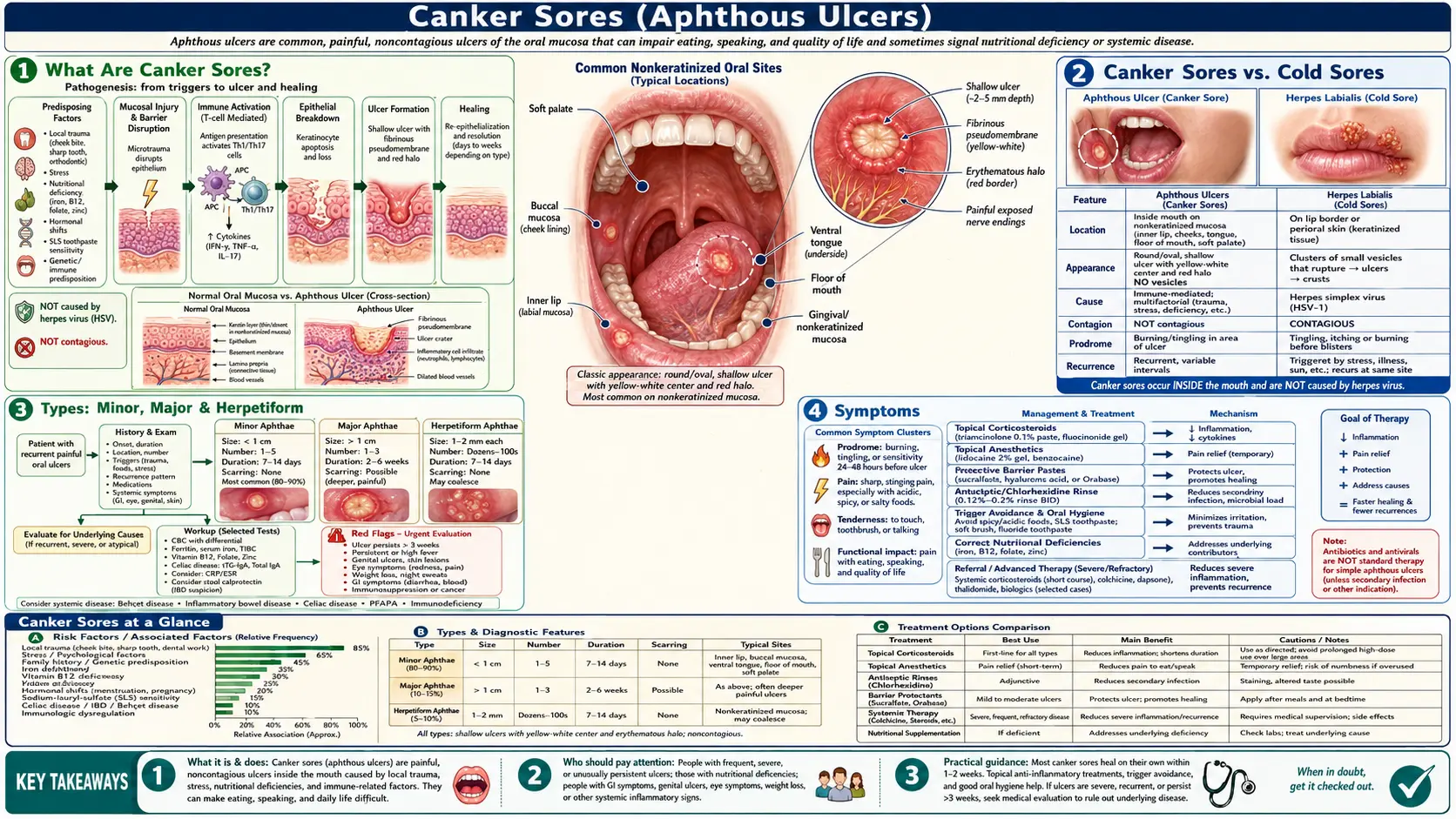
If you have ever felt a small, stinging crater appear on the inside of your lip or cheek — the kind that makes a sip of orange juice feel like an electric shock — you have almost certainly had a canker sore. Doctors call them aphthous ulcers, and the recurring pattern most people experience is recurrent aphthous stomatitis (RAS). Here is the reassuring news up front: canker sores are among the most common conditions of the human mouth, affecting roughly one in five people at some point. They are not contagious, they are not a sexually transmitted infection, and — this is the point most worth remembering — they are not caused by the herpes virus. They are not "cold sores." Most canker sores are small, heal on their own within one to two weeks without scarring, and never need a doctor. This page explains what they are, why people confuse them with cold sores, what triggers them, when a mouth ulcer is worth investigating, and the practical steps that genuinely reduce the pain and the frequency.
Table of Contents
- What Are Canker Sores?
- Canker Sores vs. Cold Sores
- Types: Minor, Major & Herpetiform
- Symptoms
- Triggers and Causes
- When They Signal Something Else
- Diagnosis
- Treatment
- Home Care and Prevention
- When to See a Doctor
- Key Research Papers
- Connections
- Featured Videos
What Are Canker Sores?
A canker sore is a small, shallow ulcer — an open break in the delicate lining (mucosa) inside the mouth. The medical term is an aphthous ulcer (from the Greek aphtha, meaning "eruption"), and the tendency to get them repeatedly is called recurrent aphthous stomatitis. It is the most common ulcerative disease of the oral mucosa worldwide, and it usually begins in childhood or adolescence, often becoming less frequent with age.
Canker sores form only on the soft, movable, non-keratinized tissue inside the mouth — the inner surface of the lips and cheeks, the floor of the mouth, the underside and sides of the tongue, and the soft palate at the back. This location is a diagnostic clue. They do not normally appear on the tough, tightly bound tissue such as the roof of the mouth (hard palate), the gums attached to the teeth, or the outside of the lips. A blister on the outer lip is almost never a canker sore.
A typical minor canker sore is round or oval, a few millimeters across, with a whitish-yellow or grayish center (a thin film of dead tissue called a pseudomembrane) ringed by a bright red, inflamed halo. That red border is a hallmark. Underneath the discomfort, the process is thought to be an immune-mediated one: T-lymphocytes and inflammatory signaling molecules such as tumor necrosis factor-alpha (TNF-α) attack a small patch of mucosa. It is not an infection that spreads, and you cannot "catch" a canker sore from someone else or give one to another person by kissing, sharing a drink, or sharing utensils.
Canker Sores vs. Cold Sores
This is the single most common source of confusion, so it is worth being crystal clear. Canker sores and cold sores are completely different conditions. They sound alike, both hurt, and both happen around the mouth — but the cause, the location, and whether they are contagious could not be more different.
Cold sores (also called fever blisters, or herpes labialis) are caused by the herpes simplex virus, usually HSV-1. They are contagious. They appear as clusters of small fluid-filled blisters, most often on the outside of the lip along the border where lip meets skin, or on the surrounding skin and nose. The blisters break, weep, and crust over into a scab. Once someone is infected, the virus stays dormant in the nerves for life and reactivates periodically, often triggered by sunlight, fever, or illness — hence "fever blister."
Canker sores, by contrast, are not caused by any virus, are not contagious, appear inside the mouth on soft tissue, and are flat ulcers rather than blisters. There is no dormant virus to reactivate.
| Feature | Canker Sore (Aphthous Ulcer) | Cold Sore (Herpes Labialis) |
|---|---|---|
| Cause | Immune-mediated; not infectious | Herpes simplex virus (usually HSV-1) |
| Contagious? | No | Yes — spread by contact with the sore or saliva |
| Location | Inside the mouth (inner lip, cheek, tongue, floor of mouth, soft palate) | Outside — the border of the lip, surrounding skin, nose |
| Appearance | Flat, shallow ulcer with a white/gray center and red halo | Cluster of fluid-filled blisters that crust over |
| Warning signs | Burning or tingling 1–2 days before it appears | Tingling/itching, then blisters; may accompany fever |
| Recurrence | Recurs, but each is a fresh event, not a reactivation | Same virus reactivates, often at the same spot |
A simple rule of thumb: inside the mouth and not contagious → canker sore. On the lip or face, blistering, and contagious → cold sore. Because they are viral, cold sores are the ones antiviral medicines (and remedies such as lysine) target — those approaches do nothing for canker sores.
Types: Minor, Major & Herpetiform
Clinicians recognize three forms of recurrent aphthous stomatitis. Knowing which type you tend to get helps set expectations for healing time and whether treatment is worth pursuing.
Minor Aphthous Ulcers
By far the most common form — roughly 80–85% of cases. These are the everyday canker sores: small (usually under 10 mm, often 2–8 mm), round or oval, shallow, and appearing singly or in small numbers of one to five. They are painful out of proportion to their size but heal within about 7 to 14 days and leave no scar. Most people who get canker sores only ever have this kind.
Major Aphthous Ulcers
About 10% of cases. Sometimes called Sutton disease, these are larger (over 10 mm), deeper, and much more painful. They can take several weeks to a few months to heal and may leave scarring. They tend to appear on the lips, soft palate, and throat, and can seriously interfere with eating and speaking. Major aphthae warrant a doctor's or dentist's evaluation, both to ease the pain and to rule out other causes of a large, slow-healing ulcer.
Herpetiform Ulcers
The least common form, roughly 5–10% of cases, and the most confusingly named. Despite the label "herpetiform," these have nothing to do with the herpes virus — the name simply reflects that the clusters can resemble the grouped pattern of a herpes outbreak. They present as crops of many tiny pinpoint ulcers (from ten up to a hundred at once), each only 1–3 mm across, which may merge into larger irregular sores. They tend to affect slightly older adults and are somewhat more common in women. Like minor ulcers, they generally heal within one to two weeks.
Symptoms
Many people feel a canker sore coming before they can see it. Common features include:
- A prodrome: a burning, tingling, or prickling sensation at the spot for a day or two before the ulcer actually forms.
- Pain, often surprisingly sharp for such a small lesion, made worse by eating, drinking (especially acidic, salty, or spicy items), talking, or brushing the area.
- A visible ulcer: round or oval, with a white-to-yellowish center and a distinct red inflamed rim.
- Location on movable tissue: inside the lips or cheeks, the tongue's underside or edges, the floor of the mouth, or the soft palate.
- Difficulty eating or speaking when the sore is large or well-placed to be irritated.
Simple minor canker sores usually cause no fever and no swollen glands. If a mouth ulcer comes with fever, widespread mouth blisters, swollen lymph nodes, skin rash, eye irritation, genital ulcers, or gut symptoms, that combination points away from ordinary canker sores and toward something that deserves medical attention (see below).
Triggers and Causes
There is no single cause of canker sores. The current understanding is that some people carry a genetic predisposition — canker sores often run in families, and having two affected parents substantially raises the odds — and that in those people, a variety of triggers can set off the immune reaction that produces an ulcer. Identifying and avoiding your personal triggers is often the most effective long-term strategy.
- Local trauma. Biting the inside of your cheek or lip, a poke from a toothbrush, sharp or hard foods (chips, crusty bread), braces, dentures, or dental work can all seed an ulcer at the injured spot.
- Stress and lack of sleep. Emotional stress and fatigue are among the most frequently reported triggers, and flares commonly cluster around exams, deadlines, and stressful life events.
- Sodium lauryl sulfate (SLS). This common foaming detergent in many toothpastes has been linked in several studies to more frequent canker sores in susceptible people. Switching to an SLS-free toothpaste is a low-cost experiment that helps some people noticeably.
- Acidic and certain trigger foods. Citrus fruits and juices, tomatoes, pineapple, vinegar, and other acidic foods can provoke or aggravate sores. Some people also link flares to chocolate, coffee, nuts, cheese, or strawberries — triggers are individual, and keeping a simple food diary can reveal a pattern.
- Hormonal changes. Some women notice canker sores appear in a predictable rhythm with their menstrual cycle, suggesting a hormonal influence in at least a subset of cases.
- Stopping smoking. Somewhat counterintuitively, canker sores are less common in smokers (tobacco thickens and keratinizes the mucosa), and some people experience a temporary increase after quitting. This is not a reason to smoke — the many harms of tobacco vastly outweigh a few extra mouth ulcers — but it explains a pattern some ex-smokers notice.
- Nutritional deficiencies. Low levels of iron, vitamin B12, folate, or zinc are found more often in people with recurrent canker sores than in the general population, and correcting a genuine deficiency can reduce recurrences. This link is important enough to have its own section below.
When They Signal Something Else
The overwhelming majority of canker sores mean nothing more than that you are prone to canker sores. But because mouth ulcers can be an outward sign of an internal problem, frequent, severe, or unusually persistent aphthous ulcers — especially if they start or worsen in adulthood — are worth a check for an underlying condition. The main ones to know about:
- Nutritional deficiency — iron, B12, and folate. A meaningful minority of people with recurrent aphthous stomatitis turn out to be low in iron, vitamin B12, folate (vitamin B9), or zinc. Classic research found that replacing a deficient nutrient could clear the ulcers in a substantial share of those patients, and a later randomized trial showed vitamin B12 supplementation reduced ulcer duration and pain even in some people whose blood levels were normal. This is why a simple blood panel is reasonable when sores are frequent.
- Celiac disease. Recurrent mouth ulcers can be one of the presenting features of celiac disease, an immune reaction to gluten that damages the small intestine and impairs absorption of iron, folate, and B12. If canker sores come with digestive symptoms, unexplained anemia, or a family history of celiac, ask about testing.
- Inflammatory bowel disease. Crohn's disease and ulcerative colitis can both produce aphthous-type mouth ulcers, sometimes before the bowel symptoms become obvious. Mouth sores paired with abdominal pain, diarrhea, or blood in the stool deserve evaluation.
- Behçet's disease. This rare inflammatory condition is defined in part by recurrent oral ulcers, and classically pairs them with recurrent genital ulcers, eye inflammation (uveitis), and skin lesions. Anyone with the combination of recurring mouth and genital ulcers should be evaluated for Behçet's disease.
- Immune and other systemic conditions. HIV infection and rare disorders of the white blood cells (such as cyclic neutropenia, more often seen in children) can also cause recurrent or unusually severe oral ulcers, which is why a doctor may look at the broader picture when ulcers are persistent and hard to control.
The practical takeaway: an occasional canker sore that heals in a week is normal and needs no workup. Ulcers that are relentless, severe, or accompanied by symptoms elsewhere in the body are the ones that may be pointing at something treatable underneath.
Diagnosis
Canker sores are diagnosed clinically — that is, by their appearance and history, not by a specific test. There is no blood test or swab that confirms an ordinary aphthous ulcer. A doctor or dentist typically recognizes them from a few features: the location on soft, movable tissue inside the mouth; the round shape with a gray-white center and red halo; the history of recurrence; and healing within one to two weeks.
Further testing is reserved for situations that do not fit that simple pattern:
- Blood tests — a complete blood count plus ferritin (iron stores), vitamin B12, and folate — when sores are frequent or severe, to catch a correctable deficiency or anemia.
- Celiac screening (antibody blood tests) if there are digestive symptoms or unexplained deficiency.
- Referral or biopsy for any single ulcer that fails to heal within two to three weeks, is unusually large or firm, or looks atypical — primarily to exclude oral cancer and other mucosal diseases. A non-healing solitary ulcer is the classic red flag that changes the situation from reassurance to investigation.
Importantly, if a clinician can see a cluster of blisters on the outer lip, or the sores are clearly contagious in pattern, the diagnosis shifts toward a cold sore (herpes) rather than an aphthous ulcer — and the management is entirely different.
Treatment
There is no cure that eliminates canker sores permanently, and minor ones will heal on their own regardless of treatment. The realistic goals of therapy are to relieve pain, speed healing, and reduce how often sores return. Treatment intensity should match severity: most people need nothing more than over-the-counter comfort measures, while frequent or major ulcers may justify prescription options.
Topical pain relief and protection
- Topical anesthetics such as benzocaine or lidocaine gels numb the sore briefly — useful right before meals. Follow label directions; benzocaine is not for infants.
- Protective pastes and barrier gels form a film over the ulcer to shield it from food and friction while it heals.
- Antiseptic mouthwash — chlorhexidine gluconate rinse — can reduce discomfort and secondary irritation and may shorten healing, though it can stain teeth with prolonged use.
Anti-inflammatory and prescription options
- Topical corticosteroids are the mainstay of medical treatment for troublesome canker sores. Triamcinolone acetonide in an oral paste, or more potent gels such as fluocinonide or clobetasol, and dexamethasone used as a rinse-and-spit, calm the inflammation and can cut pain and healing time when started early.
- Amlexanox paste, where available, is a topical anti-inflammatory specifically studied for aphthous ulcers.
- Systemic (whole-body) treatment — a short course of oral corticosteroids, or agents such as colchicine or pentoxifylline — is reserved for severe, major, or very frequent ulcers under specialist supervision. Thalidomide is effective for the most refractory cases but is used rarely and cautiously because it causes severe birth defects. Cochrane reviewers have noted that no single systemic treatment is reliably effective for everyone, which is why care is individualized.
When a deficiency is found, correcting it is itself a treatment: iron, B12, or folate replacement can markedly reduce recurrences in people who are genuinely low.
When to bring in a doctor or dentist
Consider professional care if canker sores are large (major type), keep coming back in tight succession, are severe enough to interfere with eating and drinking, or are not responding to over-the-counter measures. A dentist can also check whether a rough tooth, filling, or appliance is repeatedly injuring the same spot.
Home Care and Prevention
Most canker sores are managed entirely at home. These measures ease the pain and lower the odds of the next one:
- Rinse with warm salt water (about half a teaspoon of salt in a cup of warm water) or a baking soda rinse (one teaspoon of baking soda in warm water) a few times a day to soothe the area and keep it clean.
- Avoid known irritants while a sore is healing: acidic foods and drinks (citrus, tomato, soda), salty and spicy foods, and crunchy or sharp foods that scrape the ulcer.
- Eat soft, bland foods and stay hydrated. Cool foods like yogurt can be soothing, and probiotic foods such as yogurt may support a healthy oral microbiome.
- Try an SLS-free toothpaste if you get sores often — removing sodium lauryl sulfate helps some people.
- Use a soft-bristled toothbrush and brush gently to avoid injuring the mouth lining, and be careful eating hard or sharp foods.
- Keep a trigger diary. Noting foods, stress, sleep, and (for women) cycle timing around each flare often reveals a personal pattern you can then avoid.
- Manage stress and sleep, since both are common flare triggers.
- Address nutrition. A balanced diet with adequate iron, B12, folate, and zinc supports the mouth's lining; if sores are frequent, ask about testing rather than guessing at supplements.
When to See a Doctor
See a doctor or dentist if any of the following apply:
- A mouth ulcer that does not heal within two to three weeks — this is the most important red flag, because a persistent solitary ulcer needs to be checked to rule out oral cancer.
- Sores that are unusually large, deep, or spreading.
- Ulcers that recur very frequently or seem almost continuous.
- Pain that is not controlled by over-the-counter measures, or sores so painful you cannot eat or drink enough (risk of dehydration).
- Mouth ulcers accompanied by high fever, feeling generally unwell, a skin rash, eye irritation, genital ulcers, or digestive symptoms — combinations that suggest an underlying condition such as Behçet's disease, celiac disease, or inflammatory bowel disease.
- Sores that first appear or dramatically worsen in adulthood, especially with other new symptoms.
For the everyday canker sore, though, the message is simple and reassuring: it is common, it is not contagious, it is not herpes, and it will almost certainly heal on its own within a couple of weeks.
Key Research Papers
- Scully C, Porter S. Oral mucosal disease: recurrent aphthous stomatitis. British Journal of Oral and Maxillofacial Surgery. 2008;46(3):198-206.
- Scully C, Gorsky M, Lozada-Nur F. The diagnosis and management of recurrent aphthous stomatitis: a consensus approach. The Journal of the American Dental Association. 2003;134(2):200-207.
- Porter SR, Scully C, Pedersen A. Recurrent aphthous stomatitis. Critical Reviews in Oral Biology & Medicine. 1998;9(3):306-321.
- Chavan M, Jain H, Diwan N, Khedkar S, et al. Recurrent aphthous stomatitis: a review. Journal of Oral Pathology & Medicine. 2012;41(8):577-583.
- Ślebioda Z, Szponar E, Kowalska A. Etiopathogenesis of recurrent aphthous stomatitis and the role of immunologic aspects: literature review. Archivum Immunologiae et Therapiae Experimentalis. 2014;62(3):205-215.
- Akintoye SO, Greenberg MS. Recurrent aphthous stomatitis. Dental Clinics of North America. 2014;58(2):281-297.
- Baccaglini L, Lalla RV, Bruce AJ, Sartori-Valinotti JC, et al. Urban legends: recurrent aphthous stomatitis. Oral Diseases. 2011;17(8):755-770.
- Belenguer-Guallar I, Jiménez-Soriano Y, Claramunt-Lozano A. Treatment of recurrent aphthous stomatitis. A literature review. Journal of Clinical and Experimental Dentistry. 2014;6(2):e168-e174.
- Brocklehurst P, Tickle M, Glenny AM, Lewis MA, et al. Systemic interventions for recurrent aphthous stomatitis (mouth ulcers). Cochrane Database of Systematic Reviews. 2012;(9):CD005411.
- Barrons RW. Treatment strategies for recurrent oral aphthous ulcers. American Journal of Health-System Pharmacy. 2001;58(1):41-50.
- Volkov I, Rudoy I, Freud T, Sardal G, et al. Effectiveness of vitamin B12 in treating recurrent aphthous stomatitis: a randomized, double-blind, placebo-controlled trial. The Journal of the American Board of Family Medicine. 2009;22(1):9-16.
- Wray D, Ferguson MM, Mason DK, Hutcheon AW, et al. Recurrent aphthae: treatment with vitamin B12, folic acid, and iron. British Medical Journal. 1975;2(5969):490-493.
Live PubMed Searches
These links open live PubMed searches for the listed keywords — results update as new studies are indexed.
- Recurrent aphthous stomatitis treatment — PubMed search
- Aphthous ulcers etiology — PubMed search
- Canker sores and nutritional deficiency — PubMed search
- Topical corticosteroids for oral ulcers — PubMed search
- Behçet disease and oral ulcers — PubMed search
- Aphthous stomatitis in children — PubMed search
Connections
- ENT
- Gum Disease
- Cold Sores (Herpes Simplex)
- Lysine for Cold Sores
- Vitamin B12
- Vitamin B12 Deficiency
- Folate (Vitamin B9)
- Iron
- Zinc
- Celiac Disease
- Crohn's Disease
- Ulcerative Colitis
- Behçet's Disease
- Oral Microbiome
- Complete Blood Count
- Immunology
- Herbs covered on this site that discuss this condition: Betel Nut (Areca catechu) · Calendula · Kencur (Kaempferia galanga) · Licorice (Glycyrrhiza glabra) · Marshmallow Root