Horsetail as a Diuretic and for Urinary Health
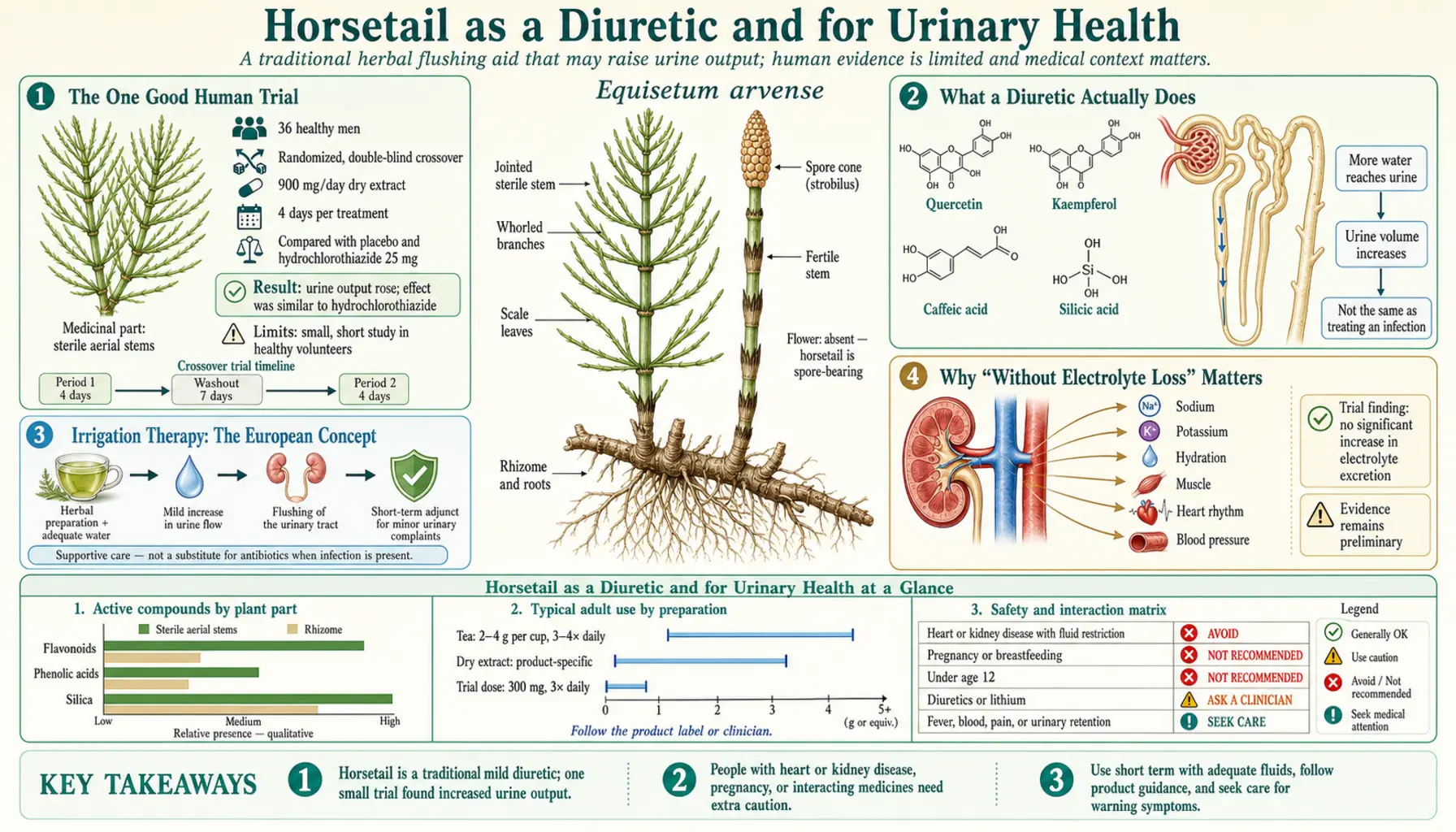
Of everything horsetail is sold for, this is the use with the best evidence — and, unusually, it is also the oldest use. Long before anyone measured silicon, European herbalism used horsetail as a “water herb”: a mild tea taken to increase urine flow and rinse through the urinary tract. Germany's Commission E, the expert body that reviewed herbal medicines for the German drug authority, recognised horsetail for irrigation therapy of the lower urinary tract and for supporting the passage of kidney gravel, always paired with drinking plenty of water.
Then in 2014 someone actually tested it properly, and the herb held up. A randomized, double-blind crossover trial in healthy volunteers compared a dried Equisetum arvense extract against placebo and against the standard thiazide diuretic hydrochlorothiazide, and the horsetail arm increased 24-hour urine output substantially more than placebo — broadly comparable to the drug — without the significant electrolyte disturbance the drug caused.
That result is the strongest thing in horsetail's file, and it changes the conversation in two directions at once. It makes the traditional use credible. It also means horsetail is a real pharmacological diuretic, which brings real interactions and real reasons not to take it casually. A herb that works is a herb that can do harm. This page covers both halves.
Table of Contents
- The One Good Human Trial
- What a Diuretic Actually Does
- Irrigation Therapy: The European Concept
- Why “Without Electrolyte Loss” Matters
- Urinary Tract Infections: Flushing Is Not Curing
- Kidney Gravel and Stones
- Fluid Retention and Swelling: Where This Goes Badly Wrong
- Bladder, Prostate and Incontinence Claims
- Interactions That Follow From Any Real Diuretic
- Water Weight, “Detox” and Drug Testing
- Preparation, Dose and Duration
- When to Stop and When to Get Seen
- Bottom Line
- Key Research Papers
- Connections
The One Good Human Trial
The study to know is Carneiro DM and colleagues, “Randomized, Double-Blind Clinical Trial to Assess the Acute Diuretic Effect of Equisetum arvense (Field Horsetail) in Healthy Volunteers,” published in Evidence-Based Complementary and Alternative Medicine in 2014.
Design features worth noting, because they are better than most herbal research:
- Randomized, double-blind, crossover. Each volunteer received each treatment in turn, so people served as their own comparison — a strong design for a measurement as variable as urine output.
- Three arms: a standardised dried E. arvense extract, placebo, and hydrochlorothiazide as an active comparator. Including a real drug is unusual and it is what makes the result interpretable.
- Objective primary endpoint: measured urine volume over 24 hours, with electrolyte excretion measured alongside.
- Result: horsetail produced significantly greater urine output than placebo, of an order comparable to the thiazide, and did so without the significant changes in electrolyte excretion seen in the drug arm.
The limits are equally worth stating, because they define what the trial licenses you to believe. It was small. It enrolled healthy adult men, not patients. It was acute — a short dosing window, not weeks or months. And it is one study: a single well-run trial is a promising signal, not a settled fact, and it has not been replicated at scale. Tier: randomized clinical trial — small, acute, healthy volunteers. PubMed search: acute diuretic effect of Equisetum arvense
What the trial establishes: horsetail extract meaningfully increases urine volume in humans. What it does not establish: that it helps any disease, that it is safe over months, or that it can substitute for prescribed diuretic therapy in anyone who needs that therapy.
What a Diuretic Actually Does
It helps to be concrete, because “diuretic” is used loosely in supplement marketing to mean something vaguely cleansing.
Your kidneys filter a very large volume of plasma every day and then reabsorb almost all of the water and most of the dissolved salts back into the blood. Urine is what is left after that reabsorption. A diuretic increases urine output by interfering with reabsorption — usually by blocking a specific sodium transporter in a specific segment of the nephron. Water follows sodium, so blocking sodium reabsorption means more water leaves. This is how thiazides, loop diuretics and potassium-sparing agents each work, at different points along the tubule, with different electrolyte consequences.
Plant diuretics generally act less specifically. Proposed mechanisms include increased renal blood flow, effects on sodium handling, osmotic contributions from the potassium and other solutes in the herb itself, and simply the volume of fluid you drink to take a tea. Which of these dominates for horsetail has not been resolved, and the 2014 trial measured the outcome rather than the mechanism. Tier: mechanism unresolved. PubMed search: herbal diuretic mechanism renal sodium handling For an interactive look at how the nephron handles filtration and reabsorption, see the kidney nephron visualization.
The practical consequence of any diuretic: more urine, some degree of volume loss, and a shift in electrolyte balance. That is useful in some situations, irrelevant in most, and dangerous in a few.
Irrigation Therapy: The European Concept
Irrigation therapy (Durchspülungstherapie in the German literature) is a concept English-language health writing largely lacks, and it explains what horsetail traditionally was and was not for. The idea is deliberately modest: increase urine flow so that the lower urinary tract is rinsed more frequently and more copiously, in order to discourage bacterial establishment and help small particles pass. It is explicitly supportive and preventive, not antibacterial and not curative. Its instructions always include drinking a large volume of fluid — the herb is the prompt, the water does the rinsing.
Commission E's positive assessment of horsetail was for exactly this: post-traumatic and static oedema of the lower limbs as an internal use in some formulations, and irrigation of the lower urinary tract along with support for passing kidney gravel. Crucially, its monograph also carried a contraindication for irrigation therapy in the presence of heart or kidney insufficiency — because in those conditions loading a person with fluid and increasing urine output is a medical decision, not a herbal one. European regulatory treatment since then has been more cautious still, treating horsetail as a traditional herbal medicinal product with restricted duration of use rather than a proven therapy.
Understanding irrigation therapy resolves a lot of confusion. A tradition that says “drink plenty of water with this herb to flush your bladder” is not making the claim that modern marketing makes when it says horsetail “fights urinary infections.” Tier: traditional use with regulatory recognition.
Why “Without Electrolyte Loss” Matters
The most interesting detail in the 2014 trial is not the urine volume — it is the electrolytes.
Thiazide and loop diuretics are effective drugs with a well-known cost: they drag electrolytes out with the water. Hypokalaemia (low potassium) is the classic problem, and it is not trivial. Low potassium causes muscle weakness and cramping, fatigue, constipation, and disturbances of cardiac rhythm; it is also what makes digoxin dangerous, because a heart low in potassium becomes far more sensitive to that drug. Thiazides can additionally lower sodium and magnesium and raise uric acid and blood glucose. Monitoring blood chemistry is a routine part of prescribing them for exactly these reasons.
The horsetail arm increased urine output without producing significant changes in the electrolyte excretion measured. If that finding is real and holds over longer use, it would be genuinely interesting — a diuretic effect with a gentler electrolyte profile.
Three cautions before treating it as established. First, the study was acute; short-term electrolyte stability says little about weeks of daily use. Second, the participants were healthy, with normal kidneys and normal regulatory reserve; the people at risk of electrolyte trouble are the elderly, those on other medications and those with impaired kidneys. Third, absence of a significant change in a small trial is weak evidence of no effect — a study of that size lacks the power to exclude a modest one. Anyone taking horsetail regularly and also taking a medication where potassium matters should be having potassium measured, not reasoning from a single healthy-volunteer study. See potassium deficiency and kidney function tests. PubMed search: diuretic-induced hypokalaemia
Urinary Tract Infections: Flushing Is Not Curing
Horsetail is widely marketed for urinary tract infections, and this is where the claim most needs qualifying.
What is reasonable. Increased urine flow genuinely reduces the time bacteria spend in contact with the bladder wall and mechanically removes some of them. This is not folklore — it is why frequent, complete voiding and good fluid intake are standard advice for people with recurrent cystitis, and increasing fluid intake has been shown in trials to reduce recurrence in women prone to repeated infections. A herb that prompts you to drink more and increases urine output slots into that logic as a supportive measure. Tier: the fluid-intake principle has randomized support; horsetail's own contribution does not. PubMed search: increased water intake and recurrent cystitis
What is not reasonable. Treating an established urinary infection with horsetail instead of getting it assessed. There is no clinical evidence that horsetail eradicates urinary pathogens. Laboratory studies report antimicrobial activity of Equisetum extracts against various organisms, as they do for most plant extracts, and in-vitro antimicrobial activity is a famously poor predictor of clinical effect — the concentrations achieved in a dish are not the concentrations achieved in a bladder. Tier: preliminary (in vitro) only. PubMed search: Equisetum arvense antibacterial activity
Untreated urinary infection can ascend to the kidneys, and pyelonephritis is a serious illness. Fever, flank or back pain, shaking chills, vomiting, blood in the urine, symptoms in a man, symptoms in pregnancy, or symptoms that are not settling all warrant medical assessment rather than a herb. See urinary tract infections.
Kidney Gravel and Stones
“Kidney gravel” is the traditional term for the small crystalline sand that can form in the urinary tract, and helping it pass is the second historical indication for horsetail. The rationale is again the flow: a larger, more dilute urine volume both discourages crystals from forming and helps small ones move along.
That principle is solid, and it does not depend on the herb. High fluid intake is the single best-evidenced measure for preventing recurrent kidney stones, with randomized support, and urologists prescribe it as a target volume of urine per day rather than as a number of glasses. A herb that increases urine volume is at least pointing in the right direction.
Horsetail's own stone evidence is preliminary. Rodent studies in induced-urolithiasis models have reported reduced crystal deposition with Equisetum extracts, and there is a broader herbal antiurolithiatic literature of similar quality. No human stone-prevention trial of horsetail exists. Tier: preliminary (animal). PubMed search: Equisetum arvense antiurolithiatic calcium oxalate
Two practical cautions specific to stones. Stone prevention depends on stone type — calcium oxalate, uric acid, cystine and struvite stones need different strategies, which is why stone analysis and a metabolic workup matter more than any supplement. And an obstructing stone is an emergency-adjacent problem: severe colicky flank pain, fever with pain, or inability to pass urine needs urgent care, not a diuretic tea, because increasing urine production behind an obstruction can make pain worse. See kidney stones, the kidney stone formation visualization, and chanca piedra for kidney stones.
Fluid Retention and Swelling: Where This Goes Badly Wrong
This section exists because it is the most likely way horsetail causes real harm, and it is almost never discussed.
Swollen ankles are a symptom, not a diagnosis. The causes range from the benign — standing all day in hot weather, a long flight, premenstrual fluid shifts, mild venous insufficiency — to the serious: heart failure, kidney disease, liver disease with low albumin, deep vein thrombosis, and drug side effects. A herbal diuretic will reduce the visible swelling in several of those conditions without touching the cause, which means it can mask a deteriorating heart or kidney for weeks while the underlying problem advances.
Commission E's own contraindication for irrigation therapy in heart or kidney insufficiency was written for this reason. In heart failure and kidney disease, fluid balance is actively managed with measured doses, daily weights and blood tests; adding an unmeasured herbal diuretic on top of prescribed therapy risks over-diuresis, low blood pressure, dizziness, falls, worsening kidney function and electrolyte disturbance.
New, asymmetric, painful, or progressive swelling should be assessed before anything else — particularly with breathlessness, breathlessness lying flat, waking at night short of breath, rapid weight gain, reduced urine output, or calf pain and tenderness in one leg. See kidney disease.
The one legitimate traditional context is mild, benign, positional fluid retention in an otherwise healthy person — and even there, elevation, movement, compression and reducing salt do more than any herb.
Bladder, Prostate and Incontinence Claims
Horsetail turns up in formulas aimed at bladder control and prostate symptoms, and the reasoning there deserves scrutiny, because it can run backwards.
Incontinence and overactive bladder. A diuretic increases urine volume and therefore increases urinary frequency and urgency. For someone whose complaint is frequency, urgency or leakage, that is the opposite of helpful. Horsetail sometimes appears in these formulas on the strength of its astringent, tissue-tightening reputation, which is a topical property rather than a systemic one. The honest position: an oral diuretic is a poor choice for a storage-symptom problem. See overactive bladder and urinary incontinence.
Prostate enlargement. Benign prostatic hyperplasia obstructs outflow. Producing more urine does not relieve obstruction and can worsen nocturia and urgency; in significant obstruction, brisk diuresis risks acute retention. Horsetail has no evidence base for prostate size or urinary flow rates. Herbs with at least some relevant trial evidence are different herbs. See benign prostatic hyperplasia and saw palmetto.
Interstitial cystitis and bladder pain. Also often marketed to, also without evidence, and increasing urine volume can aggravate frequency in some people while diluting irritants in others. Unpredictable, untested. See interstitial cystitis. Tier for all three: traditional use or marketing only.
Interactions That Follow From Any Real Diuretic
Because the diuretic effect is real, the interactions are real. These are the ones that matter.
- Lithium. The most important. Lithium is handled by the kidney much like sodium; diuretics and volume depletion reduce its clearance and can push blood levels into the toxic range. Lithium toxicity causes tremor, vomiting, confusion, unsteadiness and can be life-threatening. Do not combine horsetail with lithium.
- Prescription diuretics — thiazide, loop or potassium-sparing. Stacking diuretic effects risks volume depletion, low blood pressure and electrolyte disturbance. If a doctor has prescribed a diuretic, the dose was chosen; do not add an unmeasured one.
- Digoxin. Its toxicity is potassium-dependent. Anything that might lower potassium raises the risk of dangerous rhythm disturbance.
- ACE inhibitors, angiotensin receptor blockers and other antihypertensives. Additive blood-pressure lowering and dizziness, plus effects on kidney function when volume-depleted.
- Non-steroidal anti-inflammatory drugs. The combination of an NSAID, a diuretic and a renin-angiotensin blocker is a recognised recipe for acute kidney injury when someone becomes volume-depleted.
- Corticosteroids and stimulant laxatives, which can independently lower potassium.
- Anything requiring careful hydration — and note that the herb's thiaminase is itself a reason for caution in people already losing thiamine through diuresis, which is discussed in the safety article.
Note the pattern: none of these interactions is exotic herbal pharmacology. They are the standard interactions of a diuretic, and horsetail earns them by working.
Water Weight, “Detox” and Drug Testing
Three misuses worth naming directly.
Weight loss. Horsetail appears in “water weight” and slimming products. Diuresis removes fluid, not fat. The scale moves, nothing about body composition changes, the fluid returns within a day or two of stopping, and the practice encourages dehydration. There is no legitimate weight-management role for a diuretic herb.
“Detox.” Urine volume is not the rate-limiting step in eliminating anything. Kidneys clear what they clear; making more dilute urine does not increase the removal of “toxins” in any meaningful sense, and the word is doing marketing work rather than physiological work here.
Competitive sport. Diuretics are on the World Anti-Doping Agency prohibited list, both in their own right and as masking agents that dilute urine samples. An athlete subject to testing should treat any product marketed as a diuretic — herbal included — as a hazard, and should check the specific product against current anti-doping guidance rather than assuming “herbal” means “permitted.”
Preparation, Dose and Duration
Traditional and regulatory practice converge on a fairly narrow picture.
- Form. A tea from the dried aerial stems is the traditional preparation. For urinary irrigation the water volume is part of the therapy, so tea suits the purpose better than capsules do.
- Frequency. Traditional practice is one to a few cups spread through the day, with a large total fluid intake alongside — and not in the evening, since the whole point is more urine and broken sleep is the predictable result.
- Duration. Short. This is not a herb for indefinite daily use, both because of thiaminase and because ongoing diuresis is not a neutral state. European traditional-use guidance restricts duration explicitly, and the practical reading is a course of weeks with a clear end point, not a permanent habit.
- Species. Equisetum arvense on the label, from a supplier that tests identity. Equisetum palustre is a toxic look-alike.
- Water. Every historical description of irrigation therapy insists on generous fluid intake. Taking a diuretic without drinking is simply dehydration.
Specific milligram doses are not given here because there is no clinically established one, and the extract used in the 2014 trial was a particular standardised preparation rather than the herb generally. Follow a reputable product's directions and treat any number on a label as the manufacturer's choice.
When to Stop and When to Get Seen
Stop the herb and seek advice if any of these appear:
- Dizziness on standing, lightheadedness, unusual thirst, dark and scanty urine — signs of volume depletion.
- Muscle cramps, weakness, palpitations or an irregular heartbeat — possible electrolyte disturbance.
- Fever, flank or back pain, chills, vomiting, or blood in the urine — possible kidney infection or stone.
- Severe colicky pain, or inability to pass urine — urgent assessment.
- Increasing breathlessness, breathlessness lying flat, or rapid weight gain — these point at the heart, and a herb is not the answer.
- Any numbness, tingling, unusual fatigue, appetite loss or confusion during prolonged use — consider thiamine, and read the safety article.
Bottom Line
The diuretic use is horsetail's real one. A single well-designed randomized trial in healthy volunteers found that Equisetum arvense extract increased 24-hour urine output comparably to a thiazide without the same electrolyte disturbance, which is a better result than most herbs ever achieve and which vindicates the oldest thing anyone ever did with this plant. As a short-course supportive measure for lower-urinary-tract irrigation, taken with plenty of water in an otherwise healthy person, it is a defensible traditional choice.
And precisely because it works, it is not casual. It does not treat an infection, it does not dissolve stones, it is a poor idea for urgency, frequency or prostate obstruction, it must never be taken with lithium, it should not be stacked on prescribed diuretics, it has no legitimate role in weight loss or “detox,” it is a doping-control hazard for tested athletes, and using it to reduce swelling without knowing why the swelling is there can hide a failing heart or kidney. Use it short, use it hydrated, use it in the right person, and get the swelling or the urinary symptom properly explained first.
Key Research Papers
Cited as PubMed topic searches. Titles, journals and years are stated where confident; otherwise the finding is described and the search surfaces the literature.
- Carneiro DM and colleagues. Randomized, Double-Blind Clinical Trial to Assess the Acute Diuretic Effect of Equisetum arvense (Field Horsetail) in Healthy Volunteers. Evidence-Based Complementary and Alternative Medicine, 2014. Horsetail extract versus placebo versus hydrochlorothiazide; greater urine output than placebo, comparable to the drug, without the drug's electrolyte changes. Tier: randomized clinical trial, small and acute. PubMed search
- Herbal diuretics and renal electrolyte handling. The wider literature on plant diuretics, their proposed mechanisms and their effects on sodium and potassium excretion. Tier: mixed, mostly preclinical. PubMed search
- Antiurolithiatic activity of Equisetum in animal models. Rodent studies of crystal deposition and stone formation with horsetail extracts. Tier: preliminary (animal). PubMed search
- Fluid intake and recurrent cystitis. Randomized evidence that increasing daily water intake reduces recurrence of urinary infection in prone women — the mechanism irrigation therapy borrows. Tier: randomized clinical trial. PubMed search
- Fluid intake and kidney stone recurrence. The best-established preventive measure in stone disease, and the reason a urine-volume target is prescribed. Tier: randomized and cohort evidence. PubMed search
- In-vitro antimicrobial activity of Equisetum extracts. Laboratory antibacterial screening — the basis for UTI marketing, and a poor predictor of clinical effect. Tier: preliminary (in vitro). PubMed search
- Diuretic-induced hypokalaemia and its consequences. Why the electrolyte finding in the horsetail trial is the interesting part, and why potassium matters clinically. Tier: established clinical medicine. PubMed search
- Diuretics and lithium clearance. The interaction that makes this combination genuinely dangerous. Tier: established pharmacokinetics. PubMed search
- NSAID, diuretic and renin-angiotensin blocker combination and acute kidney injury. The classic three-way interaction that turns volume depletion into kidney injury. Tier: human observational. PubMed search
- Peripheral oedema: causes and evaluation. Why swelling has to be explained before it is treated, and how often the answer is cardiac, renal or hepatic. Tier: clinical reviews. PubMed search
- Gründemann C and colleagues. Equisetum arvense (common horsetail) modulates the function of inflammatory immunocompetent cells. BMC Complementary and Alternative Medicine, 2014. Cell-level immune effects, often over-read as clinical anti-inflammatory action. Tier: preliminary (in vitro). PubMed search
- Diuretics as prohibited substances and masking agents in sport. Relevant to any tested athlete considering a herbal diuretic. Tier: regulatory and analytical literature. PubMed search
Connections
- All Herbs
- Horsetail (main page)
- Horsetail: Benefits Deep Dive
- Horsetail, Silica and Bone Health
- Horsetail Safety and Dose Limits
- Urinary Tract Infections
- Kidney Stones
- Overactive Bladder
- Urinary Incontinence
- Interstitial Cystitis
- Benign Prostatic Hyperplasia
- Kidney Disease
- Kidney Stones (Nephrology)
- Kidney Function Tests
- Potassium
- Potassium Deficiency
- Dandelion
- Uva Ursi
- Chanca Piedra: Kidney Stone Protocol
- Saw Palmetto
- Visualization: Kidney Nephron
- Visualization: Kidney Stone Formation
Safety and disclaimer. This page is educational and is not medical advice. Horsetail is a genuine diuretic: do not combine it with lithium, do not add it to prescribed diuretic therapy, and use caution with digoxin, blood-pressure medication and non-steroidal anti-inflammatory drugs. It is not a treatment for urinary infection and it does not dissolve stones. Never use it to reduce swelling that has not been explained — oedema can be the first sign of heart, kidney or liver disease. Avoid it in pregnancy and breastfeeding, in children, in kidney disease or heart failure, and with low thiamine status; use only correctly identified Equisetum arvense, in short courses, with generous fluid intake.