Chanca Piedra Kidney-Stone Protocol
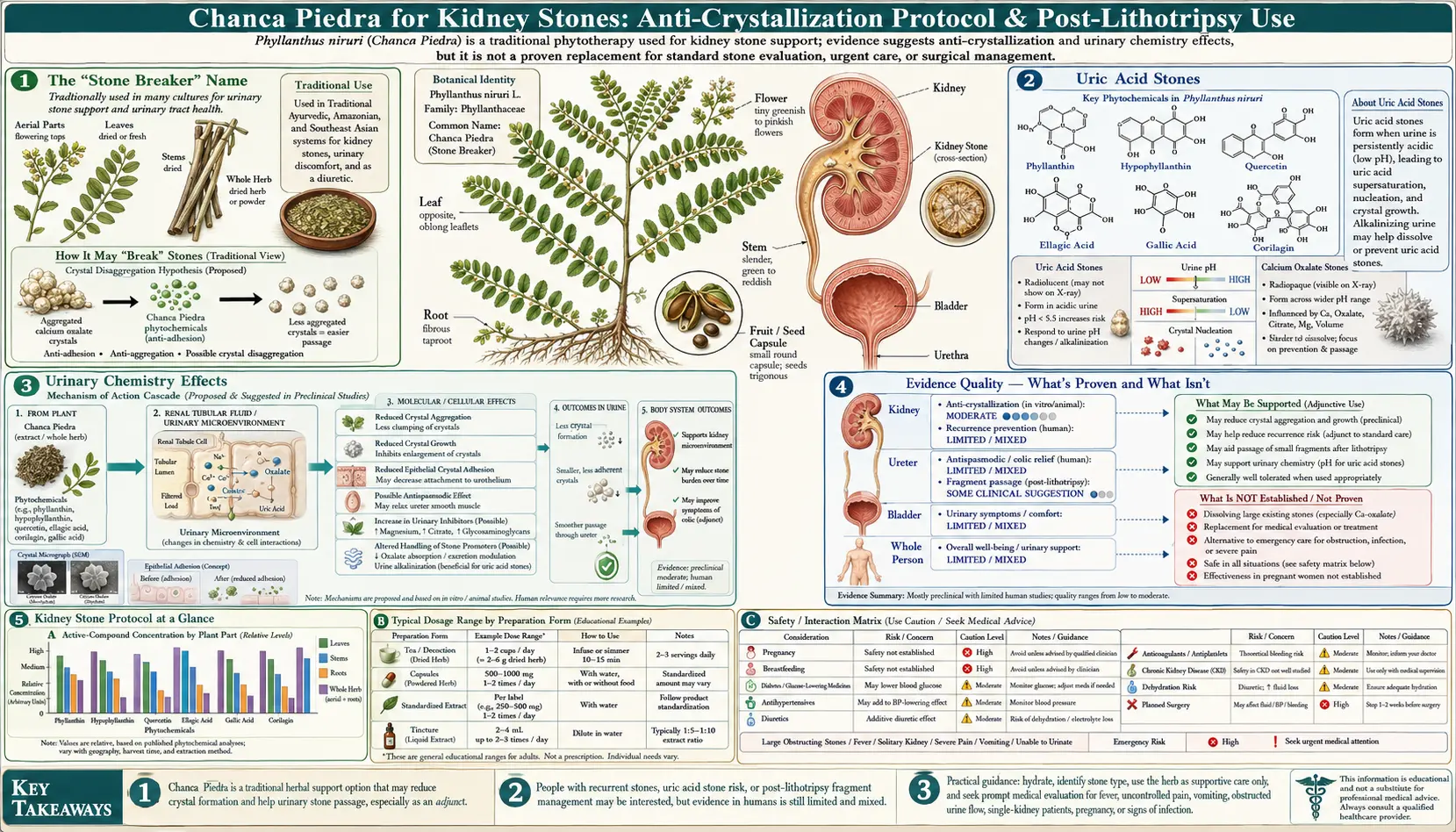
The Portuguese name chanca piedra means “stone breaker,” and the Spanish-speaking Amazon has used Phyllanthus niruri for urolithiasis for at least four centuries. This page is the practical, step-by-step protocol: who should attempt herbal-assisted stone passage at home, how to combine the herb with hydration and pH management, what timeline to expect, how to integrate with conventional urology (lithotripsy, ureteroscopy, nephrology follow-up), and the red flags that should send you to the emergency department immediately. The companion Kidney Stones Benefits page reviews the underlying clinical-trial evidence; this page operationalizes it. None of this replaces a urologist’s judgement about your specific stone — it gives you a structured framework for the patient-facing decisions.
Table of Contents
- Overview — What the Protocol Is and Who It’s For
- Stone Types and Mechanism of Action
- Pre-Protocol Assessment
- Daily Protocol — Step by Step (Acute Phase)
- Maintenance Phase — Recurrence Prevention
- Combining with Conventional Care
- Expected Timeline and Signs of Progress
- Drug Interactions and Cautions During Protocol
- Red Flags — When to Stop and Seek ER Care
- References
- Connections
- Featured Videos
Overview — What the Protocol Is and Who It’s For
This protocol is a structured 2- to 4-week home regimen designed to (a) reduce crystal aggregation in the renal pelvis and ureter, (b) relax ureteral smooth muscle to ease stone passage, and (c) increase urine flow rate so existing stones move and new ones don’t form. It is built around standardized Phyllanthus niruri extract, aggressive but controlled hydration, dietary pH management, and ureteric symptom tracking. It is not a stand-alone cure: it is the patient-facing scaffolding around a urology workup.
Who this protocol is reasonable for:
- Imaging-confirmed kidney or upper-ureteral stone, single, under 7 mm in greatest diameter, with no proximal hydronephrosis severe enough to require intervention
- Recurrent stone formers in a quiescent phase, using the herb adjunctively to reduce recurrence between episodes
- Patients with multiple small (under 4 mm) calcium-oxalate fragments after extracorporeal shock-wave lithotripsy (ESWL) or ureteroscopy with laser lithotripsy, where the fragments need to clear the lower urinary tract
- Adults with no contraindication to the herb (see Safety) and reliable access to oral hydration
- Patients who can return for urology re-imaging in 2–4 weeks if symptoms persist
Who this protocol is NOT for:
- Anyone with a stone over 7 mm, a staghorn calculus, or bilateral obstructing stones — intervention required
- Pregnant patients (Chanca Piedra is not established as safe in pregnancy, and pregnant patients with obstructing stones need urologic and obstetric co-management)
- Single-functioning kidney (any obstruction is an urgency, even of a small stone)
- Suspected infected obstruction — fever, chills, dysuria with flank pain is a urologic emergency
- Severe hydronephrosis on imaging or a creatinine that has bumped upward during the current episode
- Children and adolescents (different stone biology, different evidence base, urology referral)
- Patients on lithium, warfarin, tacrolimus, or cyclosporine without explicit pharmacy review
The protocol is most useful as a structured way to give an in-the-window stone a fair chance to pass spontaneously while you stay in contact with your urology team. It is least useful as a substitute for imaging or for clinical follow-up.
Stone Types and Mechanism of Action
Kidney stones are not a single disease. Composition drives everything: dietary changes, urinary pH targets, the antibiotic question, and the herb’s likely usefulness. The major types in adults:
- Calcium oxalate (CaOx) — about 70% of stones. Forms in acidic-to-neutral urine. Driven by hypercalciuria, hyperoxaluria, hypocitraturia, low fluid intake. Chanca Piedra has its strongest mechanistic and clinical evidence for this stone type.
- Calcium phosphate (CaP) — about 15%, often mixed with CaOx. Forms in alkaline urine. Driven by hypercalciuria, alkaline urine (renal tubular acidosis), urinary tract infection-related alkalinization. Acidifying dietary measures may help; over-alkalinization with citrate can worsen this stone type.
- Uric acid — about 10%. Forms in acidic urine (pH under 5.5) regardless of serum urate. Driven by metabolic syndrome, insulin resistance, low urine volume. Highly amenable to medical dissolution by alkalinizing the urine to pH 6.5–7.0 with potassium citrate.
- Struvite (magnesium ammonium phosphate) — about 5%. Forms only in the presence of urea-splitting bacterial infection (Proteus, Klebsiella, Pseudomonas). Cannot be passed conservatively; requires antibiotic-plus-stone-removal management.
- Cystine — under 1%. Genetic; autosomal recessive cystinuria. Forms recurrent staghorn calculi; requires specialty management.
How Chanca Piedra works against calcium-oxalate stones — mechanistic synthesis:
- Anti-nucleation / anti-crystallization. Aqueous and hydroalcoholic extracts of P. niruri increase the “metastable limit” for calcium oxalate, the supersaturation level above which crystals nucleate. In Barros et al.’s and Nishiura et al.’s rat and human studies, urine from Phyllanthus-treated subjects required higher oxalate concentrations before crystals formed, and the crystals that did form were smaller and less prone to aggregation.
- Glycosaminoglycan-like coating effect. Phyllanthus extracts increase urinary glycosaminoglycans (GAGs), which coat developing crystals and inhibit their attachment to renal tubular cells. This is the same mechanism that endogenous GAGs and Tamm-Horsfall protein use.
- Smooth-muscle relaxation of the ureter. The herb’s lignans (phyllanthin, hypophyllanthin) and ellagitannins (geraniin, corilagin) produce a mild calcium-channel-blocker-like effect on ureteral smooth muscle, reducing the spasm component of renal colic and easing transit. This is plausibly why patients on Chanca Piedra report a less crampy passage experience.
- Mild diuresis. Increases urine output by a measurable but modest amount, helping clear small stones and fragments. The diuresis is not driven by potent salt-wasting; it is a soft, sustained effect.
- Geraniin to urolithins. The ellagitannin geraniin is metabolized by gut microbiota into urolithins, which provide systemic anti-inflammatory cover during the irritation phase of stone passage. This is the same urolithin pathway active for pomegranate ellagitannins.
- Reduced hypercalciuria. Micali and colleagues showed that idiopathic hypercalciuria patients on P. niruri had reduced 24-hour urinary calcium excretion, a finding consistent with normalized renal calcium handling rather than reduced calcium intake.
For uric-acid stones, the dominant intervention is urinary alkalinization with potassium citrate — Chanca Piedra is at best secondary. For struvite, the dominant intervention is antibiotic eradication of the urea-splitting infection plus mechanical stone clearance — Chanca Piedra is not indicated.
Pre-Protocol Assessment
Do not start the protocol blind. The minimum workup before deciding the herb is reasonable for a current episode:
Imaging confirmation:
- Non-contrast CT of the abdomen and pelvis (low-dose stone protocol) is the gold standard. It confirms presence, position, and greatest diameter to the nearest millimeter, identifies hydronephrosis, and reveals second stones.
- Renal ultrasound is the radiation-free alternative for follow-up or for the first imaging in younger patients and pregnancy. Less sensitive for ureteral stones in the mid-ureter, but adequate for proximal and distal stones and for grading hydronephrosis.
- KUB plain film is now mostly used for follow-up of known radio-opaque stones to track migration; insufficient as the primary diagnostic.
What the imaging needs to tell you before starting the protocol:
- Stone size — under 4 mm: high spontaneous passage probability (around 80%); 4–6 mm: moderate (around 60%); 6–7 mm: borderline (around 30%); over 7 mm: low (under 20%) and increasingly likely to need intervention
- Stone location — lower-ureteral stones pass more readily than mid- or proximal-ureteral stones of equivalent size; renal-pelvis stones must first transit through the ureteropelvic junction
- Hydronephrosis grade — mild (grade 1–2) is acceptable for outpatient management; moderate-to-severe (grade 3–4) is an indication for prompt urology involvement
- Single versus bilateral — bilateral obstructing stones is a urologic urgency
- Second-functioning kidney confirmed (anyone with a known solitary kidney needs urology in real time, not herb-and-hope)
Labs to baseline:
- Serum creatinine, eGFR, BUN — baseline renal function
- Complete blood count — to detect infection (leukocytosis)
- Urinalysis with microscopy — pH, specific gravity, blood, leukocyte esterase, nitrite, crystal type if seen
- Urine culture — mandatory if any infectious symptoms, leukocyte esterase positive, or nitrite positive
- Serum calcium, uric acid, phosphorus, sodium, potassium, chloride, bicarbonate — metabolic baseline
- 24-hour urine for calcium, oxalate, citrate, uric acid, sodium, magnesium, creatinine, volume (the standard recurrent-stone workup, done at least two weeks after the acute episode resolves)
- If stone is retrieved, send for stone composition analysis by infrared spectroscopy or X-ray diffraction — this is the single most useful piece of data for long-term recurrence prevention
Hard contraindications — do not attempt herb-assisted passage if any are present:
- Stone over 7 mm
- Stone in a single functioning kidney
- Bilateral obstructing stones
- Fever, sepsis signs, or any suggestion of infected obstruction (white blood cells in urine plus stone is an emergency)
- Moderate-to-severe hydronephrosis (grade 3 or 4)
- Creatinine rise from baseline during the current episode
- Pregnancy
- Inability to maintain oral hydration (vomiting refractory to anti-emetics)
- Anatomical urinary tract abnormality (horseshoe kidney, ureteropelvic junction obstruction, ureterocele) without urology guidance
Daily Protocol — Step by Step (Acute Phase)
The acute phase runs for 2–4 weeks from the start of symptoms or from a recent procedure. The goal is spontaneous passage of the index stone (or post-procedure fragments) while supporting symptom control.
Hydration
The single most important variable. The goal is at least 2.5 to 3.5 liters of urine output per 24 hours, which usually requires 3–4 liters of fluid intake spread evenly across waking hours plus 250–500 mL on waking if you got up overnight.
- Drink steadily, not in surges. Aim for 250–350 mL every waking hour.
- Water is the base. Plain mineral waters with low calcium and moderate-to-high bicarbonate (San Pellegrino, Gerolsteiner, Vichy, Apollinaris) are useful for both CaOx and uric-acid stones; the alkalinizing effect is a small bonus on top of the volume.
- Add fresh lemon juice (juice of half a lemon per 500 mL) for citrate — citrate is the body’s natural inhibitor of CaOx and CaP crystallization.
- Limit soda, sweetened drinks, and concentrated fruit juices — the fructose load increases urinary uric acid and oxalate.
- Coffee in moderation is acceptable and may be slightly protective; check the Coffee page for the evidence.
- Alcohol is best avoided during acute passage — the rebound dehydration overnight is the wrong direction.
Confirm urine output is on target. Bladder volumes correspond loosely to color: pale straw is the goal, dark amber means you are behind on fluid, clear-and-frequent is fine. If you are not voiding at least every 2–3 hours during the day, you are not drinking enough.
Chanca Piedra dosing — acute phase
- Capsule, standardized extract — 400–500 mg of standardized P. niruri aerial-parts extract, taken three times daily with meals. This is the most reproducible dose form and the closest to the dosing used in published clinical trials (Nishiura, Micali).
- Liquid extract / tincture — 2–3 mL (about 40–60 drops) of a 1:5 hydroalcoholic tincture, three times daily, diluted in 100 mL water with meals.
- Traditional decoction (tea) — 1 tablespoon dried herb simmered in 1 L water for 10 minutes, drunk over the day in three or four portions. Less reproducible extractive efficiency than capsules; reasonable as a supplement to capsule dosing for the hydration value.
See the Forms, Dosing and Standardization page for the full dosing matrix, brand notes, and shelf-life considerations.
Timing: with meals; the meal-protein context helps stabilize gastric tolerance and the lignans absorb well in a mixed-meal matrix. Avoid taking it within an hour of black or green tea (tannins compete for absorption).
Urine pH targeting
pH matters more than people realize. Buy pH test strips (range 4.5 to 8.0) and check first-morning urine and one mid-afternoon void daily for the first week.
- Calcium-oxalate stones — target 6.5 to 7.0. Don’t go above 7.2 (CaP crystallization risk) or below 6.0 (encourages CaOx aggregation).
- Calcium-phosphate stones — the target is harder: 6.0 to 6.5, slightly more acidic. Do not aggressively alkalinize.
- Uric-acid stones — target 6.5 to 7.0 with potassium citrate, prescribed by urology; many uric-acid stones literally dissolve at sustained urine pH above 6.5 over 2–6 weeks. Chanca Piedra is helpful as an adjunct here but not the primary intervention.
- Struvite stones — pH targeting is irrelevant; antibiotic + surgical clearance.
To gently alkalinize for CaOx or uric-acid stones: lemon juice (above), potassium-rich plant foods, alkaline mineral waters. If a stronger effect is needed, urology often prescribes potassium citrate 10–20 mEq three times daily — do not self-prescribe high-dose oral alkali; potassium and acid-base management is a clinical decision.
Diet during acute passage
- Adequate dietary calcium (around 1000–1200 mg/day from food, especially with meals) — low-calcium diets paradoxically increase CaOx stone risk because dietary calcium binds dietary oxalate in the gut
- Reduce high-oxalate foods during acute episode: spinach, beets, rhubarb, almonds, peanuts, chocolate, sweet potato, soy
- Reduce dietary sodium to under 2300 mg/day — sodium drives calciuria
- Limit animal protein to roughly 0.8–1.0 g/kg body weight — high animal protein raises urinary calcium and uric acid and lowers citrate
- Eat the fruit, not the juice; juices concentrate fructose without the fiber buffering
- Include magnesium-rich foods (pumpkin seeds, leafy greens that are not high-oxalate, avocado) — magnesium competes with calcium for oxalate binding
Urine straining
Strain every void during acute passage. Buy a stone-collection strainer at any pharmacy, or use a coffee filter over a clean container. When you catch the stone:
- Rinse it with water and let it dry on a tissue.
- Photograph it next to a millimeter ruler.
- Drop it into a clean dry container (a small zip bag works) and label it with date and time.
- Bring it to your urologist for composition analysis. This is the single most useful piece of data you will ever obtain for stopping the next stone.
Symptom control
- NSAIDs (ibuprofen 600 mg every 6–8 hours with food, or ketorolac if prescribed) are first-line for renal colic. They reduce ureteral edema and pain in parallel.
- Acetaminophen 1000 mg every 6 hours adds analgesia without NSAID overlap.
- Tamsulosin 0.4 mg at bedtime is widely prescribed as medical expulsive therapy for distal-ureteral stones 5–10 mm; evidence is mixed but the safety profile is acceptable and it’s standard practice in many urology guidelines.
- Antiemetics (ondansetron 4–8 mg every 8 hours) if nausea is the limiter on hydration.
- Warm shower or a warm compress on the costovertebral angle for refractory crampy pain.
Maintenance Phase — Recurrence Prevention
About half of all first-time stone formers will form another stone within 5–10 years if no preventive measures are adopted. The maintenance phase is where Chanca Piedra’s anti-nucleation evidence base earns its keep.
Maintenance dosing — structured cycling:
- Continuous low-dose — 250–400 mg standardized extract once daily, ongoing. Reasonable for high-recurrence patients with documented hypercalciuria or hypocitraturia who have tolerated the herb well.
- Cycled dosing — 400 mg three times daily for 2 weeks every 8–12 weeks (a quarterly “tune-up” that gives plasma levels of the lignans periodic peaks without continuous exposure). The traditional Amazonian dosing approximates this rhythm.
- Trigger-event dosing — full acute-phase dose during periods of higher recurrence risk: travel, extreme heat exposure, illness with prolonged antibiotics, periods of dietary lapse.
Lifestyle priorities for sustained prevention:
- Fluid — minimum 2.5 L urine output / 24 h, every day, forever. The single most evidence-based prevention measure for all stone types.
- Maintain the dietary calcium intake (1000–1200 mg/day from food, not supplements) — supplemental calcium taken outside meals worsens CaOx stones; food calcium with meals reduces them
- Keep dietary sodium under 2300 mg/day
- Keep animal-protein intake moderate
- Lemon water habitually — the citrate is durable, daily, low-cost recurrence prevention
- Maintain magnesium intake — see the Magnesium page for the dietary and supplemental options; magnesium glycinate is well-tolerated and non-laxative at moderate doses
- Repeat the 24-hour urine workup once or twice during the first year and annually thereafter for high-recurrence patients
- If a uric-acid stone was identified: dietary purine moderation, weight management if obesity-associated, urinary alkalinization habit (urology may prescribe long-term potassium citrate)
- If a struvite stone was identified: prompt antibiotic management of any UTI; mechanical stone clearance is required and the herb has no role
Follow-up imaging — renal ultrasound annually for high-recurrence patients is reasonable; non-contrast CT is reserved for symptomatic episodes or unusual presentations to limit radiation exposure.
Combining with Conventional Care
Herbal-assisted passage and modern urology are not opposites. The best results in published studies have come from combining them.
As an adjunct to extracorporeal shock-wave lithotripsy (ESWL)
This is the best-studied indication. Pucci and colleagues (2018) reviewed the literature on P. niruri as an ESWL adjunct, summarizing several randomized trials in which patients receiving 400–500 mg three times daily for 4–8 weeks after ESWL had higher rates of complete fragment clearance at 30–90 days than ESWL-alone controls. The proposed mechanism is the combination of anti-aggregation (preventing fragment re-cohesion) plus mild diuresis (washing fragments through the ureter) plus ureteral smooth-muscle relaxation (easing transit through the ureterovesical junction).
Practically, this means: if your urologist has performed ESWL on a renal-pelvis or upper-ureteral stone and you are now in the “fragment clearance” phase, ask whether Chanca Piedra at 400 mg three times daily for 4–8 weeks is appropriate for your case. Many urologists are open to it for adherent, motivated patients; some are skeptical of the evidence. Either response is defensible.
As an adjunct to ureteroscopy (URS)
Less studied than ESWL adjunct. Plausibly useful for the same reasons (residual fragment clearance, ureteral relaxation around the stent), but the evidence base is thinner. If you have a JJ ureteral stent in place after URS, expect bladder irritation; the herb does not address stent pain (anticholinergics or alpha-blockers do).
Medical expulsive therapy (MET) overlap
Tamsulosin is widely prescribed for ureteral stones in the 5–10 mm range. Chanca Piedra is mechanistically additive, not redundant: tamsulosin is an alpha-1 antagonist (ureteral and lower-urinary-tract effect), Chanca Piedra works partly through general smooth-muscle relaxation. There is no published interaction between the two; clinicians and patients combining them have not reported a problem.
When to keep nephrology and urology in the loop
- Any stone >5 mm warrants a documented urology decision about expectant versus interventional management
- Any recurrent stone former (two or more stones) should have a metabolic workup with a nephrologist or a urologist who runs stone clinic
- Any cystinuria, primary hyperoxaluria, or distal renal tubular acidosis case is specialty management territory
- Any patient on therapy that may itself be lithogenic (high-dose vitamin C, indinavir, topiramate, acetazolamide, calcium-D supplementation) needs a medication review
Expected Timeline and Signs of Progress
Communicate expectations to yourself realistically. Stone-passage timing depends mostly on stone size and location at the moment the protocol begins.
- Stones under 4 mm in the lower ureter — usually pass within 1–2 weeks of starting hydration and the herb. Most patients pass within 7 days.
- Stones 4–6 mm in the lower ureter — 2–4 weeks. Some pass quickly; some take the full month. Persistent pain past 4 weeks is the trigger for re-imaging.
- Stones 4–7 mm in the mid- or proximal ureter — 3–6 weeks; some need intervention even within the window of acceptable size, especially proximal stones
- Renal-pelvis stones — may sit for weeks before mobilizing into the ureter. The Chanca Piedra protocol is most useful here as a chronic-low-dose anti-aggregation prevention rather than acute expectation
- Post-ESWL fragments — 4–12 weeks for complete clearance; the herb’s job is to keep the fragments from re-coalescing and to ease them out
Signs of progress (good news):
- Pain pattern shifts downward: flank pain transitions to lower abdomen and inguinal area as the stone moves into the distal ureter, then to suprapubic and urethral as it reaches the bladder
- Pain becomes intermittent rather than sustained — ureteral spasm relaxes
- Mild hematuria (pink to tea-colored urine) on and off — expected as the stone abrades the urothelium
- Brief intense pain followed by relief, often with the sensation of needing to urinate, often with stone in the strainer afterward
- Resolution of nausea
- Imaging at week 2 or 4 showing stone migration distally or absent
Signs of no progress (decision point):
- Same pain in the same location at week 2 — re-image
- Worsening flank pain rather than improving — re-image, watch creatinine
- Gross hematuria that does not abate, or large blood clots
- New or worsening hydronephrosis on follow-up ultrasound
- Creatinine rise from baseline — urology, now
Hematuria interpretation: mild discoloration of urine for several days during acute passage is normal. Frank red blood, large clots, or hematuria that persists more than 7–10 days after the stone has clearly passed is worth a urology call.
Drug Interactions and Cautions During Protocol
A condensed version is here; the full list lives on the Safety, Drug Interactions and Cautions page. Cross-check anything you take.
- Lithium — P. niruri’s mild diuresis can reduce renal lithium clearance and lift serum lithium levels. Anyone on lithium needs psychiatric and pharmacy oversight before combining.
- Antihypertensives — Chanca Piedra has mild blood-pressure-lowering activity through ACE-inhibition-like mechanisms in the geraniin / corilagin fraction. Patients on ACE inhibitors, ARBs, beta-blockers, or calcium channel blockers may see modest additive lowering. Home BP checks during the first 2 weeks are sensible.
- Anticoagulants (warfarin) and antiplatelet agents — the tannin fraction has shown mild antiplatelet activity in vitro. Combination with warfarin warrants INR checks more frequently during the first month. Avoid combination with full-dose dual antiplatelet therapy without cardiology review.
- Diabetes medications — Chanca Piedra has modest blood-glucose-lowering activity; insulin and sulfonylurea users should monitor for hypoglycemia, especially during the higher-dose acute phase.
- CYP3A4 substrates — the herb mildly inhibits CYP3A4 and CYP2C9. Narrow-therapeutic-window substrates (tacrolimus, cyclosporine, certain statins, ergot alkaloids, several immunosuppressants, certain antiarrhythmics) need specific pharmacist review.
- Vitamin C in high doses — over 1000 mg/day of ascorbate increases urinary oxalate in some patients and may negate the anti-stone benefits. Keep vitamin C from supplements modest during the acute phase.
- Diuretics (thiazide / loop) — thiazide diuretics are themselves anti-stone (they reduce urinary calcium) and combine reasonably with Chanca Piedra. Loop diuretics increase urinary calcium and are generally avoided in stone formers.
Pregnancy: not established as safe; do not use.
Breastfeeding: insufficient data; standard guidance is to avoid.
Pre-operative discontinuation: stop Chanca Piedra at least 2 weeks before any planned surgery (CYP3A4 and antiplatelet considerations).
Red Flags — When to Stop and Seek ER Care
Stop the protocol, take only your prescribed analgesics, and go to the emergency department (or call emergency services) for any of the following:
- Fever (over 38.0°C / 100.4°F) with flank or back pain, with or without chills — infected obstructed kidney is a true emergency; sepsis can develop in hours
- Rigors / shaking chills with flank pain — same; do not wait for a fever to appear
- Anuria (no urine output for over 8 hours) in a patient who has been hydrating — suggests bilateral obstruction or obstruction in a single functioning kidney
- Unilateral severe flank pain that does not respond to NSAID plus acetaminophen at over 6 hours — pain that breaks through full outpatient analgesia is severe colic; intervention may be needed
- Confusion, lethargy, or marked weakness with stone symptoms — signs of urosepsis
- Persistent vomiting that prevents oral hydration for more than 12 hours — IV fluids and antiemetics are needed; ongoing dehydration worsens stone-passage prospects
- Gross hematuria with passing of large clots — uncommon but warrants urgent evaluation
- Hypotension or syncope with stone symptoms — could be severe pain plus dehydration or could be early sepsis; ER for evaluation
- New rash, marked liver-area discomfort, jaundice, or marked fatigue — rare hepatic reactions to the herb have been reported; stop and obtain liver-function testing
- Pregnancy onset during the protocol — stop the herb, contact obstetrics and urology
- Severe abdominal pain that is no longer typical of renal colic — rule out other emergencies (aortic, appendiceal, gynecologic, biliary)
Three sentinel symptoms deserve special emphasis because patients dismiss them too readily:
- Fever plus stone symptoms is an emergency. Not a “wait and see” situation. Infected obstruction can progress to urosepsis in hours.
- Stop urinating is an emergency. Not normal at any point in the protocol.
- Pain that breaks through full-dose NSAID plus tamsulosin plus the herb is an indication that the protocol is failing. Either the stone has not moved or it is causing damage. Re-image.
The protocol exists to give an in-the-window stone a fair chance to pass at home. It does not exist to replace urgent or emergent urologic care.
References
- Barros ME, Schor N, Boim MA. Effects of an aqueous extract from Phyllanthus niruri on calcium oxalate crystallization in vitro. Urol Res 2003;30(6):374-9. PMID: 12599017. — PubMed · DOI
- Nishiura JL, Campos AH, Boim MA, Heilberg IP, Schor N. Phyllanthus niruri normalizes elevated urinary calcium levels in calcium stone forming (CSF) patients. Urol Res 2004;32(5):362-6. PMID: 15221244. — PubMed · DOI
- Micali S, Sighinolfi MC, Celia A, et al. Can Phyllanthus niruri affect the efficacy of extracorporeal shock wave lithotripsy for renal stones? A randomized, prospective, long-term study. J Urol 2006;176(3):1020-2. PMID: 16890682. — PubMed · DOI
- Pucci ND, Marchini GS, Mazzucchi E, et al. Effect of Phyllanthus niruri on metabolic parameters of patients with kidney stone: a perspective for disease prevention. Int Braz J Urol 2018;44(4):758-764. PMID: 29570251. — Search PubMed · DOI
- Freitas AM, Schor N, Boim MA. The effect of Phyllanthus niruri on urinary inhibitors of calcium oxalate crystallization and other factors associated with renal stone formation. BJU Int 2002;89(9):829-34. PMID: 12010223. — PubMed · DOI
- Campos AH, Schor N. Phyllanthus niruri inhibits calcium oxalate endocytosis by renal tubular cells: its role in urolithiasis. Nephron 1999;81(4):393-7. PMID: 10095175. — Search PubMed · DOI
- Pinheiro Boim MA, Heilberg IP, Schor N. Phyllanthus niruri as a promising alternative treatment for nephrolithiasis. Int Braz J Urol 2010;36(6):657-64; discussion 664. PMID: 21176272. — Search PubMed · DOI
- Calixto JB, Santos AR, Cechinel Filho V, Yunes RA. A review of the plants of the genus Phyllanthus: their chemistry, pharmacology, and therapeutic potential. Med Res Rev 1998;18(4):225-58. PMID: 9664291. — PubMed · DOI
- Patel JR, Tripathi P, Sharma V, Chauhan NS, Dixit VK. Phyllanthus amarus: ethnomedicinal uses, phytochemistry and pharmacology: a review. J Ethnopharmacol 2011;138(2):286-313. PMID: 21982793. — PubMed · DOI
- Devarbhavi H, Aithal G, Treeprasertsuk S, et al. Drug-induced liver injury: Asia Pacific Association of Study of Liver consensus guidelines. Hepatol Int 2021;15(2):258-282. PMID: 33641080. — PubMed · DOI
- Curhan GC, Willett WC, Speizer FE, Spiegelman D, Stampfer MJ. Comparison of dietary calcium with supplemental calcium and other nutrients as factors affecting the risk for kidney stones in women. Ann Intern Med 1997;126(7):497-504. PMID: 9092314. — PubMed · DOI
- Borghi L, Schianchi T, Meschi T, et al. Comparison of two diets for the prevention of recurrent stones in idiopathic hypercalciuria. N Engl J Med 2002;346(2):77-84. PMID: 11784873. — PubMed · DOI
PubMed Topic Searches
- PubMed: P. niruri kidney stone
- PubMed: P. niruri calcium oxalate
- PubMed: Phyllanthus + ESWL
- PubMed: Phyllanthus + hypercalciuria
- PubMed: medical expulsive therapy
- PubMed: stone recurrence prevention
- PubMed: potassium citrate & urolithiasis
- PubMed: uric-acid stone dissolution
Connections
- All Herbs
- Chanca Piedra Overview
- Chanca Piedra Benefits Hub
- Uric Acid, Gout and Hypertension
- Kidney Stones
- Magnesium
- Vitamin B12
- Coffee
- Morley Robbins Protocol
- Uric Acid (Lab Test)
- Vitamin K
- Milk Thistle
- Calcium — adequate dietary calcium taken with meals binds oxalate in the gut, so restricting it paradoxically raises calcium-oxalate stone risk.