Gymnema — Benefits Deep Dive
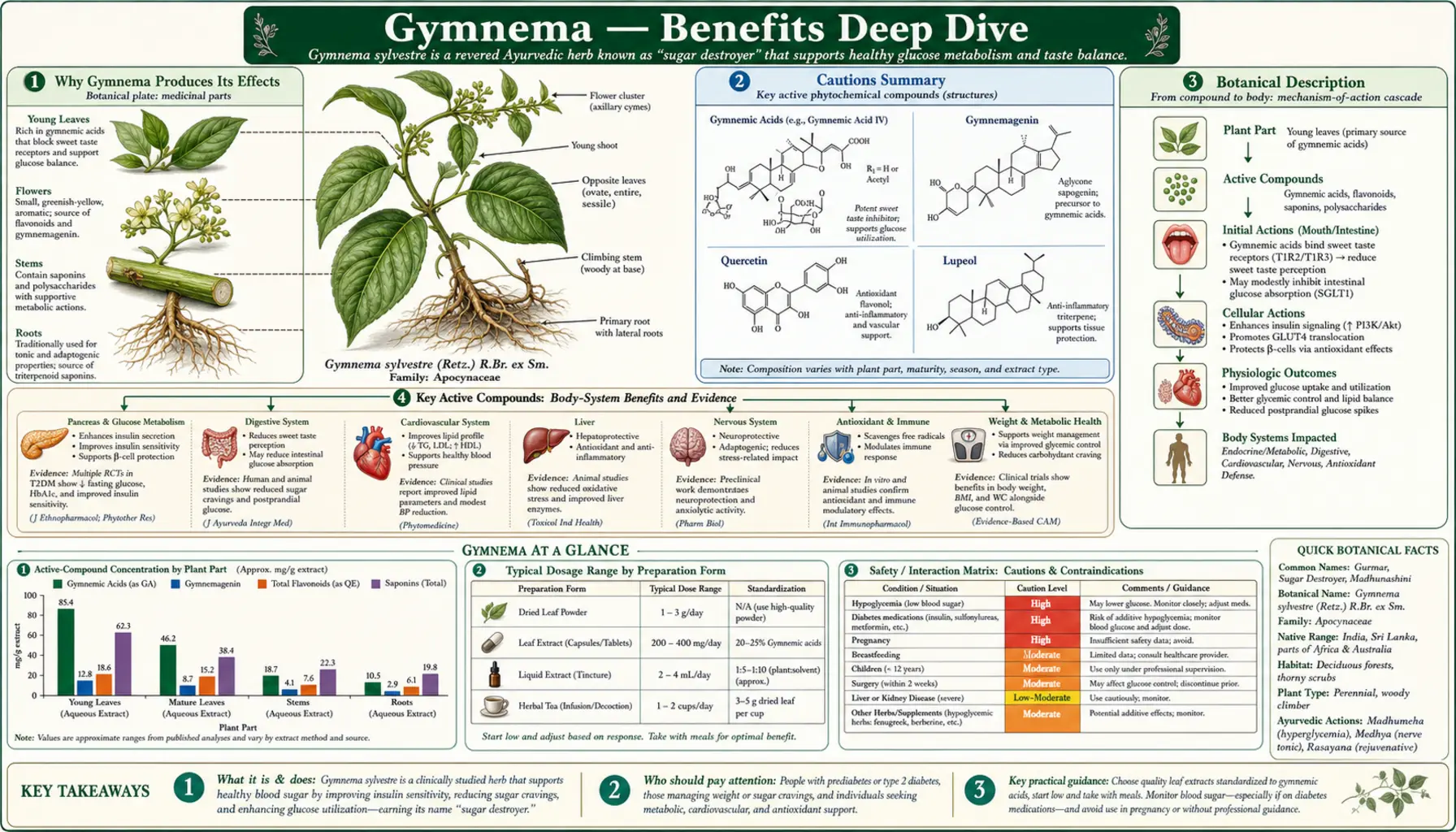
Gymnema sylvestre is the woody Indian climbing vine whose Hindi name — gurmar, literally "sugar destroyer" — ranks among the most evocative descriptors in the entire herbal pharmacopoeia. Ayurvedic physicians have used it for over 2,000 years to treat madhumeha, the Sanskrit "honey urine" we now call diabetes. The active triterpene saponins called gymnemic acids do two extraordinary things: applied to the tongue they bind sweet-taste receptors and transiently abolish the perception of sweetness for roughly an hour, and ingested they reduce postprandial glucose spikes, support pancreatic beta-cell function, and over months of consistent use lower HbA1c by 0.5-1.0 percentage points in controlled trials. The four benefit pages below explore the conditions where Gymnema produces its largest clinical effects — type 1 and type 2 diabetes, sugar cravings and addictive eating, weight loss, and the lipid abnormalities that travel with metabolic syndrome.
Deep-Dive Articles
Blood Sugar Regulation
The Shanmugasundaram 1990 trials in both type 1 and type 2 diabetics that established the GS4 standardized extract (25% gymnemic acids) as a credible antidiabetic; the three-mechanism explanation (sweet-receptor mimicry blocking intestinal glucose absorption, beta-cell insulin secretion enhancement, possible pancreatic regeneration); how gymnema compares to glipizide in head-to-head trials; and the Indian Ayurvedic "gurmar" tradition that pointed Western researchers to the plant in the first place.
Sugar Cravings & Taste Blockade
The famous sweet-taste-receptor blockade: hold a gymnema lozenge or chewed leaf on the tongue for one minute and sugar tastes like sand for the next 60-90 minutes. The T1R2/T1R3 receptor mechanism, applications in sugar-craving and food-addiction protocols, the historical role gymnemic acids played in Big Pharma's development of selective T1R2/T1R3 antagonists as anti-obesity drugs, and the lozenge-before-temptation behavioral hack that turns the plant's sensory effect into willpower amplification.
Weight Loss & Appetite
The appetite-suppression mechanism — reduced palatability of sweet foods plus improved insulin sensitivity plus modest leptin/ghrelin modulation. Pilot RCT data on gymnema-chromium-fiber combinations, the role of postprandial glucose flatness in reducing cravings hours later, and how gymnema fits into broader weight-loss protocols emphasizing whole foods, protein adequacy, and reduced refined-carbohydrate intake. Modest weight losses of 2-5 kg over 12-16 weeks are typical in controlled trials.
Cholesterol & Lipid Profile
The lipid-lowering effects in diabetic dyslipidemia — total cholesterol down 10-15%, LDL down similarly, triglycerides down 15-20%, with modest HDL rises. Two mechanisms: indirect (insulin sensitization reverses the de novo lipogenesis driving high triglycerides) and direct (bile-acid binding by saponin fractions interrupting enterohepatic cholesterol recycling). Smaller than berberine, but contributing meaningfully to cardiovascular risk reduction when gymnema is used long-term.
Table of Contents
- Deep-Dive Articles
- Why Gymnema Produces Its Effects
- Key Research Papers
- External Authoritative Resources
- Cautions Summary
- Connections
- Featured Videos
Why Gymnema Produces Its Effects
Most herbs work through a single principal mechanism. Gymnema is unusual because its active triterpene saponins — the gymnemic acids and the closely related gymnemasaponins and gurmarin — produce four distinct molecular effects, and each maps to a different clinical use. Understanding the mechanisms separately is the key to using the herb intelligently.
- Sweet-taste-receptor blockade at T1R2/T1R3 — gymnemic acid molecules share enough geometric similarity with glucose to occupy the binding pocket of the T1R2/T1R3 heterodimeric sweet receptor on the tongue. They bind without activating, blocking the receptor for genuine sweeteners (sucrose, glucose, fructose, aspartame, sucralose, stevia) for roughly 30-90 minutes. The bitter and salty receptors are unaffected, so coffee still tastes like coffee but with no detectable sweetness. This is the basis of the famous sweet-taste blockade and its use in sugar-craving interruption.
- Intestinal glucose absorption inhibition — the same structural mimicry that lets gymnemic acids occupy sweet-taste receptors also lets them competitively inhibit SGLT1 and possibly GLUT2 glucose transporters in the small-intestinal brush border. The result is a reduced postprandial glucose spike. This mechanism is dose-dependent and contributes meaningfully to the glycemic effects observed in type 2 diabetes.
- Pancreatic beta-cell insulin secretion enhancement — in isolated pancreatic islet preparations and in vivo, gymnema extracts increase glucose-stimulated insulin secretion. The exact molecular mechanism is incompletely characterized, but appears to involve direct stimulation of the beta-cell membrane and possibly a calcium-channel effect that mimics the sulfonylurea drug class. This is part of why gymnema can lower blood glucose in subjects who already have functional (if impaired) beta cells.
- Possible beta-cell regeneration — the most extraordinary claim, established primarily in rodent studies but with some supporting human data. The Shanmugasundaram group demonstrated increases in serum C-peptide (a marker of endogenous insulin production) in type 1 and type 2 diabetics on long-term GS4 extract, suggesting either preservation of remaining beta-cell mass or actual regeneration of new beta cells. The mechanism is hypothesized to involve modulation of beta-cell apoptosis pathways. This is the basis of the case-series evidence of insulin requirement reduction in type 1 diabetics on gymnema.
The combined effect of these four mechanisms is why gymnema lowers HbA1c by approximately 0.5-1.0 percentage points in controlled trials — a magnitude comparable to a low-dose metformin or sulfonylurea, but achieved by a plant. The lipid-lowering, weight-loss, and cholesterol effects all flow indirectly from the same metabolic improvements: better insulin sensitivity reduces de novo lipogenesis (lowering triglycerides), flatter postprandial glucose curves reduce subsequent hunger and cravings (supporting weight loss), and bile-acid-binding saponin fractions provide a small additional cholesterol reduction through interrupted enterohepatic recycling.
Key Research Papers
- Shanmugasundaram ER et al. (1990). Use of Gymnema sylvestre leaf extract in the control of blood glucose in insulin-dependent diabetes mellitus. Journal of Ethnopharmacology. The landmark trial in type 1 diabetics showing reduced insulin requirements on GS4. — PubMed
- Baskaran K, Shanmugasundaram ER et al. (1990). Antidiabetic effect of a leaf extract from Gymnema sylvestre in non-insulin-dependent diabetes mellitus patients. Journal of Ethnopharmacology. Companion trial in type 2 diabetics, 400 mg GS4 daily for 18-20 months. — PubMed
- Tiwari P et al. (2014). Gymnema sylvestre for diabetes: from traditional herb to a finished dietary supplement. Indian Journal of Pharmacology. Comprehensive modern review of mechanism and clinical evidence. — PubMed
- Kanetkar P, Singhal R, Kamat M (2007). Gymnema sylvestre: A Memoir. Journal of Clinical Biochemistry and Nutrition. Review of pharmacology including the sweet-taste-blockade and intestinal glucose absorption mechanisms. — PubMed
- Pothuraju R et al. (2014). A systematic review of Gymnema sylvestre in obesity and diabetes management. Journal of the Science of Food and Agriculture. Meta-summary of human trials. — PubMed
PubMed Topic Searches
- PubMed: Gymnema sylvestre diabetes
- PubMed: gymnemic acid sweet taste receptor
- PubMed: gymnema beta-cell regeneration
- PubMed: GS4 standardized extract HbA1c
- PubMed: gymnema weight loss and cravings
External Authoritative Resources
- NCCIH — Diabetes and Dietary Supplements (includes gymnema in the section on herbal interventions with credible evidence)
- MedlinePlus — Gymnema
- Drugs.com — Gymnema Professional Monograph
- Examine.com — Gymnema sylvestre evidence summary
- PubMed — All research on Gymnema sylvestre
Cautions Summary
Gymnema is a glucose-lowering herb and must be treated with the same respect as any antidiabetic drug. The most consequential cautions:
- Hypoglycemia in patients on insulin or sulfonylureas — gymnema can stack additively with these drugs to produce dangerously low blood glucose. Do not start gymnema without first arranging closer glucose monitoring and a plan to reduce insulin or sulfonylurea doses with your prescribing physician.
- Hypoglycemia-prone patients — anyone with reactive hypoglycemia, post-bariatric-surgery dumping syndrome, or a history of unexplained hypoglycemia should not use gymnema without medical supervision.
- Type 1 diabetes — gymnema must never replace insulin. It may be used as an adjunct under endocrinology supervision with insulin-dose downward adjustment, but is not a substitute for exogenous insulin in absolute insulin deficiency.
- Pregnancy and breastfeeding — insufficient safety data; avoid.
- Surgery — discontinue at least one week before any scheduled surgery due to glucose-lowering effects that complicate intra-operative glucose management.
- Drug interactions — potentiates all antidiabetic medications (metformin, sulfonylureas, GLP-1 agonists, SGLT2 inhibitors, insulin). Theoretical interaction with statins (both lower lipids).
Connections
- All Herbs
- Gymnema (Main Page)
- Gymnema for Blood Sugar
- Gymnema for Sugar Cravings
- Gymnema for Weight Loss
- Gymnema for Cholesterol
- Berberine
- Cinnamon
- Bitter Melon
- Fenugreek
- Chromium
- Diabetes
- Insulin Resistance
- Obesity
- Blood Sugar Control
- HbA1c
- Fasting Insulin
- Lipid Panel