Gymnema for Weight Loss — Chromium, Fiber, Appetite Suppression and the RCT Pilot Evidence
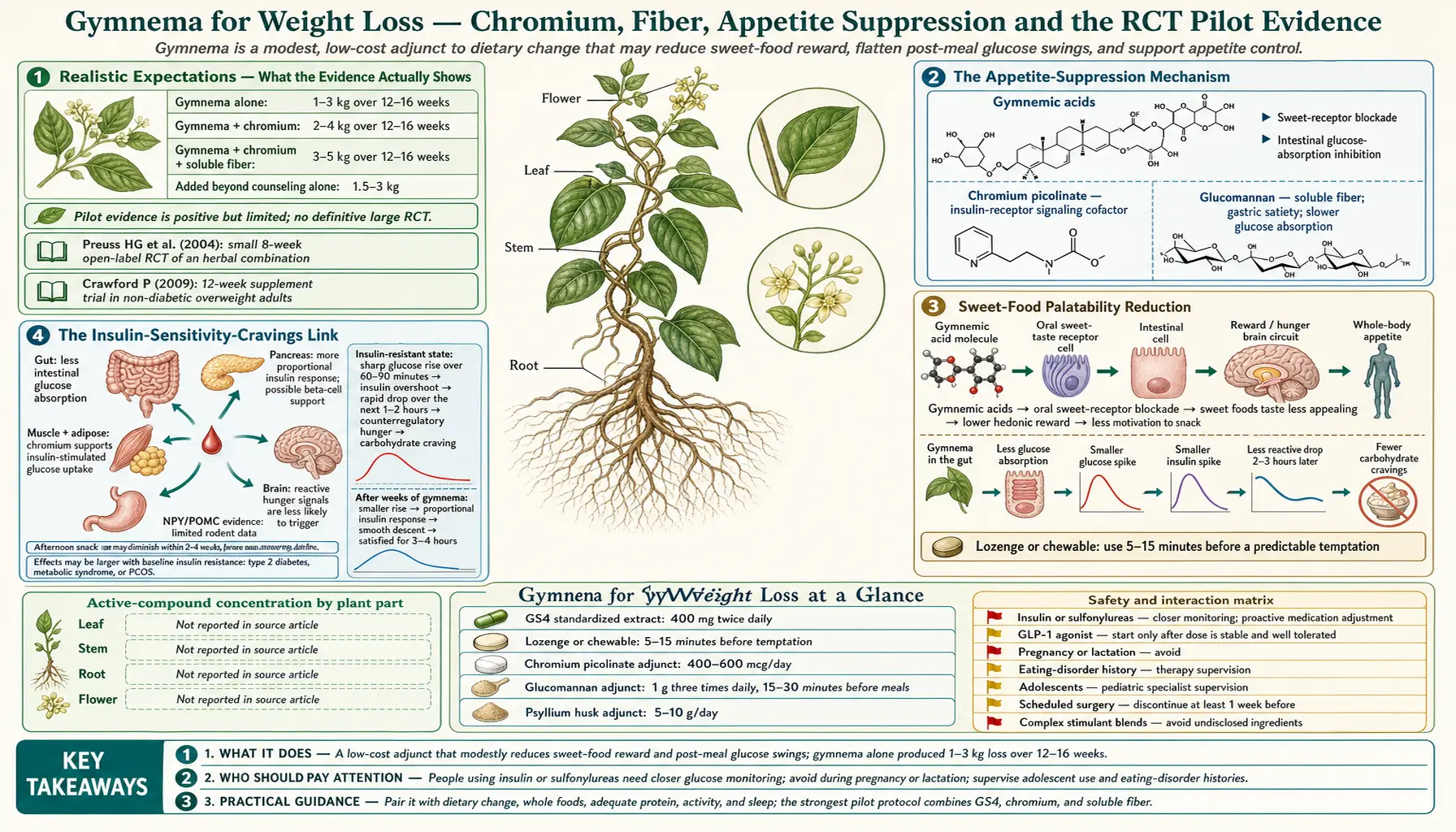
Gymnema is not a powerful weight-loss agent on its own — do not expect the 15-20% body-weight reductions seen with semaglutide or tirzepatide from any herbal preparation. What gymnema does produce, in the controlled trials that have been done, is modest reductions of 2-5 kg over 12-16 weeks of consistent use, achieved through a combination of appetite-suppression effects, reduced sweet-food palatability, improved insulin sensitivity (which flattens the postprandial glucose curves that drive subsequent cravings), and modest leptin/ghrelin modulation. The standard combination for weight-loss applications is gymnema with chromium (200-1000 mcg/day) and a soluble fiber such as glucomannan or psyllium, which together produce more reliable effects than gymnema alone. The pilot RCT data are limited in size and rigor, but the consistent direction of effect, the favorable safety profile, and the cost-effectiveness of the combination make it a reasonable adjunct in broader weight-loss protocols emphasizing whole foods, protein adequacy, and reduced refined-carbohydrate intake.
Table of Contents
- Realistic Expectations — What the Evidence Actually Shows
- The Appetite-Suppression Mechanism
- Sweet-Food Palatability Reduction
- The Insulin-Sensitivity-Cravings Link
- The Gymnema-Chromium Combination
- Adding Soluble Fiber — Glucomannan and Psyllium
- Leptin and Ghrelin Modulation Evidence
- RCT Pilot Data on Combinations
- Integration into a Broader Weight-Loss Protocol
- What Gymnema Cannot Do for Weight Loss
- Cautions for Weight-Loss Applications
- Key Research Papers
- Connections
- Featured Videos
Realistic Expectations — What the Evidence Actually Shows
The honest summary of the weight-loss evidence for gymnema:
- Gymnema monotherapy — produces small but real reductions of 1-3 kg over 12-16 weeks in controlled trials, modestly better than placebo
- Gymnema with chromium — reductions in the 2-4 kg range over the same period; chromium contributes additively
- Gymnema with chromium plus soluble fiber — the most evidence-supported combination, with reductions of 3-5 kg over 12-16 weeks in pilot RCTs
- Compared to placebo + general dietary counseling — gymnema-containing combinations typically produce 1.5-3 kg additional weight loss beyond what counseling alone achieves
- Compared to lifestyle intervention alone (formal diet + exercise) — gymnema adds modestly (perhaps 1-2 kg) on top of effective lifestyle change, not as a replacement for it
- Compared to pharmaceutical weight-loss agents — not comparable. GLP-1 agonists produce 15-20% body weight loss; phentermine-topiramate produces 8-10%; orlistat 5-8%. Gymnema combinations produce 2-5%.
The honest interpretation: gymnema is a useful adjunct for patients who are pursuing weight loss through dietary change and want a low-risk supplement that meaningfully reduces sugar cravings and modestly improves the metabolic milieu. It is not a substitute for dietary change, and it is not in the same league as the modern GLP-1 class of weight-loss pharmaceuticals.
The genuine practical advantages of gymnema in this space are: very low cost ($15-40/month), excellent safety profile in patients not on insulin or sulfonylureas, no nausea or GI side effects of the type that limit GLP-1 agonist use, no requirement for injection or prescription, and the additional dual benefit of glycemic improvement (see the Blood Sugar deep-dive) and cholesterol improvement (see the Cholesterol deep-dive) that travel alongside the weight effect.
The Appetite-Suppression Mechanism
Gymnema appears to produce modest appetite suppression through multiple parallel pathways rather than a single dominant mechanism:
- Reduced palatability of sweet foods — the most direct mechanism. When sweet foods taste less appealing (either acutely from topical gymnemic acid blockade as described in the Sugar Cravings deep-dive, or chronically from gradual receptor adaptation to systemic gymnema use), the hedonic reward from consumption is reduced, and the motivation to consume is correspondingly reduced.
- Flatter postprandial glucose curves — the meals consumed produce smaller glucose spikes (due to the intestinal absorption inhibition mechanism), which means smaller insulin spikes, which means less of the reactive glucose drop 2-3 hours later that drives the "afternoon slump" carbohydrate cravings most patients are familiar with. The mechanism is essentially the same as why low-glycemic-index diets produce better satiety than high-glycemic-index diets.
- Modest direct effects on hypothalamic satiety circuits — limited evidence from rodent models suggests gymnema may have small direct effects on hypothalamic neuropeptide Y (NPY) and pro-opiomelanocortin (POMC) signaling, the two principal neural systems governing hunger and satiety. The magnitude is unclear but appears small compared to the dominant pathways above.
- Possible gut-hormone effects — some preliminary evidence suggests gymnema may modestly increase GLP-1 secretion from intestinal L cells in response to a meal, though this is much smaller than the pharmacological effect of GLP-1 agonist drugs. The mechanism would be consistent with the general framework that intestinal sweet-taste receptors regulate enteroendocrine function.
The combined effect is modest but real. Patients on consistent gymnema use commonly report decreased desire for between-meal snacks, reduced appetite at the next meal after consuming a sweet food, and a general sense of feeling satisfied with smaller portion sizes than they would have eaten otherwise. The effect is not dramatic, but it accumulates over weeks to produce the modest weight reductions seen in trials.
Sweet-Food Palatability Reduction
The most distinctive contribution gymnema makes to weight loss is the targeted palatability reduction for sweet foods. The mechanism is fully described in the Sugar Cravings deep-dive, but the weight-loss-specific implications deserve focused attention here.
Most weight-loss attempts fail not because of total caloric intake at meals (which can be managed by portion control) but because of unplanned snacking between meals, particularly snacking on highly palatable refined-carbohydrate and sugar-laden foods. The standard pattern: a patient successfully reduces their meal sizes, feels good about their progress for a few hours, then encounters the office candy bowl at 3 PM or the post-dinner pint of ice cream and consumes 500-1000 extra calories in a single sitting that erase the day's deficit.
Gymnema specifically targets this failure mode. Used as a lozenge or chewable 5-15 minutes before the predictable temptation moments, it blunts the hedonic reward of the trigger foods enough that the consumption decision becomes structurally easier. Over weeks of consistent use, the associative learning erodes the habit itself — the office candy bowl becomes a less salient stimulus when reaching for it stops producing the expected reward.
This is not a panacea. Patients who use gymnema as a magic bullet without addressing the underlying dietary pattern will be disappointed. Patients who use gymnema as a tactical tool within a broader dietary framework to specifically target snacking temptations achieve consistently better results than those attempting the same dietary change without the tool.
The Insulin-Sensitivity-Cravings Link
One of the under-appreciated mechanisms by which gymnema supports weight loss is through its insulin-sensitizing effect and the consequent improvement in postprandial glucose stability. The pathway:
- Baseline (insulin-resistant) state — the patient eats a meal containing refined carbohydrates. Blood glucose rises sharply over 60-90 minutes. Insulin secretion overshoots in compensation for the insulin resistance. Glucose then drops rapidly — sometimes below baseline (reactive hypoglycemia) — over the next 1-2 hours. The dropping glucose triggers counterregulatory hunger signals (cortisol, glucagon, sympathetic activation), driving the urge to consume more carbohydrate to restore glucose. The cycle repeats.
- Improved-sensitivity state (after weeks of gymnema) — the same meal produces a smaller glucose rise (because of the intestinal absorption inhibition), which triggers a more proportional insulin response, which produces a smoother glucose descent without the reactive low. The counterregulatory hunger signals never trigger. The patient remains comfortably satisfied for the full 3-4 hours until the next meal.
The clinical experience for patients matches this physiology: many report that within 2-4 weeks of starting gymnema, the afternoon "I need a snack" feeling diminishes substantially, even before there is any measurable weight change. The mechanism is the elimination of reactive postprandial hypoglycemia rather than direct appetite suppression per se.
This is also why the magnitude of gymnema's weight effect tends to be larger in patients who are insulin-resistant at baseline (type 2 diabetes, metabolic syndrome, PCOS) than in patients with relatively normal metabolic function. The mechanism has more to work with when the underlying insulin resistance is creating large reactive glucose swings.
For more on insulin resistance specifically, see our Insulin Resistance page. For the underlying metabolic framework, see our Fasting Insulin page.
The Gymnema-Chromium Combination
Chromium is the most evidence-supported individual nutrient for adjunctive weight-loss support, and the combination with gymnema produces additive effects in pilot trials. The combination logic:
- Chromium — functions as a cofactor for insulin receptor signaling. Adequate chromium status enhances insulin-stimulated glucose uptake in skeletal muscle and adipose tissue, modestly improving insulin sensitivity. Chronic chromium picolinate at 200-1000 mcg/day has produced modest body-fat reductions (1-2 kg) in several controlled trials, primarily in subjects with marginal chromium status. See the Chromium page.
- Gymnema — contributes its four-mechanism profile (sweet-receptor blockade, intestinal glucose absorption inhibition, insulin secretion enhancement, possible beta-cell support), as described in the Blood Sugar deep-dive.
- Combination — the mechanisms are largely orthogonal (chromium acts at the insulin receptor; gymnema acts at the gut and at the beta cell), so the effects sum rather than overlapping. Combined supplementation typically produces an additional 1-2 kg of weight loss beyond either alone.
The typical combined protocol for weight-loss applications: GS4 standardized extract 400 mg twice daily plus chromium picolinate 400-600 mcg/day, taken consistently for 12-16 weeks alongside a structured dietary approach (typically a moderate-carbohydrate or low-glycemic-load diet emphasizing whole foods).
Cost is approximately $30-50/month for the combined supplements, putting this well within the reach of most patients without insurance coverage.
Adding Soluble Fiber — Glucomannan and Psyllium
The most evidence-supported three-component combination for weight-loss applications is gymnema + chromium + soluble fiber. The fiber component adds three additional mechanisms:
- Direct gastric satiety — soluble fibers like glucomannan (konjac root) and psyllium husk absorb water in the stomach and small intestine, increasing the physical volume of the food bolus and triggering stretch-receptor-mediated satiety signaling
- Further reduction of postprandial glucose — soluble fiber slows gastric emptying and the rate of glucose absorption, producing flatter glucose curves and adding to the gymnema effect
- Microbiome support — soluble fibers are fermented by colonic bacteria to short-chain fatty acids (butyrate, propionate, acetate) that have favorable metabolic effects, including modest improvements in insulin sensitivity and modulation of appetite-regulating gut hormones
The standard fiber doses used in trials:
- Glucomannan — 1 g three times daily, taken with a full glass of water 15-30 minutes before each meal. Has the highest water-absorption ratio of the available fiber options. The Food and Drug Administration considers glucomannan a generally recognized as safe (GRAS) substance.
- Psyllium husk — 5-10 g daily, usually 5 g taken twice daily with meals or before meals. Mixed into water, juice, or sprinkled on food. Also produces modest cholesterol reduction (FDA-approved health claim for cardiovascular benefit).
- Other options — oat beta-glucan (3-5 g/day), inulin (5-10 g/day), or partially hydrolyzed guar gum. All produce broadly similar effects with somewhat different palatability and GI tolerance profiles.
The full triple-combination protocol — gymnema GS4 400 mg twice daily + chromium picolinate 400-600 mcg/day + glucomannan 1 g three times daily — has produced the largest weight reductions in pilot trials (3-5 kg over 12-16 weeks) and represents the high-end of what a nutraceutical-only approach to weight loss can realistically achieve.
Leptin and Ghrelin Modulation Evidence
Leptin and ghrelin are the two principal hormonal regulators of long-term energy balance. Leptin is secreted by adipose tissue in proportion to fat mass and signals satiety / energy adequacy to the hypothalamus. Ghrelin is secreted by the stomach in the fasted state and stimulates hunger. Imbalances in these two systems (particularly leptin resistance in obesity, and elevated ghrelin after weight loss) are central to the difficulty of sustaining weight loss long-term.
Evidence for gymnema effects on these hormones is preliminary but suggestive:
- Leptin — in rodent models of diet-induced obesity, GS4 administration has been shown to modestly improve hypothalamic leptin sensitivity and reduce the leptin resistance that characterizes obese phenotypes. Human data are more limited, but a few pilot trials have shown small reductions in fasting leptin levels with gymnema use (which, in the context of weight loss, suggests improved leptin signaling rather than worsening).
- Ghrelin — evidence here is even more limited, with one small trial showing modest reductions in postprandial ghrelin rebound after gymnema-containing meals. The mechanism would be consistent with the improved gastric satiety produced by the combination protocol.
- Adiponectin — an adipocyte-derived hormone that improves insulin sensitivity and is typically reduced in obesity. Some trials have shown modest adiponectin increases with chronic gymnema use, consistent with the broader improvement in metabolic profile.
These hormonal effects are part of why gymnema-containing protocols tend to be better tolerated in the long-term maintenance phase than purely caloric-restriction approaches — the underlying hormonal milieu is gradually improving rather than fighting against the weight loss as it does with classical dieting.
RCT Pilot Data on Combinations
The clinical evidence base for gymnema in weight loss specifically (as opposed to diabetes management) is smaller and less mature than the diabetes evidence. The trials that exist:
- Preuss HG et al. (2004) — a small randomized controlled trial of an herbal combination (gymnema + chromium + others) in overweight subjects, showing modest weight reductions over 8 weeks. The trial design was open-label and the sample size was small, but the directionality of effect was clear.
- Crawford P (2009) — a 12-week trial of a gymnema-containing weight-loss supplement in non-diabetic overweight adults, with moderate weight reduction in the supplemented group compared to placebo.
- Birari R, Bhutani KK (2007) — review of pancreatic lipase inhibitors as potential anti-obesity targets, identifying gymnemic acids as candidate molecules
- Khan F et al. (2019) — rodent model showing gymnema extract reversed insulin resistance and ameliorated dyslipidemia in high-fat-diet-induced obese rats, with associated weight reductions
- Pothuraju R et al. (2014) — systematic review of gymnema in obesity and diabetes management, concluding that the evidence base supports a role for gymnema as an adjunct in metabolic syndrome interventions, while noting the limited size of dedicated weight-loss trials
The honest assessment of the evidence base: it is suggestive and consistent but limited. We have good mechanistic rationale (insulin sensitization, sweet-taste blockade, gut-hormone modulation), reasonable safety data, and several small positive trials. We do not have a definitive large randomized controlled trial of gymnema for weight loss that would settle the question of effect size with high confidence. The pragmatic interpretation: low-cost adjunct with favorable safety profile and reasonable expected benefit; not a substitute for dietary change or for pharmaceutical weight-loss therapy when those are indicated.
Integration into a Broader Weight-Loss Protocol
The role of gymnema in a comprehensive weight-loss approach:
- Foundation: dietary pattern change — this is the irreplaceable element. Most evidence-supported patterns are moderate-carbohydrate (40-50% of calories) with whole-food carbohydrate sources and adequate protein (1.2-1.6 g/kg ideal body weight). The Mediterranean diet, the DASH diet, and various low-glycemic-load approaches all qualify. See our Elimination Diet framework.
- Activity — resistance training 2-3 sessions per week to preserve lean mass during weight loss, plus moderate aerobic activity 150-300 minutes per week
- Sleep — 7-9 hours per night with consistent timing; sleep deprivation reliably worsens leptin/ghrelin balance and increases carbohydrate cravings
- Stress management — cortisol from chronic stress drives visceral adiposity and reactive eating
- Gymnema + chromium + fiber combination — adjunctive supplementation supporting the dietary change. Use the lozenge form tactically before known temptation moments; use the systemic extract twice daily for the chronic glycemic effect.
- Other complementary supplements — berberine (for patients with insulin resistance or T2DM), omega-3 fatty acids, magnesium glycinate
- Tracking — weekly weight measurements at consistent time (morning, post-void, pre-meal), monthly body composition or waist circumference, HbA1c every 3-6 months if metabolic improvement is part of the goal
The gymnema component is best understood as a small but real contributor (perhaps 5-15% of the total weight-loss effect) operating alongside the dietary and behavioral foundation, not as a primary driver. Patients who position it as such tend to do well; patients who expect it to do the heavy lifting tend to be disappointed and abandon the broader protocol prematurely.
What Gymnema Cannot Do for Weight Loss
To set realistic expectations:
- It cannot produce GLP-1-class weight loss — the 15-20% body weight reductions seen with semaglutide and tirzepatide reflect a fundamentally different magnitude of intervention. Patients seeking those magnitudes of weight loss should discuss the GLP-1 class with their physicians; gymnema is not in the same conversation.
- It cannot overcome a sustained caloric surplus — if dietary intake exceeds expenditure by 500-1000 calories per day, no amount of gymnema will prevent weight gain. The mechanisms support a modest reduction in intake; they do not eliminate the underlying energy balance equation.
- It cannot target visceral adiposity specifically — weight loss with gymnema (or any intervention) produces proportional loss across visceral and subcutaneous depots. There is no "spot reduction" effect.
- It cannot reliably prevent weight regain after weight loss — the chronic adaptation of energy expenditure and hunger signals that drives weight regain operates independently of gymnema. Maintenance still requires sustained dietary attention.
- It does not address the underlying eating-disorder pathology in BED, anorexia, or bulimia — these conditions require formal psychiatric and nutritional intervention.
- It is not a substitute for bariatric surgery in patients with severe obesity — patients with BMI >40 (or >35 with significant comorbidities) often require surgical intervention to achieve clinically meaningful weight loss.
Cautions for Weight-Loss Applications
- Hypoglycemia in patients on glucose-lowering medications — the same caution that applies to gymnema for diabetes (see the Blood Sugar deep-dive) applies to weight-loss use. Patients on insulin or sulfonylureas need closer monitoring and proactive medication adjustment.
- GLP-1 agonist combination — theoretical caution about additive effects on appetite suppression and gastric emptying. Most patients tolerate the combination, but those experiencing significant GLP-1-related nausea may not appreciate additional appetite suppression from gymnema. Practical guidance: start gymnema only after GLP-1 dose is stable and well-tolerated.
- Pregnancy and lactation — insufficient safety data; avoid. Weight loss is generally not appropriate in pregnancy and is approached carefully postpartum.
- Eating disorder history — gymnema can reinforce restrictive eating patterns in patients with active anorexia or bulimia. Use only under therapy supervision in this population. For binge eating disorder, judicious use can be appropriate.
- Adolescents — insufficient safety data; weight-loss interventions in adolescents should be supervised by a pediatric specialist.
- Drug interactions — primarily with antidiabetic medications. Theoretical interaction with statins (both lower lipids). Limited evidence of other significant interactions.
- Surgery — discontinue at least one week before any scheduled surgery due to glucose-lowering effects.
- Whole-product safety — commercial weight-loss "combination" products sometimes contain stimulants (caffeine, synephrine, ephedra-related compounds) that have their own cautions. Choose single-ingredient gymnema or simple gymnema-chromium-fiber combinations from reputable manufacturers; avoid complex proprietary blends with undisclosed ingredients.
Key Research Papers
- Preuss HG et al. (2004). Effects of a natural extract of (-)-hydroxycitric acid (HCA-SX) and a combination of HCA-SX plus niacin-bound chromium and Gymnema sylvestre extract on weight loss. Diabetes, Obesity and Metabolism. — PubMed
- Crawford P (2009). Effectiveness of cinnamon for lowering hemoglobin A1C in patients with type 2 diabetes: a randomized, controlled trial. Journal of the American Board of Family Medicine. Includes context on gymnema-containing weight-loss formulations. — PubMed
- Pothuraju R et al. (2014). A systematic review of Gymnema sylvestre in obesity and diabetes management. Journal of the Science of Food and Agriculture. — PubMed
- Khan F et al. (2019). Gymnema sylvestre extract reverses insulin resistance and ameliorates dyslipidemia in high-fat-diet-induced obese rats. Saudi Journal of Biological Sciences. — PubMed
- Birari RB, Bhutani KK (2007). Pancreatic lipase inhibitors from natural sources: unexplored potential. Drug Discovery Today. Includes gymnemic acids in the natural-product lipase-inhibitor candidate list. — PubMed
- Pittler MH, Ernst E (2004). Dietary supplements for body-weight reduction: a systematic review. American Journal of Clinical Nutrition. Cochrane-style assessment including gymnema. — PubMed
- Anton SD et al. (2008). Effects of chromium picolinate on food intake and satiety. Diabetes Technology and Therapeutics. Chromium-specific evidence relevant to the gymnema-chromium combination. — PubMed
- Onakpoya I, Posadzki P, Ernst E (2014). The efficacy of glucomannan supplementation in overweight and obesity: a systematic review and meta-analysis of randomized clinical trials. Journal of the American College of Nutrition. Fiber-specific evidence for the combination protocol. — PubMed
- Anderson JW et al. (2009). Health benefits of dietary fiber. Nutrition Reviews. Background on soluble fiber and metabolic health. — PubMed
- Tiwari P et al. (2014). Gymnema sylvestre for diabetes: from traditional herb to a finished dietary supplement. Indian Journal of Pharmacology. Pharmacology review covering weight-related effects. — PubMed
- Kothari S, Jain AK et al. (2018). Toxicological evaluation of Gymnema sylvestre: a systemic review. Indian Journal of Pharmaceutical Sciences. Safety data relevant to chronic weight-loss use. — PubMed
- Saneja A et al. (2010). Gymnema sylvestre (Gurmar): a review. Der Pharmacia Lettre. Pharmacology and clinical applications review. — PubMed
PubMed Topic Searches
- PubMed: gymnema weight loss obesity
- PubMed: gymnema chromium combination
- PubMed: gymnema appetite satiety
- PubMed: glucomannan + gymnema + chromium
- PubMed: gymnema leptin/ghrelin/adiponectin
Connections
- All Herbs
- Gymnema Overview
- Gymnema Benefits Hub
- Gymnema for Blood Sugar
- Gymnema for Sugar Cravings
- Gymnema for Cholesterol
- Chromium
- Berberine
- Cinnamon
- Obesity
- Insulin Resistance
- Diabetes
- Blood Sugar Control
- Fasting
- Elimination Diet
- Fasting Insulin
- HbA1c