Cassia vs Ceylon Cinnamon — Coumarin Safety
CRITICAL SAFETY READ
"Cinnamon" sold in North America is almost entirely cassia (Cinnamomum cassia, C. burmannii, or C. loureiroi), which contains 1–12 mg of coumarin per teaspoon. Coumarin is a documented hepatotoxin (the EU classifies it as a substance of toxicological concern). Ceylon cinnamon (Cinnamomum verum, the "true" cinnamon from Sri Lanka) contains less than 0.05% coumarin — effectively trace amounts. The German Federal Institute for Risk Assessment (BfR) calculated that a 60 kg adult exceeds the tolerable daily coumarin intake with as little as 2 grams of cassia per day. If you take cinnamon supplements daily, eat oatmeal with cinnamon every morning, or otherwise consume cinnamon habitually, this distinction matters enormously and is the single most important practical decision in cinnamon use.
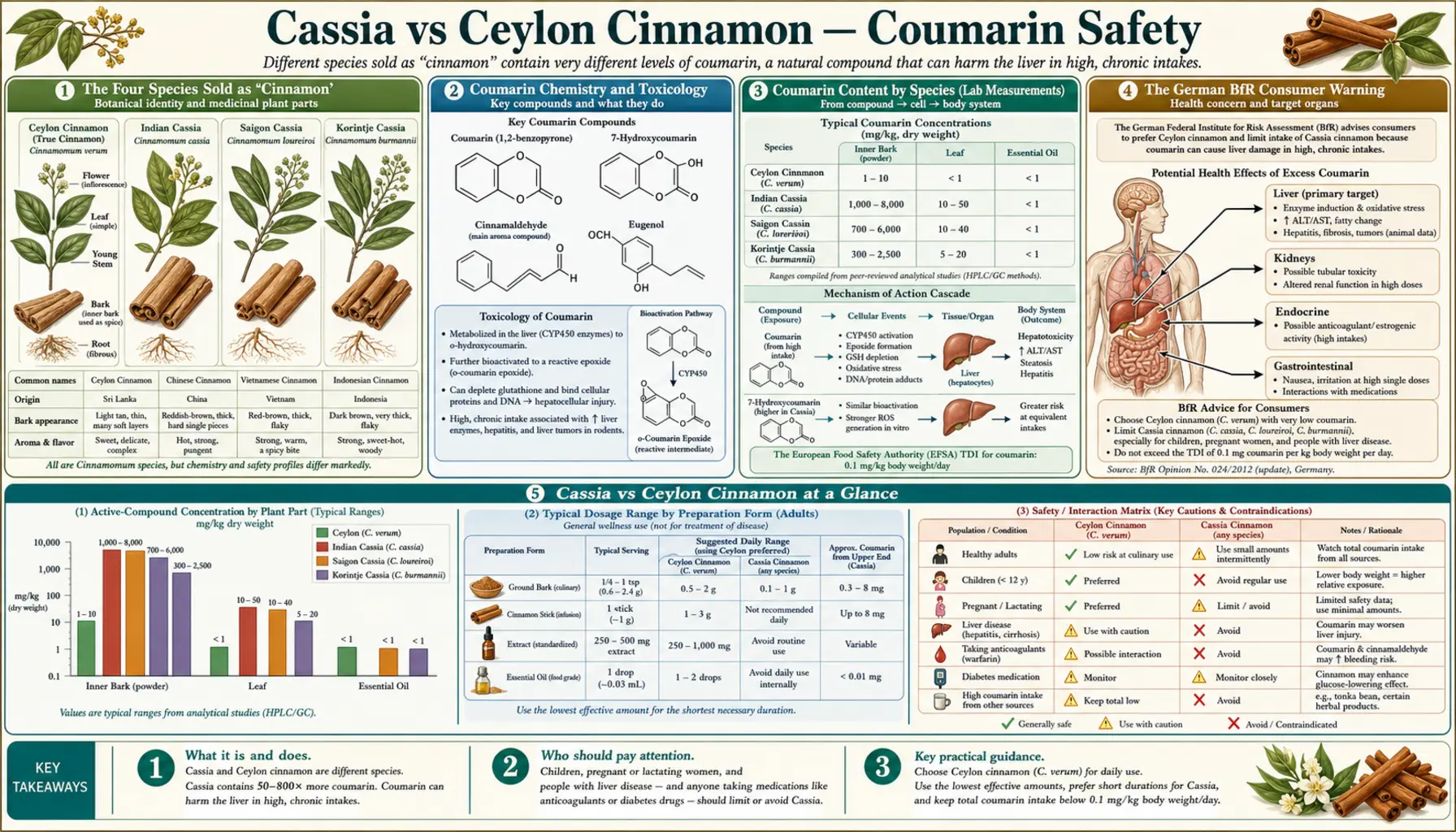
The four species sold as "cinnamon" in international commerce differ enormously in coumarin content, a hepatotoxic and weakly nephrotoxic benzopyrone that is regulated in the European Union and that the German Federal Institute for Risk Assessment (BfR) issued a formal consumer warning about in 2006. Cassia cinnamon (C. cassia, the dominant supermarket variety in North America) contains 1–12 mg of coumarin per teaspoon. Ceylon cinnamon (C. verum, the "true" cinnamon from Sri Lanka) contains less than 0.05%. Indonesian cassia (C. burmannii) and Vietnamese cassia (C. loureiroi) fall between the two, often closer to C. cassia coumarin levels. For occasional culinary use (a sprinkle in baked goods consumed once a week), the species choice does not materially matter. For daily users — diabetic supplementation, daily oatmeal, capsule regimens — the species choice is the single most important practical decision, and the answer is unambiguous: use Ceylon, not cassia.
Table of Contents
- The Four Species Sold as "Cinnamon"
- Coumarin Chemistry and Toxicology
- Coumarin Content by Species (Lab Measurements)
- The German BfR Consumer Warning
- EU Regulatory Limits (50 mg/kg)
- Tolerable Daily Intake (TDI)
- Dose Calculations for Daily Users
- Case Reports of Cinnamon-Challenge Hepatitis
- How to Identify Ceylon vs Cassia (Visual, Aroma, Label)
- Sourcing Verified Ceylon
- Species-Specific Recommendations by Use Case
- Key Research Papers
- Connections
- Featured Videos
The Four Species Sold as "Cinnamon"
The English word "cinnamon" maps to at least four distinct species in international commerce, all in the genus Cinnamomum (family Lauraceae):
- Cinnamomum verum (synonym C. zeylanicum) — Ceylon cinnamon, "true" cinnamon. Native to Sri Lanka (formerly Ceylon) and the Malabar Coast of India. Bark is thin, light tan-brown in color, with multiple thin layers visible in cross-section that roll into a tight scroll. Aroma is sweet, citrusy, complex. Coumarin content: <0.05% (typically <0.1 mg per teaspoon). Price: 2–4× cassia.
- Cinnamomum cassia (synonym C. aromaticum) — Chinese cassia. Native to southern China and Vietnam. Bark is thick, dark red-brown, with a single hollow scroll in cross-section. Aroma is sharper, hotter, more pungent than Ceylon. Coumarin content: 0.4–0.8% (typically 5–12 mg per teaspoon). This is the dominant supermarket variety in North America.
- Cinnamomum burmannii — Indonesian cassia, Padang cassia, "korintje" cassia. Native to Sumatra and Java in Indonesia. Most "Saigon-style" or generic "ground cinnamon" in US bulk supply is actually C. burmannii. Coumarin content: typically 0.2–0.6% (2–9 mg per teaspoon), with high variability between samples.
- Cinnamomum loureiroi — Vietnamese cassia, Saigon cinnamon. Highest cinnamaldehyde content of the four (and the most intensely flavored), but also high coumarin content: typically 0.3–0.7% (3–10 mg per teaspoon). Often marketed as a premium "spicy" cinnamon.
The US FDA does not require species labeling on cinnamon products. A jar labeled "ground cinnamon" or "ceylon cinnamon" or "Saigon cinnamon" gives the buyer essentially no enforced guarantee about the species composition. Even products labeled "Ceylon cinnamon" may contain adulterant cassia in regions with weak enforcement.
The EU is stricter — the EU Spice Association mandates species declaration for retail spice products, and the German BfR consumer warning specifically references the cassia-versus-Ceylon distinction.
Coumarin Chemistry and Toxicology
Coumarin (2H-chromen-2-one or 2H-1-benzopyran-2-one) is a fragrant benzopyrone, naturally present in many plants (cassia cinnamon, sweet clover, tonka bean, sweet woodruff, lavender, vanilla grass). It is responsible for the characteristic sweet hay-like smell of newly mown grass. Pharmacologically it is unrelated to the anticoagulant warfarin and dicumarol (which are 4-hydroxycoumarin derivatives), though the misconception that "coumarin is a blood thinner" persists in lay literature.
Coumarin's relevant toxicology:
- Hepatotoxicity. Coumarin produces dose-dependent hepatocyte necrosis in rodents (rat, dog, baboon studies). The mechanism involves cytochrome P450-mediated metabolism to a reactive coumarin 3,4-epoxide intermediate that depletes glutathione and produces oxidative liver injury. Human metabolism differs — the major human pathway is 7-hydroxylation rather than 3,4-epoxidation — but a minority of human extensive metabolizers do produce the toxic intermediate, and case reports of human hepatitis at sustained coumarin intake exist.
- Nephrotoxicity. High-dose chronic coumarin produces renal tubular damage in rats. Human nephrotoxicity has not been clearly documented at dietary doses.
- Carcinogenicity (rodent only). Coumarin produces liver tumors in male rats at extreme chronic doses. The mechanism is thought to be species-specific (the 3,4-epoxide-driven hepatocyte cycling) and is not believed to translate to humans, but the EU has maintained precautionary regulatory limits partly on this basis.
- Therapeutic use. Coumarin has been used pharmacologically for high-protein lymphedema and as an immunomodulator at doses of 400–7000 mg/day, but the doses are above the chronic toxicity threshold and hepatotoxicity has been observed. The drug is largely withdrawn from clinical use in most countries.
Coumarin is well absorbed from the gastrointestinal tract and undergoes extensive first-pass hepatic metabolism. The dominant human metabolic pathway (~80% of metabolism) is 7-hydroxylation to 7-hydroxycoumarin (umbelliferone), catalyzed by CYP2A6. A minor pathway (~10%) is 3,4-epoxidation by CYP3A4 to the reactive epoxide that is the hepatotoxic species. Individuals with polymorphic CYP2A6 deficiency (poor metabolizers, ~5–15% of populations) preferentially shunt metabolism through the 3,4-epoxide pathway and have higher hepatotoxicity risk at any given coumarin dose.
Coumarin Content by Species (Lab Measurements)
Published coumarin content (typical ranges, mg/kg in dry bark powder):
- Cinnamomum verum (Ceylon): <7 mg/kg, often below limits of detection (<0.05% w/w)
- Cinnamomum cassia (Chinese): 2,000–12,000 mg/kg (0.2–1.2% w/w)
- Cinnamomum burmannii (Indonesian): 1,500–9,000 mg/kg (0.15–0.9% w/w)
- Cinnamomum loureiroi (Vietnamese): 2,500–7,000 mg/kg (0.25–0.7% w/w)
Converted to per-teaspoon estimates (1 teaspoon ground cinnamon ~2.6 g):
- Ceylon: <0.02 mg coumarin per teaspoon
- Cassia (Chinese): 5–31 mg coumarin per teaspoon (typical 8–12 mg)
- Cassia (Indonesian): 4–23 mg coumarin per teaspoon (typical 5–9 mg)
- Cassia (Vietnamese/Saigon): 6–18 mg coumarin per teaspoon (typical 8–10 mg)
The variability within a species is substantial — the BfR analyzed dozens of commercial cassia samples and found 4× variability between batches from the same supplier. For comparison: tonka bean (used in some baked goods and a few European liqueurs) contains 1–3% coumarin by weight; sweet woodruff (used in May wine) contains 0.6–1%. Cassia is firmly in the same coumarin-content category as these other coumarin-restricted plant materials.
The German BfR Consumer Warning
In December 2006, the German Federal Institute for Risk Assessment (Bundesinstitut für Risikobewertung, BfR) issued a formal consumer health warning — "High Daily Intakes of Cinnamon: Health Risk Cannot Be Ruled Out" — that became the seminal regulatory statement on cassia coumarin. The warning was triggered by laboratory analyses showing that several brands of commercial cinnamon-flavored breakfast cereals, cinnamon star Christmas cookies (Zimtsterne), and cinnamon biscuits in Germany contained coumarin at levels that would cause a typical adult to exceed the European Food Safety Authority (EFSA) tolerable daily intake with normal consumption.
Key BfR conclusions and recommendations:
- The tolerable daily intake (TDI) of coumarin is 0.1 mg/kg body weight per day (EFSA 2004 derivation, based on a no-observed-adverse-effect-level (NOAEL) of 10 mg/kg/day in chronic dog studies divided by a 100× safety factor).
- For a 60 kg adult, the TDI is 6 mg coumarin per day. For a 70 kg adult, 7 mg/day. For a 15 kg child, 1.5 mg/day.
- The TDI applies as a chronic-daily-intake guideline. Brief excursions above the TDI are tolerated; sustained intake above the TDI raises hepatotoxicity risk.
- For typical adults consuming cinnamon-flavored baked goods occasionally, the TDI is rarely a concern.
- For children regularly consuming cinnamon-flavored breakfast cereals, the TDI can be exceeded easily — one bowl of high-cinnamon cereal can deliver 1–3 mg of coumarin, approaching the child TDI.
- For adults taking cinnamon capsules for blood-sugar support at the higher dose range (3–6 g/day of cassia), the TDI is exceeded by 2–10× daily.
- The BfR recommendation: prefer Ceylon (C. verum) cinnamon for any daily-use application. For occasional consumption, the species distinction is less important. For pregnant women, children, and patients taking cinnamon supplements, the species distinction is paramount.
The BfR warning prompted regulatory action across the EU, leading to the current EU coumarin limits in ready-to-eat baked goods (50 mg/kg for traditional baked goods, 20 mg/kg for breakfast cereals, 5 mg/kg for desserts and other foods).
EU Regulatory Limits (50 mg/kg)
The EU regulates coumarin as a food additive under EU Regulation 1334/2008 (Annex III, Part B). Maximum coumarin levels in finished foods:
- Traditional or seasonal bakery wares (with cinnamon labeling): 50 mg/kg
- Breakfast cereals (including muesli): 20 mg/kg
- Fine bakery wares (not seasonal): 15 mg/kg
- Desserts: 5 mg/kg
These limits are enforced through EU member-state food-safety inspections. A bakery selling cinnamon star cookies (Zimtsterne) in Germany must verify that the finished cookies contain ≤50 mg/kg coumarin — which constrains the maximum cassia content in the recipe to roughly 10 g cassia per kg of finished product. Substituting Ceylon for cassia in the same recipe removes the coumarin constraint entirely and allows higher cinnamon inclusion for flavor.
The US FDA does not regulate dietary coumarin from cinnamon. The FDA banned the use of coumarin as a direct food additive in 1954 (i.e., synthetic coumarin cannot be added to foods), but coumarin naturally present in cassia is not regulated. The German BfR position — that natural and synthetic coumarin produce the same toxicology and should be regulated similarly — has not been adopted by the FDA. This regulatory gap is the reason cassia is the dominant supermarket cinnamon in North America and the reason most US consumers are unaware of the coumarin issue.
Tolerable Daily Intake (TDI)
The EFSA-derived tolerable daily intake of 0.1 mg/kg/day is the regulatory anchor for all coumarin dose calculations. The derivation:
- NOAEL of 10 mg/kg/day in dog studies. Chronic 2-year dog studies showed no hepatotoxicity at 10 mg/kg/day and significant hepatotoxicity at 25 mg/kg/day. The 10 mg/kg/day NOAEL is the anchor.
- 100× safety factor. Standard 10× for interspecies extrapolation (animal to human) and 10× for intraspecies variation (sensitive humans). 10 mg/kg/day ÷ 100 = 0.1 mg/kg/day.
- Application to body weight. 0.1 mg/kg/day × 60 kg = 6 mg/day for a typical adult. 0.1 mg/kg/day × 15 kg = 1.5 mg/day for a 4-year-old child. 0.1 mg/kg/day × 5 kg = 0.5 mg/day for an infant.
For practical purposes:
- Adult TDI: 6–7 mg coumarin per day
- Pediatric TDI: 1–2 mg coumarin per day for ages 2–6, 2–3 mg per day for ages 7–12
- Pregnant/breastfeeding TDI: some regulatory agencies recommend halving the TDI as additional precaution; the BfR has not formally lowered it
The TDI is a chronic-intake guideline, not an acute-toxicity threshold. Brief excursions (occasional high-coumarin meal) do not cause acute injury. Sustained intake above the TDI for months to years is the relevant concern, and is the scenario where daily cassia supplementation falls.
Dose Calculations for Daily Users
Specific scenarios for typical daily-use patterns, assuming a 60 kg adult and a TDI of 6 mg coumarin/day:
Scenario 1: Daily oatmeal with 1 teaspoon cinnamon.
- 1 tsp cassia: 5–12 mg coumarin (typical 8 mg) → approaches or exceeds TDI from breakfast alone
- 1 tsp Ceylon: <0.02 mg coumarin → effectively zero, <1% of TDI
Scenario 2: 1 g/day cassia capsule for diabetic support.
- 1 g cassia: 2–5 mg coumarin (typical 3 mg) → half of TDI from supplement alone, exceeds TDI if combined with any cinnamon-containing food
- 1 g Ceylon: <0.01 mg coumarin → negligible
Scenario 3: 3 g/day cassia (the Khan 2003 mid-dose for diabetic effect).
- 3 g cassia: 6–15 mg coumarin (typical 9 mg) → 1.5× TDI from supplement alone; sustained for weeks-months is the case-report risk range
- 3 g Ceylon: <0.05 mg coumarin → well within safe limits
Scenario 4: 6 g/day cassia (the Khan 2003 high-dose arm).
- 6 g cassia: 12–30 mg coumarin (typical 18 mg) → 3× TDI from supplement alone; not recommended for chronic use
- 6 g Ceylon: <0.1 mg coumarin → still well within safe limits
Scenario 5: Holiday cinnamon-roll-and-cookie season.
- 2–3 cinnamon stars + a cinnamon roll on a December weekend: could deliver 5–15 mg coumarin in a single day if made with cassia → exceeds TDI for that day but is a brief excursion, not chronic exposure. Less concerning than sustained supplement use, but worth being aware of.
- The EU 50 mg/kg limit in baked goods is intended to keep this scenario from chronically exceeding TDI for typical consumers.
The unmistakable pattern: for daily users, the difference between cassia and Ceylon is the difference between approaching/exceeding the TDI and being far below it. For occasional users, the species choice is much less important.
Case Reports of Cinnamon-Challenge Hepatitis
Several published case reports document acute or subacute hepatitis in patients with sustained high-dose cassia cinnamon supplementation, with the working diagnosis of coumarin-driven hepatotoxicity:
- A 73-year-old woman with type 2 diabetes who took 1 g/day of cassia cinnamon supplement for 7 days developed transaminase elevation 5× the upper limit of normal, resolving with discontinuation (Brancheau et al., American Journal of Therapeutics 2015).
- A 65-year-old man who consumed several teaspoons of cassia daily for cholesterol management developed elevated AST/ALT that resolved on cessation.
- Several case reports of European patients consuming cinnamon-rich teas or supplements developing cholestatic liver injury, with biopsies showing patterns consistent with idiosyncratic drug-induced liver injury.
- The LiverTox database (NIH, the standard reference for drug-induced liver injury) lists cinnamon among hepatotoxic supplements, with the mechanism attributed to coumarin.
The case-report literature is small relative to the population taking cassia supplements, suggesting the hepatotoxicity risk is idiosyncratic — not every user develops liver injury, but a minority does, plausibly those with CYP2A6 poor-metabolizer polymorphisms or pre-existing liver vulnerability. The risk is dose-related (higher cassia doses, longer durations more likely to produce liver enzyme elevation) and is reversible on discontinuation.
The practical screening recommendation for daily cassia users: baseline liver function tests (AST, ALT, alkaline phosphatase, bilirubin) before starting, repeat at 3–6 months, and discontinue if transaminases rise to 3× upper limit of normal. Switching to Ceylon removes the coumarin concern entirely.
How to Identify Ceylon vs Cassia (Visual, Aroma, Label)
Visual identification (whole-stick form): This is the most reliable identification, requiring only visual inspection of cross-section.
- Ceylon sticks: Multiple thin (paper-like) layers rolled into a tight scroll, like a rolled cigar. Cross-section shows 10–15 visible bark layers. Color is light tan to medium brown. Sticks are typically softer and break easily.
- Cassia sticks: Single thick (1–2 mm) bark layer rolled into a hollow scroll, like a thick-walled tube. Cross-section shows one or two thick layers with a hollow center. Color is darker, more reddish-brown. Sticks are hard and require force to break.
Aroma: A trained nose can distinguish the two:
- Ceylon: Sweet, citrusy, complex, with notes of clove and a delicate floral quality. Less "burn" on the tongue.
- Cassia: Sharper, hotter, more pungent. More straightforward "cinnamon candy" flavor. Stronger initial impression, less complexity.
Label identification (powder form): Powder cannot be distinguished by sight. Rely on the label:
- "Cinnamomum verum" or "C. zeylanicum" or "Ceylon cinnamon" or "true cinnamon" — Ceylon
- "Cinnamomum cassia" or "Chinese cinnamon" — cassia (Chinese)
- "Cinnamomum burmannii" or "Indonesian cinnamon" or "korintje cassia" or "Padang cassia" — cassia (Indonesian)
- "Cinnamomum loureiroi" or "Vietnamese cinnamon" or "Saigon cinnamon" — cassia (Vietnamese)
- Label says only "cinnamon," "ground cinnamon," or "cinnamon powder" with no species declaration — almost certainly cassia; treat as cassia for safety purposes
In the US, supermarket cinnamon (McCormick, Spice Islands, Kirkland, Trader Joe's generic) is almost universally cassia, mostly C. burmannii. Ceylon cinnamon is available at higher price points at specialty grocers (Whole Foods, Fresh Market, Penzeys), South Asian grocers, and online (Frontier Co-op, Anthony's, Burlap & Barrel, Diaspora Co.). Expect to pay 2–4× supermarket cassia prices.
Sourcing Verified Ceylon
Practical guidance for buying Ceylon cinnamon:
- Look for explicit species labeling. Reputable Ceylon-cinnamon sellers will print "Cinnamomum verum" or "C. zeylanicum" on the label. Vague labels ("organic ceylon-style cinnamon") deserve skepticism.
- Look for Sri Lanka country of origin. Authentic Ceylon comes almost exclusively from Sri Lanka. "Ceylon-style cinnamon from Indonesia" is almost certainly mislabeled cassia.
- Buy stick form when possible. The visual identification of layered scrolled bark vs single-layer hollow tube is unambiguous and adulterant-resistant. Grind your own from sticks for maximum quality control.
- Reputable US online sources: Frontier Co-op (whole-foods cooperative, certified organic Ceylon from Sri Lanka), Anthony's (Amazon-distributed, batch-tested for coumarin), Burlap & Barrel (direct-trade with Sri Lankan farmers), Diaspora Co. (premium single-origin), Penzeys Spices (long-trusted spice merchant with strict species labeling), Spices Inc.
- Reputable international sources: The Sri Lanka Export Development Board maintains a list of verified Ceylon exporters; products carrying the "Pure Ceylon Cinnamon" hallmark (a lion-and-cinnamon-leaf logo) are authenticated by the Sri Lankan government.
- Capsule supplements: If using cinnamon capsules daily, choose products that explicitly state "Cinnamomum verum" or "Ceylon cinnamon." Reputable brands: Pure Encapsulations, Thorne, NOW Foods (Ceylon line), Swanson Premium (Ceylon line). Many "cinnamon 500 mg" or "cinnamon extract" products use unspecified-species cassia — check the label.
- Cinnamon extract or Cinnulin PF: the aqueous extraction process removes most of the coumarin regardless of starting species, so these standardized extracts are an alternative for chronic daily users who cannot reliably source Ceylon.
The price differential matters less than it appears. At typical retail, Ceylon costs roughly $0.40–0.80 per teaspoon vs $0.10–0.20 for supermarket cassia. For a daily user consuming 1–2 tsp/day, the annual cost difference is $30–$100. For the safety margin gained on chronic daily use, this is a trivial expense.
Species-Specific Recommendations by Use Case
- Occasional baking (apple pie, cinnamon roll, holiday cookies): Either species is fine. The cinnamon-per-serving in baked goods is small enough that even cassia coumarin is well below TDI for a typical occasional consumer.
- Daily morning oatmeal or coffee: Use Ceylon. A daily teaspoon of cassia approaches or exceeds the TDI; the same teaspoon of Ceylon is negligible.
- Diabetic supplementation (1–6 g/day): Use Ceylon or aqueous extract (Cinnulin PF). Cassia at clinically effective doses exceeds the TDI by 2–10× daily and has been associated with case reports of hepatotoxicity.
- Cardiovascular adjunct (1–3 g/day): Use Ceylon. Same reasoning as for diabetic use.
- Children: Limit cinnamon-flavored cereals and snacks. If used regularly, prefer Ceylon products. The pediatric TDI is easily exceeded with sustained cassia exposure.
- Pregnancy: Avoid supplemental doses entirely. Limit even culinary cassia to occasional small amounts. Ceylon at culinary doses is acceptable.
- Pre-existing liver disease: Avoid cassia entirely. Use Ceylon at modest doses only with liver-function monitoring. The liver is the organ of coumarin metabolism and toxicity.
- Patients on hepatotoxic medications (acetaminophen at high doses, methotrexate, isoniazid, ketoconazole, valproate): avoid cassia. Use Ceylon if cinnamon is desired.
- Topical or essential-oil applications: Coumarin is largely removed by steam distillation; essential oils of either species have low coumarin content. Species choice matters less for topical use than for ingested use.
- Aqueous extract / Cinnulin PF: the extraction process removes coumarin regardless of starting species. This is a reasonable alternative for daily users who cannot reliably source Ceylon.
Key Research Papers
- Abraham K, Wohrlin F, Lindtner O, Heinemeyer G, Lampen A (2010). Toxicology and risk assessment of coumarin: focus on human data. Molecular Nutrition & Food Research 54(2):228–239. — Search PubMed
- Lake BG (1999). Coumarin metabolism, toxicity and carcinogenicity: relevance for human risk assessment. Food and Chemical Toxicology 37(4):423–453. — Search PubMed
- European Food Safety Authority (EFSA) (2004). Opinion of the Scientific Panel on Food Additives, Flavourings, Processing Aids and Materials in Contact with Food (AFC) on Coumarin. EFSA Journal 104:1–36. PubMed: EFSA coumarin opinion
- Wang YH, Avula B, Nanayakkara NPD, Zhao J, Khan IA (2013). Cassia cinnamon as a source of coumarin in cinnamon-flavored food and food supplements in the United States. Journal of Agricultural and Food Chemistry 61(18):4470–4476. — PubMed: Wang 2013 US cinnamon coumarin
- Blahova J, Svobodova Z (2012). Assessment of coumarin levels in ground cinnamon available in the Czech retail market. Scientific World Journal 2012:263851. — Search PubMed
- Woehrlin F, Fry H, Abraham K, Preiss-Weigert A (2010). Quantification of flavoring constituents in cinnamon: high variation of coumarin in cassia bark from the German retail market and in authentic samples. Journal of Agricultural and Food Chemistry 58(19):10568–10575. — Search PubMed
- Brancheau D, Patel B, Zughaib M (2015). Do cinnamon supplements cause acute hepatitis? American Journal of Case Reports 16:250–254. — Search PubMed
- Loprinzi CL, Kugler JW, Sloan JA et al. (1999). Lack of effect of coumarin in women with lymphedema after treatment for breast cancer. NEJM 340(5):346–350. (Hepatotoxicity reported at pharmacologic doses.) — PubMed: Loprinzi coumarin lymphedema
- Hadi A, Campbell MS, Hassani B, Pourmasoumi M, Salehi-Sahlabadi A, Hosseini SA (2020). The effect of cinnamon supplementation on blood pressure in adults: A systematic review and meta-analysis of clinical trials. Clinical Nutrition ESPEN 36:10–16. — Search PubMed
- Ballin NZ, Sorensen AT (2014). Coumarin content in cinnamon containing food products on the Danish market. Food Control 38:198–203. PubMed: Ballin Danish market
- NIH LiverTox Database. Cinnamon. National Institute of Diabetes and Digestive and Kidney Diseases. PubMed: Cinnamon LiverTox
- Ranasinghe P, Pigera S, Premakumara GA, Galappaththy P, Constantine GR, Katulanda P (2013). Medicinal properties of 'true' cinnamon (Cinnamomum zeylanicum): a systematic review. BMC Complementary and Alternative Medicine 13:275. — PubMed: Ranasinghe Ceylon cinnamon review
PubMed Topic Searches
- PubMed: Coumarin cassia hepatotoxicity
- PubMed: Ceylon coumarin content
- PubMed: BfR coumarin TDI
- PubMed: Cinnamon DILI
- PubMed: CYP2A6 coumarin metabolism
Connections
- All Herbs
- Cinnamon Overview
- Cinnamon Benefits Hub
- Cinnamon for Blood Sugar
- Cinnamon for Cardiovascular Health
- Cinnamon Antimicrobial & Antifungal
- Hepatology (Liver Disease)
- Toxins Overview
- Inflammatory Markers
- Fenugreek
- Turmeric
- Clove
- Oregano
- Type 2 Diabetes
- Metabolic Syndrome
- Blood Sugar Control