Chen Pi (Aged Tangerine Peel): History and Traditional Use
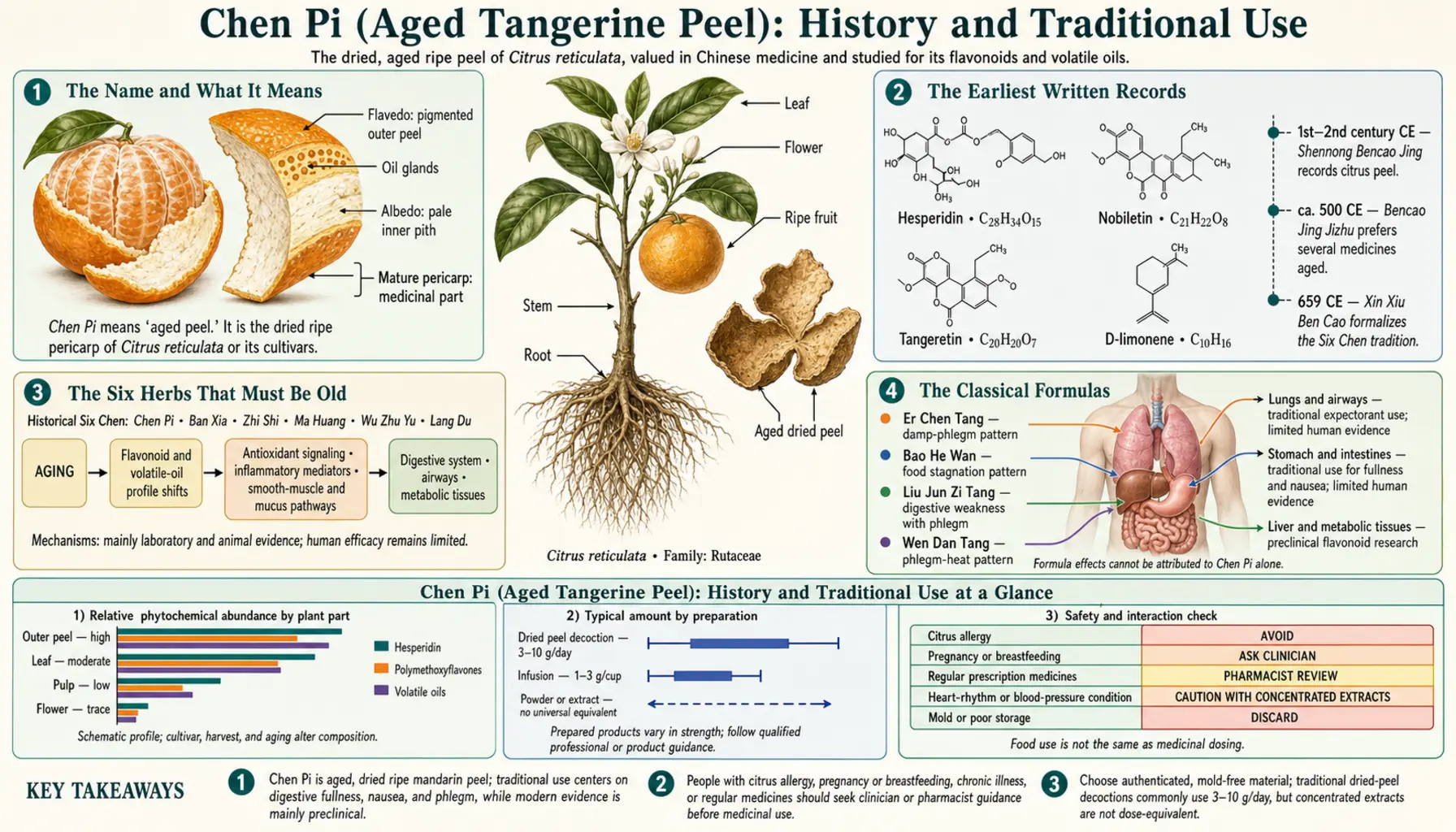
Almost every herb in the world is valued for being fresh. Tangerine peel is one of the few valued for being old — and the tradition says so in the name itself. This is the story of how a piece of fruit rind that most cultures throw away became a pharmacy staple, a Cantonese kitchen essential, and eventually an item sold by vintage year at prices that rival fine tea.
Table of Contents
- The Name and What It Means
- The Earliest Written Records
- The Six Herbs That Must Be Old
- The Classical Formulas
- How the Peel Was Made and Stored
- Xinhui and the Rise of Guang Chen Pi
- Botanical Naming: Citrus reticulata Blanco
- Regional Spread: Vietnam, Japan, Korea
- From Pharmacy to Kitchen
- How Chen Pi Entered Modern Research
- Confirmed, Unconfirmed, and Overstated
- Research Papers
- Connections
- Featured Videos
The Name and What It Means
The Chinese name is 陈皮, chén pí. The second character, 皮 pí, simply means skin, hide or peel. The first, 陈 chén, is the interesting one: it means old, long-kept, laid down, matured — the same character used for aged wine and for things that have been stored a long time. In ordinary speech it can even carry the sense of "stale". Applied to this herb it is unambiguously a compliment.
So the name literally reads "aged peel". Not "tangerine peel", not "citrus peel" — the age is the identity. That is unusual enough in Chinese pharmacy to be worth pausing on. There are hundreds of herbs whose names describe their colour, their shape, their place of origin or their action. Very few are named for how long you must wait before using them.
Earlier texts more often call the drug 橘皮 jú pí — "mandarin peel", using 橘 jú, the character for the mandarin orange. Over the centuries 陈皮 displaced 橘皮 as the standard pharmacy name, and that shift is itself a small piece of evidence: the profession came to regard the aging as inseparable from the drug.
Other names you will meet:
- Guang chen pi (广陈皮) — "Guangdong aged peel", the premium regional grade.
- Trần bì — the Vietnamese name, the same two characters read in Sino-Vietnamese. Vietnamese labels often give the Latin as Pericarpium Citri reticulatae perenne, where perenne (lasting through the years) is doing the same job as 陈.
- Chinpi (陳皮) — the Japanese reading, used in kampo medicine and in the kitchen.
- Jinpi (진피) — the Korean reading.
The Earliest Written Records
Mandarin peel enters the written record about as early as anything does in Chinese pharmacy. It appears in the Shennong Bencao Jing (神农本草经, the Divine Husbandman's Classic of Materia Medica), the foundational Chinese pharmacological text, compiled from earlier oral and manuscript traditions and generally dated to around the first or second century of the common era. The original is lost; what survives is reconstructed from later quotations, which is standard for texts of that age.
In that classic the entry is 橘柚 jú yòu — mandarin and pomelo, treated together — and it is placed in the upper class of drugs. The Shennong Bencao Jing sorts its materials into three grades: upper-class drugs were held to be nourishing, suitable for long-term use and non-toxic; middle-class drugs treated disease and needed care; lower-class drugs were potent and potentially harmful. Putting citrus peel in the top tier is a statement that it was regarded as safe enough for sustained everyday use — a judgement that two thousand years of subsequent use has not seriously challenged.
The recorded indications are recognisably the ones still used today: fullness and blockage in the chest, qi that rebels upward, and a general effect on the digestion.
Later materia medica traditions elaborated the entry rather than revising it. By the Tang and Song dynasties the peel had been separated from pomelo, distinguished from the peel of unripe fruit (qing pi), and split further into the outer red layer (ju hong) and the white inner strands (ju luo). The Bencao Gangmu (本草纲目, Compendium of Materia Medica) of Li Shizhen, completed in 1578 and first printed in 1596, gives a long and characteristically careful entry that gathers these distinctions, discusses the difference between peel with and without the white pith, and repeats the by-then standard instruction that the peel should be old.
The Six Herbs That Must Be Old
Classical Chinese pharmacy transmitted a mnemonic verse known as the Song of the Six Aged Herbs (六陈歌, Liu Chen Ge) — a rhymed list of drugs held to improve with storage rather than degrade. The verse circulated in materia medica literature for centuries and is quoted in later compendia including Li Shizhen's. Its exact origin and earliest attribution are debated by textual scholars, and it is better described as a long-transmitted pharmacy tradition than as the work of a datable author.
The six normally listed are:
| Herb | Chinese | What it is |
|---|---|---|
| Chen pi / ju pi | 陈皮 / 橘皮 | Mandarin peel |
| Ban xia | 半夏 | Pinellia rhizome |
| Zhi shi | 枳实 | Immature bitter orange fruit |
| Ma huang | 麻黄 | Ephedra stem |
| Wu zhu yu | 吴茱萸 | Evodia fruit |
| Lang du | 狼毒 | A toxic root, variously identified |
Look at that list and a pattern emerges. Almost every one of them is either harsh, irritating or outright toxic when fresh. Pinellia is acridly irritating to the throat raw. Ephedra is a powerful stimulant. Lang du is frankly poisonous. And fresh tangerine peel is sharp, oily and hard on the stomach.
Whatever the theoretical justification given at the time — the texts speak of the "fire toxin" or excessive acridity of new material dissipating over time — the empirical observation behind the rule is sound. Storage lets volatile and unstable constituents decline. For chen pi specifically, that means the essential oil, which is the fraction responsible for the harshness. Traditional pharmacy noticed the effect and made a rule out of it about a thousand years before anyone could measure limonene.
This is one of the more honest success stories in traditional processing lore, and it is worth flagging why: the tradition did not claim aging added anything. It claimed aging removed harshness. That is a much easier claim to observe by taste and by patient tolerance, and it turned out to be right.
The Classical Formulas
Chen pi's real importance in Chinese medicine is structural rather than starring. It is the small ingredient added to many formulas to keep them moving. Four canonical prescriptions show the pattern.
Er Chen Tang — Two Aged Herbs Decoction (二陈汤)
The archetypal phlegm formula, recorded in the Taiping Huimin Heji Jufang (太平惠民和剂局方, Formulary of the Bureau of People's Welfare Pharmacies), the Song-dynasty government pharmacopoeia compiled over the late eleventh and early twelfth centuries. This was one of the first state-sponsored standard formularies in the world — an attempt to regularise what the official pharmacies dispensed.
The name is a small joke that tells you the whole theory: the "two aged" ingredients are chen pi and ban xia (pinellia), the two members of the Six Aged Herbs in the prescription. Poria and honey-fried licorice complete it, with fresh ginger and a black plum added in the original preparation instructions. Er Chen Tang is still the base from which dozens of later phlegm formulas were built by modification.
Ping Wei San — Calm the Stomach Powder (平胃散)
Also from the Heji Jufang, and still one of the most-prescribed digestive formulas in East Asia. It pairs chen pi with atractylodes and magnolia bark for the pattern of damp, heavy, sluggish digestion — the feeling of a meal sitting like a stone, a thickly coated tongue, loose heavy stool.
Liu Jun Zi Tang — Six Gentlemen Decoction (六君子汤)
A digestive tonic, recorded in Ming-dynasty formularies, built by taking the four-herb tonic Si Jun Zi Tang — ginseng or codonopsis, atractylodes, poria and licorice — and adding chen pi and pinellia. The two additions exist for one reason: the four-herb base is sweet and heavy and can leave a weak patient bloated. Chen pi is the corrective.
This formula matters to modern research because its Japanese kampo equivalent, rikkunshito (六君子湯), is one of the few chen pi–containing prescriptions to have been studied in reasonably designed clinical trials, mainly for functional dyspepsia and appetite loss.
Bu Zhong Yi Qi Tang — Tonify the Middle, Augment the Qi (补中益气汤)
Created by Li Dongyuan (李东垣, 1180–1251), one of the four great physicians of the Jin–Yuan period, and set out in his Pi Wei Lun (脾胃论, Treatise on the Spleen and Stomach) of 1249. Li Dongyuan's whole medical philosophy held that digestive weakness was the root of chronic illness, and this formula — still widely used for fatigue, chronic weakness and organ prolapse — is his signature. Chen pi appears again in a small dose among much heavier tonic herbs, doing the same job it always does.
The through-line across all four is clear. Chen pi was never the herb you reached for to attack a disease. It was the herb that made other herbs tolerable — the pharmacological equivalent of putting fennel in a bean stew.
How the Peel Was Made and Stored
Traditional production is simple in principle and fussy in practice.
- Harvest ripe fruit. Late autumn to midwinter, when the skin has coloured. Green fruit gives qing pi, a different and more aggressive drug.
- Open the peel deliberately. In Xinhui the traditional cut is the "three knives, two flaps" method — three incisions from the base leaving the peel joined at the stem end, so it can be pulled off in one connected piece. A whole, intact peel is a mark of good workmanship and helps the piece dry into a consistent shape.
- Dry in sun and air. Not in an oven. Sun-drying is slow, which matters: fast heat drives off aromatics and can case-harden the surface.
- Store, and keep tending it. The peel goes into cloth sacks, baskets or sealed jars in a dry, ventilated room. Traditional practice is to bring it out periodically — classically once a year — to sun and air it again, which controls mould and insects and is held to advance the maturing. In humid southern China this annual re-drying was not optional.
Xinhui producers grade by harvest window, which is really a grading by ripeness:
| Grade | Chinese | Harvest | Character |
|---|---|---|---|
| Gan qing pi | 柑青皮 | Earliest, fruit still green | Thin, dark, strongly aromatic, sharpest |
| Wei hong pi | 微红皮 | Fruit turning | Balanced; often considered the sweet spot |
| Da hong pi | 大红皮 | Fully ripe | Thicker, softer, sweeter, less pungent |
Note that gan qing pi is peel from a green-skinned but developing fruit of the local mandarin, and is not the same as the separate drug qing pi made from genuinely immature fruit. The overlapping vocabulary trips up a lot of English writing on the subject.
Xinhui and the Rise of Guang Chen Pi
The finest chen pi comes from Xinhui (新会), a district of Jiangmen in Guangdong province, in the Pearl River Delta. The local mandarin is a cultivar known as chazhigan (茶枝柑), recognised in the botanical literature as Citrus reticulata 'Chachi'. Xinhui peel production is generally described as having several hundred years of history, with local tradition tracing it back to around the Song–Yuan transition in the thirteenth century.
Why there? The usual explanation combines the cultivar with the site: Xinhui sits where the fresh river water of the Xi and Tan rivers meets tidal saltwater, on alluvial silt, and growers hold that this brackish, mineral-rich ground produces peel with thicker oil glands and a distinctive aroma. That is a terroir argument, and like all terroir arguments it is part chemistry and part marketing, but the cultivar difference at least is real and measurable.
Guang chen pi is important enough to be listed as its own entry, separate from ordinary chen pi, in the Chinese Pharmacopoeia — a formal acknowledgement in a national drug standard that the regional grade is a distinct article. It also carries Chinese national geographical-indication protection, the same legal instrument that protects named regional foods elsewhere in the world.
Over the last several decades, aged Xinhui peel has developed a collector's market that closely mirrors aged pu-erh tea: sold by vintage year, stored as an appreciating asset, traded in sealed jars, and photographed for auction catalogues. Twenty-, thirty- and fifty-year peel commands prices per gram that would astonish anyone who thinks of this as fruit waste.
The predictable consequence is fraud. Young peel is dyed, smoked, baked, or stored in artificially humid conditions to fake the colour and brittleness of age; peel from other citrus species and other regions is relabelled; vintages are simply invented. Chinese regulators and the Xinhui industry association have both put effort into authentication, including chemical fingerprinting by mass spectrometry, precisely because the visual cues are so easy to counterfeit. Our page on Aging, Grades and Quality covers what a buyer can realistically check.
Botanical Naming: Citrus reticulata Blanco
The mandarin received its accepted botanical name from Francisco Manuel Blanco, a Spanish Augustinian friar and botanist who spent decades in the Philippines and published Flora de Filipinas in 1837. The authority abbreviation "Blanco" after Citrus reticulata is his. The epithet reticulata means "netted", describing the fine web of fibres visible on the inside of the peel — the same structures Chinese pharmacy had already named and used separately as ju luo.
That a European friar in Manila supplied the name for a fruit domesticated in southern China thousands of years earlier is a fair summary of how botanical nomenclature works: priority goes to the first valid published description under the Linnaean system, not to the first people to grow, name and use the plant.
Citrus taxonomy is notoriously messy, and this is worth knowing if you read the labels closely. Most cultivated citrus are hybrids, and genomic work over the past two decades has established that the mandarin is one of a small number of true ancestral species — alongside pomelo and citron — from which sweet orange, grapefruit, lemon and the rest were derived. Even so, most cultivated mandarins carry some pomelo admixture. The consequence for herb buyers is that "Citrus reticulata" on a label covers a wide range of cultivars with genuinely different chemistry, which is one reason published flavonoid contents for chen pi vary so much between studies.
Regional Spread: Vietnam, Japan, Korea
Vietnam. Chen pi travelled south as trần bì and is embedded in both Vietnamese traditional medicine (thuốc bắc, the northern or Chinese-derived tradition) and Vietnamese cooking. Vietnamese pharmacopoeial labelling preserves the aging requirement explicitly in its Latin name, Pericarpium Citri reticulatae perenne. Vietnam is today a significant producer as well as a consumer.
Japan. Read as chinpi, the peel is a standard kampo ingredient, appearing in rikkunshito, ninjin'yoeito and other formulas. It also has a firmly domestic life outside medicine: dried mandarin peel is one of the seven standard components of shichimi tōgarashi (七味唐辛子), the ubiquitous Japanese chilli-and-spice blend, where it supplies the citrus note. Traditional Japanese households also added peel to the yuzu-style winter-solstice bath.
Korea. Read as jinpi and used in traditional Korean medicine along similar lines. Jeju Island's long history of mandarin cultivation gives Korea its own domestic supply, and citrus-peel tea is a familiar home remedy for colds.
The diaspora. Cantonese emigration carried chen pi worldwide. It has been a fixture of Chinatown dried-goods shops from San Francisco to London to Sydney for well over a century — usually sold from an open bin, priced by grade, long before anyone in the West had heard the word "nobiletin".
The interesting absence is Europe. Mediterranean cooking has used citrus zest forever, and dried orange peel is a classic Provençal seasoning, but the specific practice of long-aging peel as a distinct upgraded material never developed there. The West kept the flavour and discarded the time.
From Pharmacy to Kitchen
In China, the line between food and medicine has always been porous — the phrase 药食同源 (yao shi tong yuan, "medicine and food share the same origin") is the usual shorthand — and chen pi sits squarely on that line. It is one of the herbs officially listed by Chinese health authorities as suitable for use in ordinary food as well as medicine, which is why you can buy it in a supermarket rather than only a pharmacy.
Its established culinary roles:
- Cantonese sweet soups. A piece of chen pi in red-bean or black-sesame soup is near-mandatory; the bitterness cuts the sugar and the aroma gives the dish its finish. This is the single most common domestic use in Guangdong.
- Sichuan orange-peel beef (陈皮牛肉). A classic cold dish in which the peel is a defining flavour rather than a background note, working against chilli and Sichuan pepper.
- Braised duck, goose and beef. The peel's bitterness cuts fat, and unlike fresh zest its aroma survives hours of braising.
- Steamed dishes. Shredded rehydrated peel on steamed fish or pork ribs, used much as a European cook uses lemon zest.
- Gan pu tea. A relatively modern Guangdong creation with old roots: small mandarins are hollowed out, packed with pu-erh tea, and the whole thing is dried and aged so that peel and tea mature together. Sold as gan pu or, for the smallest green fruit, xiao qing gan.
- Preserved snacks. Salted, liquorice-cured and sweetened citrus peel is a widespread East Asian confection — and, less romantically, a traditional remedy for motion sickness and morning queasiness.
How Chen Pi Entered Modern Research
Chen pi arrived in the laboratory by two separate routes, and it matters that they were separate.
Route one: the flavonoid chemists
Citrus peel became a subject of European chemistry well before anyone in the West cared about Chinese medicine. Hesperidin was first crystallised in 1828 by the French chemist Lebreton, who obtained it from orangettes — the small unripe oranges that drop from the tree — rather than from mature peel; in modern citrus it is most concentrated in the albedo, the white inner layer of the rind. It is one of the earliest plant flavonoids ever obtained in pure form, and it is named after Hesperides, the mythological garden of golden fruit.
A century later citrus flavonoids had a brief and famous career as a proposed vitamin. In July 1936, in a one-page letter to Nature, Albert Szent-Györgyi — who had already isolated vitamin C — and his colleague István Rusznyák reported that citrus flavonoids restored capillary resistance in patients whom ascorbic acid alone had not helped, and tentatively named the active principle "vitamin P", for permeability. Later the same year, working with Bruckner and Bentsáth, they isolated a crystalline flavonoid fraction from lemon juice and called it citrin — subsequently shown to be a mixture of hesperidin and a related flavanone glycoside, not a single compound. The designation stuck in the popular literature for years, but it did not survive scrutiny: no deficiency state could be demonstrated. Szent-Györgyi conceded the weakness himself in his 1937 Nobel lecture, admitting the vitamin-like properties had "not yet been successfully demonstrated in a completely irreproachable and reproducible fashion." In November 1950 a joint nomenclature committee — Vickery, Nelson, Almquist and Elvehjem — published a recommendation in Science that the term "vitamin P" be discontinued. It was a recommendation to drop a name, not a formal revocation, and papers using the term continued to appear for years afterwards. The episode is a useful historical caution, because "vitamin P" language still turns up in citrus-bioflavonoid marketing seventy-five years after it was retired.
The polymethoxyflavones were characterised in the same broad era of citrus chemistry, and their names record where they were found: nobiletin from Citrus nobilis, tangeretin from the tangerine. For decades they were mostly a curiosity of peel analysis — interesting because they are so heavily methylated, and because they barely occur outside citrus rind.
Route two: the pharmacology of a traditional drug
From the 1980s onward, Chinese and Japanese groups began systematically screening traditional materia medica, and Citri Reticulatae Pericarpium was an obvious candidate given how heavily it was prescribed. Early work focused on gastrointestinal motility and on the essential oil. Kampo research in Japan ran in parallel, driven by the fact that kampo formulas are prescription drugs there and are subject to regulatory scrutiny — which is why rikkunshito has clinical trials at all.
The convergence
The two routes met in the 2000s and 2010s, when nobiletin turned out to have striking effects in rodent models of metabolic disease. A 2010 study reported that nobiletin improved hyperglycaemia and insulin resistance in obese diabetic mice; a 2011 study in Diabetes found it reduced VLDL overproduction, corrected dyslipidaemia and cut atherosclerotic plaque in insulin-resistant mice. In 2016 a group publishing in Cell Metabolism reported that nobiletin acts on the molecular circadian clock, enhancing the amplitude of the body's daily oscillator, with metabolic protection that appeared to require an intact clock — a genuinely novel mechanism that pulled nobiletin into circadian biology as well as nutrition science.
At that point a herb that had been described for two thousand years as a mild digestive aid acquired a second reputation, in a literature that has essentially nothing to do with digestion.
Confirmed, Unconfirmed, and Overstated
A history page owes the reader an honest scorecard.
What modern work supports
- The aging instruction was chemically sound. Volatile monoterpenes decline with storage while non-volatile flavonoids remain, so old peel really is milder and proportionally richer in flavonoids. The tradition's stated reason — that harshness dissipates — matches what happens.
- The plant identification was stable and accurate. Chinese pharmacy distinguished ripe from unripe peel, and the coloured layer from the white pith, long before chemistry could justify the distinctions. Modern analysis confirms those parts differ measurably in composition.
- The carminative effect has a mechanism. Monoterpene-rich aromatics do relax gastrointestinal smooth muscle. Chen pi belongs to the same functional family as fennel and peppermint, both better studied in humans.
- The peel is a genuinely unusual source. Polymethoxyflavones are close to unique to citrus rind. Traditional practice happened to preserve the one part of the fruit that contains them.
- Excellent safety. The Shennong Bencao Jing's upper-class placement has held up. Two thousand years of daily food and medicinal use with no significant toxicity signal is a real result.
What remains unproven
- Efficacy for any specific condition, tested alone. There is no adequately designed randomised trial of chen pi by itself for dyspepsia, bloating, cough or anything else. Trials that exist are of multi-herb formulas, most often rikkunshito, and cannot apportion credit.
- The metabolic story in humans. The nobiletin results are mouse results. There is no meaningful human trial evidence for nobiletin or tangeretin in diabetes, obesity or cardiovascular disease.
- The brain story in humans. Likewise entirely preclinical.
- Whether age improves potency. Tradition says older is better; that judgement is about taste, aroma and gentleness, on which it is credible. Whether thirty-year peel is more therapeutically effective than three-year peel has never been tested clinically, and the price gradient runs far ahead of any evidence.
What gets overstated
- "Drink chen pi tea for blood sugar." The rodent nobiletin doses correspond, after standard body-surface-area scaling, to several hundred to a thousand milligrams a day in a human adult. Ten grams of good aged peel contains a few tens of milligrams at best, and polymethoxyflavones extract poorly into water, so a mug of tea delivers a fraction of that again. The shortfall is at least fifteen- to fiftyfold on content alone, and larger once extraction is accounted for. See Polymethoxyflavones and Metabolism for the arithmetic.
- "Chen pi is a fat burner." This confusion comes from bitter orange (Citrus aurantium), a different species whose immature fruit is extracted and standardised for p-synephrine. Ripe mandarin peel has only trace synephrine and no stimulant action.
- "Citrus peel interacts like grapefruit." The grapefruit–drug interaction is driven by furanocoumarins, which grapefruit, pomelo, lime and Seville orange have in quantity and mandarin is close to devoid of; tangerine juice given with the standard CYP3A4 probe drug left its metabolism unchanged in human volunteers. There are real questions about citrus flavonoids and drug transport — hesperidin reduces absorption of some medicines, which is the opposite direction from grapefruit — but equating chen pi with grapefruit juice is not one of them.
- "Vitamin P." Never established as a vitamin, and formally recommended for discontinuation as a term in 1950. Its survival in supplement copy is marketing, not nutrition science.
The fair verdict is that chen pi is a well-characterised traditional drug with an outstanding safety record, a sound mechanistic basis for its mildest and oldest claim, a chemically real justification for its most distinctive processing rule, and a large, genuinely interesting preclinical literature that has not yet been tested in people. That is a more interesting story than the marketing version, and it has the advantage of being true.
Research Papers
Author names, titles and journals are given in full so each can be verified independently. Every identifier was checked against the live PubMed index — authors, title, journal and year all match the linked record. One older paper predates PubMed's coverage of its journal and is linked by DOI instead.
- Yu X, Sun S, Guo Y, Liu Y, Yang D, Li G, Lü S. Citri Reticulatae Pericarpium (Chenpi): Botany, ethnopharmacology, phytochemistry, and pharmacology of a frequently used traditional Chinese medicine. Journal of Ethnopharmacology. 2018;220:265–282. Covers the historical record, the regional grades and the chemistry in one place.
- Wu GA, Terol J, Ibanez V, López-García A, Pérez-Román E, Borredá C, et al. Genomics of the origin and evolution of Citrus. Nature. 2018;554(7692):311–316. Establishes the mandarin as one of the ancestral citrus species.
- Lee YS, Cha BY, Saito K, Yamakawa H, Choi SS, Yamaguchi K, Yonezawa T, Teruya T, Nagai K, Woo JT. Nobiletin improves hyperglycemia and insulin resistance in obese diabetic ob/ob mice. Biochemical Pharmacology. 2010;79(11):1674–1683.
- Mulvihill EE, Assini JM, Lee JK, Allister EM, Sutherland BG, Koppes JB, Sawyez CG, Edwards JY, Telford DE, Charbonneau A, St-Pierre P, Marette A, Huff MW. Nobiletin attenuates VLDL overproduction, dyslipidemia, and atherosclerosis in mice with diet-induced insulin resistance. Diabetes. 2011;60(5):1446–1457.
- He B, Nohara K, Park N, Park YS, Guillory B, Zhao Z, Garcia JM, Koike N, Lee CC, Takahashi JS, Yoo SH, Chen Z. The small molecule nobiletin targets the molecular oscillator to enhance circadian rhythms and protect against metabolic syndrome. Cell Metabolism. 2016;23(4):610–621. The paper that pulled a traditional digestive herb into circadian biology.
- Guo J, Tao H, Cao Y, Ho CT, Jin S, Huang Q. Prevention of obesity and type 2 diabetes with aged citrus peel (Chenpi) extract. Journal of Agricultural and Food Chemistry. 2016;64(10):2053–2061. Tests the aged peel itself rather than an isolated compound.
- Li S, Lo CY, Ho CT. Hydroxylated polymethoxyflavones and methylated flavonoids in sweet orange (Citrus sinensis) peel. Journal of Agricultural and Food Chemistry. 2006;54(12):4176–4185. Why polymethoxyflavones are a peel-only class.
- Manthey JA, Grohmann K. Concentrations of hesperidin and other orange peel flavonoids in citrus processing byproducts. Journal of Agricultural and Food Chemistry. 1996;44(3):811–814. Baseline flavonoid quantification in citrus peel. Predates PubMed's indexing of this journal, so it is linked by DOI.
- Bailey DG, Dresser G, Arnold JM. Grapefruit–medication interactions: forbidden fruit or avoidable consequences? Canadian Medical Association Journal. 2013;185(4):309–316. The reference that separates furanocoumarins from flavonoids in the interaction story.
- Rusznyák S, Szent-Györgyi A. Vitamin P: flavonols as vitamins. Nature. 1936;138(3479):27. The one-page letter that proposed the name. Predates PubMed, so it is linked by DOI.
- Vickery HB, Nelson EM, Almquist HJ, Elvehjem CA. Term "vitamin P" recommended to be discontinued. Science. 1950;112(2917):628. The nomenclature committee's recommendation — the actual end of the vitamin P designation, and a recommendation rather than a revocation.
- Luo M, Luo H, Hu P, Yang Y, Wu B, Zheng G. Evaluation of chemical components in Citri Reticulatae Pericarpium of different cultivars collected from different regions by GC-MS and HPLC. Food Science & Nutrition. 2018;6(2):400–416. Shows that cultivar, not age, dominates the polymethoxyflavone content of chen pi.
Live PubMed Searches
- Citri Reticulatae Pericarpium history
- Chenpi aging and chemical composition
- Guang chenpi, Xinhui and the 'Chachi' cultivar
- Citrus reticulata authentication and chemical fingerprinting
- Rikkunshito clinical trials
- Er Chen Tang
- Qing pi (green tangerine peel)
- Citrus flavonoids and the "vitamin P" episode
Connections
- All Herbs
- Chen Pi (Aged Tangerine Peel) — the main research article: chemistry, evidence, dosage and cautions.
- Chen Pi Benefits — the deep-dive hub.
- Aging, Grades and Quality — how the vintages are defined, and how they are faked.
- Digestion and Appetite — the oldest and best-supported use.
- Phlegm, Cough and Lungs — the Er Chen Tang tradition and what modern data show.
- Polymethoxyflavones and Metabolism — the nobiletin story and the dose gap.
- Hesperidin — first crystallised from orange in 1828, and one of the two flavonoids in the citrin fraction behind the 1930s "vitamin P" episode.
- Licorice — chen pi's partner in Er Chen Tang and Liu Jun Zi Tang.
- Ginger — added to Er Chen Tang in the original Song-dynasty preparation instructions.
- Atractylodes — the other principal herb in Ping Wei San.
- Codonopsis — the tonic base of Liu Jun Zi Tang that chen pi was added to lighten.
- Fennel — the European carminative tradition running in parallel.
- Peppermint — the aromatic digestive with the strongest modern trial record.