Chen Pi Aging, Grades and Quality
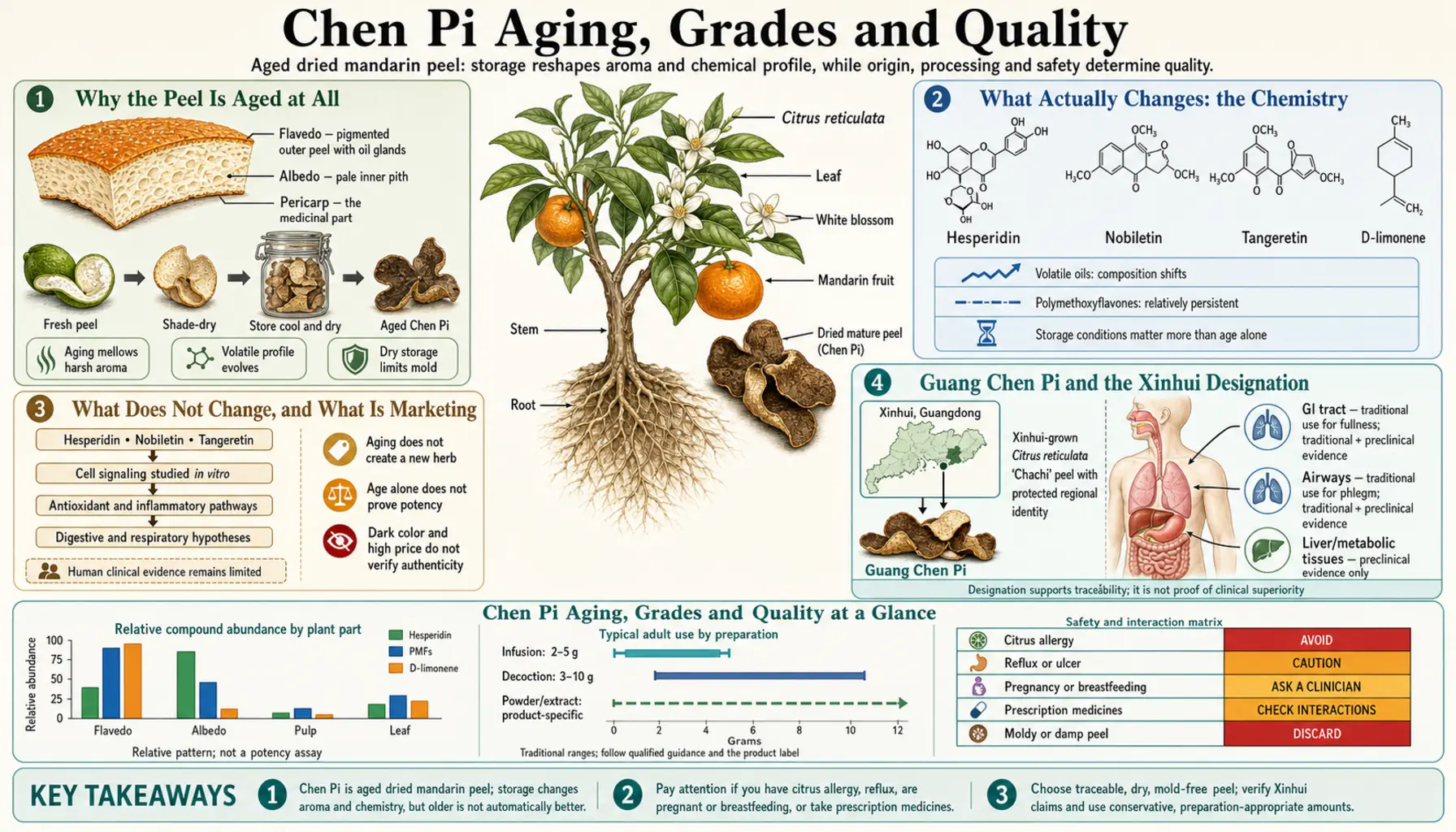
This is the buyer’s page. Chen pi is one of the very few herbs whose name contains an instruction — 陈皮 means “aged peel” — and the market that has grown around that instruction ranges from an honest ingredient costing a few dollars a bag to a collector’s commodity sold by vintage year at prices that rival fine tea. Here is what genuinely changes with age, what is marketing, how to tell aged peel from dried fresh peel, and the quality problem that matters far more than vintage: peel is the most pesticide-prone part of the fruit.
Table of Contents
- Why the Peel Is Aged at All
- What Actually Changes: the Chemistry
- What Does Not Change, and What Is Marketing
- Guang Chen Pi and the Xinhui Designation
- Grades, Cuts and Vintages: Reading a Label
- Chen Pi, Qing Pi, Ju Hong and Ju Luo
- Telling Aged Peel from Dried Fresh Peel
- Pesticide Residue: The Real Quality Problem
- Sulfur, Dyes, Mould and Other Adulteration
- Storing and Aging Peel at Home
- Vintage Pricing as a Collector’s Market
- Key Research Papers
- Connections
- Featured Videos
Why the Peel Is Aged at All
Fresh mandarin peel is harsh. It is intensely aromatic, sharply bitter, and traditional practitioners described it as too dispersing and too irritating for the digestive complaints it was meant to treat. The traditional solution was simply to put it away and use it later, and the convention hardened into the herb’s name.
The thresholds in the trade are these. One year is the minimum before the material is properly called chen pi at all; anything younger is just dried tangerine peel. Three years is the common commercial threshold at which sellers begin to advertise age, and it is the point at which most practitioners consider the peel to have settled. Beyond that, five, ten, twenty and thirty years are marketed as distinct grades, and in Xinhui the material is dated by harvest year the way wine is.
Vietnamese herb labels often print Pericarpium Citri reticulatae perenne. That is not a separate species — perenne signals the aged grade, distinguishing it from freshly dried peel.
What Actually Changes: the Chemistry
Aging chen pi is not folklore dressed up as pharmacy. Measurable things happen, and they are worth understanding precisely, because knowing what changes also tells you what does not.
1. The volatile oil declines. This is the dominant change. Dried peel starts with a few percent essential oil by weight, 60–90% of it d-limonene, and that fraction is volatile by definition. Over years of storage it evaporates, and what remains partly oxidizes — limonene converts to carveol, carvone and limonene oxides, and the balance of the remaining minor terpenes shifts. Analytical studies of peel across storage years consistently show total volatile content falling and the volatile profile changing in composition, not just in quantity.
2. The flavonoid fraction becomes proportionally more concentrated. Hesperidin, nobiletin and tangeretin are not volatile. As the oil leaves and the dry mass drops, everything non-volatile becomes a larger share of what is left. Well-aged peel is therefore richer in flavonoids per gram than freshly dried peel from the same fruit. This is a real and measurable shift — and note carefully that it is a change in ratio, not the creation of new medicine. Aging does not manufacture nobiletin.
3. The aroma changes character. Fresh peel smells like citrus zest: sharp, bright, green-edged. Aged peel smells mellow, resinous, faintly medicinal, with a woody or almost incense-like quality and a much longer, rounder finish. That transformation is exactly what you would predict from losing the light monoterpenes and retaining the heavier, less volatile aroma compounds and their oxidation products. Anyone who has smelled a 10-year Xinhui peel next to a supermarket dried peel can identify the difference instantly; it is not subtle and it is not imaginary.
4. Taste softens. The acrid, tongue-scraping quality of fresh peel fades. Old peel is bitter but rounded, sometimes with a faint sweetness in the aftertaste, and it rehydrates into an amber rather than orange infusion.
5. Microbial and enzymatic activity. This is the least settled part and an active area of research. Peel in traditional storage carries a surface microflora, and there is published work examining how bacteria and fungi on stored peel contribute to the chemical transformation — broadly analogous to what is understood about post-fermented tea. It is plausible and interesting; it is not yet a well-characterized mechanism, and you should treat confident claims about “fermentation” in chen pi marketing as ahead of the science.
What Does Not Change, and What Is Marketing
Now the other side of the ledger, because the aged-peel trade generates a lot of claims.
Age is not a dose-response curve. A 30-year peel is not thirty times a 1-year peel, or three times a 10-year peel. The chemical changes are largest in the early years and flatten out; the volatile fraction cannot fall below zero, and the flavonoids stop concentrating once there is nothing left to evaporate. Beyond roughly a decade, most of what you are paying for is aroma, provenance and rarity.
No clinical trial has compared vintages. There is no study showing that 20-year peel relieves bloating better than 3-year peel, or that any age of chen pi outperforms another for any clinical outcome. The chemistry is documented; the clinical superiority is assumed. Those are different claims and sellers routinely merge them.
“More potent with age” is at best half right. If the active fraction you care about is the aromatic oil — the carminative, antispasmodic part — then aged peel has less of it, not more. If the fraction you care about is the flavonoids, aged peel has proportionally more. Blanket potency claims ignore that the herb contains two fractions moving in opposite directions.
Health claims attached to vintage. Anything asserting that old chen pi treats a disease is unsupported. The metabolic literature that gets borrowed for these claims is rodent work at doses far above what any peel can deliver — see Polymethoxyflavones and Metabolism for the arithmetic.
Guang Chen Pi and the Xinhui Designation
Guang chen pi (广陈皮) means chen pi from Guangdong, and in practice the prestige name refers to peel from Xinhui, a district of Jiangmen in the Pearl River Delta. Xinhui peel comes from a specific local mandarin, the Chachi (茶枝柑) cultivar of Citrus reticulata, grown in the delta’s brackish alluvial soils. Xinhui chen pi is a registered Chinese geographical-indication product, which means the name is legally tied to origin in the way that Champagne or Parma ham are.
Whether Xinhui peel is pharmacologically superior is a separate question from whether it is culturally and commercially superior. Comparative analyses do find compositional differences between cultivars and growing regions — different flavonoid ratios, different volatile profiles — which is unsurprising and true of most crops. Whether those differences matter clinically has not been tested. What is not in dispute is that Xinhui material is more aromatic, more consistent, better processed and vastly more expensive.
Because the name carries a price premium, it is also the most counterfeited designation in the Chinese herb trade. Peel from other regions and other mandarin cultivars is routinely sold as Xinhui, and there is a substantial scientific literature on authenticating it by chemical fingerprinting and DNA methods — which tells you how big the problem is.
Grades, Cuts and Vintages: Reading a Label
Xinhui peel is graded on three axes, and knowing them makes a label legible.
By harvest stage. Within the Xinhui system the same orchard yields three products depending on when the fruit is picked:
- Gan qing pi (柑青皮) — picked early, autumn, peel still green. Thin, hard, strongly acrid, high in oil.
- Wei hong pi (微红皮) — picked at the turning point, peel yellow-red. The balanced middle grade.
- Da hong pi (大红皮) — picked fully ripe, deep orange-red. Thicker, softer, sweeter, more mellow. This is what most people mean by chen pi.
Note that this is a within-Xinhui grading of ripeness, and it is not the same thing as the separate drug qing pi discussed below.
By cut. Traditional Xinhui peeling produces the three-petal form (三瓣) — the peel opened with three cuts from the base so it comes off in a connected three-lobed piece, which then dries in a characteristic curl. An intact three-petal piece is a marker of proper hand processing; shredded or fragmented peel tells you nothing about origin and is where blending and substitution happen.
By vintage. Serious sellers state the harvest year, not the age — “2015 Xinhui” rather than “10 years.” A stated year is checkable against a purchase record and does not silently advance; “10 years” on a label that has sat in a warehouse means nothing. If a seller cannot name a year, treat the age claim as decoration.
Chen Pi, Qing Pi, Ju Hong and Ju Luo
One tree yields four distinct articles of trade, and they are not interchangeable.
| Name | What it is | Traditional role |
|---|---|---|
| Chen pi 陈皮 | Dried, aged peel of the ripe fruit | Regulates qi, dries damp, transforms phlegm, harmonizes the stomach |
| Qing pi 青皮 | Peel of the unripe green fruit | Stronger and more acrid; “breaks” stagnant qi in the Liver channel, for distension and pain in the sides |
| Ju hong 橘红 | The outer coloured layer (flavedo) shaved off alone, white pith removed | More drying and more focused on phlegm and cough |
| Ju luo 橘络 | The white fibrous strands of pith and vascular bundles | Minor herb, used for chest discomfort and cough in the collaterals |
The chen pi / qing pi distinction is the important one. They are different harvests of the same plant with genuinely different chemistry — unripe peel is higher in volatile oil and in some flavonoid fractions — and they were assigned quite different jobs by traditional practice. A supplier who cannot distinguish them is not a supplier you should rely on for the rest.
Telling Aged Peel from Dried Fresh Peel
You cannot verify a vintage claim by inspection, and anyone selling certainty is selling something. But you can usually tell genuinely aged peel from young peel, and you can spot the crude fakes. Use all four senses in this order.
Smell first, and smell it dry. This is the most reliable single test. Young peel smells like citrus zest — bright, sharp, immediate. Aged peel smells mellow, deep, slightly resinous or woody, with the citrus note receding and a long finish. If a piece sold as 15-year-old peel smells like a fresh orange, it is not 15 years old. If it smells of caramel, smoke or burnt sugar, it has been cooked or treated.
Look at both faces. The outer surface darkens with age, from bright orange through brown to a dark, sometimes nearly black brown, with the oil glands still visible as pits. The inner (white pith) face is the more informative one: it starts white or cream and progresses to pale yellow, then tan, then brown. A piece with a dark outside and a still-white inside has been surface-treated or dyed. Colour should also be uneven and natural, not uniform.
Feel it. Well-aged peel is dry, light and brittle — it snaps cleanly rather than bending, and it feels almost weightless for its size because both moisture and volatile oil have gone. Young or improperly dried peel is leathery and pliable. Peel that feels heavy or damp has re-absorbed moisture and is a mould risk.
Steep a piece. Genuine aged peel gives a clear amber to reddish-brown infusion that develops slowly over several minutes, with a mellow bitterness and no harsh edge. Dyed peel releases colour fast, often within seconds, and the colour looks too orange or too even. Sugar- or molasses-treated peel tastes sweet immediately. Smoked peel tastes of smoke, which no amount of ageing produces.
Common fakery to be aware of: high-temperature baking to darken peel quickly; staining with strong tea, caramel or dye; blending a small amount of genuine old peel with a large amount of young peel; and selling peel from other citrus species or other regions under the Xinhui name. None of these are exotic — all are well documented in the trade.
Pesticide Residue: The Real Quality Problem
If you take one thing from this page, take this one. Vintage is a luxury question. Residue is a safety question, and peel is the worst-case matrix.
Three things stack up against citrus peel specifically:
- Peel is the outside. Every spray applied in the orchard lands on it first, and it is never washed off by the consumer because the consumer usually throws it away.
- Peel is fatty and waxy. Lipophilic pesticides partition into the oil glands and cuticular wax and stay there. Residue analyses of citrus routinely find concentrations in peel many times higher than in the pulp — which is exactly why regulatory limits for whole citrus are set with the assumption that people eat the flesh.
- Post-harvest fungicides are applied to the peel deliberately. Citrus destined for storage and shipping is commonly treated after picking with fungicides such as imazalil, thiabendazole and 2-phenylphenol, often in wax, precisely to stop the peel rotting. That treatment is targeted at the exact part you intend to eat.
Add to that the fact that aging concentrates residues along with everything else non-volatile, and that some organochlorine-era contaminants persist in soil for decades, and the case for caring about sourcing is strong.
Practical guidance. Buy peel intended as a medicinal or culinary product, from a supplier who can say where it came from — not peel improvised from ordinary supermarket fruit, which is likely to be waxed and post-harvest treated. Prefer organic where available, or reputable Xinhui and Guangdong producers who publish residue testing. Chinese and international pharmacopeias set residue limits for herbal materials, and serious traders test against them; a supplier who has never heard of the question is answering it. If you make your own peel at home, use organic, unwaxed fruit — this is the single situation where organic sourcing is clearly worth the premium, because you are eating the sprayed surface itself.
Sulfur, Dyes, Mould and Other Adulteration
Sulfur fumigation. Burning sulfur in a closed room with drying herbs is a long-standing practice in the Chinese herb trade. It bleaches the material to a brighter colour, kills insects and moulds, and speeds drying — and it leaves sulfur dioxide and sulfite residues behind. Excessive fumigation has been a recurring scandal, and Chinese authorities introduced residue limits in response, on the order of 150 mg/kg of sulfur dioxide for most herbal materials with a higher allowance for a small number of traditionally fumigated ones. Two reasons to care: sulfites provoke bronchoconstriction in a minority of people with asthma, sometimes sharply; and heavy fumigation degrades the herb’s own constituents. Sulfured peel often looks suspiciously bright and uniform and can smell faintly of struck matches. Buy unsulfured.
Dyes and sweeteners. Covered above under authentication — peel that bleeds colour instantly or tastes sweet on the first chew has been treated.
Mould and mycotoxins. This is the genuine risk of buying “aged” peel that has been stored badly. Peel that re-absorbs humidity, particularly in a subtropical summer, can support mould growth, and some storage fungi produce mycotoxins including aflatoxins. Traditional Xinhui practice manages this by periodically airing and sun-drying the stock, which is labour that costs money and is one honest justification for the price of properly kept old peel. Reject any peel with visible fuzzy growth, white or green powdery patches, or a musty cellar smell. Age is not a licence for mould, and “that’s just the aging” is not an acceptable answer.
Heavy metals. Standard concern for any plant material grown near industry or in contaminated soil, and another reason to prefer suppliers who test.
Storing and Aging Peel at Home
You can do this, and it is cheap and satisfying, as long as you are honest about what you will end up with.
- Start with organic, unwaxed mandarins. Non-negotiable, for the reasons above. Scrub and dry them first.
- Peel cleanly. The traditional three-cut method from the base gives you connected three-lobed pieces that dry in the characteristic curl. Keep the white pith attached — chen pi is the whole peel, not just the coloured layer.
- Dry thoroughly. Air-dry in a warm, well-ventilated place out of direct strong sun until the peel is brittle and snaps. Incomplete drying is the single commonest cause of failure, because residual moisture means mould. A very low oven (below about 50 °C) with the door ajar is acceptable if your climate is damp; high heat cooks the peel and destroys the point of the exercise.
- Store dry and breathable. Cardboard, paper, cloth bags or unglazed ceramic in a dry cupboard. Not sealed plastic, which traps any residual moisture. Not the refrigerator.
- Air it periodically. Two or three times a year on a dry, sunny day, spread the peel out for a few hours, then re-store it. This is precisely what commercial agers do, and it is how mould is prevented over decades.
- Label the harvest year. Write the date on the container the day you store it. This is the only vintage record that will ever be trustworthy to you.
- Wait. One year before you call it chen pi. Three before it is noticeably mellow.
The honest caveat: home-aged peel from supermarket mandarins is not Xinhui Chachi peel and will not develop the same aroma, because cultivar and terroir matter for the starting material. What it will be is clean, cheap, traceable, free of sulfur and dye, and perfectly good for cooking and everyday tea — which for most purposes is the more important set of properties.
Vintage Pricing as a Collector’s Market
It is worth naming clearly what the top end of this market is.
Ordinary dried tangerine peel is inexpensive: a large bag costs a few dollars. Decent 3- to 5-year peel is a modest premium. Authenticated 10-year Xinhui peel routinely sells for hundreds of dollars a kilogram. Twenty- and thirty-year Xinhui peel trades in the thousands and beyond, appears at auction, is bought as an investment, is stored in bank-style vaults by some collectors, and in Guangdong is given as a status gift in the same register as aged pu-erh tea or fine baijiu. There have been periods of speculative price inflation in Xinhui peel, with all the features that implies.
None of that is dishonest in itself. Rarity, provenance, careful decades-long storage and genuine sensory quality are real things and people are entitled to pay for them, exactly as with wine or tea. The dishonesty enters when the collector’s premium is justified by a health claim — when a thousand-dollar peel is sold as being a thousand dollars’ worth of medicine.
Our position, stated plainly: buy young-to-middling peel for use, and old peel for pleasure, and do not confuse the two. For a digestive tea or a pot of soup, clean 3-year organic peel does the job. If you love the aroma of a 20-year Xinhui and can afford it, that is a legitimate reason to buy it — it is a superb ingredient and a piece of living craft tradition. It is not a better drug, and no evidence says it is.
Key Research Papers
Each link runs a PubMed query, so it resolves to real records rather than to a numeric identifier we might have mistyped. Much of the aging and authentication work in this field is published in Chinese-language analytical journals and is best reached by topic search rather than by single citation.
- Yu X, Sun S, Guo Y, et al. Citri Reticulatae Pericarpium (Chenpi): botany, ethnopharmacology, phytochemistry, and pharmacology of a frequently used traditional Chinese medicine. Journal of Ethnopharmacology. 2018. Covers cultivars, grades and the aging convention.
- Analytical studies comparing volatile and flavonoid composition across storage years. Browse the aging-chemistry literature.
- Chemical-fingerprint and DNA approaches to authenticating Xinhui-origin peel. Browse the authentication literature.
- Microbial communities on stored chen pi and their role in transformation. Browse the storage-microbiology literature.
- Kohlert C, van Rensen I, März R, et al. Bioavailability and pharmacokinetics of natural volatile terpenes in animals and humans. Planta Medica. 2000. Context for why losing the volatile fraction matters.
- Mulvihill EE, Burke AC, Huff MW. Citrus flavonoids as regulators of lipoprotein metabolism and atherosclerosis. Annual Review of Nutrition. 2016. Context for the flavonoid fraction that aging concentrates.
Live PubMed Searches
- Pesticide residues in citrus peel
- Post-harvest fungicides on citrus
- Sulfur fumigation of Chinese herbs
- Sulfite sensitivity in asthma
- Mycotoxins in stored herbal material
- Hesperidin as a quality marker
- Qing pi vs chen pi chemistry
- Limonene oxidation during storage
- Heavy metals in herbal materials
- Chachi cultivar chemistry
Connections
- All Herbs
- Chen Pi (Aged Tangerine Peel)
- Chen Pi Benefits
- Chen Pi: History and Traditional Use
- Chen Pi for Digestion and Appetite
- Chen Pi for Phlegm, Cough and the Lungs
- Chen Pi Polymethoxyflavones and Metabolism
- Hesperidin
- Licorice
- Ginger
- Fennel
- Peppermint
- Atractylodes