Chen Pi for Phlegm, Cough and the Lungs
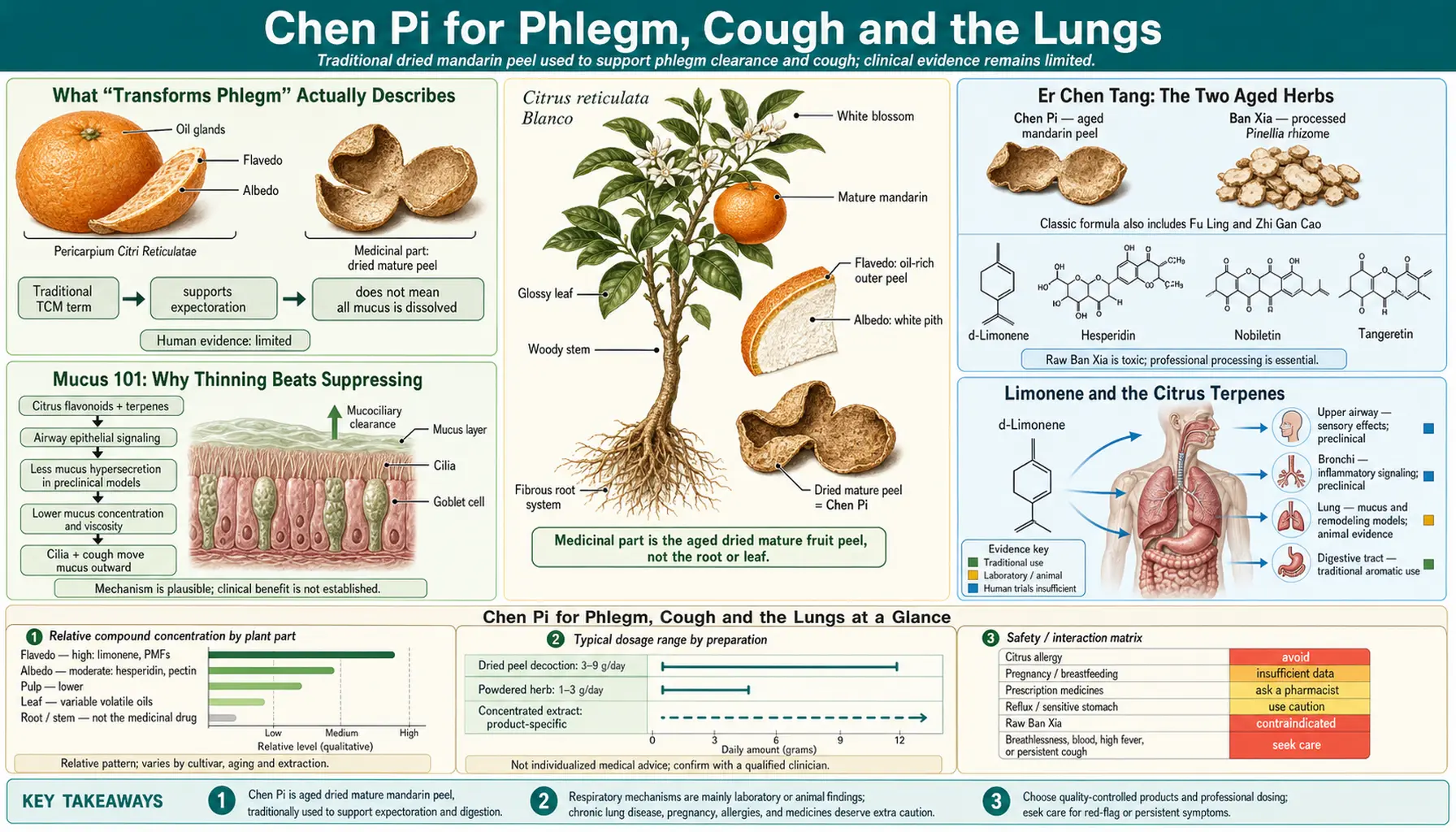
The second great use of aged mandarin peel is for a wet, rattling, productive cough — what classical Chinese texts call phlegm. Chen pi is half of Er Chen Tang, the “Two Aged Herbs Decoction,” which is to phlegm what aspirin is to headache in that tradition: the default. This article explains what “transforming phlegm” describes in physiological terms, what the terpene pharmacology genuinely supports, and where the evidence runs out — because on this topic the gap between the laboratory and the teacup is unusually wide.
Table of Contents
- What “Transforms Phlegm” Actually Describes
- Er Chen Tang: The Two Aged Herbs
- Mucus 101: Why Thinning Beats Suppressing
- Limonene and the Citrus Terpenes
- 1,8-Cineole: The Best Terpene Evidence We Have
- Flavonoids, Nobiletin and Airway Inflammation
- The Honest Limit: Capsules Are Not Tea
- Practical Use: Decoction, Steam and Formulas
- When a Cough Needs a Doctor, Not a Tea
- Key Research Papers
- Connections
- Featured Videos
What “Transforms Phlegm” Actually Describes
Phlegm (痰, tán) in Chinese medicine is broader than the mucus you cough up. It is a category that includes visible sputum but also stretches to describe heaviness, a muffled head, nausea, dizziness and lumps. Modern readers should not try to force that whole concept into a physiological box — large parts of it do not translate.
But the narrow, respiratory sense does translate well, and it is the sense in which chen pi is used most. The classical picture for chen pi is a cough with copious, thin-to-sticky white sputum, a sense of fullness in the chest, and often nausea or poor appetite alongside it. Not a dry, tickly, hacking cough — for that, traditional practice reaches for moistening herbs and explicitly warns that a drying herb like chen pi is the wrong choice. Not a cough with thick yellow-green sputum and fever either, which is classified as heat and treated differently.
“Transforming phlegm” therefore means, in ordinary terms: make the mucus easier to clear. Not suppress the cough, not dry the airway out entirely — change the character of the secretions so that the cough accomplishes something and stops. In modern pharmacological vocabulary that is a mucolytic or expectorant action, and it is a real drug category with real drugs in it (N-acetylcysteine, carbocisteine, ambroxol, guaifenesin, and in Europe several standardized plant preparations).
There is a second thread worth naming. Traditional theory holds that “the Spleen is the source of phlegm and the Lung is the container that stores it” — meaning that chronic mucus is generated by a poorly functioning digestion and merely accumulates in the chest. That is why the classical phlegm formulas are built from digestive herbs rather than respiratory ones. Whether or not you accept the physiology, it explains why a stomach herb is the traditional cough remedy, which otherwise looks arbitrary.
Er Chen Tang: The Two Aged Herbs
Er Chen Tang (二陈汤) is the foundational phlegm formula, recorded in the Song-dynasty imperial formulary. Its name refers to its two principal ingredients, both of which are traditionally used aged: chen pi (aged tangerine peel) and ban xia (prepared pinellia rhizome). The classic version also contains fu ling (poria) and a small amount of prepared licorice, usually decocted with fresh ginger.
Structurally it is a very simple prescription: pinellia as the chief, chen pi as its deputy, poria to drain fluid, licorice to harmonize and soothe, ginger to counteract pinellia’s harshness. Dozens of later formulas are Er Chen Tang plus modifications — add scutellaria for heat, add apricot kernel for wheeze, add atractylodes for damp. It functions as a chassis.
Two honest notes about it. First, raw pinellia is toxic; it is intensely acrid and irritating and must be processed (with ginger, alum, or licorice-and-lime depending on the method) before use. Anyone considering the whole formula should buy properly prepared material from a competent supplier or, better, work with a practitioner. Chen pi on its own carries none of that risk.
Second, the clinical evidence base for Er Chen Tang as a formula is thin by modern standards — small trials, mostly Chinese-language, often with methodological limitations, frequently testing modified versions rather than the classical one. Its authority rests on nine centuries of continuous use, which is genuinely meaningful information about tolerability and about practitioners’ sustained impression of usefulness, and is not the same thing as a controlled trial.
Mucus 101: Why Thinning Beats Suppressing
Airway mucus is mostly water, with large gel-forming mucin glycoproteins (MUC5AC and MUC5B) providing the structure. Those mucins are enormous molecules cross-linked by disulfide bonds; the density of that cross-linking, plus the water content, determines how stiff and sticky the mucus is. On top of it sits a watery layer in which the cilia beat, sweeping the gel blanket up and out — the mucociliary escalator.
When mucus becomes too concentrated and too cross-linked, three things fail at once: cilia can no longer move it, cough becomes less effective at shearing it loose, and the stagnant layer becomes a comfortable environment for bacteria. That is the core problem in chronic bronchitis, in cystic fibrosis, and in the tail end of an ordinary chest infection.
There are three broad pharmacological responses:
- True mucolytics chemically break the gel — N-acetylcysteine cleaves disulfide bonds directly.
- Expectorants and secretolytics increase the watery secretion, diluting the gel and making it easier to move; guaifenesin is the familiar example, and several volatile plant oils act this way.
- Cough suppressants switch off the reflex. Useful for a dry cough that is doing no work and preventing sleep; counterproductive when there is mucus that needs to come out.
The traditional framing of chen pi — make the phlegm easier to clear rather than silence the cough — puts it squarely in the second category, which is the physiologically sensible one for a wet cough. That is a point in favour of the tradition’s clinical observation, independent of whether the herb is potent.
Limonene and the Citrus Terpenes
Chen pi’s essential oil is 60–90% d-limonene, with γ-terpinene, myrcene and linalool making up most of the remainder. Monoterpenes of this class have documented, if modest, respiratory activity.
What is reasonably well established about volatile monoterpenes generally: they are absorbed rapidly from the gut, they are partly excreted through the lungs (which is why you can smell them on the breath after a large dose), and along the way they are secreted into airway fluid. There they can increase the volume of watery secretion, alter mucus viscosity, and stimulate ciliary beat frequency in tissue preparations. That is a coherent secretolytic mechanism, and it is the pharmacological basis of the whole European tradition of terpene-based expectorants.
For d-limonene specifically, most of the well-known human data are not respiratory at all — they concern its use for reflux, its metabolic fate (rapidly converted to perillyl alcohol and perillic acid), its excellent tolerability at gram doses, and oncology dose-finding work. Direct human trials of limonene as an expectorant are not something we can point to. The respiratory claim for limonene is a class inference, not a demonstrated effect.
There is also a chemical caution worth knowing. Limonene oxidizes. On exposure to air and light it forms limonene hydroperoxides and carvone, and those oxidation products are well-documented contact allergens — limonene hydroperoxide is a standard patch-test allergen in occupational dermatology. This matters for two reasons: it is why old, badly stored citrus oil smells wrong, and it is a genuine reason not to slather aged citrus oil on skin. Drinking a decoction is a different matter entirely and this is not a concern there.
1,8-Cineole: The Best Terpene Evidence We Have
If you want to know whether the terpene-expectorant idea holds up in actual patients, the compound to look at is not limonene but 1,8-cineole (eucalyptol) — and we include it here specifically because it is the honest reference point for the whole class.
Cineole has been studied in properly designed, placebo-controlled human trials. A double-blind trial by Juergens and colleagues in bronchial asthma found that cineole had an anti-inflammatory, steroid-sparing effect. Later placebo-controlled work examined cineole in acute bronchitis and in chronic obstructive pulmonary disease, with reported reductions in cough frequency and exacerbations. These are not enormous trials and the field is dominated by a small number of groups with commercial connections to the preparation, which is worth knowing. But they are real randomized human data, and they establish that a purified monoterpene, given at a defined dose, can measurably affect airway disease.
Now the crucial caveat, and the reason this section exists: chen pi contains essentially no 1,8-cineole. Its oil is a limonene oil, not a cineole oil. The cineole trials tell you that the class of volatile monoterpenes can do something clinically meaningful under the right conditions. They do not tell you that tangerine peel does. Presenting cineole trial results as evidence for chen pi — which happens constantly in supplement marketing — is a substitution, not an argument.
Flavonoids, Nobiletin and Airway Inflammation
The non-volatile fraction has its own airway literature, entirely preclinical.
Hesperidin has been reported in animal models to reduce airway inflammation and cough sensitivity, generally through broad anti-inflammatory pathways rather than anything airway-specific. Nobiletin and tangeretin suppress NF-κB signalling and reduce inflammatory cytokine output in cultured cells, and in rodent asthma and lung-injury models they reduce eosinophil influx and airway hyperresponsiveness. Some work has looked at nobiletin’s effect on MUC5AC expression — that is, on how much gel-forming mucin the airway makes in the first place — which would be a more interesting mechanism than simple thinning if it held up.
All of this is cell culture and rodents. There is no human trial of nobiletin or tangeretin in any respiratory condition that we can point to. The compounds are genuinely interesting — see Polymethoxyflavones and Metabolism for the full picture — but interesting in the laboratory is where this evidence currently stops.
The Honest Limit: Capsules Are Not Tea
This is the section that most articles on chen pi and coughs leave out, so we will be concrete.
The human trials that make the terpene story credible used purified compounds in enteric-coated capsules at pharmaceutical doses — on the order of hundreds of milligrams of a single terpene per day, delivered in a form designed to survive the stomach and reach absorption intact, taken on a fixed schedule for weeks.
A cup of chen pi tea is a different object. Dried peel contains a few percent essential oil by weight at best, and aged peel contains considerably less because evaporation of the volatile fraction is precisely what aging does. Take a generous 6-gram dose of well-aged peel: even at 2% residual oil that is about 120 mg of total essential oil in the pot, of which perhaps 70–100 mg is limonene — and that is before you account for the fact that a hot, open simmer drives volatile oil off as steam rather than into the cup. Realistically a cup of chen pi tea delivers a few tens of milligrams of terpene, mostly as an aroma you inhale over the cup rather than a dose you swallow.
That is one to two orders of magnitude below the amounts used in the trials that established the class effect. So the honest statement is: chen pi tea is not a mucolytic drug. It is a warm, aromatic, mildly bitter drink whose vapour is pleasant on a congested chest, whose terpene content is real but small, and whose traditional reputation for helping a wet cough is centuries old and untested.
That is not nothing. Warm fluids, steam, and something aromatic to breathe over genuinely make a productive cough more comfortable, and comfort is a legitimate outcome. But the claim on the label and the claim the evidence supports should match, and here they usually do not.
Practical Use: Decoction, Steam and Formulas
Dose. The standard range is 3–10 g of dried peel per day in decoction. For a cough, the higher end of that range in two or three divided servings is typical of traditional practice.
Preserve the volatile fraction. Since the aromatic oil is the fraction most plausibly relevant to mucus, do not boil it away. Keep the pot lidded. If you are making a longer multi-herb decoction, add the chen pi in the last five minutes. If you are making a simple tea, steep it covered for 10 minutes rather than simmering it uncovered for thirty.
Steam. A bowl of hot water with a few pieces of broken peel, a towel over the head, five minutes of breathing the vapour, is entirely traditional and entirely reasonable. The warm humidity does most of the work; the aroma makes it tolerable. Keep the water off the boil so you do not scald yourself — steam burns to the face are a real emergency-department presentation.
Common pairings. With ginger for a cold, wet cough with nausea. With licorice for throat irritation. With fennel for cough accompanied by bloating. With peppermint for a stuffy head — though note that menthol’s effect on congestion is largely a cooling sensation rather than a measured change in airflow, and menthol preparations should be kept away from infants and young children entirely.
What not to use it for. A dry, unproductive, tickly cough. Traditional practice is unambiguous that a drying, dispersing herb aggravates that pattern, and there is no modern reason to think otherwise.
When a Cough Needs a Doctor, Not a Tea
Herbal support for a cough is reasonable when the cough is ordinary and self-limiting. It is unreasonable when it is not, and the difference is usually clear.
- Coughing up blood — always investigate, always promptly.
- Breathlessness at rest, chest pain, or blue lips — emergency.
- Fever with rigors, one-sided chest pain, or rusty sputum — possible pneumonia.
- A cough lasting more than eight weeks — chronic cough needs a cause: asthma, reflux, post-nasal drip, ACE-inhibitor side effect, or something worse.
- Night sweats, weight loss, or known TB exposure — tuberculosis is not gone.
- A smoker with a changed cough, or any new hoarseness lasting weeks — lung and laryngeal cancer both present this way.
- Any cough in an infant that is barking, whooping, or accompanied by poor feeding.
Chen pi is safe, cheap, and mild. Its worst realistic harm is not toxicity — it is delay. Do not use it to postpone the assessment of a cough that has stopped behaving like a cold.
Standard cautions apply as elsewhere: possible aggravation of reflux from concentrated citrus terpenes, a theoretical additive effect with anticoagulants at high supplement-level intake, and a much milder and far less established CYP concern than grapefruit — because the grapefruit interaction is driven by furanocoumarins, which mandarin peel largely lacks. Full detail is in Digestion and Appetite.
Key Research Papers
Each link runs a PubMed query on the paper’s exact title, so it resolves to the correct record rather than to a numeric identifier we might have mistyped.
- Juergens UR, Dethlefsen U, Steinkamp G, Gillissen A, Repges R, Vetter H. Anti-inflammatory activity of 1.8-cineol (eucalyptol) in bronchial asthma: a double-blind placebo-controlled trial. Respiratory Medicine. 2003. The reference trial for the terpene class — note the compound is not one chen pi contains.
- Kohlert C, van Rensen I, März R, et al. Bioavailability and pharmacokinetics of natural volatile terpenes in animals and humans. Planta Medica. 2000. Why delivery form and dose dominate the terpene story.
- Yu X, Sun S, Guo Y, et al. Citri Reticulatae Pericarpium (Chenpi): botany, ethnopharmacology, phytochemistry, and pharmacology of a frequently used traditional Chinese medicine. Journal of Ethnopharmacology. 2018. The standard review, including the respiratory pharmacology.
- Sun J. D-limonene: safety and clinical applications. Alternative Medicine Review. 2007. Useful survey of what limonene has and has not been used for in people.
- Mulvihill EE, Burke AC, Huff MW. Citrus flavonoids as regulators of lipoprotein metabolism and atherosclerosis. Annual Review of Nutrition. 2016. Background on the flavonoid fraction discussed above.
Live PubMed Searches
- Er Chen Tang / Erchen decoction
- Chenpi as expectorant
- Cineole in acute bronchitis
- Cineole and COPD exacerbations
- Monoterpenes and mucociliary clearance
- Nobiletin, airway inflammation and MUC5AC
- Hesperidin in airway models
- Limonene oxidation products and contact allergy
- Pinellia processing and toxicity
- Expectorant efficacy: the wider question
Connections
- All Herbs
- Chen Pi (Aged Tangerine Peel)
- Chen Pi Benefits
- Chen Pi: History and Traditional Use
- Chen Pi for Digestion and Appetite
- Chen Pi Polymethoxyflavones and Metabolism
- Chen Pi Aging, Grades and Quality
- Hesperidin
- Licorice
- Ginger
- Peppermint
- Fennel
- Atractylodes