Chen Pi Polymethoxyflavones and Metabolism
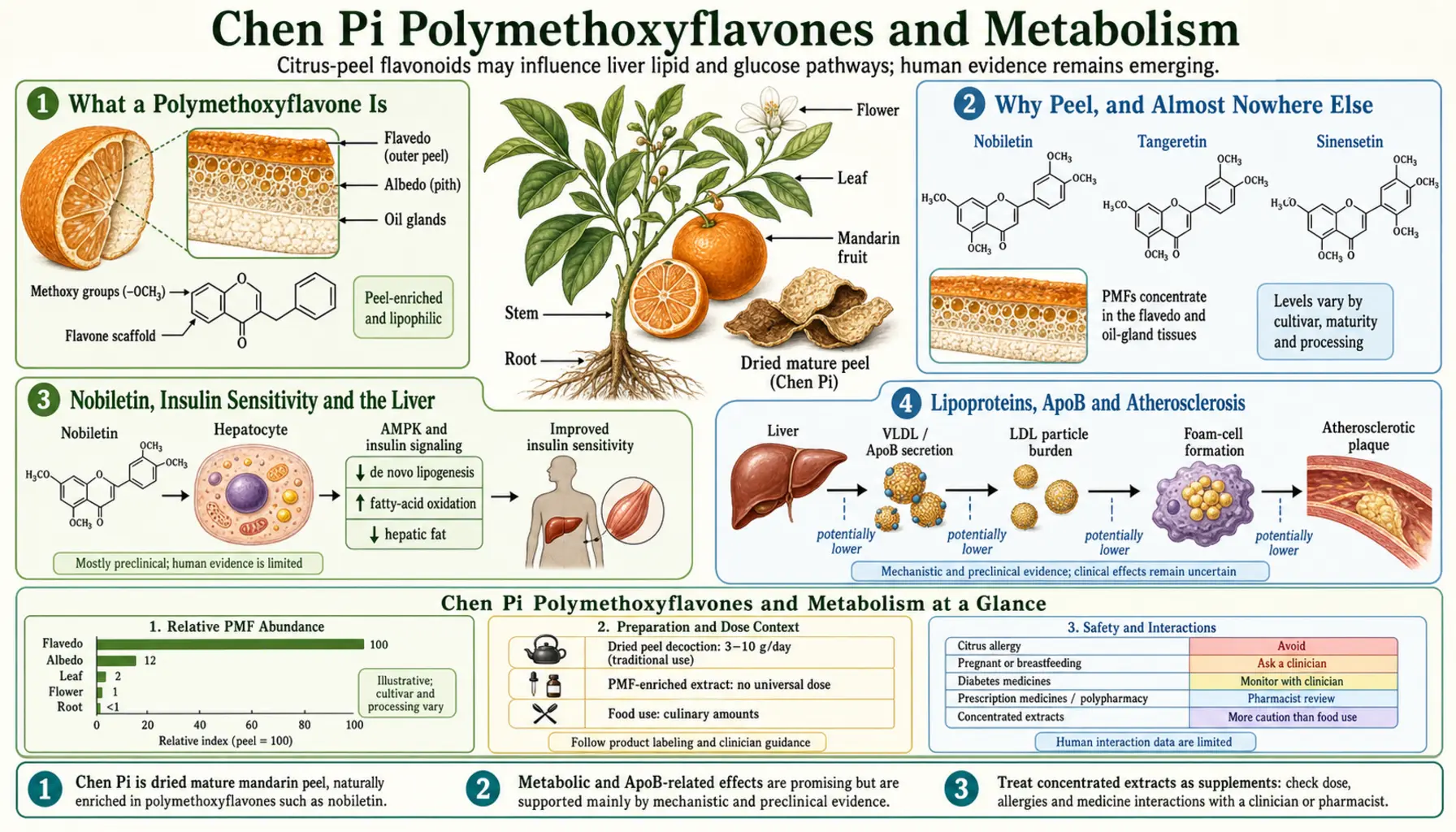
This is the page where chen pi stops being a folk remedy and starts appearing in Cell Metabolism and Diabetes. Mandarin peel contains two compounds — nobiletin and tangeretin — that have become genuinely important tools in metabolic research. They improve insulin sensitivity, cut liver fat and lipoprotein output, remodel fat tissue and reset the circadian clock in mice, sometimes dramatically. It is exciting science. It is also, at the level of human evidence, almost entirely a blank page — and the doses that produce those mouse results are hundreds of times what a cup of chen pi tea delivers. This article gives you the findings and then the arithmetic.
Table of Contents
- What a Polymethoxyflavone Is
- Why Peel, and Almost Nowhere Else
- Nobiletin, Insulin Sensitivity and the Liver
- Lipoproteins, ApoB and Atherosclerosis
- Fat Tissue: Signalling and Browning
- The Circadian Clock Story
- Tangeretin, Nobiletin and the Brain
- Hesperidin: The Human Trials That Do Exist
- Absorption, Metabolism and What Reaches Your Blood
- The Dose Gap, With Numbers
- The Honest Reckoning
- Key Research Papers
- Connections
- Featured Videos
What a Polymethoxyflavone Is
Most dietary flavonoids carry free hydroxyl (–OH) groups on their ring systems, and often a sugar attached as well. Those hydroxyls are chemical handles: the intestine and liver grab them and bolt on glucuronic acid or sulfate within minutes, which makes the molecule water-soluble and easy to excrete. That is the fundamental reason most flavonoid supplements produce disappointing blood levels — the body treats them as waste and disposes of them efficiently.
A polymethoxyflavone (PMF) has had those hydroxyls replaced with methoxy (–OCH3) groups. Nobiletin carries six; tangeretin carries five. Three consequences follow, and they are the entire reason these molecules are interesting:
- They are much more fat-soluble, so they cross membranes readily and partition into tissues rather than staying in the water compartment.
- They resist rapid conjugation, because the handles the conjugating enzymes need have been capped. Absorbed PMFs circulate largely as the parent molecule for a while, which is unusual for a flavonoid.
- They are cleared by demethylation instead — CYP enzymes strip the methyl groups off, and gut bacteria do the same, producing hydroxylated metabolites that are then conjugated normally. Some of those metabolites are themselves biologically active, which complicates interpretation of every experiment.
In short: a PMF behaves less like a typical polyphenol and more like a small-molecule drug. That is why pharmacologists took an interest, and why the field is dominated by people who are trying to develop nobiletin analogues rather than to sell tangerine peel.
Why Peel, and Almost Nowhere Else
Polymethoxyflavones are concentrated in the oil glands and flavedo of citrus peel and are largely absent from the juice and the segments. Sweet orange peel, mandarin peel and tangerine peel are the main dietary sources; mandarin peel is the richest in nobiletin and tangeretin specifically. If you eat citrus but discard the peel — which is nearly everyone — your intake of these compounds is close to zero.
That is genuinely the interesting thing about chen pi as a food: it is one of the few traditional foodstuffs anywhere that delivers PMFs at all, and it does so daily in the parts of southern China and Vietnam where peel goes into everyday soups, braises and desserts. Reported concentrations in dried mandarin peel vary widely with cultivar, growing region, ripeness and age, but published analyses generally land in the range of roughly 1–5 mg of nobiletin per gram of dried peel, with tangeretin typically somewhat lower. Treat those as order-of-magnitude figures, not label values: batch-to-batch variation in this material is large, and it is one reason research on the whole herb is hard to reproduce.
Aging matters here too. Because the volatile oil evaporates over years while the flavonoids do not, well-aged peel is proportionally richer in PMFs by weight than freshly dried peel. That is a real and measurable shift, and it is discussed properly in Aging, Grades and Quality. It is a change in ratio, not the creation of new material.
Nobiletin, Insulin Sensitivity and the Liver
The core rodent finding, replicated across many laboratories, is that nobiletin given to mice on a fattening diet improves how they handle glucose and fat.
Typical results: improved glucose tolerance and insulin sensitivity on tolerance testing; reduced fasting insulin; markedly less fat accumulation in the liver; reduced expression of the lipogenic transcription factor SREBP-1c and its downstream enzymes; increased fatty-acid oxidation; and reduced inflammatory signalling in liver and fat tissue. AMP-activated protein kinase (AMPK) activation is frequently reported, as is suppression of NF-κB. Several groups have shown nobiletin reduces diet-induced hepatic steatosis in models of what is now called metabolic dysfunction–associated steatotic liver disease.
Some of these effects are large. In several published experiments nobiletin-fed mice remained metabolically near-normal on a diet that made control mice obese and insulin-resistant, without eating less. That is the sort of result that gets a compound taken seriously.
What does not exist: a randomized controlled trial in humans showing that nobiletin, at any dose, improves insulin sensitivity, HbA1c, or liver fat. Not a small one, not a negative one. The human column is empty.
Lipoproteins, ApoB and Atherosclerosis
The most rigorous line of PMF work comes from lipoprotein researchers, and it is worth understanding because it is mechanistically specific rather than a general “antioxidant” story.
Murray Huff’s group and colleagues showed that nobiletin reduces hepatic production of apolipoprotein B–containing lipoproteins — VLDL, the precursor of LDL — in mice with diet-induced insulin resistance, and that this translated into less atherosclerotic plaque in Ldlr-deficient mice. The mechanism involves reduced hepatic triglyceride availability and altered ApoB secretion rather than the LDL-receptor pathway that statins act on, which makes it complementary in principle rather than redundant. Earlier work had shown nobiletin inhibits scavenger-receptor–mediated uptake of modified LDL by macrophages, the step that turns a macrophage into a foam cell.
This is good, careful science published in strong journals. It also remains mouse science. The one place where something resembling human data exists is a small trial of a proprietary supplement combining citrus polymethoxyflavones with palm tocotrienols, reported to lower LDL cholesterol in people with high cholesterol. That study is hard to lean on: it tested a combination product, so any effect cannot be attributed to PMFs specifically; it was small; and it was conducted with industry involvement in a product that was subsequently marketed. It is a signal worth following up, not a result to act on.
Fat Tissue: Signalling and Browning
A third strand concerns adipose tissue itself. In cultured adipocytes, nobiletin and tangeretin increase glucose uptake, influence adiponectin secretion, and inhibit differentiation of pre-adipocytes into mature fat cells. In whole animals, nobiletin has been reported to increase expression of thermogenic genes including UCP1 in white adipose tissue — the “browning” phenomenon, in which energy-storing white fat takes on some characteristics of energy-burning brown fat.
Browning is a legitimately exciting idea and a graveyard of failed translations. Mice have a great deal of functional brown fat relative to their body size, because a small animal loses heat quickly and needs it. Adult humans have much less, and it is far less metabolically consequential. Compounds that produce impressive browning in mice have repeatedly produced nothing measurable in people. Read this literature with that history in mind.
The Circadian Clock Story
The most novel PMF finding, and the one that made nobiletin briefly famous outside pharmacology, is circadian.
In 2016, He and colleagues reported in Cell Metabolism that nobiletin acts on the molecular clock — specifically as an agonist at the ROR nuclear receptors, which sit in one of the clock’s feedback loops — and that it increases the amplitude of circadian oscillation. In obese and diabetic mice, nobiletin improved metabolic parameters, and crucially the benefit depended on an intact clock: in mice with the clock genetically disabled, the effect was lost. Later work from the same and other groups extended this to skeletal muscle function, mitochondrial respiration and, in some reports, healthspan measures in aged mice.
Why this matters conceptually: circadian amplitude flattens with age, with shift work, with obesity and with constant light exposure, and flattened rhythms track with metabolic disease. A small molecule that restores amplitude is a genuinely different kind of intervention from an antioxidant or an enzyme inhibitor.
Why it should not be over-read: it is mouse work, the mechanism target (RORα/γ) is not exclusive to nobiletin, and no human study has shown that oral nobiletin measurably changes any circadian parameter in a person. Drinking tangerine-peel tea has not been shown to affect anyone’s body clock.
Tangeretin, Nobiletin and the Brain
Both PMFs cross the blood-brain barrier in animals to a meaningful degree — a direct consequence of their fat solubility — which is why the neuroscience literature exists at all.
Reported preclinical effects include: protection of dopaminergic neurons in 6-hydroxydopamine rat models of Parkinson’s disease, with tangeretin detected in brain tissue after oral dosing; improvement of memory performance in transgenic Alzheimer’s mouse models with reductions in amyloid burden; enhancement of CREB and ERK signalling, pathways central to memory formation; and reduction of neuroinflammation in various insult models. Akira Nakajima and Yasushi Ohizumi’s group in Japan have pursued nobiletin as a cognition-enhancing candidate for two decades and have published extensively on it.
Once again, and this is the pattern of the entire page: no human trial. Nobiletin has not been tested in Alzheimer’s disease, in Parkinson’s disease, or in healthy cognition in any study we can point to. If you encounter a supplement marketed for memory on the strength of nobiletin, the evidence behind it is rodent evidence.
Hesperidin: The Human Trials That Do Exist
There is one chen pi constituent with genuine human clinical data, and it is not a polymethoxyflavone. Hesperidin, the flavanone glycoside that serves as the pharmacopeial quality marker for chen pi (minimum roughly 3.5%), has been tested in people.
Two reasonably well-conducted randomized studies are worth knowing. Morand and colleagues gave healthy overweight men orange juice, hesperidin-supplemented control drink, or placebo in a crossover design and found improvements in postprandial and chronic endothelial function, measured as flow-mediated dilation, along with a modest reduction in diastolic blood pressure — and showed that hesperidin accounted for much of the juice’s effect. Rizza and colleagues gave hesperidin to people with metabolic syndrome and reported improved endothelial function and reduced inflammatory markers, with supporting cell work on nitric oxide production.
These are real results, and they are modest: small improvements in a surrogate marker of vascular health, not changes in heart attacks or deaths. They used supplemental hesperidin at doses in the hundreds of milligrams per day. And note the direction of the finding — it is vascular, not glycaemic. Hesperidin trials have generally not shown impressive effects on blood sugar. More on the compound itself on our Hesperidin page.
Absorption, Metabolism and What Reaches Your Blood
Three practical facts govern how much of any of this could apply to a person drinking a decoction.
Water is a poor solvent for PMFs. Nobiletin and tangeretin are lipophilic and only sparingly water-soluble. A hot-water decoction extracts a modest fraction of what is in the peel; ethanol or oil extracts far more. This is why laboratory studies of chen pi almost always use methanolic or ethanolic extracts, and why extrapolating from those studies to tea overstates the dose twice over — once on extraction and once on concentration.
Fat helps. Because PMF absorption is lipid-dependent, peel simmered in a fatty broth or braise plausibly delivers more than peel steeped in water. This is speculation about degree, not about direction; the direction is well founded.
Metabolism is fast and extensive. Absorbed PMFs are demethylated by intestinal and hepatic CYP enzymes and further metabolized by gut bacteria. Human plasma pharmacokinetic data for nobiletin are sparse, and what exists suggests low micromolar or sub-micromolar peaks after substantial oral doses. Many of the cell-culture experiments that produced striking results used concentrations at or above 10–50 µM — concentrations that plausibly exceed what oral dosing achieves in human plasma. That mismatch is the standard weakness of nutraceutical cell biology and it applies here in full.
The Dose Gap, With Numbers
Abstract caveats do not change anyone’s behaviour. Numbers do. So here is the arithmetic, using generous assumptions at every step in favour of the tea.
Step 1 — what is in the peel. Take a large 6 g daily dose of good-quality dried peel at the upper end of reported nobiletin content, 5 mg/g. That is 30 mg of nobiletin in the pot. A more typical 1–2 mg/g peel at a 3 g dose gives 3–6 mg.
Step 2 — what gets into the cup. Water extracts poorly. Even assuming an optimistic 30% extraction into a long decoction, the 30 mg becomes roughly 9 mg in the liquid, and the typical case becomes 1–2 mg.
Step 3 — what the mouse studies used. Effective doses in the rodent literature commonly run 50–200 mg/kg/day, or diets containing on the order of 0.1–0.3% nobiletin by weight.
Step 4 — convert to a human-equivalent dose. Body-surface-area scaling, the standard method (Reagan-Shaw and colleagues), divides a mouse dose by about 12.3 to get the human equivalent per kilogram. So 100 mg/kg in a mouse corresponds to roughly 8 mg/kg in a person — about 570 mg/day for a 70 kg adult. At the top of the rodent range it is well over a gram a day.
| Source | Nobiletin delivered | Ratio to human-equivalent effective dose |
|---|---|---|
| Typical cup of chen pi tea | ~1–2 mg | roughly 300–600× too little |
| Generous 6 g decoction, rich peel | ~9 mg | roughly 60× too little |
| Eating all 6 g of peel, nothing lost | ~30 mg | roughly 20× too little |
| Mouse study, scaled to a 70 kg human | ~570 mg–1 g+ | reference |
To reach the scaled-up mouse dose from tea you would need something on the order of a kilogram of peel a day. That is the gap. It is not a rounding error and no reasonable adjustment of the assumptions closes it.
Two fair objections deserve answers. First, allometric scaling is a crude tool and the true human-effective dose might be lower — true, but it would have to be lower by two orders of magnitude, which would be extraordinary. Second, chronic low-dose exposure over decades might do something that acute dosing does not — also true, also entirely untested, and it is a hypothesis rather than a defence of the claim on the label.
The Honest Reckoning
Here is what we think a careful reader should take away.
- Nobiletin and tangeretin are real pharmacological agents with a serious preclinical literature. This is not fringe science. It is published in high-quality journals by competent groups and the mechanisms are specific and plausible.
- The human trial record is close to empty. No randomized controlled trial has demonstrated a metabolic, cognitive or cardiovascular benefit of nobiletin or tangeretin in people. The one lipid trial that exists tested a combination product.
- Chen pi tea does not deliver a pharmacological PMF dose. It is short by roughly one to three orders of magnitude depending on how you prepare it.
- Concentrated PMF supplements are a different product with a different risk profile. If you take one, you are not taking a traditional herb; you are taking an untested single-agent supplement at doses no human trial has evaluated for safety over the long term. Enzyme-inhibition and drug-interaction questions that are negligible for tea become real questions at that scale.
- Hesperidin is the constituent with actual human data, and the data support a modest vascular effect at supplement-level doses — not a metabolic transformation.
- None of this diminishes chen pi as a food or as a digestive herb. Its traditional uses stand on their own merits, which are discussed in Digestion and Appetite and Phlegm, Cough and Lungs. The mistake is borrowing the prestige of the nobiletin literature to sell the tea.
Cautions. At culinary and decoction doses chen pi is unremarkable. At supplement doses, three things deserve care: mild additive antiplatelet effects with anticoagulants; a theoretical CYP interaction that is much weaker than grapefruit’s, because the grapefruit effect is driven by furanocoumarins — bergamottin and dihydroxybergamottin — which mandarin peel largely lacks; and the plain fact that long-term safety data for isolated PMFs in humans do not exist. Pregnancy: culinary amounts traditional and unremarkable, concentrated extracts unstudied and best avoided.
Key Research Papers
Each link runs a PubMed query on the paper’s exact title, so it resolves to the correct record rather than to a numeric identifier we might have mistyped.
- He B, Nohara K, Park N, et al. The small molecule nobiletin targets the molecular oscillator to enhance circadian rhythms and protect against metabolic syndrome. Cell Metabolism. 2016. The clock-amplitude paper.
- Mulvihill EE, Assini JM, Lee JK, et al. Nobiletin attenuates VLDL overproduction, dyslipidemia, and atherosclerosis in mice with diet-induced insulin resistance. Diabetes. 2011. The central lipoprotein result.
- Mulvihill EE, Burke AC, Huff MW. Citrus flavonoids as regulators of lipoprotein metabolism and atherosclerosis. Annual Review of Nutrition. 2016. The best single review of the field, including its limits.
- Nakajima A, Ohizumi Y. Potential benefits of nobiletin, a citrus flavonoid, against Alzheimer’s disease and Parkinson’s disease. International Journal of Molecular Sciences. 2019. Review from the group that has pursued the neuro work longest.
- Datla KP, Christidou M, Widmer WW, Rooprai HK, Dexter DT. Tissue distribution and neuroprotective effects of citrus flavonoid tangeretin in a rat model of Parkinson’s disease. 2001. The paper that showed tangeretin reaches brain tissue after oral dosing.
- Morand C, Dubray C, Milenkovic D, et al. Hesperidin contributes to the vascular protective effects of orange juice: a randomized crossover study in healthy volunteers. American Journal of Clinical Nutrition. 2011. Real human data, modest effect size.
- Rizza S, Muniyappa R, Iantorno M, et al. Citrus polyphenol hesperidin stimulates production of nitric oxide in endothelial cells while improving endothelial function and reducing inflammatory markers in patients with metabolic syndrome. Journal of Clinical Endocrinology and Metabolism. 2011.
- Reagan-Shaw S, Nihal M, Ahmad N. Dose translation from animal to human studies revisited. FASEB Journal. 2008. The scaling method used in the dose-gap table above.
- Yu X, Sun S, Guo Y, et al. Citri Reticulatae Pericarpium (Chenpi): botany, ethnopharmacology, phytochemistry, and pharmacology of a frequently used traditional Chinese medicine. Journal of Ethnopharmacology. 2018.
Live PubMed Searches
- Nobiletin and insulin resistance
- Nobiletin and fatty liver
- Nobiletin and the circadian clock
- Tangeretin in adipocytes
- Polymethoxyflavone pharmacokinetics
- PMF metabolism and gut bacteria
- PMF content of citrus peel
- The PMF + tocotrienol lipid trial
- Hesperidin randomized trials
- Nobiletin and adipose browning
Connections
- All Herbs
- Chen Pi (Aged Tangerine Peel)
- Chen Pi Benefits
- Chen Pi: History and Traditional Use
- Chen Pi for Digestion and Appetite
- Chen Pi for Phlegm, Cough and the Lungs
- Chen Pi Aging, Grades and Quality
- Hesperidin
- Licorice
- Ginger
- Fennel
- Peppermint
- Atractylodes