Chen Pi (Aged Tangerine Peel) Benefits
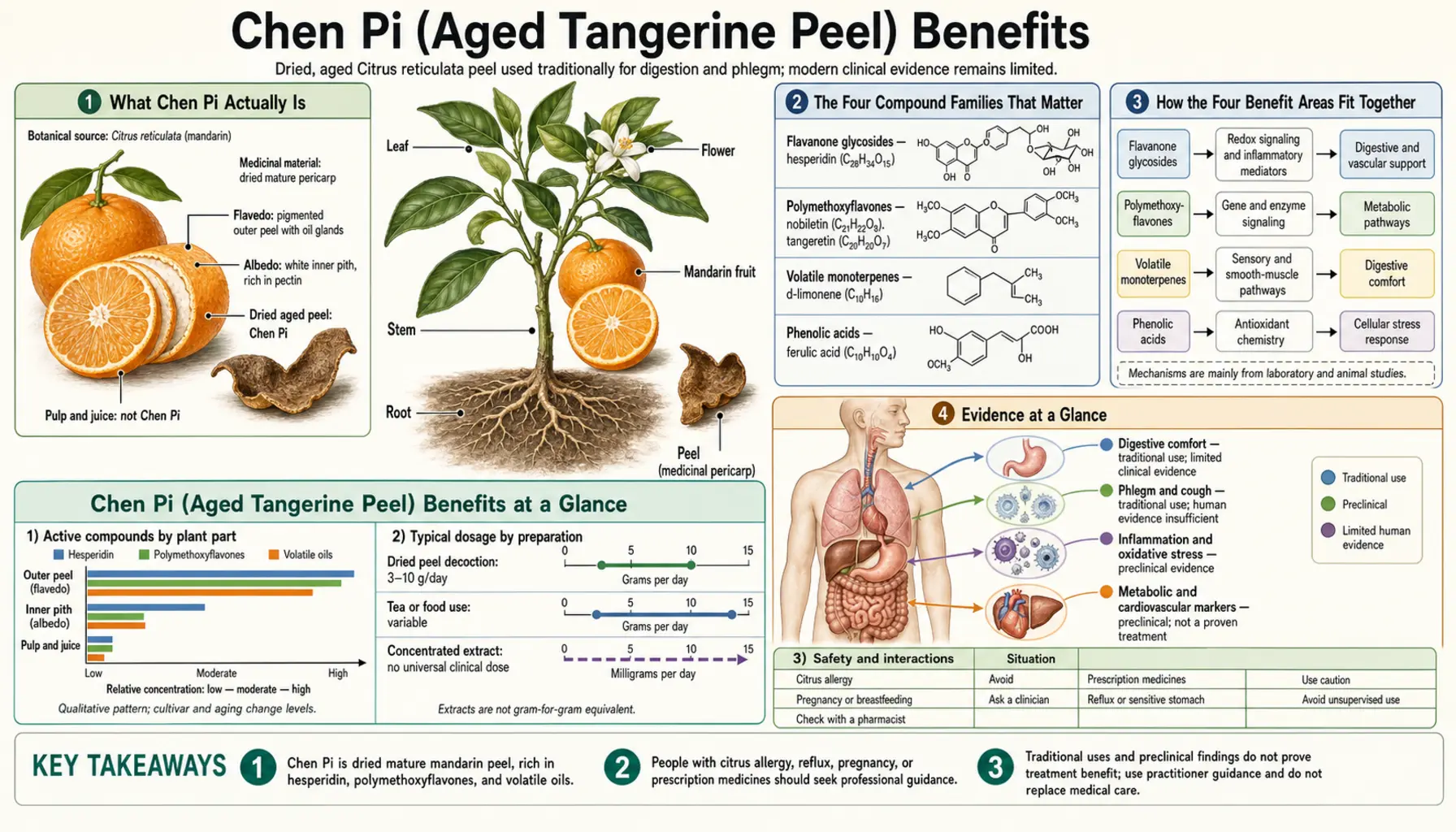
Chen pi is the dried, deliberately aged peel of the mandarin orange — Citrus reticulata Blanco and its cultivars, in the rue family (Rutaceae). In the pharmacopeia it is Pericarpium Citri Reticulatae; in Chinese it is 陈皮, literally “aged peel,” and in Vietnamese trần bì. It is one of the few herbs in the world that is considered defective when fresh and valuable when old, and that single fact organizes almost everything worth knowing about it.
These four deep dives separate what chen pi has actually been shown to do from what is traditional framing, from what is laboratory chemistry that has never been tested in a person. The short version: it is a genuinely useful digestive and aromatic herb with a modest, mostly traditional evidence base; it contains two compounds — nobiletin and tangeretin — with an enormous and genuinely exciting preclinical literature and an almost empty human trial record; and the price of a piece of it can vary a thousandfold for reasons that have far more to do with collecting than with pharmacology.
Digestion and Appetite
The bitter-aromatic pharmacology behind chen pi’s oldest use, its role as the “assistant” that keeps tonic formulas from causing bloating, the motility data, and the reflux caution nobody mentions.
Phlegm, Cough and Lungs
What “transforms phlegm” means in plain language, Er Chen Tang, the real terpene evidence for thinning mucus, and why most of that evidence comes from capsules, not tea.
Polymethoxyflavones and Metabolism
Nobiletin and tangeretin on insulin sensitivity, blood lipids, fat tissue, the circadian clock and the brain — and an honest, numerical account of the gap between mouse doses and a cup of tea.
Aging, Grades and Quality
How Xinhui Guang Chen Pi is graded and dated, what genuinely changes with age, how to spot dried-fresh peel sold as aged, and why pesticide residue matters more here than for any other herb.
Table of Contents
- What Chen Pi Actually Is
- The Four Compound Families That Matter
- How the Four Benefit Areas Fit Together
- Evidence at a Glance
- Who Should Be Careful
- Key Research Papers
- External Resources
- Connections
- Featured Videos
What Chen Pi Actually Is
Take a ripe mandarin, peel it, dry the peel, and put it away. That is the entire manufacturing process. What separates chen pi from the citrus zest in your spice drawer is time: the peel is stored, in cloth or paper or ceramic, for years. One year is the conventional minimum before the peel may be called chen pi at all. Three years is a common commercial threshold and the point at which most sellers begin to advertise the age. And in the town of Xinhui in Guangdong province, peel from the local Citrus reticulata ‘Chachi’ cultivar is aged for decades and sold by vintage year, at prices that overlap with fine pu-erh tea.
Vietnamese herb labels frequently print Pericarpium Citri reticulatae perenne. The word perenne is not a botanical epithet for a different plant — it is a signal that the material is the aged grade rather than freshly dried peel.
It matters which peel, and when it was picked. Chen pi is the ripe peel. Qing pi (青皮) is the peel of the same tree’s unripe green fruit — sharper, more acrid, and used in traditional practice to “break” stagnant qi in the Liver channel rather than to gently regulate it in the digestive centre. Ju hong is the outer coloured flavedo shaved off on its own; ju luo is the fibrous white strands of pith. Four different articles of trade, one tree. If a supplier cannot tell you which one you are buying, that is information about the supplier.
The Four Compound Families That Matter
Chen pi is not a mystery. Its chemistry has been mapped thoroughly, and four groups account for essentially all of the plausible pharmacology.
Hesperidin is the dominant flavanone glycoside and the official quality marker. The Chinese Pharmacopoeia sets a minimum content of roughly 3.5% hesperidin for chen pi — which is a remarkably high number for a plant marker compound, and it means a 6-gram dose of decent peel carries a couple of hundred milligrams of hesperidin into the pot, though only a fraction of that survives into the cup and less still into the bloodstream. Hesperidin is the one chen pi constituent with a real, if modest, human clinical literature, mostly from orange-juice and supplement trials on vascular function.
Polymethoxyflavones — principally nobiletin and tangeretin — are flavones whose hydroxyl groups have been replaced by methoxy groups. That small structural change makes them far more fat-soluble and far more resistant to the gut’s rapid conjugation machinery than ordinary flavonoids, which is why they are so interesting pharmacologically. They are also almost entirely restricted to citrus peel; you will not get them from juice or from segments. They are the reason chen pi shows up in metabolic and neuroscience journals.
Essential oil makes up a few percent of the fresh-dried peel and is 60–90% d-limonene, with γ-terpinene, myrcene, linalool and a long tail of minor terpenes. The oil is what you smell, what makes the peel taste bright, and — critically — the fraction that declines during aging.
Trace synephrine. Mandarin peel contains small amounts of synephrine, the protoalkaloid that makes bitter orange (Citrus aurantium) a stimulant-adjacent supplement. The amount in chen pi is far lower than in bitter orange peel extracts, and a normal culinary or decoction dose is not a stimulant. We say this explicitly because readers who have encountered synephrine warnings around weight-loss products reasonably worry, and the worry does not transfer to a few grams of aged mandarin peel in soup.
How the Four Benefit Areas Fit Together
In traditional Chinese medicine, chen pi is described as regulating qi, drying dampness, transforming phlegm, and harmonizing the middle burner. Stripped of the classical vocabulary, that is a compact description of a herb that helps food move, reduces the sensation of fullness and gurgling, thins mucus, and settles the stomach. It is also the classic assistant ingredient: added to rich, sweet, cloying tonic formulas specifically so that they do not cause bloating. That job description — make the heavy thing tolerable — is one of the most consistently reported uses of any herb in the materia medica, and it is what our Digestion and Appetite article is about.
The lung use is the same herb seen from a different angle. Er Chen Tang, the “Two Aged Herbs Decoction,” pairs chen pi with aged pinellia and is the archetypal phlegm formula. Modern pharmacology has a real story about volatile terpenes and mucus rheology — but the strongest data come from purified 1,8-cineole capsules at pharmaceutical doses, not from citrus peel tea, and our Phlegm, Cough and Lungs article says so directly.
The metabolic material is a completely different kind of literature. Nobiletin and tangeretin have been studied in hundreds of cell and rodent experiments covering insulin sensitivity, lipoprotein output, adipose signalling, circadian rhythm and neuroprotection. Some of that work is genuinely first-rate science. Almost none of it has been replicated in humans, and the doses used in mice are one to two orders of magnitude above what a cup of tea provides. Polymethoxyflavones and Metabolism gives the numbers rather than the adjectives.
Finally, the practical page. Aging changes the material in ways that are chemically real: volatile monoterpenes evaporate and oxidize, the flavonoid fraction becomes proportionally more concentrated, and the aroma shifts from sharp and citrusy to mellow, resinous and slightly medicinal. That is genuine chemistry, not folklore. It is also not a linear dose-response, and a 30-year vintage is not thirty times the herb. Aging, Grades and Quality covers grading, authentication, pesticide residue and sulfur bleaching — the things that actually determine whether the peel in your cupboard is worth using.
Evidence at a Glance
The following table is our honest reading of the literature. “Traditional” means centuries of documented use and no controlled trial. “Preclinical” means cells and animals only. “Human, limited” means small or indirect trials, often of an isolated constituent rather than the herb.
| Claim | Best available evidence | Our reading |
|---|---|---|
| Relieves bloating and fullness; improves appetite | Traditional; small multi-herb formula trials | Plausible and low-risk; the oldest and most consistent use |
| Speeds gastric emptying / stimulates motility | Preclinical (rodent, isolated tissue) | Mechanistically reasonable, not demonstrated in people |
| Loosens and thins phlegm | Traditional; human trials of isolated terpenes (cineole), not of chen pi | The terpene class has real data; chen pi itself does not |
| Improves insulin sensitivity / blood lipids | Extensive rodent work on nobiletin; almost no human data | Hypothesis only at tea-level doses |
| Supports blood-vessel function (hesperidin) | Human, limited — randomized trials with orange juice and hesperidin supplements | Real but modest, and at supplement-level doses |
| Neuroprotection / cognition (nobiletin) | Preclinical only | Interesting; do not treat it as a therapy |
| Older vintages are more medicinal | Chemical change is documented; clinical superiority is not | Real chemistry, unproven clinical claim |
Who Should Be Careful
Chen pi is a food. It is eaten daily across southern China and Vietnam in soups, braises and desserts, and its safety profile at culinary and normal decoction doses (roughly 3–10 g of dried peel per day) is unremarkable. Still, four things are worth flagging.
- Reflux. Concentrated citrus oil relaxes the lower oesophageal sphincter in some people. If you have GERD and strong citrus preparations reliably give you heartburn, chen pi can too. Start low, take it with food, and stop if it aggravates you.
- Anticoagulants. Citrus flavonoids have mild antiplatelet activity in laboratory systems. At high, sustained supplement-level intakes there is a theoretical additive effect with warfarin, direct oral anticoagulants, or high-dose aspirin. Tea-level intake is very unlikely to matter; concentrated extracts deserve a conversation with whoever manages your anticoagulation.
- The grapefruit question — stated correctly. The famous grapefruit–drug interaction is caused by furanocoumarins, chiefly bergamottin and 6′,7′-dihydroxybergamottin, which irreversibly inactivate intestinal CYP3A4. Grapefruit and Seville orange are rich in them. Mandarin peel largely lacks them. Chen pi does contain flavonoids that can inhibit CYP enzymes in cell-free assays, so a mild interaction is plausible in principle — but it is much weaker and far less established than the grapefruit effect, and repeating “citrus interacts with CYP3A4” as though chen pi and grapefruit were equivalent is simply wrong. If you take a narrow-therapeutic-index CYP3A4 substrate, mention chen pi to your pharmacist; do not panic about a bowl of soup.
- Pregnancy. Culinary amounts are traditionally regarded as unproblematic and chen pi appears in formulas given for pregnancy nausea. Concentrated extracts and essential oil have not been studied for safety in pregnancy; avoid those.
Key Research Papers
Every link below opens a PubMed query for the paper’s exact title, so it resolves to the correct record rather than to a numeric ID we might have mistyped.
The herb itself: botany, chemistry and pharmacology
- Yu X, Sun S, Guo Y, et al. Citri Reticulatae Pericarpium (Chenpi): botany, ethnopharmacology, phytochemistry, and pharmacology of a frequently used traditional Chinese medicine. Journal of Ethnopharmacology. 2018.
- Zhang M, Nan H, Wang Y, et al. Comparison of flavonoid and volatile composition in Citri Reticulatae Pericarpium of different ages and cultivars. Search PubMed for the aging-chemistry literature.
Digestion and gastrointestinal motility
- Studies of citrus-peel extracts on gastric emptying and small-intestinal transit are almost entirely rodent work. Browse the motility literature.
- Rikkunshito (Liu Jun Zi Tang), the classical formula containing chen pi, has the largest clinical dataset of any chen pi–containing preparation, mostly Japanese trials in functional dyspepsia. Browse the rikkunshito trials.
Airway, phlegm and terpenes
- Juergens UR, Dethlefsen U, Steinkamp G, Gillissen A, Repges R, Vetter H. Anti-inflammatory activity of 1.8-cineol (eucalyptol) in bronchial asthma: a double-blind placebo-controlled trial. Respiratory Medicine. 2003.
- Kohlert C, van Rensen I, März R, et al. Bioavailability and pharmacokinetics of natural volatile terpenes in animals and humans. Planta Medica. 2000.
Polymethoxyflavones and metabolism
- He B, Nohara K, Park N, et al. The small molecule nobiletin targets the molecular oscillator to enhance circadian rhythms and protect against metabolic syndrome. Cell Metabolism. 2016.
- Mulvihill EE, Assini JM, Lee JK, et al. Nobiletin attenuates VLDL overproduction, dyslipidemia, and atherosclerosis in mice with diet-induced insulin resistance. Diabetes. 2011.
- Mulvihill EE, Burke AC, Huff MW. Citrus flavonoids as regulators of lipoprotein metabolism and atherosclerosis. Annual Review of Nutrition. 2016.
Hesperidin in humans
- Morand C, Dubray C, Milenkovic D, et al. Hesperidin contributes to the vascular protective effects of orange juice: a randomized crossover study in healthy volunteers. American Journal of Clinical Nutrition. 2011.
- Rizza S, Muniyappa R, Iantorno M, et al. Citrus polyphenol hesperidin stimulates production of nitric oxide in endothelial cells while improving endothelial function and reducing inflammatory markers in patients with metabolic syndrome. Journal of Clinical Endocrinology and Metabolism. 2011.
Safety and drug interactions
- Bailey DG, Dresser G, Arnold JM. Grapefruit-medication interactions: forbidden fruit or avoidable consequences? CMAJ. 2013.
- Paine MF, Widmer WW, Hart HL, et al. A furanocoumarin-free grapefruit juice establishes furanocoumarins as the mediators of the grapefruit juice-felodipine interaction. American Journal of Clinical Nutrition. 2006.
Live PubMed Searches
- Citri Reticulatae Pericarpium
- Chenpi aging and quality markers
- Nobiletin and insulin sensitivity
- Tangeretin pharmacology
- Hesperidin randomized controlled trials
- D-limonene and reflux
- Er Chen Tang / Erchen decoction
- Polymethoxyflavone bioavailability in humans
- Citrus peel pesticide residues
- Synephrine content in citrus
External Resources
- PubChem: Hesperidin
- PubChem: Nobiletin
- PubChem: Tangeretin
- PubChem: Limonene
- Kew Plants of the World Online (Citrus reticulata)
- Memorial Sloan Kettering: About Herbs
- NCCIH: Herbs at a Glance
- LiverTox: drug and herb liver-injury database
- Dr. Duke’s Phytochemical and Ethnobotanical Databases
Connections
- All Herbs
- Chen Pi (Aged Tangerine Peel)
- Chen Pi: History and Traditional Use
- Chen Pi for Digestion and Appetite
- Chen Pi for Phlegm, Cough and the Lungs
- Chen Pi Polymethoxyflavones and Metabolism
- Chen Pi Aging, Grades and Quality
- Hesperidin
- Licorice
- Ginger
- Fennel
- Peppermint
- Atractylodes