Black Walnut Antimicrobial & Skin Uses — Juglone Research
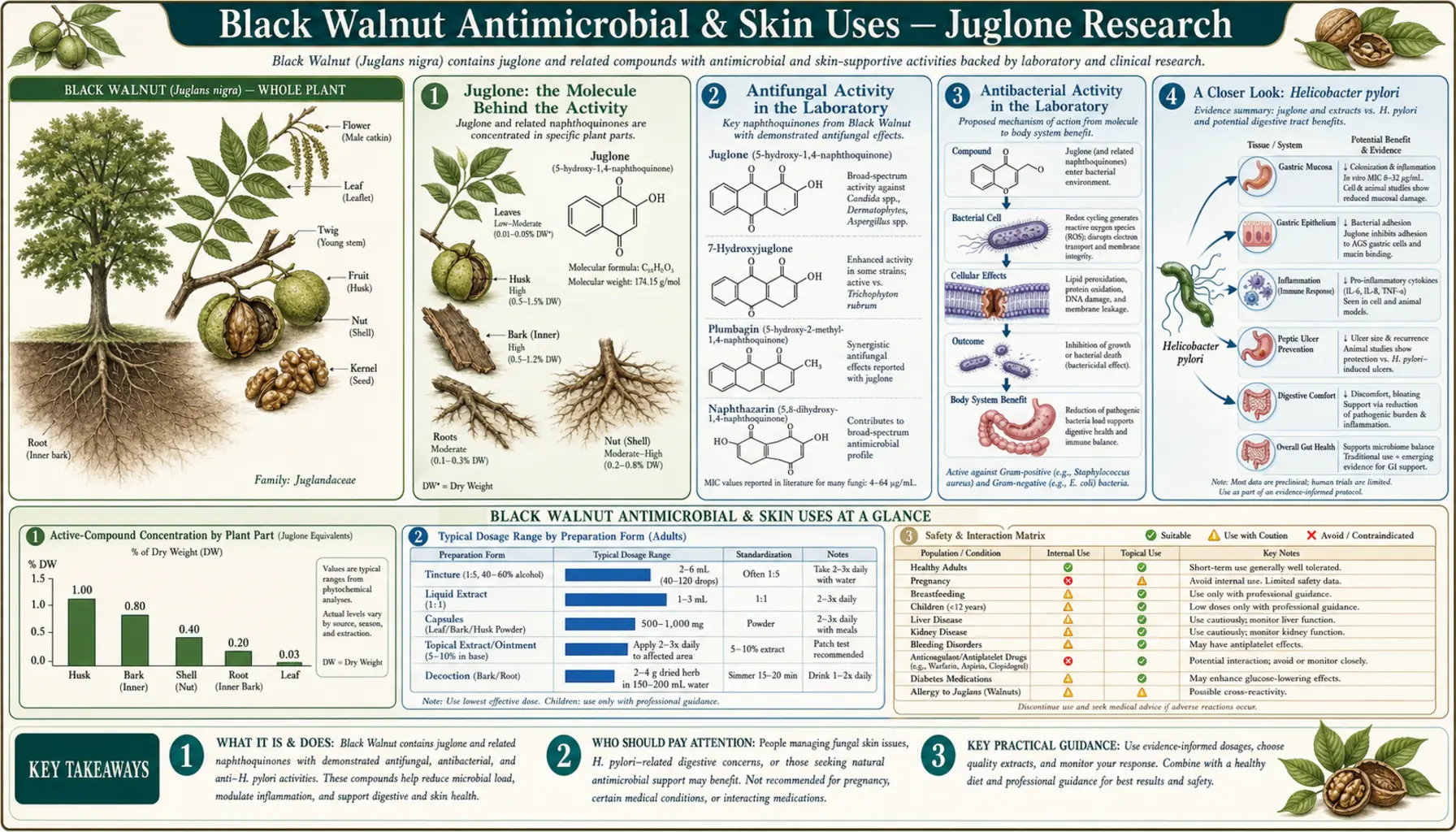
Of all black walnut's traditional claims, the antimicrobial ones have the most laboratory backing. Juglone, the naphthoquinone concentrated in the green hull, reliably kills fungi and bacteria in cell culture — including drug-resistant Candida yeast, Staphylococcus aureus, and the ulcer bacterium Helicobacter pylori. This in-vitro record is genuine and reproducible. It is also, so far, only in-vitro: there are no human trials showing that a black walnut product cures a fungal or bacterial infection in a person. This page lays out what the laboratory shows, why the same chemistry that kills microbes also limits juglone as a medicine, and how the hull's old topical reputation for ringworm and athlete's foot should be read.
Table of Contents
- Juglone: the Molecule Behind the Activity
- Antifungal Activity in the Laboratory
- Antibacterial Activity in the Laboratory
- A Closer Look: Helicobacter pylori
- How Juglone Kills Microbes — and Why That Cuts Both Ways
- Traditional Topical Use for Skin
- Ringworm, Athlete's Foot, and Other Skin Fungus
- What the Lab Data Cannot Tell Us
- Practical Use and Cautions
- Key Research Papers
- Connections
- Featured Videos
Juglone: the Molecule Behind the Activity
Juglone (5-hydroxy-1,4-naphthoquinone) belongs to the naphthoquinone family — the same broad chemical class as plumbagin, lawsone (the henna dye), and the anticancer compound beta-lapachone. Naphthoquinones share a defining trait: they are redox-active. They readily accept and donate electrons, cycling between oxidized and reduced forms, and in doing so they generate reactive oxygen species (superoxide, hydrogen peroxide) inside cells. This is the chemical engine behind juglone's antimicrobial punch.
In the black walnut tree, juglone is stored mostly as the colorless, non-toxic precursor hydrojuglone glucoside. When plant tissue is damaged — or when a fallen husk breaks down — enzymes and air convert it to the reactive orange-brown juglone. This is why fresh green hulls stain everything they touch a stubborn brown, and why walnut has long been used as a natural dye and wood stain. The staining and the antimicrobial activity are two faces of the same reactive chemistry.
Antifungal Activity in the Laboratory
Antifungal activity is the best-documented laboratory property of juglone. Several independent groups have shown it inhibits and kills medically important fungi in culture:
- Against Candida. Juglone inhibited both fluconazole-susceptible and, notably, fluconazole-resistant Candida isolates in vitro. Activity against drug-resistant strains is scientifically interesting because resistance to standard antifungals is a growing clinical problem.
- Compared with walnut extracts. A study comparing extracts from different Juglans regia cultivars with pure juglone confirmed that juglone is a major driver of the plant's antifungal effect, though other constituents contribute.
- Formulation research. Because juglone is poorly water-soluble and unstable, researchers have packaged it into nanoparticles (for example, PLGA polymer particles) to boost and stabilize its antifungal activity — a sign that the raw compound has real limits as a deliverable drug.
These findings explain the traditional use of hull preparations against skin fungus. They do not establish that swallowing or applying a crude hull tincture reaches a fungal infection at an effective, safe concentration in a person.
Antibacterial Activity in the Laboratory
Juglone is also a laboratory antibacterial, with the most work done against Staphylococcus aureus:
- A proteomic study mapped how juglone disrupts S. aureus — interfering with energy metabolism, oxidative-stress defenses, and protein synthesis all at once.
- In a wound-infection model, juglone reduced S. aureus burden, and researchers have built juglone into wound-dressing and food-preservation materials.
- Broader work shows activity against Escherichia coli, Salmonella, and Enterococcus faecalis, and a 2023 review catalogs the antibacterial record of juglone and its naphthoquinone relatives.
- Walnut pellicle (the papery seed coat) extract, rich in related polyphenols, also shows antimicrobial and antioxidant activity in culture.
The recurring pattern — broad activity across many unrelated bacteria — is a clue to how juglone works, and also a warning, discussed below.
A Closer Look: Helicobacter pylori
Helicobacter pylori is the stomach bacterium behind most peptic ulcers and a major stomach-cancer risk factor. It has drawn particular interest because juglone hits it through a specific, well-characterized mechanism: a structural study showed juglone inhibits three key H. pylori enzymes involved in the bacterium's protein-folding and survival machinery, and crystallography confirmed how it binds. Related naphthoquinones from other plants show similar anti-H. pylori activity.
This is elegant molecular pharmacology and a legitimate lead for drug development. But confirmed H. pylori infection in humans is cured by a proven regimen of two antibiotics plus an acid-suppressing drug, taken for one to two weeks, with cure rates around 85–90%. Nobody should attempt to treat an H. pylori ulcer with black walnut. The juglone research is a starting point for future medicine, not a home remedy.
How Juglone Kills Microbes — and Why That Cuts Both Ways
Juglone's antimicrobial power comes mainly from oxidative stress: it floods a cell with reactive oxygen species that damage proteins, lipids, and DNA, while simultaneously draining the cell's energy chemistry. Microbes with weaker antioxidant defenses are overwhelmed.
The problem is selectivity. Human cells run on the same basic redox chemistry that juglone attacks, and juglone damages them too — it is cytotoxic to mammalian cells and shows mutagenic potential in some test systems. A good antimicrobial drug is toxic to the microbe at a dose that spares the patient (a wide "therapeutic window"). Juglone's window appears narrow: the concentrations that kill microbes overlap with those that harm human cells. This is the central reason a compound can look impressive in a dish and still be a poor medicine — and why most juglone research now focuses on chemical derivatives and targeted delivery rather than the raw compound. See the Sources & Safety page for the full toxicity picture.
Traditional Topical Use for Skin
Historically, black walnut has been used far more on the skin than swallowed. Folk practice across North America and Europe applied hull decoctions, poultices, and later tinctures to fungal skin infections, warts, cold sores, and eczema-like rashes. Topical use has a certain logic that oral use lacks: a reactive antimicrobial compound applied directly to a surface infection does not have to survive digestion or be absorbed into the bloodstream to reach its target — it is already there.
That said, "more plausible than swallowing it" is not the same as "proven." There are still no controlled human trials of topical black walnut for any skin condition, and the same juglone that stains a countertop brown will readily stain skin. Any topical use is traditional and experimental, not evidence-based dermatology.
Ringworm, Athlete's Foot, and Other Skin Fungus
The skin conditions most often linked to black walnut are the dermatophyte ("tinea") fungal infections:
- Ringworm (tinea corporis) — the ring-shaped body rash despite having nothing to do with worms.
- Athlete's foot (tinea pedis) — itchy, scaling skin between the toes.
Juglone's laboratory antifungal activity makes these traditional targets plausible in principle. In practice, these infections respond very well to inexpensive over-the-counter antifungal creams (clotrimazole, terbinafine, miconazole) that are backed by strong clinical evidence. There is no reason to choose an unproven, staining hull preparation over a proven cream that costs a few dollars. Black walnut is also sometimes mentioned for acne because of its antibacterial and astringent properties; see our Acne page for treatments that actually have evidence.
What the Lab Data Cannot Tell Us
It is worth being explicit about the gap between the laboratory record and a usable remedy. Even a large, consistent pile of in-vitro papers cannot answer:
- Dose. How much juglone is in a given tincture or cream, and how much reaches the infection?
- Delivery. Does oral juglone survive the stomach and get absorbed? Does topical juglone penetrate skin to where a fungus lives?
- Safety at effective doses. Given juglone's narrow window, is a dose that clears the microbe safe for the patient?
- Real-world effectiveness. Does any of this translate into cured infections in an actual randomized trial?
Until those questions are answered by human research, the honest label for black walnut's antimicrobial and skin uses is "traditional, with supportive laboratory chemistry" — not "an effective treatment."
Practical Use and Cautions
- For an actual fungal or bacterial infection, use a proven treatment. Over-the-counter antifungal creams cure most ringworm and athlete's foot; H. pylori and staph infections need prescribed antibiotics.
- Expect staining. Hull preparations turn skin, nails, cloth, and surfaces brown — sometimes for days.
- Patch-test topical products and stop if irritation, redness, or a rash develops. Contact reactions to reactive plant compounds are common.
- Do not use on broken skin, deep wounds, or the eyes, and avoid in pregnancy and breastfeeding.
- See a clinician for a spreading, painful, or non-healing skin infection, or any infection with fever — these need real diagnosis and treatment.
Key Research Papers
- Majdi C et al. (2023). An overview on the antibacterial properties of juglone, naphthazarin, plumbagin and lawsone derivatives and their metal complexes. Biomedicine & Pharmacotherapy. — PubMed PMID: 37075666
- Wang J et al. (2016). Antibacterial Activity of Juglone against Staphylococcus aureus: From Apparent to Proteomic. International Journal of Molecular Sciences. — PubMed PMID: 27322260
- Wan Y et al. (2023). Antibacterial Activity of Juglone Revealed in a Wound Model of Staphylococcus aureus Infection. International Journal of Molecular Sciences. — PubMed PMID: 36835350
- Wang L et al. (2025). Antimicrobial activity and possible mechanisms of juglone against Escherichia coli, Staphylococcus aureus, and Salmonella pullorum. BMC Microbiology. — PubMed PMID: 41107751
- Vaezi A et al. (2022). In vitro activity of juglone against fluconazole-resistant and susceptible Candida isolates. Revista Iberoamericana de Micología. — PubMed PMID: 35701335
- Wianowska D et al. (2016). Comparison of antifungal activity of extracts from different Juglans regia cultivars and juglone. Microbial Pathogenesis. — PubMed PMID: 27744101
- Arasoglu T et al. (2016). Enhancement of Antifungal Activity of Juglone Using a PLGA Nanoparticle System. Journal of Agricultural and Food Chemistry. — PubMed PMID: 27600097
- Kong YH et al. (2008). Natural product juglone targets three key enzymes from Helicobacter pylori: inhibition assay with crystal structure characterization. Acta Pharmacologica Sinica. — PubMed PMID: 18565285
- Khalil AAK et al. (2019). A new anti-Helicobacter pylori juglone from Reynoutria japonica. Archives of Pharmacal Research. — PubMed PMID: 31073878
- D'Angeli F et al. (2021). Antimicrobial, Antioxidant, and Cytotoxic Activities of Juglans regia L. Pellicle Extract. Antibiotics. — PubMed PMID: 33557378
- Ahmad T, Suzuki YJ (2019). Juglone in Oxidative Stress and Cell Signaling. Antioxidants. — PubMed PMID: 30959841
- Dos Santos Moreira C et al. (2021). Juglone: A Versatile Natural Platform for Obtaining New Bioactive Compounds. Current Topics in Medicinal Chemistry. — PubMed PMID: 34348624
PubMed Topic Searches
- PubMed: juglone antifungal
- PubMed: juglone antibacterial
- PubMed: juglone Candida
- PubMed: juglone H. pylori
- PubMed: Juglans regia antimicrobial / skin
External Resources
- NIH NCCIH — Herbs at a Glance
- MedlinePlus — Black Walnut
- American Academy of Dermatology — Ringworm Treatment
Connections
- All Herbs
- Black Walnut (Main Page)
- Black Walnut Benefits Hub
- Antiparasitic — Traditional Use
- Sources & Safety
- Ringworm
- Athlete's Foot
- Acne
- Oregano
- Thyme
- Garlic
- Olive Leaf
- Pau d'Arco
- Antibacterial Herbs
- Immune Boosting