Bacopa Monnieri — Benefits Deep Dive
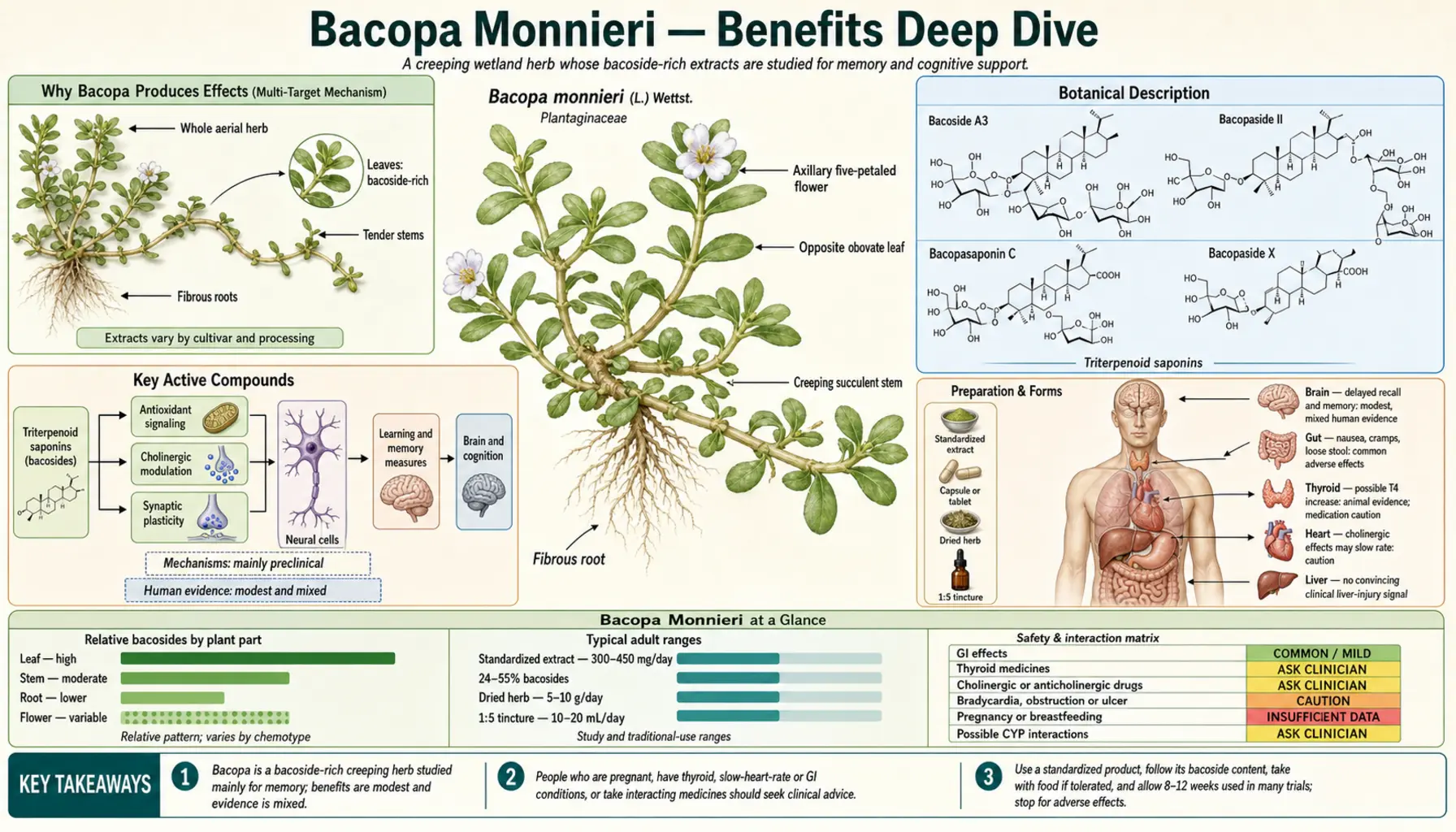
Bacopa monnieri — the small succulent wetland herb known across Ayurvedic medicine as brahmi, and to Western botanists as Indian water hyssop — is the single most extensively clinical-trialed nootropic herb in the world. Classified in the Charaka Samhita over two thousand years ago as a medhya rasayana (intellect-promoting rejuvenator), Bacopa owes its modern cognitive-enhancing reputation to a complex group of dammarane-type triterpenoid saponins called bacosides A and B, which act through a uniquely multi-target mechanism: acetylcholinesterase inhibition (preserving acetylcholine for memory and attention), GABAergic enhancement (anxiolysis), antioxidant defense (preventing neuronal oxidative damage), and stimulation of dendritic arborization (growing new synaptic connections). The four deep-dive pages below explore Bacopa's four most clinically validated applications — memory enhancement, anxiety relief, neuroprotection against Alzheimer's-type pathology, and pediatric ADHD — with one critical caveat that runs through all of them: Bacopa requires approximately 12 weeks of daily use to produce its full clinical effect. Unlike caffeine or modafinil, this is not an acute pharmacological stimulant. The benefits are structural — gradual remodeling of the dendritic tree and the cholinergic system — and they accumulate over time.
Deep-Dive Articles
Memory & Learning
The most thoroughly validated clinical benefit. Roodenrys et al. 2002 first demonstrated improved retention of new information on the Auditory Verbal Learning Test (AVLT) in healthy adults. Stough et al. 2001 and 2008 confirmed faster verbal learning and information processing in healthy volunteers, with significant effects emerging only at the 12-week mark. Calabrese et al. 2008 extended the finding to elderly subjects (mean age 65), demonstrating improved delayed word recall and reduced state anxiety. Mechanism: bacosides A and B enhance hippocampal acetylcholine and promote dendritic length and branching density — structural changes that require 12 weeks of cumulative exposure.
Anxiety Relief
Calabrese et al. 2008 demonstrated significant reductions in state and trait anxiety in elderly subjects alongside cognitive improvements — an unusual property because most anxiolytics impair cognition. Mechanism: dual modulation of the GABAergic system (Bacopa upregulates GABA-A receptor subunits and glutamate decarboxylase, raising inhibitory tone) and the cholinergic system (preserving acetylcholine, which supports the calm-focused attentional state). Animal head-to-head studies comparing Bacopa with lorazepam show comparable anxiolytic potency without the cognitive impairment, sedation, or amnesia that limit benzodiazepine usefulness. Onset again at 12 weeks for full effect.
Neuroprotection
The most active area of current Bacopa research. Holcomb et al. demonstrated reduced beta-amyloid plaque burden in PSAPP transgenic Alzheimer's mouse models. Bacosides interact with glycogen synthase kinase-3 beta (GSK-3 beta) to reduce tau hyperphosphorylation, inhibit BACE1 (the rate-limiting enzyme of amyloid precursor protein cleavage), suppress NF-kB-driven neuroinflammation, and protect mitochondrial function. The herb's antioxidant activity (raising SOD, catalase, and glutathione peroxidase) addresses one of the central upstream drivers of neurodegeneration. Acetylcholinesterase inhibition (the same mechanism as donepezil) provides additional symptomatic benefit.
ADHD & Children
The most promising natural approach to pediatric ADHD. Negi et al. 2000 open-label study found symptom reduction in 85% of children for attention deficit and 93% for restlessness. Dave et al. 2014 demonstrated significant improvement in sentence repetition, logical memory, and learning-rate scores in children with ADHD on standardized Bacopa extract for 6 months. Kean et al. 2016 randomized controlled trial (CDRI 08, 14 weeks) showed decreased error-making on cognitive tasks. Safety profile in children is excellent — only 2.3% of participants report mild side effects across published trials — making Bacopa a candidate adjunct to behavioral interventions for families seeking alternatives to or supplements alongside stimulant medications.
Table of Contents
- Deep-Dive Articles
- Why Bacopa Produces Effects (Multi-Target Mechanism)
- Key Research Papers
- External Authoritative Resources
- Connections
- Featured Videos
Why Bacopa Produces Effects (Multi-Target Mechanism)
Most single-compound nootropics work through one mechanism — caffeine antagonizes adenosine A1 and A2A receptors, modafinil modulates dopamine reuptake, donepezil inhibits acetylcholinesterase. Bacopa monnieri is unusual because its phytochemical complexity — dominated by bacosides A and B but extending to bacopasaponins C through G, the flavonoids luteolin and apigenin, betulinic acid, and the alkaloids brahmine and herpestine — produces simultaneous effects across at least four distinct neurobiological pathways. Each pathway maps to a different clinical benefit, and the cumulative effect of all four operating together is what produces the herb's broad cognitive, anxiolytic, and neuroprotective profile.
- Cholinergic enhancement — Bacopa inhibits acetylcholinesterase, the enzyme that breaks down acetylcholine in synaptic clefts. This is the same mechanism used by the prescription Alzheimer's drugs donepezil (Aricept), rivastigmine (Exelon), and galantamine (Razadyne). Increased synaptic acetylcholine supports memory formation, attention, and cognitive processing speed — the cognitive domains most studied in Bacopa clinical trials. The cholinergic effect is also central to Bacopa's Alzheimer's-relevant neuroprotection, since cholinergic neuron loss in the basal forebrain is one of the earliest pathological events in the disease.
- GABAergic enhancement — Bacopa upregulates expression of GABA-A receptor subunits and glutamate decarboxylase (GAD), the enzyme that converts excitatory glutamate into inhibitory GABA. This raises whole-brain inhibitory tone, producing measurable anxiolytic effects without the sedation, amnesia, or addictive potential of benzodiazepines. The GABAergic effect also contributes to Bacopa's anticonvulsant activity, validated in pentylenetetrazol seizure models, and explains the herb's traditional Ayurvedic use as a calming agent for students and meditators.
- Dendritic arborization and BDNF upregulation — the structural mechanism that distinguishes Bacopa from any pharmaceutical nootropic. Bacosides stimulate brain-derived neurotrophic factor (BDNF) signaling and promote increased dendritic length, branching density, and spine number in the hippocampus and cortex. In other words, Bacopa physically grows the synaptic connections that store memory and support cognition. This structural change is the basis for the herb's well-documented 12-week onset — receptors can upregulate in days, but growing new dendritic spines takes weeks. Animal studies show that the dendritic effect persists for weeks after Bacopa is discontinued, distinguishing it from pharmacological stimulants whose effects vanish within hours of the last dose.
- Antioxidant and anti-inflammatory protection — Bacopa raises the brain's endogenous antioxidant defenses (superoxide dismutase, catalase, glutathione peroxidase) and directly scavenges reactive oxygen species. It simultaneously suppresses NF-kB-driven inflammatory cytokine production (TNF-alpha, IL-6, IL-1 beta) and inhibits the COX-2 and lipoxygenase pathways. This dual antioxidant-anti-inflammatory action addresses two of the central drivers of neurodegeneration and cognitive aging, and underlies the herb's protective effects against heavy-metal neurotoxicity, beta-amyloid toxicity, and excitotoxic damage.
The critical clinical implication of this multi-target architecture is the 12-week onset rule. Patients accustomed to pharmaceutical drugs that act within hours often discontinue Bacopa within the first two or three weeks because they perceive no effect. This is a serious misreading of the herb's mechanism. The cholinergic and GABAergic effects begin within days, but they are subtle and not subjectively noticeable. The dramatic, measurable clinical effects on memory, anxiety, and cognitive processing — the effects that show up reliably in randomized controlled trials — require the dendritic remodeling to occur, and that process takes approximately 12 weeks of consistent daily dosing at 300 to 600 mg of a 50%-bacoside-standardized extract. Once the structural changes are in place, the cognitive benefits persist even after a short break in dosing, and continued use produces ongoing accumulation of benefit. Patients should be counseled to commit to a minimum 12-week trial before judging the herb's effect, and ideally to evaluate at the 16- or 20-week mark for maximum effect.
Key Research Papers
- Roodenrys S et al. (2002). Chronic effects of Brahmi (Bacopa monnieri) on human memory. Neuropsychopharmacology 27(2):279-281. — PubMed: Roodenrys 2002
- Stough C et al. (2001). The chronic effects of an extract of Bacopa monniera (Brahmi) on cognitive function in healthy human subjects. Psychopharmacology 156(4):481-484. — PubMed: Stough 2001
- Stough C et al. (2008). Examining the nootropic effects of a special extract of Bacopa monniera on human cognitive functioning: 90 day double-blind placebo-controlled randomized trial. Phytotherapy Research 22(12):1629-1634. — PubMed: Stough 2008
- Calabrese C et al. (2008). Effects of a standardized Bacopa monnieri extract on cognitive performance, anxiety, and depression in the elderly: a randomized, double-blind, placebo-controlled trial. Journal of Alternative and Complementary Medicine 14(6):707-713. — PubMed: Calabrese 2008
- Holcomb LA et al. (2006). Bacopa monniera extract reduces amyloid levels in PSAPP mice. Journal of Alzheimer's Disease 9(3):243-251. — PubMed: Holcomb 2006
External Authoritative Resources
- PMC — Neuropharmacological Review of the Nootropic Herb Bacopa monnieri (Aguiar & Borowski 2013) — the most comprehensive open-access review of Bacopa's pharmacology
- Alzheimer's Drug Discovery Foundation — Cognitive Vitality: Bacopa — balanced clinical-research summary aimed at researchers
- Memorial Sloan Kettering — Bacopa About Herbs Database — conservative clinical-resource summary with drug-interaction warnings
- MedlinePlus — Bacopa
- PubMed — All research on Bacopa monnieri (~1,500 papers)
Connections
- All Herbs
- Bacopa Monnieri (Main Page)
- Bacopa for Memory and Learning
- Bacopa for Anxiety Relief
- Bacopa for Neuroprotection
- Bacopa for ADHD and Children
- Ginkgo Biloba
- Ashwagandha
- Rhodiola Rosea
- Rosemary
- Sage
- Alzheimer's Disease
- ADHD
- Anxiety
- Dementia
- Epilepsy
- Gut-Brain Axis
- Oxidative Stress
- Cognitive Enhancement and ADHD