Bacopa Monnieri: History and Traditional Use
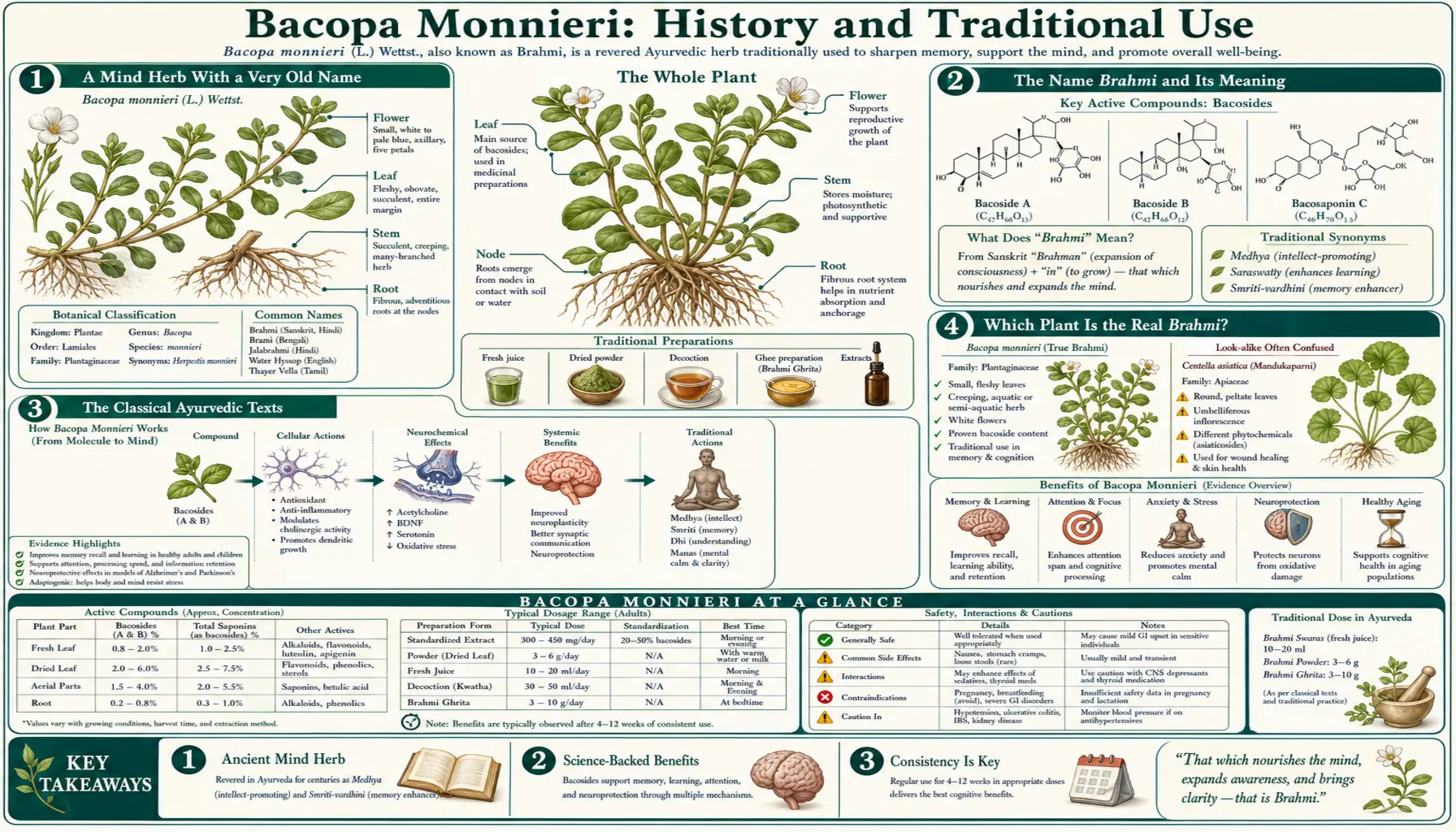
For most of its long story, the plant we now call Bacopa monnieri has been valued for one thing above all: a clear, steady mind. Traditional Indian medicine knew it as Brahmi, a name tied to wisdom itself, and ranked it among the very highest of the “mind herbs.” This page traces what is actually documented about that history — the classical texts, the centuries-old debate over which plant the name truly belongs to, the folklore around memory and meditation, and the moment in the twentieth century when chemists finally gave the herb’s reputation a molecular name. Where the record is tradition, we say so plainly; where it is firm history, we name it.
Table of Contents
- A Mind Herb With a Very Old Name
- The Name “Brahmi” and Its Meaning
- The Classical Ayurvedic Texts
- Which Plant Is the “Real” Brahmi?
- Traditional Preparations and Uses
- Folklore: Scholars, Monks, and Memory
- From Folk Tonic to Laboratory: The Discovery of the Bacosides
- From Tradition to Modern Research
- Research Papers and References
- Connections
- Featured Videos
A Mind Herb With a Very Old Name
Few medicinal plants have been associated with the mind as consistently, and for as long, as Bacopa monnieri. It is a small, creeping, fleshy herb of warm wetlands — marshy ground, the muddy edges of pools and rice paddies, riverbanks — found across India and much of tropical Asia, and now naturalized in wetlands on most continents. Botanists give its accepted name as Bacopa monnieri (L.) Wettst., placing it today in the plantain family (Plantaginaceae) after a reclassification from the figwort family (Scrophulariaceae) where older texts list it. In English it carries the gentle, descriptive names water hyssop, herb of grace, thyme-leaved gratiola, and Indian pennywort; in Indian languages it is best known by the Sanskrit name Brahmi.
What sets Bacopa apart historically is not a dramatic story of a single discoverer — there is none, and this page invents none. Like nearly every traditional herb, it has no “founder.” Instead its history is the slow accumulation of use: generations of physicians, scholars, and households in South Asia who reached for the same humble pondside plant whenever the concern was memory, concentration, anxiety, or a mind worn thin. That long, repeated, cross-generational reliance — documented in the oldest surviving medical texts of the subcontinent and still alive in herbal practice today — is the real subject of Bacopa’s history.
It is worth being clear at the outset about what kind of history this is. Much of it is traditional — recorded in classical and folk sources that describe how people used the plant and what they believed it did, not the results of modern controlled experiments. Those traditional claims are presented here as tradition. The firmly documented, dated, modern milestones — chiefly the isolation of the plant’s active compounds in the 1960s — are presented separately and named.
The Name “Brahmi” and Its Meaning
The Sanskrit name Brahmi is itself a piece of cultural history. It is traditionally derived from Brahman — the supreme universal consciousness of Hindu philosophy — and from Brahma, the creator. The name is also commonly linked to Saraswati, the goddess of knowledge, speech, learning, and the arts; in this reading “Brahmi” marks a herb of the intellect and of expanded awareness. The plain meaning that comes down to us is consistent across sources: a plant named for the mind, for knowledge, and for consciousness.
This naming is not incidental decoration. In the traditional framework, a herb tied to Brahman and to Saraswati was understood as one that supported the higher faculties — memory, comprehension, and the calm clarity prized for study and meditation. Whether or not one shares that worldview, the etymology tells us plainly how the herb was categorized by the people who used it for centuries: not as a remedy for one organ or complaint, but as a tonic for the mind as a whole. That framing — Bacopa as a mind-and-memory herb — has remained remarkably stable from the classical period to the modern supplement shelf.
The Classical Ayurvedic Texts
Brahmi appears in the foundational literature of Ayurveda, the traditional medical system of the Indian subcontinent. It is referenced in the great classical compendia — the Charaka Samhita and the Sushruta Samhita — and the name is associated with the still older Atharva Veda. In these texts Brahmi is placed in an elite category called medhya rasayana: medhya meaning intellect, memory, and the faculties of the mind, and rasayana meaning a rejuvenating, restorative preparation. A medhya rasayana, in other words, was a herb specifically held to sharpen intellect, strengthen memory, and restore mental vitality — the highest traditional praise an Indian medical text could give a brain herb.
The dating of these texts deserves an honest word, because precise dates are genuinely uncertain and often overstated. The classical Ayurvedic compendia took shape and were repeatedly edited over a long span; scholars place their core material across many centuries, and the Atharva Veda is far older still, with its hymns commonly dated to roughly the early first millennium BCE. The familiar claim that Brahmi has been used “for over 3,000 years” reflects this deep Vedic background, while some sources more cautiously tie the specific surviving medhya-rasayana descriptions to the early centuries CE. We therefore say, accurately, that Brahmi’s documented place in Indian medical literature is ancient and spans well over a thousand years, without pinning it to a single false date.
What the texts agree on is the indication. Traditional sources describe Brahmi for poor memory, weak concentration, and mental fatigue, and as an agent to promote intellect and longevity. The Charaka Samhita is traditionally attributed to the physician Charaka and the Sushruta Samhita to the surgeon Sushruta — figures whose historical details are themselves debated, and who are best understood as the names attached to long traditions of compiled medical knowledge rather than as single, fully documented authors. We name them here as the traditional authorities the texts are ascribed to.
Which Plant Is the “Real” Brahmi?
One of the most genuinely interesting — and well-documented — threads in Brahmi’s history is a centuries-old case of botanical mistaken identity. The name “Brahmi” has, at different times and in different regions, been attached to two different plants: Bacopa monnieri (water hyssop) and Centella asiatica (gotu kola, known in Sanskrit as Mandukaparni). This is not modern marketing confusion; it reaches back into the classical literature itself.
The commonly cited account runs as follows. The early classical authorities — Charaka, Sushruta, and later Vagbhata — appear to have treated Brahmi and Mandukaparni as two distinct herbs. Later, around the sixteenth century, influential texts including the Bhavaprakasha are said to have equated the two names, blurring the distinction. From that point onward the single word “Brahmi” came to be applied loosely to both plants, and a regional split set in that persists today: in much of northern India, “Brahmi” most often means Bacopa monnieri, while in parts of southern India the same name is frequently used for Centella asiatica (gotu kola). Authorities that aim to standardize Ayurvedic nomenclature, such as the official Ayurvedic Formulary of India, identify Bacopa monnieri as Brahmi and Centella asiatica as Mandukaparni.
This matters for anyone reading older herbals or buying “Brahmi” today: the historical record genuinely contains both plants under one name, and comparative studies confirm that the two are pharmacologically and chemically distinct — they are not interchangeable. On this site, Bacopa monnieri is treated as Brahmi throughout, in line with the standardizing authorities, while gotu kola is recognized as the separate herb Mandukaparni. The specific dates and attributions in this section (the sixteenth-century equation, the named texts) are drawn from the secondary Ayurvedic literature and are presented as that tradition reports them.
Traditional Preparations and Uses
Across its traditional use, Brahmi was prepared in simple, domestic ways. The whole fresh or dried aerial plant — the leaves and tender stems — was the part used. It was taken as a juice pressed from the fresh herb, as a paste, as a dried powder (churna), and as a decoction. A practice repeated across the traditional sources is to give Brahmi together with a fat or carrier such as milk or ghee (clarified butter), and sometimes honey — in Ayurvedic terms, an anupana or vehicle thought to aid the herb’s action. Whether such carriers measurably improve uptake of the active compounds has not been clearly established: the herb’s prized constituents, the bacosides, are amphiphilic triterpenoid saponins (they have both water- and fat-attracting parts) rather than simply fat-soluble, and modern attempts to raise their bioavailability have used engineered phospholipid complexes rather than ordinary dietary fat. The traditional pairing with ghee or milk is best recorded as a documented preparation custom, not as a practice confirmed by modern pharmacology.
While memory and intellect were the headline uses, the traditional materia medica records a broader range. Brahmi was used as a general nervous-system tonic and as a calming herb for agitation, restlessness, and disturbed sleep; it appears in traditional accounts for anxiety, as a sedative and antiepileptic agent, and as an anti-inflammatory, analgesic, and febrifuge (fever-reducer). It was also applied in skin complaints and used in formulas for general rejuvenation. In Ayurvedic constitutional terms it is described as tridoshic — balancing to all three doshas — with a cooling quality and a particular reputation for settling a mind that is overheated, anxious, or scattered. These are traditional indications, recorded in classical and folk practice, not modern clinical endorsements.
Brahmi was, in short, a household and physician’s herb at once: cheap, abundant in the wet ground of the subcontinent, gentle enough for repeated use, and reached for first whenever the trouble was the mind, the nerves, or the need for calm focus. That accessibility — a free plant growing in the nearest pond — is a recurring reason herbs like this become deeply woven into a culture’s everyday medicine.
Folklore: Scholars, Monks, and Memory
Around the medicine grew a body of folklore, and almost all of it circles the same theme: learning and a retentive mind. Tradition holds that Brahmi was the herb of students, scholars, and monks — taken by those preparing for examinations, by reciters committing long Sanskrit verses and scriptures to memory, and by meditators seeking a quiet, clear mind. In a culture that for centuries transmitted vast bodies of sacred text orally, a reputed memory-and-recall herb naturally acquired an honored place, and that association is the most persistent piece of Bacopa lore.
The plant’s spiritual framing belongs here too, and is best read as tradition rather than fact. Because of its link to Saraswati and to Brahman, Brahmi was held in some traditional accounts to support meditation and expanded awareness — described, for example, as aiding the higher faculties and the “crown” of consciousness. Folklore also holds that the herb was simply a steady daily tonic for clear thinking and emotional balance, taken over long periods rather than as a quick fix. These are cultural beliefs about the plant; we record them as the folklore they are, distinct from the documented chemistry and clinical work covered below and in the companion Benefits articles.
From Folk Tonic to Laboratory: The Discovery of the Bacosides
For most of its history Brahmi’s value rested entirely on experience and tradition. That changed in the twentieth century, when Indian chemists set out to find what in the plant might account for its reputation — and this is the part of Bacopa’s story that is firmly documented, dated, and attributable to named scientists.
The key milestone came in 1963, when N. Chatterji, R. P. Rastogi, and M. L. Dhar published a systematic chemical examination of Bacopa monnieri in the Indian Journal of Chemistry. They reported the isolation of two saponins, which they named bacoside A and bacoside B — the compounds that would become the defining markers of the herb. Follow-up work by the same group in 1965 began to elucidate the structures of these molecules. Much of the sustained early pharmacological study of standardized Bacopa extract in the decades that followed was carried out in India, including at the Central Drug Research Institute (CDRI) in Lucknow, whose standardized extract is widely referenced in the literature as CDRI-08.
Later analytical chemistry refined the picture considerably. What the early workers called “bacoside A” was eventually shown to be not a single substance but a mixture of related dammarane-type triterpenoid saponins — including the compounds now known as bacoside A3, bacopaside II, bacopasaponin C, and a jujubogenin isomer of bacopasaponin C. Modern standardized Bacopa products are typically defined by their total bacoside content measured in the laboratory. The detailed chemistry, the individual named compounds, and the proposed mechanisms are covered in the Bacopa Monnieri main article; what matters for the history is the turning point itself: in the early 1960s, a folk “mind herb” acquired, for the first time, a set of named molecules to investigate.
From Tradition to Modern Research
The isolation of the bacosides opened the door to the modern phase of Bacopa’s story: testing the ancient reputation directly in people. Beginning in the late twentieth century and accelerating into the twenty-first, researchers ran randomized, double-blind, placebo-controlled trials of standardized Bacopa extract on memory and cognition. An influential 2002 trial led by S. Roodenrys and colleagues, published in Neuropsychopharmacology, reported that Brahmi improved the retention of newly learned information in healthy adults — a finding that lines up strikingly with the herb’s thousand-year reputation as an aid to memory and recall. Subsequent trials, including a 2008 study in older adults by C. Calabrese and colleagues, and review articles synthesizing the field, have continued to examine its effects on memory, attention, and anxiety.
The honest summary is one of encouraging continuity rather than final proof. Modern reviews generally find that Bacopa shows a measurable, if modest, benefit for certain aspects of memory and cognition, that its effects tend to build gradually over weeks rather than appearing immediately, and that it is generally well tolerated — while also noting that trials vary in size and quality and that more rigorous research is still needed. In other words, the laboratory has not overturned the tradition; if anything it has cautiously echoed it. The full picture of the clinical evidence — for memory and learning, anxiety, attention, and neuroprotection — is laid out in the dedicated Benefits articles, including Memory and Learning and Anxiety Relief.
That is what makes Bacopa’s history worth telling: a small wetland herb, named for consciousness itself, prized for the mind across more than a thousand years of Indian medicine, carried forward through a centuries-long argument over its very identity, and then — in our own era — handed to chemists and clinicians who found, in its molecules and its trials, reasons the old tradition may have been onto something all along. None of this makes Bacopa a cure for any disease, and serious or worsening cognitive symptoms always warrant proper medical assessment; but as a story of how folk knowledge meets modern science, it is among the most coherent in the herbal world.
Research Papers and References
The list below combines key peer-reviewed reviews and clinical trials of Bacopa monnieri with curated PubMed topic-search links into the historical, ethnobotanical, and clinical literature. The classical Ayurvedic texts (the Charaka Samhita, Sushruta Samhita, and Atharva Veda) and the early Indian phytochemistry are named in the article as historical sources; the foundational 1963 chemistry paper predates modern digital identifiers and is listed as plain text. Each external link opens in a new tab.
- Aguiar S, Borowski T. Neuropharmacological review of the nootropic herb Bacopa monnieri. Rejuvenation Research. 2013;16(4):313-326. — doi:10.1089/rej.2013.1431 (PMID: 23772955)
- Russo A, Borrelli F. Bacopa monniera, a reputed nootropic plant: an overview. Phytomedicine. 2005;12(4):305-317. — doi:10.1016/j.phymed.2003.12.008 (PMID: 15898709)
- Roodenrys S, Booth D, Bulzomi S, Phipps A, Micallef C, Smoker J. Chronic effects of Brahmi (Bacopa monnieri) on human memory. Neuropsychopharmacology. 2002;27(2):279-281. — doi:10.1016/S0893-133X(01)00419-5 (PMID: 12093601)
- Calabrese C, Gregory WL, Leo M, Kraemer D, Bone K, Oken B. Effects of a standardized Bacopa monnieri extract on cognitive performance, anxiety, and depression in the elderly: a randomized, double-blind, placebo-controlled trial. Journal of Alternative and Complementary Medicine. 2008;14(6):707-713. — doi:10.1089/acm.2008.0018 (PMID: 18611150)
- Walker EA, Pellegrini MV. Bacopa monnieri. In: StatPearls. Treasure Island (FL): StatPearls Publishing; 2023. — NCBI Bookshelf: NBK589635
- Chatterji N, Rastogi RP, Dhar ML. Chemical examination of Bacopa monniera Wettst. — Part I: Isolation of chemical constituents (including bacoside A and bacoside B). Indian Journal of Chemistry. 1963;1:212-215. (Historical primary chemistry source; predates digital identifiers.)
- Bacopa monnieri / Brahmi ethnobotany and traditional Ayurvedic use — PubMed: Bacopa monnieri Brahmi traditional Ayurvedic use
- Brahmi versus Mandukaparni (Bacopa versus Centella) identity and comparison — PubMed: Bacopa vs Centella, Brahmi vs Mandukaparni
- Bacopa monnieri bacosides — phytochemistry and standardization — PubMed: Bacopa monnieri bacoside phytochemistry
External Authoritative Resources
- NCCIH — Herbs at a Glance
- MedlinePlus — Herbs and Supplements
- PubMed — All research on Bacopa monnieri
Connections
- All Herbs
- Bacopa Monnieri Hub
- Bacopa Monnieri Benefits
- Bacopa for Memory & Learning
- Bacopa for Anxiety Relief
- Ashwagandha
- Ginkgo Biloba
- Rhodiola Rosea
- Holy Basil (Tulsi)