Bacopa Monnieri for Memory and Learning
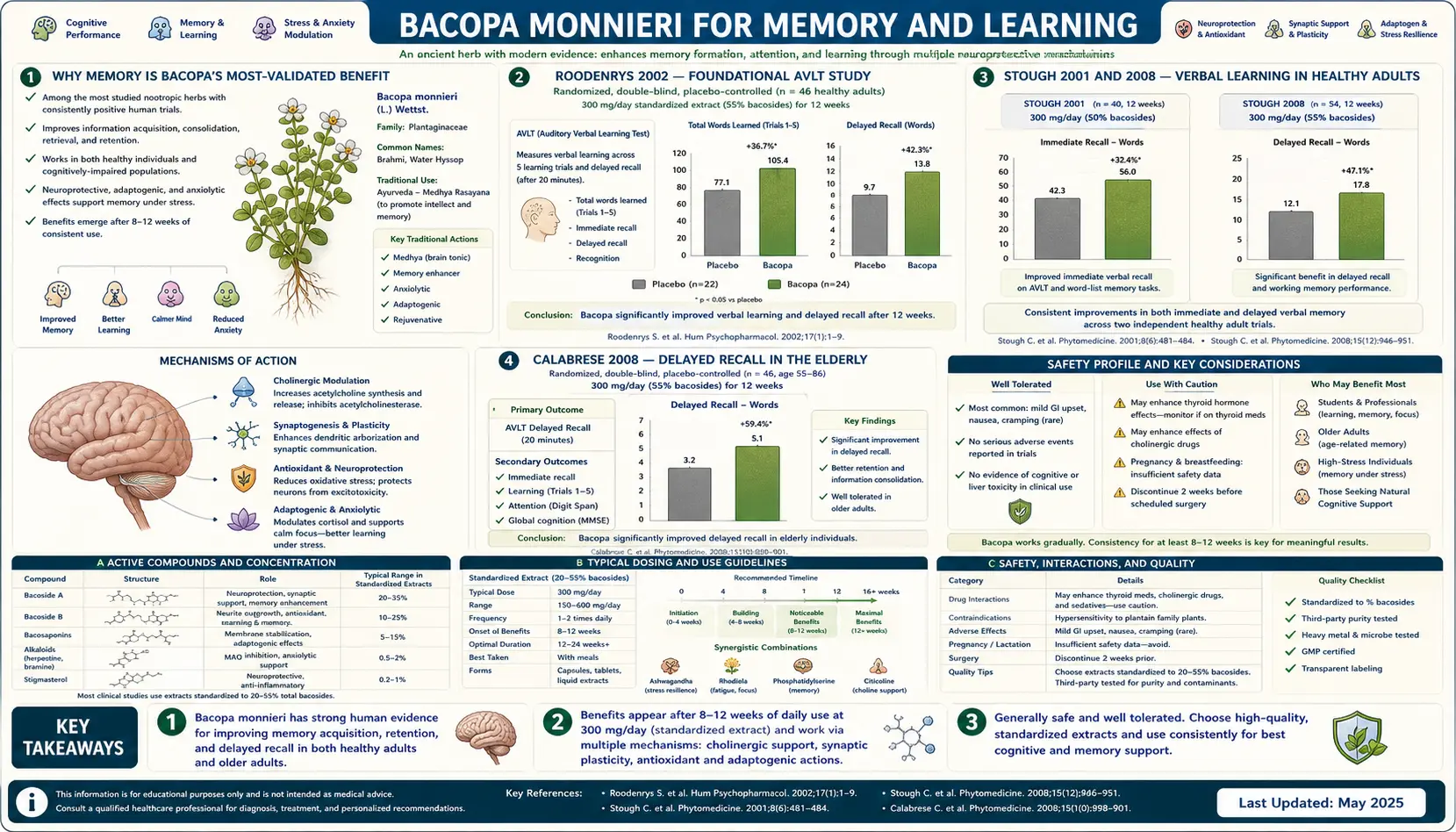
Memory enhancement is Bacopa monnieri's most rigorously documented clinical benefit and the application where the evidence base most resembles that of a conventional pharmaceutical — multiple independent randomized double-blind placebo-controlled trials, replication across research groups in three continents, dose-response data, and a converging mechanistic story at the molecular level. The pivotal early trials by Roodenrys (2002) and Stough (2001, 2008) established that 300 mg of standardized Bacopa extract daily produced measurable improvements in verbal learning, free recall, and information acquisition rate — but only after approximately 12 weeks of continuous dosing. Calabrese et al. 2008 extended the finding to elderly subjects with measurable improvements in delayed recall, the cognitive domain most vulnerable to aging and most predictive of progression to dementia. The therapeutic temperament required to use Bacopa successfully is the opposite of the temperament that drives most stimulant nootropic use: patience, daily consistency, and an acceptance that nothing dramatic will happen in the first month.
Table of Contents
- Why Memory is Bacopa's Most-Validated Benefit
- Roodenrys 2002 — The Foundational AVLT Study
- Stough 2001 and 2008 — Verbal Learning in Healthy Adults
- Calabrese 2008 — Delayed Recall in the Elderly
- Mechanism: Bacosides A and B and the Cholinergic System
- Dendritic Arborization — The Structural Basis for 12-Week Onset
- The 12-Week Onset Rule and Why It Matters Clinically
- Dosage, Standardization, and Practical Use
- Meta-Analysis Evidence and Effect Sizes
- Students, Professionals, and Healthy Cognitive Enhancement
- What Bacopa Does Not Do (Realistic Expectations)
- Key Research Papers
- Connections
- Featured Videos
Why Memory is Bacopa's Most-Validated Benefit
Bacopa monnieri is recommended in Ayurvedic medicine for a broad range of cognitive and psychological conditions — memory, anxiety, epilepsy, attention deficit, even spiritual insight. Modern clinical research has investigated several of these, but the strongest evidence by a clear margin is for memory enhancement in healthy adults. The reason is partly historical and partly methodological: Brahmi was the herb that nootropic researchers most wanted to validate against Western standards, so it received the bulk of the early randomized-controlled-trial budget. By the mid-2000s, three independent research groups (Roodenrys in Australia, Stough in Australia, Calabrese in the United States) had published well-designed double-blind placebo-controlled trials, all using standardized extracts, all measuring outcomes with established neuropsychological instruments (the Auditory Verbal Learning Test, the Rey Auditory Verbal Learning Test, the Wechsler Memory Scale), and all reporting positive effects on specific memory subscales.
The convergence is striking because it crossed continents, research traditions, and product formulations. The Australian work used the CDRI 08 extract (also marketed as KeenMind or BacoMind), standardized to 55% bacosides. The American work used various US-domestic extracts standardized to between 24% and 50% bacosides. Despite the formulation differences, the pattern of results was consistent: significant improvements in the acquisition of new information (learning rate), in the consolidation and retention of acquired information (delayed recall after a 20-minute or 24-hour interval), and in the speed of visual information processing. Other cognitive domains — reaction time, processing speed for already-known material, simple attention — showed smaller or absent effects.
The specificity matters. Bacopa is not a generic "brain booster." It selectively enhances the neural processes most directly involved in encoding and consolidating new memories, which is exactly the cognitive function that the herb's mechanism — cholinergic enhancement plus dendritic remodeling in the hippocampus — would predict.
Roodenrys 2002 — The Foundational AVLT Study
The 2002 trial published in Neuropsychopharmacology by Steven Roodenrys and colleagues at the University of Wollongong was the first methodologically rigorous Western study to demonstrate a cognitive benefit from Bacopa monnieri. Seventy-six healthy adults aged 40 to 65 were randomized to receive either 300 mg per day of standardized Bacopa extract or matching placebo for 12 weeks. Outcome assessment used the Rey Auditory Verbal Learning Test (AVLT), a standard neuropsychological measure of verbal learning and memory in which subjects hear a 15-word list read aloud over five sequential learning trials, then attempt free recall immediately and again after a 20-minute interference interval.
The key result was a significant improvement in retention of new information in the Bacopa group compared to placebo. Specifically, the rate of forgetting between immediate recall and delayed recall was significantly reduced in subjects taking Bacopa, indicating better memory consolidation. Importantly, the effect was not on learning the list initially (the acquisition slope across the five learning trials was similar) but on holding onto what had been learned across the 20-minute delay. This is a clinically meaningful distinction because delayed-recall deficits are the cardinal cognitive symptom of early Alzheimer's disease and the most reliable indicator of hippocampal dysfunction.
The Roodenrys trial established two principles that have guided all subsequent Bacopa research. First, the effect emerges at the 12-week mark and is not measurable at shorter durations — trials of 4 to 8 weeks have routinely failed to find significant effects. Second, the cognitive benefit is specific to memory consolidation rather than diffuse cognitive enhancement. The mechanistic interpretation is that Bacopa enhances hippocampal synaptic plasticity through cholinergic and dendritic effects, and that this process requires weeks to produce structural change.
Stough 2001 and 2008 — Verbal Learning in Healthy Adults
Con Stough and colleagues at Swinburne University of Technology in Melbourne ran two landmark trials that complemented the Roodenrys work. The 2001 trial, published in Psychopharmacology, randomized 46 healthy adults aged 18 to 60 to 300 mg of Bacopa or placebo for 12 weeks. The authors used a comprehensive battery of cognitive tests including the Sternberg memory scanning task, choice reaction time, the inspection-time task (a measure of perceptual speed), and the AVLT. Results showed significant improvement in the Bacopa group on the speed of visual information processing (inspection time), on the rate of learning new information (AVLT trial-by-trial improvement), and on memory consolidation. State anxiety also decreased.
The 2008 follow-up published in Phytotherapy Research was specifically designed to confirm the earlier findings using a larger sample and an even more carefully standardized extract (CDRI 08). Sixty-two healthy adults completed 90 days of randomization to 300 mg Bacopa or placebo. The results replicated the 2001 findings: significant improvement on the verbal learning task (with effect size in the moderate range), significant improvement on delayed word recall after 30 minutes, and significant improvement on visual information processing speed. The authors emphasized that these effects emerged at 12 weeks and were not present at intermediate testing points. They also noted that the cognitive improvements persisted in a partial follow-up assessment four weeks after the Bacopa was discontinued — consistent with the structural-remodeling mechanism rather than acute pharmacological action.
The Stough work was particularly important because it used healthy, cognitively intact young and middle-aged adults rather than the elderly. The finding that Bacopa improved cognition in normal subjects without pre-existing impairment expanded the herb's relevance from a treatment for dementia-spectrum decline to a true nootropic with potential applications in education, professional cognitive performance, and healthy aging.
Calabrese 2008 — Delayed Recall in the Elderly
Carlo Calabrese and colleagues at the National College of Natural Medicine in Portland, Oregon, published in 2008 a randomized double-blind placebo-controlled trial in elderly subjects that became the most-cited Bacopa study in the United States. Fifty-four healthy subjects aged 65 and older were randomized to receive 300 mg per day of standardized Bacopa extract (a US-domestic formulation standardized to 50% bacosides) or matching placebo for 12 weeks. Outcome measures included the Rey Auditory Verbal Learning Test, the Stroop test (selective attention and cognitive flexibility), the Wechsler Memory Scale (logical memory and paired-associate learning), the Beck Depression Inventory, and the State-Trait Anxiety Inventory.
The results were unusually rich. Bacopa significantly improved delayed word recall on the AVLT (the key memory-consolidation measure), improved Stroop test performance (indicating better executive function and attentional control), and reduced both state and trait anxiety scores. Depression scores also improved, though more modestly. The combination of cognitive improvement plus anxiolytic effect, all occurring in the same population over the same 12-week window, is the hallmark of Bacopa's multi-target mechanism — one supplement, two distinct clinical benefits, both produced by the same underlying neurobiological changes.
The Calabrese trial is particularly important for clinical translation to age-related cognitive concerns. The mean age of participants was approximately 73, well into the demographic where age-associated memory impairment becomes prevalent and where the question of cognitive maintenance becomes clinically urgent. The finding that Bacopa produces measurable cognitive benefit in this age group, with an excellent safety profile and no observed serious adverse events, supports the case for Bacopa as a first-line intervention for healthy elderly individuals concerned about cognitive maintenance — provided the 12-week onset is clearly explained and adherence is supported.
Mechanism: Bacosides A and B and the Cholinergic System
The mechanism by which Bacopa enhances memory consolidation has been progressively elucidated over the past two decades. The principal bioactive constituents are bacoside A (itself a mixture of bacoside A3, bacopaside II, bacopasaponin C, and the jujubogenin isomer of bacopasaponin C) and bacoside B — both dammarane-type triterpenoid saponins. These compounds enter the bloodstream after oral administration with modest bioavailability that is improved by co-administration with dietary fat (validating the traditional Ayurvedic practice of taking Brahmi with milk or ghee).
The cholinergic effect operates through two complementary mechanisms. First, Bacopa inhibits acetylcholinesterase (AChE), the enzyme that breaks down acetylcholine in the synaptic cleft. This is the same mechanism used by the FDA-approved Alzheimer's drugs donepezil (Aricept), rivastigmine (Exelon), and galantamine (Razadyne). The AChE inhibition raises synaptic acetylcholine concentration, prolonging the duration of cholinergic signaling and enhancing the activation of postsynaptic muscarinic M1 and nicotinic alpha7 receptors. Both receptor types are densely expressed in the hippocampus and cortex and are central to memory encoding, attention, and cognitive processing speed. Second, Bacopa may modestly enhance choline acetyltransferase activity (the enzyme that synthesizes acetylcholine from choline and acetyl-CoA), increasing the rate at which acetylcholine can be produced and released from cholinergic neurons.
The cholinergic enhancement explains the rapid component of Bacopa's cognitive effects — improvements in attention and information processing speed that begin within days of starting the supplement. It does not, however, explain the dramatic memory-consolidation effects that emerge only at 12 weeks. That effect requires a second mechanism: structural remodeling of dendritic trees.
Dendritic Arborization — The Structural Basis for 12-Week Onset
The structural mechanism that distinguishes Bacopa from any pharmaceutical nootropic is its capacity to promote dendritic arborization — the growth of new branches and spines on neuronal dendrites, the membrane extensions that receive synaptic input from other neurons. Animal studies have established that chronic Bacopa administration increases dendritic length, branching density, and spine number in the hippocampal CA1 and CA3 regions, the dentate gyrus, and the prefrontal cortex. The effect is most pronounced in the hippocampus, the brain region central to declarative memory formation.
Mechanistically, Bacopa appears to act through upregulation of brain-derived neurotrophic factor (BDNF), the master growth factor for adult neuroplasticity. BDNF binds the TrkB receptor on neurons and activates downstream signaling cascades (MAPK/ERK, PI3K/Akt, PLC-gamma) that promote dendritic growth, spine formation, and the long-term potentiation of existing synapses. Bacosides also activate the CREB (cAMP response element-binding protein) transcription factor, which drives expression of genes required for long-lasting synaptic plasticity. The combination of BDNF upregulation and CREB activation provides a coherent molecular explanation for the structural changes observed at the cellular level.
The clinical implication is profound. Cholinergic enhancement could plausibly improve cognition within hours of the first dose — this is approximately what happens when patients with mild Alzheimer's disease start donepezil and notice a subtle improvement in attention within the first one or two weeks. Dendritic remodeling cannot happen within hours. Growing new dendritic spines, populating them with receptors, and integrating them into functional circuits is a process that takes weeks of consistent BDNF and CREB activity. This is why Bacopa's memory-enhancement effects emerge only at 12 weeks — the structural substrate of enhanced memory has to be built. For more on the role of BDNF in cognitive aging and exercise-induced neuroplasticity, see our Exercise page.
The 12-Week Onset Rule and Why It Matters Clinically
Every clinically meaningful trial of Bacopa monnieri for memory has used a treatment duration of at least 12 weeks. Trials of 4, 6, and 8 weeks have routinely failed to show significant cognitive benefit, even when using the same extract, the same dose, and the same outcome measures. The 12-week threshold is not a methodological artifact — it is a direct reflection of the underlying mechanism. Bacopa's effect on memory requires structural remodeling of the dendritic tree, and that process takes approximately three months to produce measurable cognitive change.
The clinical implication is that most patients who try Bacopa fail because they quit too early. Patients accustomed to pharmaceutical drugs that act within hours expect to feel something within a few days of starting a new supplement. When Bacopa produces no subjective effect in the first two or three weeks, the most common patient response is to assume it does not work and discontinue. This is a serious misreading of the herb's timeline. The recommended approach is to:
- Commit to a minimum 12-week trial before judging the herb's effect. Mark a calendar date 90 days from the start of dosing as the evaluation point.
- Take Bacopa with food containing dietary fat to optimize bioavailability of the lipophilic bacosides. A breakfast containing eggs, butter, or whole-fat yogurt is ideal.
- Use a standardized extract — either CDRI 08 (also sold as KeenMind), Bacognize, or another extract standardized to at least 24% bacosides. Crude powdered herb varies dramatically in bacoside content and is not recommended for clinical trials.
- Dose 300 to 600 mg per day, in a single morning dose or split between morning and lunch. Late-evening dosing is not recommended because the cholinergic effect can be modestly activating in some individuals.
- Maintain dosing consistency. Skipping multiple days in a row resets the clock on dendritic remodeling. The benefit accumulates with daily consistency, not with occasional high doses.
For patients who complete a 12-week trial without subjective cognitive benefit, the recommended next step is a formal cognitive assessment using a validated instrument (the Montreal Cognitive Assessment, a verbal-learning test, or an electronic battery such as Cambridge Brain Sciences). Objective cognitive improvements are sometimes measurable even when the patient does not subjectively notice them.
Dosage, Standardization, and Practical Use
The clinical trial literature converges on 300 mg per day of standardized Bacopa extract as the dose at which memory-enhancement effects reliably emerge. Some trials have used 450 to 600 mg per day and reported slightly larger effects, suggesting a modest dose-response relationship within that range. Doses above 600 mg per day have not been systematically studied and are not recommended for routine use; they are unlikely to produce additional benefit and may increase the risk of gastrointestinal side effects (nausea, abdominal cramping, increased bowel motility — the most common adverse effects).
Standardization matters because the bacoside content of raw Bacopa powder varies enormously based on geographic origin, plant part used, season of harvest, and processing methods. Commercial standardized extracts are typically labeled with their bacoside percentage:
- CDRI 08 (KeenMind, BacoMind) — the most-studied extract globally, standardized to 55% bacosides. Used in the majority of the Australian clinical trials including Stough 2001, Stough 2008, and the Kean 2016 pediatric ADHD trial.
- Bacognize — a US-domestic standardized hydroalcoholic extract of the whole herb, standardized to 12% total bacopa glycosides by the USP HPLC method. Lower bacoside number than CDRI 08, but the standardization method is different (capturing a broader glycoside fraction).
- Generic 20% to 50% bacoside extracts — widely available from US, Indian, and European supplement manufacturers. Quality varies; look for third-party testing certifications (NSF, USP, ConsumerLab) and HPLC verification of bacoside content.
The traditional Ayurvedic preparation uses 5 to 10 grams of dried whole herb daily, taken with milk or ghee. This is appropriate for cultural-traditional use but is not equivalent to standardized extracts in clinical trials, and bacoside delivery is highly variable. For evidence-based memory enhancement, standardized extract is the preferred form.
Meta-Analysis Evidence and Effect Sizes
Several meta-analyses and systematic reviews have synthesized the Bacopa cognitive-enhancement literature. The 2014 systematic review by Pase et al. (published in the Journal of Alternative and Complementary Medicine) included nine randomized double-blind placebo-controlled trials comprising 437 subjects and concluded that Bacopa significantly improved cognition in three domains: cognitive processing speed (small to moderate effect size), delayed word recall (moderate effect size), and memory accuracy (small to moderate effect size). The authors noted that the largest and most consistent effects were on memory measures requiring 12 or more weeks of treatment.
A subsequent meta-analysis by Kongkeaw et al. (2014) reached similar conclusions, with the additional observation that effect sizes were larger in older subjects (where baseline cognitive performance is lower, allowing more room for improvement) than in young healthy subjects. The effect sizes are clinically meaningful but modest — on the order of 0.3 to 0.6 standard deviations on individual test measures — comparable to the effect sizes seen with cholinesterase inhibitor drugs in mild cognitive impairment, but achieved with a markedly better safety profile.
Conservatively interpreted, the meta-analytic evidence supports Bacopa as a modestly effective cognitive enhancer, with effects most pronounced in older subjects and in the memory-consolidation domain, emerging at the 12-week mark and accumulating with continued use. The evidence base is stronger than that for most other commonly marketed nootropic supplements (Ginkgo biloba has a comparable evidence base; phosphatidylserine, vinpocetine, and most racetams have much weaker evidence). For comparison, see the Ginkgo Biloba page.
Students, Professionals, and Healthy Cognitive Enhancement
Bacopa's evidence base in healthy young adults (the Stough trials) and in cognitively intact elderly (the Calabrese trial) supports its use as a general cognitive enhancer in populations without pre-existing cognitive impairment. Common use-cases include:
- Students preparing for major examinations — medical school finals, the LSAT, the bar exam, comprehensive doctoral exams. The 12-week onset means Bacopa is appropriate for someone with three or more months of preparation time; it is not suitable for cramming. Start dosing at the beginning of a 90-day study window.
- Professionals facing high-cognitive-demand work projects — software engineers learning new languages, attorneys preparing complex briefs, researchers writing grants, anyone learning a foreign language. The herb's enhancement of verbal learning and information consolidation is particularly well-suited to language acquisition.
- Aging adults concerned about cognitive maintenance — the population studied by Calabrese 2008. Bacopa is a reasonable first-line supplement for healthy elderly individuals motivated to maintain cognitive function. Concurrent attention to aerobic exercise, metabolic health, and adequate sleep produces additive benefits.
- Knowledge workers with mild subjective cognitive complaints — the population that increasingly seeks nootropic support. Modafinil, methylphenidate, and other prescription cognitive enhancers carry risks (addiction potential, cardiovascular effects, sleep disruption) that make Bacopa an attractive alternative when the desired effect is improved learning and memory rather than improved wakefulness.
What Bacopa Does Not Do (Realistic Expectations)
The clinical evidence supports specific cognitive benefits but does not support several effects sometimes claimed in promotional material. Bacopa does not appear to:
- Produce acute cognitive enhancement. Unlike caffeine or modafinil, Bacopa does not produce a noticeable cognitive boost within hours or days of dosing. Patients who expect this and quit when it does not happen miss the actual benefit.
- Improve simple reaction time or processing speed for already-learned material. The effect is specific to learning new information and consolidating new memories. Tasks that draw on already-mastered skills are not improved.
- Reverse established Alzheimer's disease. Preclinical evidence supports neuroprotective mechanisms relevant to Alzheimer's pathology, but no large clinical trial has demonstrated symptomatic benefit in established dementia. The herb may be more useful for prevention and early intervention than for treatment of advanced disease. For more detail see the Neuroprotection page.
- Replace prescription cognitive enhancers in patients with diagnosed cognitive impairment. Patients with mild cognitive impairment or early Alzheimer's who are candidates for donepezil should not substitute Bacopa for the prescribed drug without specialist consultation, though combined use is generally well tolerated.
- Produce dramatic mood elevation or anxiolysis sufficient to replace treatment for clinical depression or generalized anxiety disorder. The herb produces modest anxiolytic and mood-stabilizing effects, but patients with diagnosed mood disorders need treatment appropriate to the diagnosis.
Realistic expectations protect the patient from disappointment and support the long-term adherence needed for the herb to produce its actual benefits.
Key Research Papers
- Roodenrys S et al. (2002). Chronic effects of Brahmi (Bacopa monnieri) on human memory. Neuropsychopharmacology 27(2):279-281. — PubMed
- Stough C et al. (2001). The chronic effects of an extract of Bacopa monniera (Brahmi) on cognitive function in healthy human subjects. Psychopharmacology 156(4):481-484. — PubMed
- Stough C et al. (2008). Examining the nootropic effects of a special extract of Bacopa monniera on human cognitive functioning: 90 day double-blind placebo-controlled randomized trial. Phytotherapy Research 22(12):1629-1634. — PubMed
- Calabrese C et al. (2008). Effects of a standardized Bacopa monnieri extract on cognitive performance, anxiety, and depression in the elderly: a randomized, double-blind, placebo-controlled trial. Journal of Alternative and Complementary Medicine 14(6):707-713. — PubMed
- Pase MP et al. (2012). The cognitive-enhancing effects of Bacopa monnieri: a systematic review of randomized, controlled human clinical trials. Journal of Alternative and Complementary Medicine 18(7):647-652. — PubMed
- Kongkeaw C et al. (2014). Meta-analysis of randomized controlled trials on cognitive effects of Bacopa monnieri extract. Journal of Ethnopharmacology 151(1):528-535. — PubMed
- Morgan A, Stevens J (2010). Does Bacopa monnieri improve memory performance in older persons? Results of a randomized, placebo-controlled, double-blind trial. Journal of Alternative and Complementary Medicine 16(7):753-759. — PubMed
- Vollala VR et al. (2011). Enhanced dendritic arborization of hippocampal CA3 neurons by Bacopa monniera. Anatomical Science International 86(2):92-100. — PubMed
- Russo A, Borrelli F (2005). Bacopa monniera, a reputed nootropic plant: an overview. Phytomedicine 12(4):305-317. — PubMed
- Aguiar S, Borowski T (2013). Neuropharmacological review of the nootropic herb Bacopa monnieri. Rejuvenation Research 16(4):313-326. — PubMed
- Das A et al. (2002). A comparative study in rodents of standardized extracts of Bacopa monniera and Ginkgo biloba: anticholinesterase and cognitive enhancing activities. Pharmacology Biochemistry and Behavior 73(4):893-900. — PubMed
- Singh HK, Dhawan BN (1997). Neuropsychopharmacological effects of the Ayurvedic nootropic Bacopa monniera. Indian Journal of Pharmacology 29:S359-S365. — PubMed
PubMed Topic Searches
- PubMed: Bacopa memory clinical trials
- PubMed: Bacosides and acetylcholinesterase
- PubMed: Bacopa dendritic arborization
- PubMed: Bacopa BDNF neuroplasticity
- PubMed: Bacopa AVLT verbal learning
Connections
- All Herbs
- Bacopa Monnieri Overview
- Bacopa Benefits Hub
- Bacopa for Anxiety Relief
- Bacopa for Neuroprotection
- Bacopa for ADHD
- Ginkgo Biloba
- Ashwagandha
- Rhodiola Rosea
- Rosemary
- Alzheimer's Disease
- Dementia
- Cognitive Enhancement
- Gut-Brain Axis
- Oxidative Stress