Astragalus for Kidney and Diabetic Nephropathy
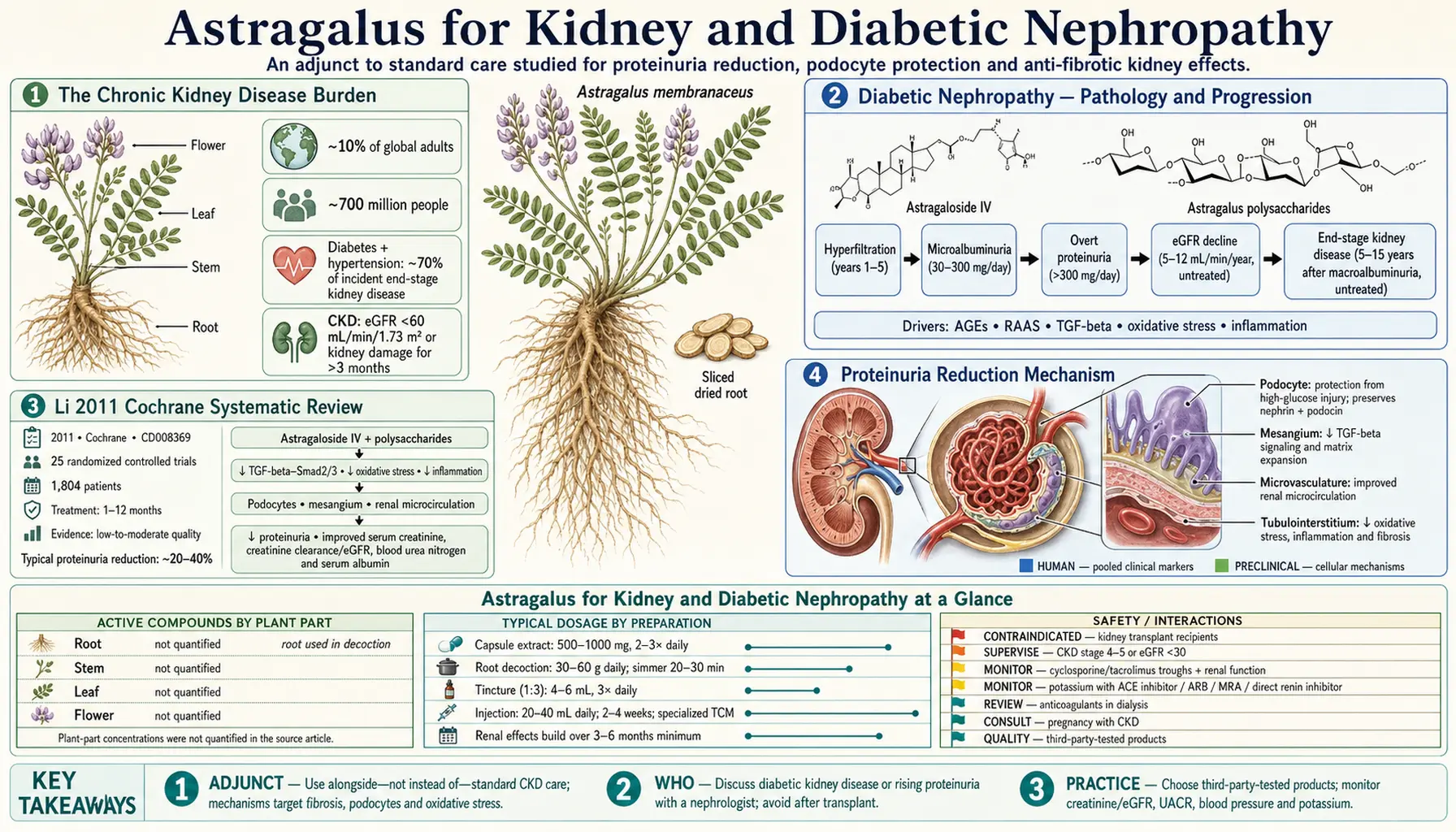
Of all the modern indications for Astragalus membranaceus, the evidence base for chronic kidney disease — and diabetic nephropathy in particular — is the strongest. Li and colleagues' 2011 Cochrane systematic review pooled 25 randomized trials of astragalus added to standard therapy for diabetic kidney disease and documented consistent reductions in proteinuria (the most clinically important kidney prognostic biomarker), improvements in serum creatinine clearance and estimated glomerular filtration rate, and protection against the progressive kidney function decline that drives diabetic patients toward dialysis. The mechanism centers on astragaloside IV's inhibition of TGF-beta-driven renal fibrosis, podocyte protection against injury, modulation of inflammatory cytokine production in kidney tissue, improvement in renal microcirculation, and reduction of oxidative stress in kidney parenchyma. The herb is also studied in IgA nephropathy, nephrotic syndrome, lupus nephritis, and chronic kidney disease of other etiologies. This deep-dive walks through the Cochrane evidence, the mechanism, the integrative-nephrology dosing guidance, and the cautions for using astragalus alongside ACE inhibitors and SGLT2 inhibitors in modern kidney disease care.
Table of Contents
- The Chronic Kidney Disease Burden
- Diabetic Nephropathy — Pathology and Progression
- Li 2011 Cochrane Systematic Review
- Proteinuria Reduction Mechanism
- TGF-beta Inhibition and Renal Fibrosis
- Podocyte Protection — The Filtration Barrier
- Broader Renoprotection Mechanisms
- IgA Nephropathy
- Nephrotic Syndrome
- Renal Ischemia-Reperfusion Injury
- Combination with ACE Inhibitors, ARBs, and SGLT2 Inhibitors
- Dosing for Renal Indications
- Cautions (Advanced CKD, Drug Interactions, Hyperkalemia)
- Key Research Papers
- Connections
- Featured Videos
The Chronic Kidney Disease Burden
Chronic kidney disease (CKD) affects approximately 10% of the global adult population — an estimated 700 million people worldwide. CKD is defined by either reduced glomerular filtration rate (eGFR less than 60 mL/min/1.73 m² for more than 3 months) or evidence of kidney damage (proteinuria, abnormal urine sediment, structural abnormalities, or biopsy findings) persisting for more than 3 months.
The two leading causes of CKD in the developed world are type 2 diabetes and hypertension, together accounting for approximately 70% of incident end-stage kidney disease cases requiring dialysis or transplantation. Other important causes include glomerulonephritis (including IgA nephropathy), polycystic kidney disease, lupus nephritis, and chronic interstitial nephritis from medication exposure.
The natural history of CKD is one of gradual eGFR decline (typically 1-5 mL/min/year in stable patients on optimal therapy, faster in poorly controlled diabetes or untreated hypertension) culminating in either death from cardiovascular disease (the most common outcome) or transition to renal replacement therapy — dialysis or kidney transplantation. The economic and human burden is enormous, and any intervention that meaningfully slows CKD progression can have substantial public health impact.
Standard CKD care emphasizes:
- Blood pressure control to target (typically less than 130/80 mmHg)
- Renin-angiotensin-aldosterone-system (RAAS) blockade with ACE inhibitors or angiotensin receptor blockers (ARBs) for any patient with proteinuria
- SGLT2 inhibitors (canagliflozin, dapagliflozin, empagliflozin) for diabetic and non-diabetic CKD — one of the most important recent additions to kidney disease therapeutics
- Glycemic control in diabetic patients
- Avoidance of nephrotoxic medications when possible (NSAIDs, IV contrast, certain antibiotics)
- Management of CKD-associated complications (anemia, bone-mineral disease, acidosis, hyperkalemia)
- Cardiovascular risk reduction (statin therapy, smoking cessation)
Astragalus enters this picture as an evidence-supported adjunctive therapy — alongside, not in place of, standard care. For more context on kidney disease, see our Kidney Disease page and the Kidney Function lab tests.
Diabetic Nephropathy — Pathology and Progression
Diabetic nephropathy — technically diabetic kidney disease — develops in approximately 30-40% of patients with type 1 or long-standing type 2 diabetes. The pathology involves a characteristic sequence of changes:
- Glomerular hyperfiltration (years 1-5 after diabetes diagnosis) — paradoxical increase in eGFR driven by efferent arteriolar constriction
- Microalbuminuria (urinary albumin 30-300 mg/day) — the earliest clinically detectable sign of glomerular injury
- Macroalbuminuria / overt proteinuria (urinary albumin >300 mg/day) — established diabetic nephropathy
- Progressive eGFR decline — typically 5-12 mL/min/year in untreated overt diabetic nephropathy
- End-stage kidney disease — requiring dialysis or transplant, typically 5-15 years after onset of macroalbuminuria in untreated patients
The underlying pathology involves glomerular basement membrane thickening, mesangial matrix expansion, podocyte injury and loss, nodular glomerulosclerosis (the pathognomonic Kimmelstiel-Wilson lesion), and progressive tubulointerstitial fibrosis. The molecular drivers include hyperglycemia-induced advanced glycation end-products (AGEs), renal RAAS activation, glomerular hypertension, increased TGF-beta signaling driving fibrosis, oxidative stress, and chronic low-grade inflammation in kidney tissue.
Modern therapy has substantially slowed the natural history. The classical IDNT (Lewis 2001) and RENAAL (Brenner 2001) trials of ARB therapy in type 2 diabetic nephropathy showed approximately 20% reduction in the composite endpoint of doubling of serum creatinine or end-stage kidney disease. The more recent CREDENCE (Perkovic 2019) and DAPA-CKD (Heerspink 2020) trials of SGLT2 inhibitors showed additional 30% reductions in similar endpoints. Astragalus has been studied as a third additive therapy on top of optimized ACE-inhibitor/ARB and increasingly with SGLT2-inhibitor backbones.
Li 2011 Cochrane Systematic Review
The 2011 Cochrane systematic review by Xinhuan Li and colleagues (Cochrane Database of Systematic Reviews, 2011, Issue 12, Article CD008369) titled "Astragalus for the treatment of type 2 diabetic nephropathy" is the most influential evidence synthesis on astragalus for kidney disease. The review pooled 25 randomized controlled trials totaling 1,804 patients with type 2 diabetic nephropathy, comparing astragalus (added to standard therapy) against standard therapy alone.
Key findings:
- Reduction in 24-hour urinary protein excretion in the astragalus arm compared to control (mean difference favoring astragalus, statistically significant across multiple subgroup analyses)
- Improvement in serum creatinine in the astragalus arm
- Improvement in creatinine clearance / eGFR
- Reduction in blood urea nitrogen
- Improvement in serum albumin (consistent with reduced protein loss)
- Most trials used the injectable form of astragalus (huang qi zhu she ye); some used oral astragalus or astragalus-containing Chinese herbal formulations
- Treatment duration in pooled trials ranged from 1 month to 12 months
The methodological limitations were significant — many included trials were small, open-label, conducted in Chinese hospital settings with non-standardized astragalus preparations, and had variable outcome definitions. The Cochrane authors appropriately graded the evidence as low-to-moderate quality. The directional effect was consistent across trials, however, and the magnitude of effect (approximately 20-40% reduction in proteinuria in treated patients) was clinically meaningful.
A 2015 updated systematic review by Zhang and colleagues, pooling additional trials published since the original Cochrane review, confirmed and strengthened the original findings. Subsequent network meta-analyses comparing different traditional Chinese medicine interventions for diabetic nephropathy have consistently identified astragalus-based formulations as among the most effective.
The clinical translation: astragalus is one of the few herbal therapies with substantial evidence for slowing diabetic nephropathy progression. Major Western nephrology guidelines have not yet incorporated astragalus, but integrative nephrologists familiar with the evidence base often recommend it as adjunctive therapy for patients who want to maximize their kidney protection beyond standard pharmaceutical therapy.
Proteinuria Reduction Mechanism
Proteinuria — the leakage of plasma proteins (most importantly albumin) into the urine — is the single most important prognostic biomarker in chronic kidney disease. Higher proteinuria predicts faster eGFR decline, higher cardiovascular mortality, and greater risk of progression to end-stage kidney disease. Reduction in proteinuria with therapy is associated with better long-term kidney outcomes — the rationale behind the standard practice of titrating ACE inhibitors and ARBs to maximum tolerated dose to achieve maximum proteinuria reduction.
The astragalus effect on proteinuria operates through multiple complementary mechanisms:
- Podocyte protection — podocytes are the specialized cells that form the glomerular filtration barrier. Astragaloside IV protects podocytes against high-glucose-induced injury and apoptosis (discussed further below).
- Reduced TGF-beta-driven mesangial expansion — mesangial matrix expansion increases intraglomerular pressure, which in turn drives more proteinuria. Astragaloside IV reduces TGF-beta signaling and mesangial expansion.
- Improved renal microcirculation — better afferent and efferent arteriolar function reduces glomerular hypertension, a key driver of progressive proteinuria.
- Antioxidant effects — reduced oxidative damage to the glomerular basement membrane preserves filtration barrier integrity.
- Possible direct effect on slit-diaphragm proteins — some preclinical studies suggest astragaloside IV preserves nephrin and podocin expression, the key proteins forming the slit diaphragm between podocyte foot processes.
The clinical magnitude of proteinuria reduction with astragalus is typically modest — on the order of 20-40% from baseline — but the effect is additive to ACE-inhibitor/ARB effects rather than overlapping, suggesting that astragalus addresses pathways the RAAS-blocker drugs do not fully control.
TGF-beta Inhibition and Renal Fibrosis
Transforming growth factor beta (TGF-beta) is the master cytokine driving chronic kidney fibrosis. TGF-beta is upregulated in diabetic kidneys, in chronically hypertensive kidneys, and in kidneys with chronic immune-mediated injury. The downstream effects include:
- Activation of resident fibroblasts and their differentiation into matrix-producing myofibroblasts
- Increased collagen and extracellular matrix protein deposition in the renal interstitium
- Epithelial-to-mesenchymal transition of tubular epithelial cells, contributing to the fibroblast pool
- Mesangial matrix expansion within glomeruli
- Progressive replacement of functional kidney tissue with non-functional scar tissue
TGF-beta is one of the most validated drug targets in nephrology, but direct TGF-beta inhibitors have so far failed in clinical trials (the FG-3019 anti-CTGF antibody and pirfenidone trials showed limited renal benefit, though pirfenidone is approved for pulmonary fibrosis). The challenge is selectively blocking TGF-beta's pathologic fibrosis-driving effects without disrupting its many other physiologic roles (immune regulation, wound healing, embryonic development).
Astragaloside IV reduces TGF-beta signaling in kidney tissue through several mechanisms:
- Reduced TGF-beta receptor expression on renal cells
- Inhibition of TGF-beta-induced Smad2/Smad3 phosphorylation (the downstream signaling cascade)
- Reduced expression of connective tissue growth factor (CTGF), a downstream TGF-beta effector
- Reduced expression of matrix-producing genes (collagen type I, fibronectin, tissue inhibitors of metalloproteinase)
- Inhibition of epithelial-to-mesenchymal transition in tubular cells
The net effect in animal kidney disease models is reduced interstitial fibrosis, reduced glomerular sclerosis, and slower progression of structural kidney damage. The translation to humans is supported by the proteinuria and eGFR improvements documented in the Li meta-analysis and subsequent reviews.
Podocyte Protection — The Filtration Barrier
Podocytes are highly specialized epithelial cells that wrap around the glomerular capillaries and form the final layer of the glomerular filtration barrier. Their interdigitating foot processes are connected by "slit diaphragms" — specialized intercellular junctions composed of nephrin, podocin, CD2-associated protein, and other proteins — that form the molecular size-selective filter that prevents albumin and larger proteins from entering the urine.
Podocyte injury is central to the pathology of multiple kidney diseases including diabetic nephropathy, focal segmental glomerulosclerosis, membranous nephropathy, and minimal change disease. Once injured, podocytes can detach from the glomerular basement membrane and are lost in the urine — and because mature podocytes have very limited proliferative capacity, podocyte loss is largely irreversible. Below a critical threshold of podocyte density, progressive glomerulosclerosis becomes inevitable.
Multiple preclinical studies have documented podocyte-protective effects of astragalus and astragaloside IV:
- Reduced high-glucose-induced podocyte apoptosis in cultured podocyte cell lines
- Preserved nephrin and podocin expression in diabetic animal kidney specimens
- Reduced podocyte foot process effacement on electron microscopy
- Maintained autophagy function in podocytes (autophagy is a key mechanism of podocyte stress tolerance)
- Reduced podocyte detachment as measured by urinary podocyte count
The clinical correlate is the proteinuria reduction discussed above. Patients with active podocyte injury (manifest as new or increasing proteinuria) may be the subgroup most likely to benefit from astragalus addition to their regimen.
Broader Renoprotection Mechanisms
Beyond the podocyte-protection and TGF-beta-inhibition pathways, astragalus exerts several other kidney-protective effects:
- Antioxidant action in kidney tissue — reduced lipid peroxidation, increased renal SOD and catalase activity, increased glutathione content. Oxidative stress is a major driver of progressive kidney damage in diabetes and hypertension.
- Anti-inflammatory effect — reduced TNF-alpha, IL-1-beta, IL-6, and monocyte chemoattractant protein-1 expression in kidney tissue. Chronic low-grade inflammation drives progressive nephron loss.
- Improved renal microcirculation — endothelial nitric oxide synthase upregulation in the renal vasculature improves intrarenal blood flow and reduces local ischemic injury.
- Mesangial cell protection — reduced mesangial matrix expansion (the cellular basis of diabetic glomerulosclerosis).
- Modulation of advanced glycation end-product (AGE) formation — reduced AGE accumulation in kidney tissue and reduced expression of the AGE receptor RAGE.
- Improved renal autophagy — preserved autophagy in tubular epithelial cells, important for clearance of damaged organelles and stress tolerance.
The collective effect is a multi-pathway kidney-protective profile that complements (rather than overlaps with) the mechanisms of standard pharmaceutical therapy. RAAS blockers reduce intraglomerular pressure; SGLT2 inhibitors reduce hyperfiltration and provide metabolic benefits; astragalus addresses fibrosis, podocyte injury, microcirculation, and oxidative stress. The additive nature of these effects is the rationale for combination therapy.
IgA Nephropathy
IgA nephropathy (Berger's disease) is the most common primary glomerulonephritis worldwide and one of the leading causes of end-stage kidney disease in young adults. The pathology involves mesangial deposition of IgA1-containing immune complexes, mesangial proliferation, complement activation, and progressive glomerular and tubulointerstitial injury. Standard therapy includes RAAS blockade for proteinuria reduction, fish oil for its anti-inflammatory effect (modest evidence base), and immunosuppression (corticosteroids, mycophenolate, or cyclophosphamide) in patients with severe or progressive disease.
Astragalus has been studied in IgA nephropathy in several Chinese trials, with findings suggesting:
- Reduced proteinuria comparable to the effect seen in diabetic nephropathy
- Reduced hematuria (microscopic blood in urine, a hallmark of IgA nephropathy activity)
- Slowed eGFR decline in long-term follow-up
- Possible reduction in serum IgA levels (though the clinical relevance of this is uncertain)
The mechanism appears to overlap with the diabetic-nephropathy mechanism (podocyte protection, anti-fibrotic, antioxidant) plus possible direct effects on the immune-complex deposition process. The evidence base is smaller than for diabetic nephropathy — IgA nephropathy is less common, and most of the published trials are small and from single Chinese centers — but the directional consistency with the diabetic-nephropathy data and the favorable safety profile justify cautious clinical use as an adjunct to standard therapy.
Nephrotic Syndrome
Nephrotic syndrome is the clinical pattern of heavy proteinuria (more than 3.5 g/day), hypoalbuminemia, edema, and hyperlipidemia, caused by any condition that produces severe glomerular injury — including minimal change disease, focal segmental glomerulosclerosis (FSGS), membranous nephropathy, diabetic nephropathy in advanced stage, and amyloidosis. Standard therapy depends on the underlying etiology and typically includes RAAS blockade, immunosuppression (corticosteroids in minimal change and many secondary causes; cyclosporine, tacrolimus, rituximab, or mycophenolate for refractory cases), and supportive care for edema and hyperlipidemia.
Astragalus has been studied as adjunctive therapy in nephrotic syndrome, particularly in cases that are poorly responsive to or relapsing on standard immunosuppression. The available evidence suggests:
- Reduction in proteinuria when added to standard therapy
- Possible steroid-sparing effect (reduced corticosteroid dose required to maintain remission)
- Improvement in serum albumin
- Reduced edema severity
The mechanism includes the podocyte-protective effect (particularly relevant in minimal change and FSGS where podocyte injury is central), plus the immune-modulating effects of astragalus polysaccharides that may help control the underlying immune dysregulation in idiopathic nephrotic syndromes. As with other immune-mediated kidney diseases, astragalus should be considered an adjunct rather than a substitute for standard immunosuppression, and decisions should involve the treating nephrologist.
Renal Ischemia-Reperfusion Injury
Acute kidney injury (AKI) from renal ischemia-reperfusion is a common clinical problem — it occurs after cardiac surgery with cardiopulmonary bypass, after kidney transplantation (the donor kidney experiences ischemia during procurement and storage and then reperfusion in the recipient), during shock states, and after IV contrast exposure in vulnerable patients. AKI doubles short-term mortality risk and substantially accelerates progression to chronic kidney disease.
Astragaloside IV has been studied extensively in animal renal ischemia-reperfusion models with consistent findings of:
- Reduced post-ischemia serum creatinine elevation
- Reduced tubular necrosis on histology
- Preserved mitochondrial function in renal tubular cells
- Reduced apoptosis markers in injured kidney tissue
- Reduced inflammatory cell infiltration
- Reduced expression of injury markers (KIM-1, NGAL)
Clinical translation to humans is preliminary — small trials of perioperative astragalus during cardiac surgery have suggested reduced post-operative AKI incidence, but the evidence is not yet sufficient for routine clinical adoption. In kidney transplantation, astragalus is sometimes used in Chinese practice as part of perioperative regimens to support graft function recovery, though Western transplant programs generally do not incorporate herbal therapy due to the complex immunosuppression and rejection management issues.
Combination with ACE Inhibitors, ARBs, and SGLT2 Inhibitors
Modern diabetic kidney disease care is built on a foundation of ACE inhibitors or ARBs for proteinuria reduction, plus SGLT2 inhibitors for additional kidney protection and cardiovascular risk reduction. Astragalus has been studied in combination with these agents in multiple trials.
The combination ACE-inhibitor (or ARB) plus astragalus has consistently shown additive benefit in proteinuria reduction compared to ACE-inhibitor alone in diabetic nephropathy trials. The mechanism is mechanistically complementary: ACE inhibitors reduce intraglomerular pressure through efferent arteriolar dilation, while astragalus addresses the fibrosis, podocyte injury, and oxidative stress mechanisms not directly affected by RAAS blockade. The combination is generally well-tolerated, with no documented adverse interactions.
The combination with SGLT2 inhibitors has been less extensively studied because SGLT2 inhibitors are a newer addition to kidney disease therapy (CREDENCE published in 2019, DAPA-CKD in 2020). On mechanistic grounds the combination should be additive — SGLT2 inhibitors reduce hyperfiltration through tubuloglomerular feedback and provide metabolic benefits, while astragalus addresses parallel fibrosis and inflammatory pathways. Initial small trials of the combination have supported additive benefit. The combination is recommended over either alone for patients seeking maximum kidney protection.
Patients on these combinations should be monitored for the expected effects of each agent: blood pressure with the ACE inhibitor or ARB, glucose and ketones with the SGLT2 inhibitor, kidney function and potassium with both, and proteinuria as the integrated efficacy biomarker. Astragalus does not change the laboratory monitoring requirements but adds an additional therapeutic agent to the regimen.
Dosing for Renal Indications
- Standardized capsule extract (renal indication) — 500-1000 mg of an extract standardized to either polysaccharide content (40%) or astragaloside IV content (0.3-1.0%), two to three times daily with meals. Both fractions appear to contribute to renal benefit.
- Sliced root decoction — 30-60 g of dried root daily, simmered in water for 20-30 minutes. The higher end of this range is used in classical Chinese renal-tonic prescriptions and is typical of doses studied in the Li 2011 meta-analysis trials.
- Tincture (1:3) — 4-6 mL three times daily
- Astragalus injection (huang qi zhu she ye) — the form used in the majority of Chinese diabetic nephropathy trials. Not generally available outside specialized TCM clinical settings. IV doses in trials have ranged from 20-40 mL daily for 2-4 weeks at a time, often repeated as cycles.
- Course duration — renal effects build over 3-6 months minimum. Many integrative nephrologists recommend long-term continuous use given the chronic progressive nature of CKD.
- Monitoring — serum creatinine and eGFR every 3-6 months, urinary albumin-to-creatinine ratio (UACR) every 3-6 months, blood pressure at all clinic visits, potassium and bicarbonate every 6-12 months. Astragalus does not change the standard kidney disease monitoring schedule.
Cautions (Advanced CKD, Drug Interactions, Hyperkalemia)
- Advanced CKD (stage 4-5) — patients with eGFR less than 30 mL/min should use astragalus only under nephrology supervision. Theoretical concerns about herbal product purity (potential nephrotoxic contaminants), drug accumulation due to reduced clearance, and unclear effects on potassium balance warrant caution in advanced disease.
- Kidney transplant recipients — astragalus is contraindicated in solid-organ transplant patients due to immunosuppression interaction risk and potential rejection.
- Cyclosporine and tacrolimus interactions — both calcineurin-inhibitor immunosuppressants are nephrotoxic at high blood levels and metabolized by CYP3A4. Astragalus may modulate CYP3A4 activity (in vitro evidence is mixed); combined use should be monitored with attention to trough levels and renal function.
- Combined hyperkalemia risk — ACE inhibitors, ARBs, mineralocorticoid receptor antagonists (spironolactone, eplerenone), and direct renin inhibitors all increase serum potassium. While astragalus itself does not strongly affect potassium, the patients on this combination of therapies should have potassium monitored, with astragalus addition not changing that requirement.
- Anticoagulants in dialysis patients — dialysis patients often receive heparin during sessions and may be on warfarin or DOACs for atrial fibrillation. Combine with astragalus only after pharmacy review for the antiplatelet interaction.
- Pregnancy with kidney disease — insufficient safety data; pregnant patients with chronic kidney disease should not start astragalus without high-risk obstetrics and nephrology consultation.
- Herbal product quality — chronic kidney disease patients are vulnerable to nephrotoxic contaminants in poorly regulated herbal products. Use only third-party tested astragalus products from reputable manufacturers, and avoid imported herbal mixtures of uncertain composition.
- Aristolochic acid contamination — the cautionary tale here is the historical aristolochic acid nephropathy outbreak from contaminated Chinese herbal weight-loss products in the 1990s. Pure single-herb astragalus has not been associated with aristolochic acid contamination, but caution and quality verification remain essential.
- Acute kidney injury or rapidly progressive glomerulonephritis — these are urgent nephrology conditions requiring immediate conventional evaluation and treatment. Astragalus is not appropriate as primary therapy for acute kidney conditions.
Key Research Papers
- Li X et al. (2011). Astragalus for the treatment of type 2 diabetic nephropathy: a Cochrane systematic review. Cochrane Database of Systematic Reviews, Article CD008369. — PubMed
- Zhang HW et al. (2014). Astragalus (a traditional Chinese medicine) for treating chronic kidney disease. Cochrane Database of Systematic Reviews. — PubMed
- Wang J et al. (2017). Astragaloside IV ameliorates diabetes-induced renal tubular epithelial-mesenchymal transition. Cellular Physiology and Biochemistry. — PubMed
- Lin J et al. (2018). Mechanism of astragaloside IV in protecting against diabetic kidney disease through inhibition of TGF-beta1/Smad signaling. Journal of Diabetes Research. — PubMed
- Sun H et al. (2014). Effect of astragaloside IV on podocyte apoptosis induced by high glucose. Journal of Ethnopharmacology. — PubMed
- Ahmed MS et al. (2007). Astragaloside IV inhibits non-enzymatic glycation in collagen IV. European Journal of Pharmacology. — PubMed
- Zhou X et al. (2017). Astragalus polysaccharides exert anti-inflammatory and renoprotective effects in diabetic kidney disease. International Immunopharmacology. — PubMed
- Liu W et al. (2014). Astragaloside IV ameliorates renal injury in diabetic rats by inhibiting oxidative stress. Diabetes Research and Clinical Practice. — PubMed
- Su Y et al. (2017). Effect of astragalus injection added to ACE-inhibitor on diabetic nephropathy: meta-analysis. Evidence-Based Complementary and Alternative Medicine. — PubMed
- Brenner BM et al. (2001). Effects of losartan on renal and cardiovascular outcomes in patients with type 2 diabetes and nephropathy (RENAAL). NEJM. — PubMed
- Perkovic V et al. (2019). Canagliflozin and renal outcomes in type 2 diabetes and nephropathy (CREDENCE). NEJM. — PubMed
- Heerspink HJL et al. (2020). Dapagliflozin in patients with chronic kidney disease (DAPA-CKD). NEJM. — PubMed
PubMed Topic Searches
- PubMed: Astragalus diabetic nephropathy
- PubMed: AS-IV TGF-beta kidney fibrosis
- PubMed: AS-IV podocyte protection
- PubMed: Astragalus IgA nephropathy
- PubMed: Astragalus CKD and eGFR
Connections
- All Herbs
- Astragalus Overview
- Astragalus Benefits Hub
- Astragalus for Immune Function
- Astragalus for Cardiovascular Health
- Astragalus for Anti-Aging
- Kidney Disease
- Kidney Function Tests
- Type 2 Diabetes
- HbA1c
- Berberine
- Stinging Nettle
- Turmeric
- Omega-3 Fatty Acids
- Vitamin D3
- Magnesium
- Potassium
- Oxidative Stress
- Cardiovascular Disease
- Diabetic Nephropathy — the disease this page's Cochrane evidence base and astragaloside IV mechanisms are aimed at slowing.