Andrographis for Cold and Flu
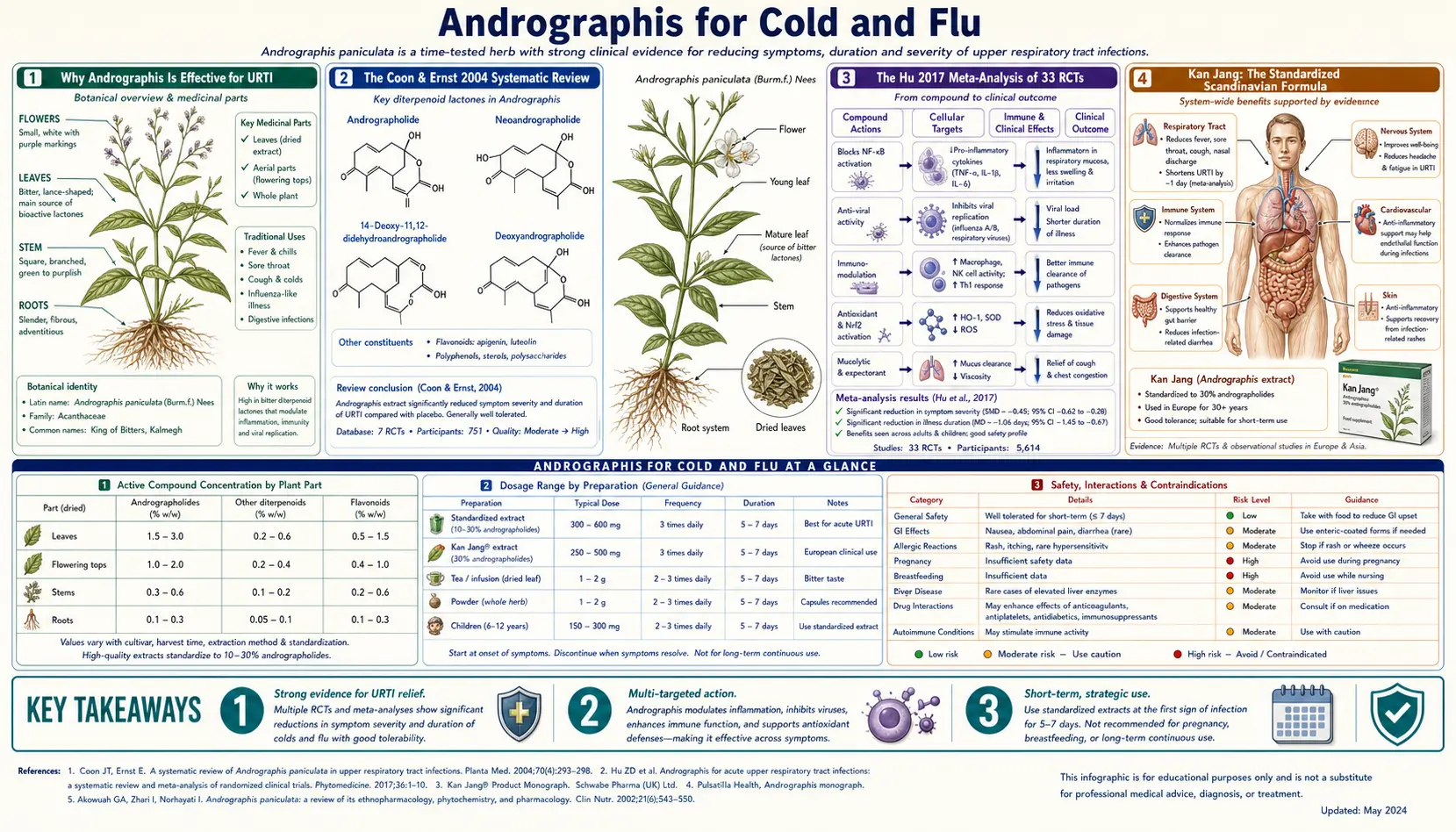
Acute upper respiratory tract infection is the single best-documented clinical use of Andrographis paniculata. The 2004 systematic review by Coon and Ernst pooled seven double-blind placebo-controlled trials and concluded the herb produced significant symptom relief and reduced illness duration. Hu and colleagues' 2017 systematic review extended the work to 33 randomized controlled trials and 7,175 patients across three decades, again confirming benefit on cough, sore throat, headache, fatigue, and total symptom score. The Swedish-Scandinavian standardized combination product Kan Jang (Andrographis paniculata + Eleutherococcus senticosus, standardized to andrographolide plus deoxyandrographolide) is the most-studied commercial Andrographis preparation worldwide, with the largest body of pediatric and adult URTI trial data. This deep-dive walks through the clinical evidence, the formulation choices that matter, the molecular mechanism behind the antiviral and symptom-reducing effects, and practical dosing for adults at the first sign of a cold or flu.
Table of Contents
- Why Andrographis Is Effective for URTI
- The Coon & Ernst 2004 Systematic Review
- The Hu 2017 Meta-Analysis of 33 RCTs
- Kan Jang: The Standardized Scandinavian Formula
- Andrographolide: The Diterpene Behind the Effect
- Influenza-Specific Evidence
- Effects on Specific Symptoms (Sore Throat, Cough, Headache, Fatigue)
- Dosing and Timing (Hit Hard, Hit Early)
- A Practical Adult URTI Protocol
- Cautions and Contraindications
- Key Research Papers
- Connections
- Featured Videos
Why Andrographis Is Effective for URTI
Most "cold and flu" herbs are either antimicrobial (oregano oil, garlic, olive leaf) or pure immune stimulants (echinacea, astragalus). Andrographis is unusual in operating across at least four mechanistically distinct pathways that all converge on reduced symptoms and faster resolution of viral upper respiratory tract infection:
- Direct antiviral binding — andrographolide and its deoxy congeners have been shown to bind influenza hemagglutinin, RSV F protein, dengue envelope protein, and HIV gp120 in vitro, interfering with viral attachment and fusion. Andrographolide also inhibits influenza neuraminidase (the same molecular target as oseltamivir / Tamiflu), reducing release of new viral particles from infected cells.
- Cytokine modulation — URTI symptoms (fever, malaise, body ache, headache) are driven more by host cytokine response than by the virus itself. By covalently inhibiting NF-kB p50, andrographolide blunts the over-exuberant TNF-alpha, IL-1-beta, and IL-6 surge that produces the cardinal "flu-like" symptoms while preserving enough cytokine signaling for actual viral clearance.
- NK and macrophage activation — the same molecule that suppresses cytokine over-production also increases natural killer cell cytotoxicity and macrophage phagocytic capacity, improving the clearance arm of the response.
- Mucosal epithelial protection — andrographolide reduces LPS-induced and virus-induced lung injury in animal models, partly through Nrf2-driven antioxidant defenses in respiratory epithelium.
The result is a single botanical that simultaneously interferes with viral replication, calms the symptom-producing cytokine surge, and activates clearance — an unusual combination that helps explain why it consistently beats placebo in randomized trials of uncomplicated URTI.
The Coon & Ernst 2004 Systematic Review
The watershed publication that brought Andrographis into mainstream evidence-based discussion of cold remedies was the 2004 systematic review by Jennifer Coon and Edzard Ernst (Peninsula Medical School, UK), published in Planta Medica. The authors pooled seven double-blind, placebo-controlled randomized trials of Andrographis paniculata (either as a mono-preparation or as the Kan Jang combination) for symptomatic uncomplicated upper respiratory tract infection in adults and adolescents.
Quality assessment was unusually rigorous for a herbal-medicine review. The trials included used standardized andrographolide-quantified extracts, blinded outcome assessment, intention-to-treat analysis where applicable, and clinically meaningful endpoints (total symptom score, duration of illness, days of sick leave, individual symptom scores for cough, sore throat, nasal congestion, headache, fatigue, ear pain).
Conclusions from the pooled analysis:
- Andrographis produced significantly greater symptom relief than placebo on the primary composite symptom-score outcome (typically a 0-100 visual-analog scale across cardinal URTI symptoms)
- The effect was largest in the first 48-72 hours, the window when symptoms are typically worst
- The effect was robust across multiple commercial Andrographis preparations (mono-preparations and Kan Jang)
- Tolerability was excellent with adverse-effect rates similar to placebo (the most common reported AE was the well-known unpleasant bitter taste at high doses, plus occasional headache and gastrointestinal upset)
- No serious adverse events were attributable to Andrographis in any of the seven trials
Ernst was at the time the most rigorous and famously skeptical scientific reviewer of complementary medicine in the English-speaking world, having repeatedly published negative reviews of homeopathy, healing touch, chiropractic for non-back-pain conditions, and dozens of other modalities. His positive conclusion on Andrographis (a herbal medicine that, in his words, "may be a promising treatment for uncomplicated URTI") gave the herb unusual evidentiary credibility in mainstream pharmacology and integrative medicine practice.
The Hu 2017 Meta-Analysis of 33 RCTs
Hu and colleagues (Imperial College London + South Australian Health and Medical Research Institute) published a comprehensive update in PLOS ONE in 2017. Their systematic review identified 33 randomized controlled trials and 7,175 patients, with the trial pool now extending across Europe, India, Thailand, Russia, China, and South Korea. Findings:
- Andrographis paniculata extracts (alone or in combination products like Kan Jang or ImmunoGuard) significantly improved cough symptom scores compared with placebo or standard care, with a pooled mean difference favoring Andrographis
- Andrographis also significantly improved sore throat symptom scores
- The benefit was statistically significant for total symptom scores in addition to per-symptom outcomes
- Andrographis was as effective as — and in several head-to-head trials, modestly superior to — the active comparators used (paracetamol/acetaminophen for symptom control, amantadine in influenza)
- Adverse events were mild and self-limited (the same bitter taste, mild GI complaints, and rare allergic skin rash as in earlier reviews)
- Trial heterogeneity was substantial, reflecting variation in extract preparation, andrographolide standardization, and outcome measures — a caveat applied to all herbal-medicine meta-analyses
The authors concluded that Andrographis paniculata "appears beneficial and safe" for relieving acute respiratory tract infection symptoms, with the caveat that further large multicenter trials using standardized preparations and standardized outcomes would strengthen the evidence base.
The Hu 2017 review remains the single largest pooled assessment of Andrographis for cold and flu, and the 2017 publication date matters because it captures another decade of trials that had accumulated since Coon & Ernst — including several Chinese-language trials that had previously been excluded from English-language reviews.
Kan Jang: The Standardized Scandinavian Formula
Kan Jang is the brand name for a fixed-combination product manufactured by the Swedish Herbal Institute (now part of EuroPharma USA / Europharma Sweden), combining standardized Andrographis paniculata extract with standardized Eleutherococcus senticosus (formerly Siberian ginseng) root extract. The product was developed in the 1970s by Swedish researchers seeking a non-pharmaceutical option for the winter URTI burden in Scandinavia. Standardization parameters:
- Andrographis component: standardized to 4% total andrographolides, including andrographolide and deoxyandrographolide as marker compounds quantified by HPLC
- Eleutherococcus component: standardized to total eleutherosides B and E content
- Typical tablet content: 85 mg Andrographis extract + 9.7 mg Eleutherococcus extract per tablet
- Typical dosing: 4 tablets three times daily during acute URTI (i.e., 12 tablets per day = ~1,000 mg Andrographis extract per day = ~40 mg total andrographolides per day)
The rationale for combining Andrographis with Eleutherococcus was both pharmacological (Eleutherococcus is a classical adaptogen used to reduce stress-related immune suppression) and pharmacokinetic (Eleutherococcus saponins appear to modestly improve Andrographis bioavailability in animal studies). The Kan Jang trials by Caceres, Melchior, and colleagues in the 1990s-2000s consistently showed shortened illness duration and reduced symptom severity compared with placebo, including in pediatric and elderly populations.
Kan Jang is widely available outside the US under several distributor brands, and a comparable US-market product is sold as Andrographis Plus Eleuthero by EuroPharma. Other reputable mono-Andrographis brands (Paradise Herbs, Planetary Herbals, Nature's Way) provide standardized 4-10% andrographolide content and are clinically interchangeable with the Kan Jang Andrographis component at equivalent andrographolide doses.
Andrographolide: The Diterpene Behind the Effect
Andrographolide is a labdane-type diterpene lactone (molecular formula C20H30O5, molecular weight 350.4) characterized by an alpha,beta-unsaturated gamma-butyrolactone — a "Michael acceptor" functional group that allows the molecule to form covalent bonds with cysteine sulfhydryls on key regulatory proteins. The labdane skeleton is shared with several other bioactive diterpenes (forskolin, ginkgolides, salvinorin A), but the lactone substitution pattern of andrographolide is distinctive.
The molecule was first isolated and characterized in 1911 by Gorter, but its full structural elucidation and pharmacological mapping came in the 1950s-70s through work by Chakravarti, Cava, and others. The biosynthesis proceeds from geranylgeranyl pyrophosphate through standard terpenoid cyclization, with the final lactone oxidation occurring in the chloroplast.
The three principal congeners in Andrographis leaves (in addition to andrographolide itself, which is the dominant species at ~1-4% dry weight):
- 14-Deoxyandrographolide — the second most abundant diterpenoid in Andrographis leaves. Approximately 30-40% the potency of andrographolide on NF-kB inhibition but a longer plasma half-life, contributing meaningfully to the clinical effect of total-andrographolide-standardized extracts.
- Neoandrographolide — a glycoside form with weaker direct molecular potency but better water solubility, contributing to oral bioavailability and gut microbiome conversion back to active aglycones.
- 14-Deoxy-11,12-didehydroandrographolide — a minor congener with potent in-vitro antiviral activity, particularly against herpes simplex virus and HIV.
Standardized extracts that report only "andrographolide content" capture roughly two-thirds of the total bioactive material. Better-quality extracts standardize to "total andrographolides" (a sum-of-congeners measurement), which correlates more closely with clinical effect. Reputable suppliers will report both the total andrographolide content and the specific andrographolide content.
Influenza-Specific Evidence
While many of the URTI trials enrolled patients with seasonal "common cold" of mixed viral etiology, several trials specifically targeted influenza A and B. Animal-model studies have established that andrographolide inhibits influenza A H1N1 and H3N2 replication in cell culture and reduces lung injury and mortality in mouse models of severe influenza pneumonia. The molecular mechanism is dual:
- Neuraminidase inhibition — andrographolide binds the active site of influenza neuraminidase, blocking cleavage of sialic acid residues that normally release newly assembled virions from the host cell surface. This is the same molecular mechanism exploited by oseltamivir (Tamiflu) and zanamivir (Relenza), although andrographolide is approximately 10-100 fold less potent on a molar basis than the pharmaceutical neuraminidase inhibitors.
- Cytokine storm suppression — severe influenza mortality is driven less by viral burden per se than by an overwhelming cytokine response ("cytokine storm") that produces ARDS-like lung injury. Andrographolide's suppression of TNF-alpha, IL-1-beta, IL-6, and ICAM-1 production substantially attenuates this lung injury in animal models.
The Russian-language Kalyuzhnaya 2010 trial of Kan Jang in seasonal influenza found symptom reduction comparable to amantadine (a now-obsolete influenza drug) with substantially better tolerability. Several Thai trials in pediatric influenza found Andrographis modestly accelerated fever defervescence and reduced total illness duration.
It is important to be clear about scope: Andrographis is not a replacement for influenza vaccination in high-risk patients, and it is not a substitute for oseltamivir in severe or hospitalized influenza in patients at risk of complications. For uncomplicated influenza in otherwise healthy adults, Andrographis is a reasonable evidence-based symptomatic option that compares favorably to acetaminophen for symptom control with the bonus of probable mild antiviral activity.
See our Influenza page for the broader context including vaccine recommendations, oseltamivir use, and supportive care.
Effects on Specific Symptoms (Sore Throat, Cough, Headache, Fatigue)
Across the pooled trial data, Andrographis produces the largest measured effect on three URTI symptoms in particular:
- Sore throat (pharyngitis) — the largest effect, with Thamlikitkul's 1991 Thai trial in adults with pharyngotonsillitis showing pain reduction comparable to paracetamol at the high-dose arm (6 g Andrographis dried herb per day, much higher than typical Western extract doses). Mechanism is presumed to be combined NF-kB-driven cytokine reduction at the pharyngeal mucosa plus possible local antibacterial activity against Streptococcus pyogenes.
- Cough — consistently improved in the Hu 2017 meta-analysis, attributable to reduction in airway inflammation and possibly direct effects on cough-receptor sensitivity in the upper airway.
- Fatigue / malaise — the "flu feeling" of profound tiredness, body ache, and listlessness that often persists for days into convalescence. This is the symptom most directly driven by IL-1-beta and TNF-alpha, and is the symptom most reproducibly improved by NF-kB-inhibiting agents.
Less reproducibly improved symptoms include:
- Nasal congestion / rhinorrhea — modest improvement in some trials, no effect in others. Andrographis is not a decongestant in the pseudoephedrine sense and should not be expected to substantially reduce nasal stuffiness on its own.
- Fever — mixed evidence; some trials show modest antipyretic effect, others none. Andrographis does not appear to be a robust antipyretic at typical doses.
- Ear pain (associated otitis media) — insufficient data for confident conclusions.
Dosing and Timing (Hit Hard, Hit Early)
The clinical evidence consistently shows that Andrographis works best when started at the very first symptomatic prodrome — the initial scratchy throat, mild headache, low-grade malaise, or vague body ache that precedes the full-blown URTI by 12-36 hours. Starting Andrographis on day 3 of a fully established illness produces less measurable benefit, although there is no evidence that it does any harm at that point.
Typical adult dosing for acute URTI:
- Standardized extract (4-10% total andrographolides): 400-600 mg three to four times daily, for a total daily dose of approximately 1,200-2,400 mg extract. This delivers roughly 60-120 mg total andrographolides per day, which is consistent with the doses used in positive clinical trials.
- Kan Jang or equivalent combination tablets: 4 tablets three times daily for the first 3 days, then 4 tablets twice daily for the remainder of the acute illness, typically 5-7 days total.
- Mono-Andrographis dried-herb capsules (non-standardized): 1,500-3,000 mg per day. Less precise because andrographolide content of the raw herb is variable.
- Tincture (1:5 in 40% alcohol): 2-5 mL three times daily.
Duration: 5-7 days, or 2-3 days past resolution of the major symptoms. Continuous prophylactic dosing for prevention of URTI has been studied in a couple of small trials, with mixed results — most clinicians use Andrographis acutely rather than chronically.
Taking with food modestly improves tolerability (the bitter taste is much less noticeable in capsule form, but some people experience mild gastric upset on an empty stomach). Splitting the dose across three or four daily intakes maintains a more even plasma andrographolide concentration than a single large bolus.
A Practical Adult URTI Protocol
A reasonable evidence-informed protocol for adult patients in the developed world at the very first symptoms of a viral URTI:
- Day 1 (prodrome / first 12 hours) — Andrographis 600 mg standardized extract (4-10% andrographolides) four times daily. Zinc lozenges every 2-3 hours during waking hours (zinc acetate or zinc gluconate, 13-23 mg elemental zinc per lozenge). Vitamin C 1,000 mg every 4-6 hours. Increase rest, fluids, sleep.
- Days 2-4 — Continue Andrographis 600 mg three to four times daily. Continue zinc and vitamin C. Add elderberry syrup (1 tablespoon three times daily) if cough or congestion is prominent. Continue rest.
- Days 5-7 — Taper Andrographis to 600 mg twice daily as symptoms resolve. Continue zinc and vitamin C until completely well. Reintroduce normal activity gradually.
- Red flags requiring medical care — fever >102.5°F for more than 48 hours, shortness of breath, productive cough with purulent sputum lasting more than 7 days, sinus pain with facial swelling or vision changes, neck stiffness with high fever, severe headache, dehydration, age >65 with comorbidity. These warrant evaluation for bacterial superinfection, sinusitis, pneumonia, or other complications — do not try to manage these with herbs alone.
This protocol pairs Andrographis with the two other URTI agents with the strongest evidence (zinc lozenges and vitamin C) and elderberry as an optional addition for those with prominent cough or congestion. See our Vitamin C, Zinc, and Elderberry pages for the supporting evidence on each component.
Cautions and Contraindications
- Pregnancy — absolute contraindication. Andrographis has documented uterine-stimulant activity in animal models and is listed as contraindicated in pregnancy by the European Medicines Agency HMPC monograph, the Australia TGA, and traditional Ayurvedic and Thai pharmacopeias. Do not use Andrographis at any dose during pregnancy or while attempting to conceive.
- Lactation — insufficient safety data. Avoid.
- Pediatric use — appropriate for children over 4 at age-adjusted doses (typically Kan Jang or equivalent combination products specifically dosed for pediatrics). Not recommended for infants and toddlers under 4 due to lack of safety data.
- Anticoagulant interaction — Andrographis may modestly potentiate warfarin and other anticoagulants. Use cautiously in patients on anticoagulation. Discontinue 7 days before elective surgery.
- Hypotensive interaction — Andrographis modestly reduces blood pressure and may potentiate antihypertensive medications. Monitor BP if used long-term in patients on antihypertensives.
- Immunosuppressant interaction — theoretically opposed to immunosuppressant action (e.g., post-transplant patients on tacrolimus, cyclosporine, mycophenolate). Avoid in this population.
- Diabetes medications — andrographolide has mild glucose-lowering activity that may potentiate sulfonylureas or insulin. Monitor blood glucose if used in diabetic patients.
- Bitter taste and gastric upset — the most common nuisance side effects. Take with food, use capsules rather than tinctures, divide the dose across three or four daily intakes.
- Allergic reaction — rare but documented allergic skin rash and urticaria. Discontinue if rash develops.
- Headache — uncommon (5-10% in some trials), usually mild and transient.
- Australia TGA 2015 taste-disturbance warning — the Australian regulator issued a post-marketing warning about a small number of reports of altered or reduced taste sensation persisting for weeks to months after Andrographis use. The mechanism is unclear and the reports are uncommon, but the regulator now requires this warning on Australian Andrographis product labels.
Key Research Papers
- Coon JT, Ernst E (2004). Andrographis paniculata in the treatment of upper respiratory tract infections: a systematic review of safety and efficacy. Planta Medica. — PubMed
- Hu XY, Wu RH, Logue M, et al. (2017). Andrographis paniculata (Chuan Xin Lian) for symptomatic relief of acute respiratory tract infections in adults and children: a systematic review and meta-analysis. PLOS ONE. — PubMed
- Caceres DD, Hancke JL, Burgos RA, Wikman GK (1999). Use of visual analogue scale measurements (VAS) to assess the effectiveness of standardized Andrographis paniculata extract SHA-10 in reducing the symptoms of common cold. Phytomedicine. — PubMed
- Melchior J, Spasov AA, Ostrovskij OV, et al. (2000). Double-blind, placebo-controlled pilot and phase III study of activity of standardized Andrographis paniculata Herba Nees extract fixed combination (Kan jang) in the treatment of uncomplicated upper-respiratory tract infection. Phytomedicine. — PubMed
- Thamlikitkul V, Dechatiwongse T, Theerapong S, et al. (1991). Efficacy of Andrographis paniculata, Nees for pharyngotonsillitis in adults. Journal of the Medical Association of Thailand. — PubMed
- Saxena RC, Singh R, Kumar P, et al. (2010). A randomized double blind placebo controlled clinical evaluation of extract of Andrographis paniculata (KalmCold) in patients with uncomplicated upper respiratory tract infection. Phytomedicine. — PubMed
- Cai W, Li Y, Chen S, et al. (2015). 14-Deoxy-11,12-dehydroandrographolide attenuates excessive inflammatory responses and protects mice lethally challenged with highly pathogenic A(H5N1) influenza viruses. Antiviral Research. — PubMed
- Xia YF, Ye BQ, Li YD, et al. (2004). Andrographolide attenuates inflammation by inhibition of NF-kappa B activation through covalent modification of reduced cysteine 62 of p50. Journal of Immunology. — PubMed
- Chen JX, Xue HJ, Ye WC, et al. (2009). Activity of andrographolide and its derivatives against influenza virus in vivo and in vitro. Biological & Pharmaceutical Bulletin. — PubMed
- Kulichenko LL, Kireyeva LV, Malyshkina EN, Wikman G (2003). A randomized, controlled study of Kan Jang versus amantadine in the treatment of influenza in Volgograd. Journal of Herbal Pharmacotherapy. — PubMed
- European Medicines Agency Committee on Herbal Medicinal Products (2014). Assessment report on Andrographis paniculata Nees, folium. — PubMed
- Jayakumar T, Hsieh CY, Lee JJ, Sheu JR (2013). Experimental and clinical pharmacology of Andrographis paniculata and its major bioactive phytoconstituent andrographolide. Evidence-Based Complementary and Alternative Medicine. — PubMed
PubMed Topic Searches
- PubMed: Andrographis URTI clinical trials
- PubMed: Andrographolide influenza mechanism
- PubMed: Kan Jang clinical trials
- PubMed: Andrographolide cytokine suppression
- PubMed: Andrographis sore throat
Connections
- All Herbs
- Andrographis Overview
- Andrographis Benefits Hub
- Andrographis Immune Modulation
- Andrographis Liver Protection
- Andrographis Anti-Inflammatory
- Echinacea
- Elderberry
- Astragalus
- Vitamin C
- Vitamin D3
- Zinc
- Immune Boosting
- Influenza
- Pneumonia
- Sinusitis