Andrographis: History and Traditional Use
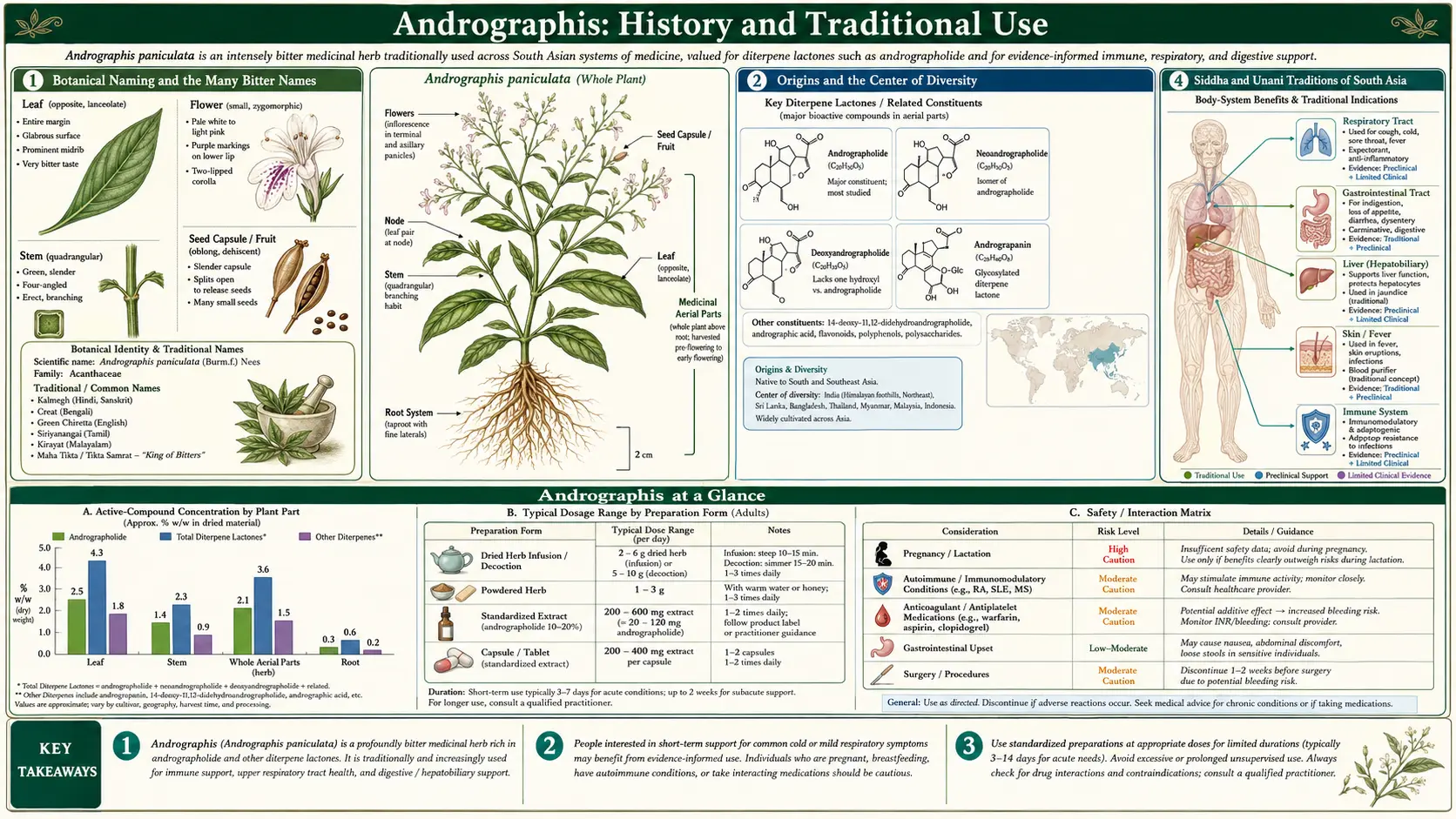
Andrographis (Andrographis paniculata) is one of the most widely used bitter herbs in the traditional medicine of South and Southeast Asia, where it has been valued for centuries as a remedy for fevers, liver complaints, and infections. Known across cultures by names that almost all mean some version of “bitter” — the “King of Bitters” in English, Kalmegh in India, Chuan Xin Lian in China — its story is one of independent traditions converging on the same intensely bitter, fast-growing weed. This article traces that documented history honestly: what the classical sources and modern reviews actually record, what is best understood as living tradition, and which popular claims the historical record does not support.
Table of Contents
- Botanical Naming and the Many Bitter Names
- Origins and the Center of Diversity
- Ayurveda: Kalmegh, the “King of Bitters”
- Siddha and Unani Traditions of South Asia
- Traditional Chinese Medicine: Chuan Xin Lian
- Across Southeast Asia
- A Documented Milestone: Isolating Andrographolide
- Repeated Claims and What the Record Supports
- From Tradition to Modern Research
- Research Papers and References
- Connections
- Featured Videos
Botanical Naming and the Many Bitter Names
Andrographis is the common English name for Andrographis paniculata, an erect annual herb of the acanthus family (Acanthaceae). The plant was first described botanically by the Dutch naturalist Nicolaas Laurens Burman, who placed it in the genus Justicia as Justicia paniculata; it was later transferred to its own genus and is today written, with its full botanical authority, as Andrographis paniculata (Burm.f.) Wall. ex Nees — the genus having been published by the botanist Christian Gottfried Daniel Nees von Esenbeck in Nathaniel Wallich's Plantae Asiaticae Rariores (volume 3, 1832). The genus name is generally traced to the Greek andro- and graphis (a stylus or fine brush), commonly explained as a reference to the brush-like staminal filaments of the small flowers, while the species epithet paniculata describes the plant's branched, panicled flower-spray.
Far more memorable than the Latin are the herb's common names, and a striking feature of them is how many encode the same single quality: an almost overwhelming bitterness. In English it is famously the King of Bitters, and the French roi des amers says exactly the same thing. The plant is also called creat and green chiretta in English, and — because it is sometimes marketed in the West as an immune herb — Indian echinacea, a modern commercial nickname rather than a traditional one. The Malay name Hempedu Bumi translates as “bile of the earth,” another direct nod to the taste.
In its South Asian heartland the herb carries a cluster of Sanskrit and vernacular names: Kalmegh (also written Kalmegha), Bhunimba or Bhui-neem (“neem of the ground,” likening its bitterness to the neem tree), Kirayat, and Kalpanath; in Tamil and Telugu it is Nilavembu. In China it is Chuan Xin Lian (穿心莲), in Thailand Fa-Talai-Jorn, and in Indonesia Sambiloto. This dense thicket of names across a dozen languages is itself a kind of historical evidence: it tells us the plant was familiar, useful, and widespread enough to be christened independently by nearly every community that grew alongside it.
Origins and the Center of Diversity
Andrographis is a plant of warm, humid Asia. It is most commonly described as native to South Asia — with peninsular (southern) India and Sri Lanka often identified as the likely center of origin and diversity of the species — and it has long been established and cultivated across the tropical and subtropical belt that stretches through India, Sri Lanka, China, Taiwan, and mainland Southeast Asia (Thailand, Myanmar, Malaysia, Indonesia, Laos, Cambodia, and Vietnam). Botanical reviews differ on the precise boundaries of its original native range; some place its native distribution chiefly in India and Sri Lanka, while others extend it to include southern China and Taiwan. What is not in dispute is that the herb has been part of the cultivated and gathered pharmacopoeia of this whole region for a very long time, and that it now grows as an introduced plant in parts of the Caribbean and other tropical areas as well.
The plant's character helps explain its reach. It is a fast-growing, unfussy annual that springs up readily in disturbed ground, on the edges of fields, and in waste places throughout the monsoon belt, which made it an abundant and essentially free medicine for ordinary households. Like many such accessible bitter herbs, it became woven into more than one of the great Asian medical systems — Ayurveda and Siddha in India, traditional Chinese medicine in China, and the folk traditions of Southeast Asia — each of which independently catalogued it and, as the following sections show, arrived at a remarkably consistent set of uses.
Ayurveda: Kalmegh, the “King of Bitters”
Within Ayurveda, the classical medical tradition of the Indian subcontinent, andrographis is best known as Kalmegh. The name is commonly translated as “dark cloud” (from kala, dark, and megha, cloud) — a translation repeated in many herbal and Ayurvedic sources, usually explained as a reference to the dark green of a dense stand of the plant; readers should treat this poetic etymology as a traditional gloss rather than a strictly documented derivation. In Ayurvedic theory the herb is a classic bitter (tikta) used as an alterative, a digestive bitter (stomachic), a fever remedy, and above all a remedy for the liver.
Andrographis is traditionally associated with the foundational Ayurvedic compendia — the Charaka Samhita and the Sushruta Samhita — and with later texts, where bitter liver-and-fever herbs identified with Kalmegh are indicated for kamala (jaundice and related liver disorders), for fevers, and for disorders of bile. (These classical texts are named here as historical sources, and matching a modern botanical species to a name in an ancient manuscript always carries some uncertainty, so the association is best stated as traditional attribution rather than as a precisely dated “first use.”) What is well attested is that, by the era of the modern printed Ayurvedic and pharmacopoeial literature, Kalmegh was firmly established as one of the principal Ayurvedic remedies for the liver and for fevers — the role it still plays in Ayurvedic practice today, where it is given as a powder (churna), a decoction (kashayam), and in numerous compound formulations, and is one of the better-studied herbs in this tradition for jaundice and liver support.
The intense bitterness was not regarded as a drawback but as the very source of the herb's power: in Ayurvedic thinking a strong bitter is understood to kindle the digestive “fire” (agni), clear heat, and act on the liver and the blood. That logic — bitterness equals liver-and-fever medicine — is the thread that runs through the Ayurvedic record and that reappears, independently, in the Chinese and Southeast Asian traditions described below.
Siddha and Unani Traditions of South Asia
Ayurveda is not the only South Asian system to have adopted andrographis. In the Siddha tradition of Tamil Nadu in southern India, the herb is known as Nilavembu and is a long-standing remedy for fevers. It is the central ingredient of the classical multi-herb decoction Nilavembu Kudineer (“Nilavembu decoction”), a formulation traditionally used in Siddha practice for fevers of various kinds; in recent decades this formula has been widely promoted in southern India for mosquito-borne fevers such as dengue and chikungunya, though it is important to be clear that this modern public-health use of a traditional formula is still being evaluated and should not be read back into the deep past as established fact.
In the Unani system — the Greco-Arabic tradition of medicine that took root in the Indian subcontinent — andrographis is likewise recorded as a bitter liver tonic and febrifuge, used for chronic and seasonal fevers, for dysentery, and for various skin complaints including boils, scabies, and skin eruptions. Across all three South Asian systems, then, the same plant occupies essentially the same niche: a cheap, abundant, intensely bitter herb reached for first in fevers, liver trouble, and bowel infections. That three distinct medical traditions, with very different underlying theories, converged on the same uses for the same weed is one of the more telling facts in andrographis's history.
Traditional Chinese Medicine: Chuan Xin Lian
In China, andrographis is known as Chuan Xin Lian (穿心莲, a name often rendered as “thread-the-heart lotus”) and is classified within traditional Chinese medicine (TCM) as a cold, bitter herb whose role is to clear heat and resolve toxins (qing re jie du). In the framework of TCM, “heat” and “toxins” are traditional categories that cover, among other things, the feverish, inflamed, and infected states that modern medicine would describe in terms of infection and inflammation. The herb is traditionally said to enter the lung, stomach, large-intestine, and small-intestine channels.
Recorded TCM uses for Chuan Xin Lian center on the throat, the chest, and the gut: the common cold and influenza, sore throat, cough with thick phlegm, and a range of digestive infections including diarrhea and dysentery, as well as boils, sores, and snakebite handled topically. Compared with the millennia-deep textual tradition around some Chinese herbs, andrographis appears to be a comparatively later and more southern addition to the Chinese materia medica — consistent with the plant's tropical-Asian distribution — and it was formally taken up into the official Pharmacopoeia of the People's Republic of China in the modern era. Today it is one of the more commonly used “heat-clearing” herbs in Chinese practice, particularly for sore throats and upper-respiratory complaints, the same indications for which it has been most studied in clinical trials.
Across Southeast Asia
Andrographis is woven into the folk medicine of much of mainland and island Southeast Asia, again under names that echo its bitterness. In Thailand it is Fa-Talai-Jorn, a familiar household and over-the-counter remedy for sore throat, the common cold, and fevers, and one that is officially listed in Thailand's national list of essential herbal medicines. In Indonesia and Malaysia it is Sambiloto (and, in Malay, Hempedu Bumi, “bile of the earth”), used traditionally for fevers, diabetes, hypertension, dysentery, and as a general bitter tonic; the herb also features in the traditional medicine of Bangladesh, Myanmar, and neighboring countries for the cold, fever, liver disorders, dysentery, and malaria.
The repetition is the point. Whether the plant is called Kalmegh, Nilavembu, Chuan Xin Lian, Fa-Talai-Jorn, or Sambiloto, the core traditional uses recur with little variation across the entire region: fevers, the common cold and its sore throat and cough, liver and jaundice complaints, and infections of the gut. This consistency across cultures that did not share a common medical theory is exactly the pattern that later drew laboratory and clinical researchers to test the herb in earnest, as the closing sections describe.
A Documented Milestone: Isolating Andrographolide
For all its centuries of traditional use, andrographis enters the documented history of modern chemistry at a specific, verifiable point. In 1911, the chemist K. Gorter isolated the plant's intensely bitter principle in pure crystalline form, established that it was structurally a lactone, and gave it the name by which it is still known: andrographolide. Gorter's work was published that year in the Dutch-Belgian chemistry journal Recueil des Travaux Chimiques des Pays-Bas et de la Belgique. (Some later reviews note that crude bitter extracts of the plant had been examined by earlier workers, but Gorter's 1911 isolation and naming of andrographolide is the milestone consistently cited in the scientific literature.)
This is the kind of claim that can be named with a real person attached, because it is a genuinely documented scientific achievement rather than a folk attribution. Andrographolide — a colorless, crystalline, very bitter labdane diterpenoid lactone — turned out to be the dominant marker compound of the herb, concentrated mostly in the leaves, and it remains the substance to which standardized andrographis extracts are titrated today. Putting a name and a date to the bitter molecule was the hinge on which andrographis swung from purely traditional remedy toward laboratory science: once the active principle could be isolated, measured, and studied, the long folk reputation of the “King of Bitters” could finally be tested by the methods of modern pharmacology.
Repeated Claims and What the Record Supports
Because accuracy matters on a public-health page, it is worth pausing on one claim that circulates very widely in popular writing about andrographis: the assertion that the herb “halted” or was “largely credited with stopping the spread of” the great 1918–1919 influenza pandemic in India. This story is repeated on many supplement and wellness websites, almost always without a contemporary source. It should be treated with real caution. Scholarly histories of the 1918–19 influenza epidemic in India — which was catastrophic, killing millions — do not corroborate the idea that any herb checked its spread, and they describe the authorities of the day as largely unable to halt the outbreak. We have not been able to trace this claim to a reliable primary source from the period, so we present it here only as a frequently repeated piece of modern folklore, not as documented history.
The same care applies to the deep antiquity sometimes asserted for the herb. Statements that andrographis was used “for thousands of years” in a named ancient text are plausible for a plant of this region, but pinning a modern botanical species to a specific verse in an ancient manuscript is genuinely uncertain, and such claims are best read as traditional attribution. What can be said with confidence and honesty is this: andrographis has a long, well-documented place in the living traditional medicine of South and Southeast Asia; its bitter principle was isolated and named in 1911; and over the past few decades it has become one of the more thoroughly studied traditional herbs for the common cold and sore throat — the part of its history that rests on the firmest evidence.
From Tradition to Modern Research
The modern scientific story of andrographis follows naturally from its traditional one. The single most consistent traditional use — for the common cold, sore throat, and other upper-respiratory complaints — is also the use for which the herb has been most rigorously tested. Systematic reviews and a meta-analysis of randomized controlled trials, including the analyses by Coon and Ernst (2004), Poolsup and colleagues (2004), and Hu and colleagues (2017), have concluded that andrographis preparations can ease the symptoms of uncomplicated upper-respiratory-tract infections — particularly cough and sore throat — more than placebo, while generally being well tolerated. Much of the strongest clinical work used a standardized andrographis extract, sometimes in the fixed combination Kan Jang (andrographis with Eleutherococcus senticosus) studied by Melchior and colleagues (2000).
This continuity — a cheap, abundant, intensely bitter weed used across many cultures for fevers, colds, and the liver, and only in the last century isolated, named, and tested — is what makes the history of andrographis worth knowing. Tradition raised the questions; modern research is testing the answers. The practical details of how the herb is used today, the evidence behind each of its specific benefits, and its dosing, forms, and safety are taken up in the companion Andrographis Benefits articles and on the main Andrographis page. As always, andrographis is a supportive remedy and not a substitute for medical care — it is contraindicated in pregnancy, and anyone with a high or persistent fever, or who is taking blood-thinning or immune medications, should speak with a clinician before using it.
Research Papers and References
The list below combines key peer-reviewed reviews and clinical analyses of Andrographis paniculata with curated PubMed topic-search links into the ethnobotanical and clinical literature. Historical primary sources (the classical Ayurvedic, Siddha, and Unani texts, and Gorter's 1911 chemistry paper) are named in the article as historical sources; Gorter's paper predates digital identifiers and so is cited by journal and year rather than by DOI. Author names, titles, and journals are given as plain text; only stable identifiers (DOI / PMID / PubMed) are hyperlinked, and each opens in a new tab.
- Hossain MS, Urbi Z, Sule A, Rahman KMH. Andrographis paniculata (Burm. f.) Wall. ex Nees: A Review of Ethnobotany, Phytochemistry, and Pharmacology. The Scientific World Journal. 2014;2014:274905. — doi:10.1155/2014/274905
- Jayakumar T, Hsieh CY, Lee JJ, Sheu JR. Experimental and Clinical Pharmacology of Andrographis paniculata and Its Major Bioactive Phytoconstituent Andrographolide. Evidence-Based Complementary and Alternative Medicine. 2013;2013:846740. — doi:10.1155/2013/846740
- Coon JT, Ernst E. Andrographis paniculata in the Treatment of Upper Respiratory Tract Infections: A Systematic Review of Safety and Efficacy. Planta Medica. 2004;70(4):293-298. — doi:10.1055/s-2004-818938
- Poolsup N, Suthisisang C, Prathanturarug S, Asawamekin A, Chanchareon U. Andrographis paniculata in the Symptomatic Treatment of Uncomplicated Upper Respiratory Tract Infection: Systematic Review of Randomized Controlled Trials. Journal of Clinical Pharmacy and Therapeutics. 2004;29(1):37-45. — doi:10.1046/j.1365-2710.2003.00534.x
- Hu XY, Wu RH, Logue M, et al. Andrographis paniculata (Chuān Xīn Lián) for Symptomatic Relief of Acute Respiratory Tract Infections in Adults and Children: A Systematic Review and Meta-Analysis. PLoS ONE. 2017;12(8):e0181780. — doi:10.1371/journal.pone.0181780
- Melchior J, Spasov AA, Ostrovskij OV, Bulanov AE, Wikman G. Double-Blind, Placebo-Controlled Pilot and Phase III Study of Activity of Standardized Andrographis paniculata Herba Nees Extract Fixed Combination (Kan Jang) in the Treatment of Uncomplicated Upper-Respiratory Tract Infection. Phytomedicine. 2000;7(5):341-350. — doi:10.1016/S0944-7113(00)80053-7
- Gorter K. The bitter constituent of Andrographis paniculata (andrographolide). Recueil des Travaux Chimiques des Pays-Bas et de la Belgique. 1911;30:151-160. (Historical source — the original isolation and naming of andrographolide; predates digital identifiers.)
- Andrographis paniculata ethnobotany and traditional use — PubMed: Andrographis paniculata ethnobotany traditional use
- Andrographis paniculata common cold and upper respiratory tract infection (clinical trials) — PubMed: Andrographis paniculata common cold respiratory
External Authoritative Resources
- NCCIH — Herbs at a Glance
- MedlinePlus — Herbs and Supplements
- PubMed — All research on Andrographis paniculata
Connections
- All Herbs
- Andrographis Hub
- Andrographis Benefits Deep Dive
- Echinacea
- Holy Basil
- Neem
- Turmeric
- Elderberry