Yogurt — Benefits Deep Dive
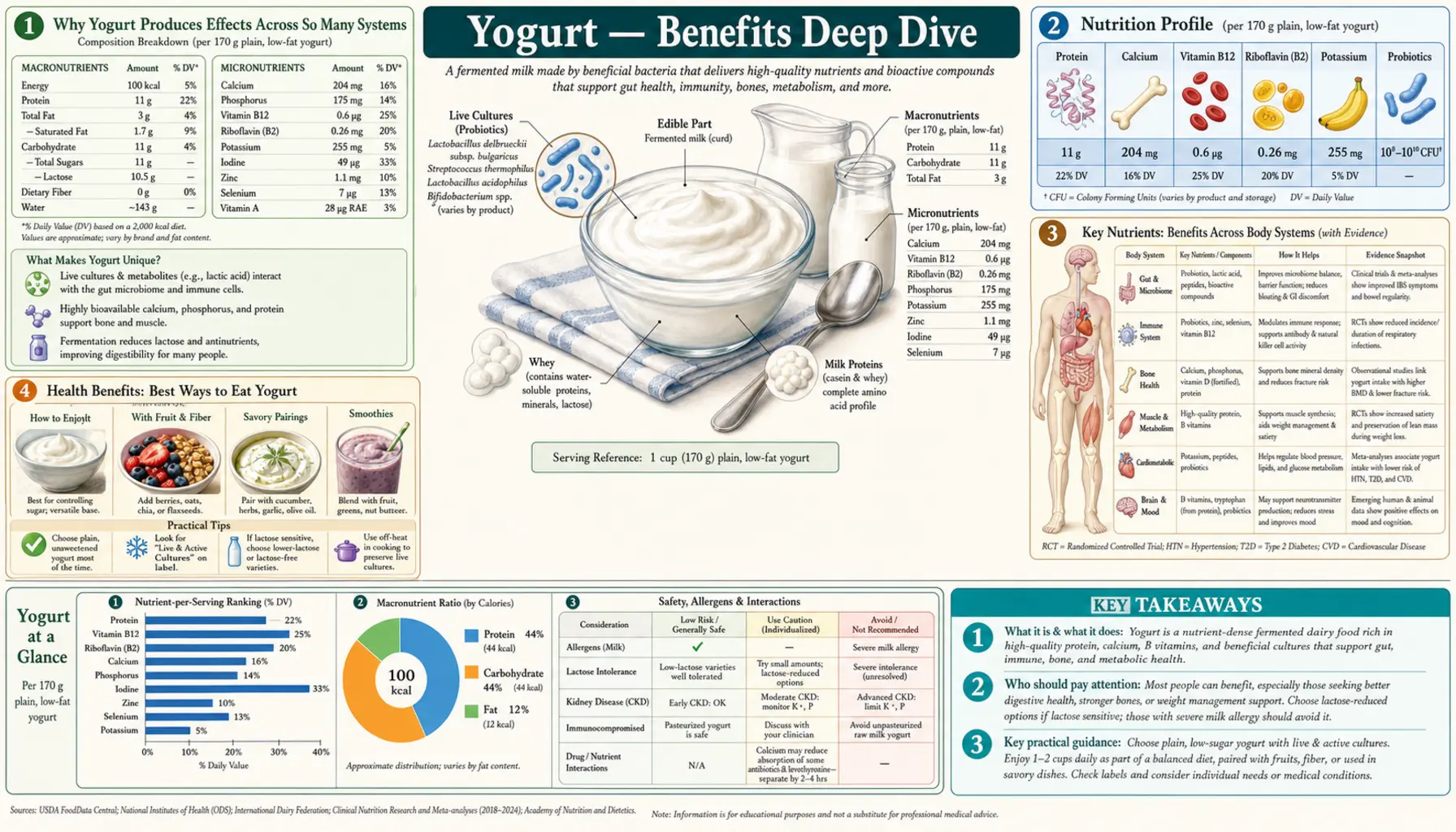
Yogurt is one of the oldest engineered foods in the human diet — predating writing and emerging independently in at least three regions (Mesopotamia, Central Asia, the Balkans) sometime in the 5th millennium BCE. It is also one of the most clinically studied. The combination of live bacterial cultures (typically Streptococcus thermophilus and Lactobacillus delbrueckii subsp. bulgaricus, plus optional probiotic adjuncts), high-quality dairy protein, bioavailable calcium, and pre-digested lactose makes yogurt a remarkably multi-purpose food. Four benefit deep-dives below explore where yogurt produces measurable clinical effects: the specific probiotic strain biology, the protein/fat differences between Greek and traditional styles, the skeletal calcium-and-protein synergy, and the lactose-tolerance mechanism that lets many lactose-intolerant adults tolerate yogurt without symptoms.
Deep-Dive Articles
Probiotic Strains
The two starter cultures required by FDA standard of identity (Streptococcus thermophilus and Lactobacillus delbrueckii subsp. bulgaricus), the optional probiotic adjuncts (L. acidophilus, L. casei, L. rhamnosus GG, Bifidobacterium species), CFU labeling conventions, the strain-specific evidence base, and what survives gastric transit.
Greek vs Regular
Why Greek yogurt has roughly twice the protein and half the lactose of traditional yogurt (the strain difference: 3x straining removes whey, lactose, and minerals while concentrating casein), the calcium trade-off, satiety and protein leverage, Skyr and labneh as related strained styles, and the marketing-versus-science of "high-protein" branding.
Bone Density and Calcium
Calcium bioavailability from dairy versus plant sources, the protein-calcium synergy in skeletal remodeling, vitamin K2 (MK-9) production by yogurt cultures, the Framingham Offspring cohort data on yogurt and hip fracture risk, and why fortified yogurts are a practical osteoporosis-prevention vehicle for older adults.
Lactose Tolerance
Why most lactose-intolerant adults tolerate yogurt without symptoms even though it contains lactose: live bacterial beta-galactosidase delivers in-situ lactose hydrolysis in the small intestine, the EFSA-approved health claim, the fermentation timeline, and the practical thresholds for individual tolerance.
Table of Contents
- Deep-Dive Articles
- Why Yogurt Produces Effects Across So Many Systems
- Research Papers: Probiotic Strains
- Research Papers: Greek vs Regular
- Research Papers: Bone Density and Calcium
- Research Papers: Lactose Tolerance
- Research Papers: Cross-Cutting (Metabolism, Cardiovascular, Immune)
- External Authoritative Resources
- Connections
- Featured Videos
Why Yogurt Produces Effects Across So Many Systems
Most fermented foods provide either a probiotic effect (sauerkraut, kefir) or a nutrient-density effect (cheese, miso). Yogurt is unusual because it delivers both simultaneously, plus a third mechanism that few other foods offer: in-situ enzyme delivery via live cultures. Each maps to a distinct category of clinical effect.
- Live bacterial culture (probiotic effect) — the FDA standard of identity (21 CFR 131.200) requires yogurt to contain live Streptococcus thermophilus and Lactobacillus delbrueckii subsp. bulgaricus. Many modern yogurts add additional probiotic strains. This is the mechanism behind gut microbiome modulation, antibiotic-associated diarrhea prevention, and modest immune effects.
- High-density nutrient matrix (protein, calcium, B-vitamins, K2) — yogurt is dense in complete protein (especially Greek and Icelandic varieties), highly bioavailable calcium, vitamin B12, riboflavin, and bacterially-produced vitamin K2 (menaquinone, principally MK-9). This is the mechanism behind skeletal benefits and the Greek-style protein-leverage satiety effect, and behind much of the cardiometabolic data showing yogurt consumption is associated with lower type 2 diabetes risk in cohort studies.
- In-situ enzyme delivery (beta-galactosidase / lactase) — the live cultures carry their own lactose-cleaving enzyme into the small intestine, where it continues to hydrolyze lactose even after ingestion. This is the basis of the EFSA-approved health claim that live yogurt improves lactose digestion in individuals with lactose maldigestion, and it explains why most lactose-intolerant adults can eat yogurt without symptoms.
Three additional considerations shape clinical recommendation. First, style matters as much as quantity: traditional cup-set yogurt, drinkable yogurt, Greek-strained yogurt, Icelandic Skyr, and Middle-Eastern labneh differ substantially in protein density, lactose content, and calcium per serving. The Greek vs regular page works through these differences. Second, added sugar can negate the metabolic benefit: a typical fruit-on-the-bottom 6-ounce yogurt contains 18-24 g added sugar, comparable to a soda; plain yogurt with fresh fruit added at home is the cleanest option. Third, not all yogurts are alive: shelf-stable yogurts and many heat-treated "yogurt-style" products contain no live cultures and provide neither the probiotic nor the lactase-delivery benefit. Look for the National Yogurt Association "Live and Active Cultures" seal or a stated minimum of 108 CFU/g at the end of shelf life.
Research Papers: Probiotic Strains
- FDA standard of identity for yogurt (21 CFR 131.200) and required starter cultures — PubMed: FDA standard of identity
- Hill C et al., ISAPP consensus statement on the scope of the term "probiotic" — PubMed: ISAPP consensus 2014
- Survival of yogurt bacteria in the human gastrointestinal tract — PubMed: GI transit survival
- Lactobacillus rhamnosus GG efficacy in pediatric acute gastroenteritis — PubMed: LGG pediatric AGE
- Probiotics for antibiotic-associated diarrhea: Cochrane review — PubMed: AAD Cochrane
- Bifidobacterium animalis subsp. lactis DN-173 010 and gut transit time — PubMed: B. lactis DN-173 010
- Yogurt consumption and gut microbiota composition (American Gut Project, etc.) — PubMed: Yogurt and microbiota
- Live cultures vs heat-treated yogurt — differential effects — PubMed: Live vs heat-treated
- L. acidophilus NCFM strain characterization and clinical use — PubMed: L. acidophilus NCFM
- National Yogurt Association Live and Active Cultures seal standard — PubMed: NYA LAC seal
Research Papers: Greek vs Regular
- Greek strained yogurt: production process and nutritional composition — PubMed: Greek yogurt composition
- Whey separation and concentration of casein in strained yogurts — PubMed: Whey separation
- High-protein yogurt and satiety / appetite suppression — PubMed: Greek yogurt satiety
- Casein versus whey protein digestion kinetics — PubMed: Casein vs whey kinetics
- Icelandic Skyr and traditional fermentation parameters — PubMed: Skyr characterization
- Labneh and Middle-Eastern strained yogurts — PubMed: Labneh
- Protein leverage hypothesis and dairy snacks — PubMed: Protein leverage
- Acid whey environmental waste and Greek-yogurt production — PubMed: Acid whey waste
- Lactose content of Greek versus regular yogurt — PubMed: Lactose comparison
- Calcium loss with whey removal in strained yogurts — PubMed: Calcium loss in straining
Research Papers: Bone Density and Calcium
- Yogurt intake and hip-fracture risk in the Framingham Offspring cohort — PubMed: Framingham yogurt and fracture
- Dairy calcium bioavailability versus plant-source calcium — PubMed: Calcium bioavailability
- Protein intake and calcium retention in postmenopausal women — PubMed: Protein and calcium retention
- Vitamin K2 (menaquinone) production by yogurt fermentation cultures — PubMed: K2 production in yogurt
- Yogurt consumption and bone mineral density in older adults — PubMed: Yogurt and BMD
- Dairy intervention trials in adolescent girls and peak bone mass — PubMed: Adolescent peak bone mass
- Yogurt-based diets in elderly fall prevention — PubMed: Elderly falls and yogurt
- Casein phosphopeptides and calcium solubility in the gut lumen — PubMed: CPP and calcium
- Yogurt fortified with vitamin D and calcium absorption — PubMed: D-fortified yogurt
- Dietary acid load, dairy protein, and the calcium-leaching hypothesis revisited — PubMed: Acid load and protein
Research Papers: Lactose Tolerance
- EFSA Panel scientific opinion on yogurt cultures and lactose digestion — PubMed: EFSA lactose claim
- Kolars JC et al., Yogurt and improved lactose digestion in lactose-intolerant individuals (NEJM 1984) — PubMed: Kolars NEJM 1984
- Beta-galactosidase activity from Lactobacillus bulgaricus and S. thermophilus — PubMed: Yogurt beta-galactosidase
- Lactase persistence (LCT polymorphism) global distribution — PubMed: Lactase persistence genetics
- Hydrogen breath test and clinical assessment of lactose malabsorption — PubMed: H2 breath test
- Survival of yogurt bacteria in the duodenum and lactase delivery — PubMed: Duodenal lactase delivery
- Lactose threshold for symptoms in lactose-maldigesting adults — PubMed: Lactose symptom threshold
- Yogurt acceptance in primarily lactose-intolerant populations — PubMed: Yogurt acceptance
- Effect of yogurt versus milk on hydrogen breath response — PubMed: Yogurt vs milk breath test
- Adaptation of colonic microflora to chronic lactose exposure — PubMed: Colonic adaptation
Research Papers: Cross-Cutting (Metabolism, Cardiovascular, Immune)
- Yogurt consumption and type 2 diabetes risk — meta-analysis — PubMed: Yogurt and T2D
- Dairy fat and cardiovascular disease (PURE study cohort) — PubMed: PURE dairy fat
- Yogurt intake and weight gain in long-term cohorts (Mozaffarian NEJM 2011) — PubMed: Mozaffarian weight
- Fermented dairy and inflammatory markers (CRP, IL-6) — PubMed: Fermented dairy and inflammation
- Yogurt and metabolic syndrome — observational evidence — PubMed: Yogurt and MetS
- Probiotic yogurt and blood pressure (mild lowering effect) — PubMed: Yogurt and BP
- Yogurt consumption and immune function biomarkers — PubMed: Yogurt and immunity
- Yogurt and respiratory infection incidence in older adults — PubMed: Yogurt and respiratory infection
- Yogurt-based diet and vaginal candidiasis prevention — PubMed: Yogurt and candidiasis
- Yogurt versus probiotic supplements for IBS symptom management — PubMed: Yogurt and IBS
External Authoritative Resources
- FDA — 21 CFR 131.200 Yogurt Standard of Identity — the legal definition that requires live cultures of S. thermophilus and L. bulgaricus
- EFSA Panel — Scientific Opinion on Yogurt Cultures and Lactose Digestion (2010) — the EU-approved health claim
- ISAPP — International Scientific Association for Probiotics and Prebiotics
- National Yogurt Association — Live and Active Cultures Seal
- PubMed — All research on yogurt health benefits (~12,000+ papers)
Connections
- All Food
- Yogurt (Main Page)
- Yogurt — Probiotic Strains
- Yogurt — Greek vs Regular
- Yogurt — Bone Density and Calcium
- Yogurt — Lactose Tolerance
- Milk
- Calcium
- Vitamin D3
- Vitamin K2
- Immune Boosting
- SIBO
- Osteoporosis
- Type 2 Diabetes
- Probiotics