Yogurt — Greek vs Regular
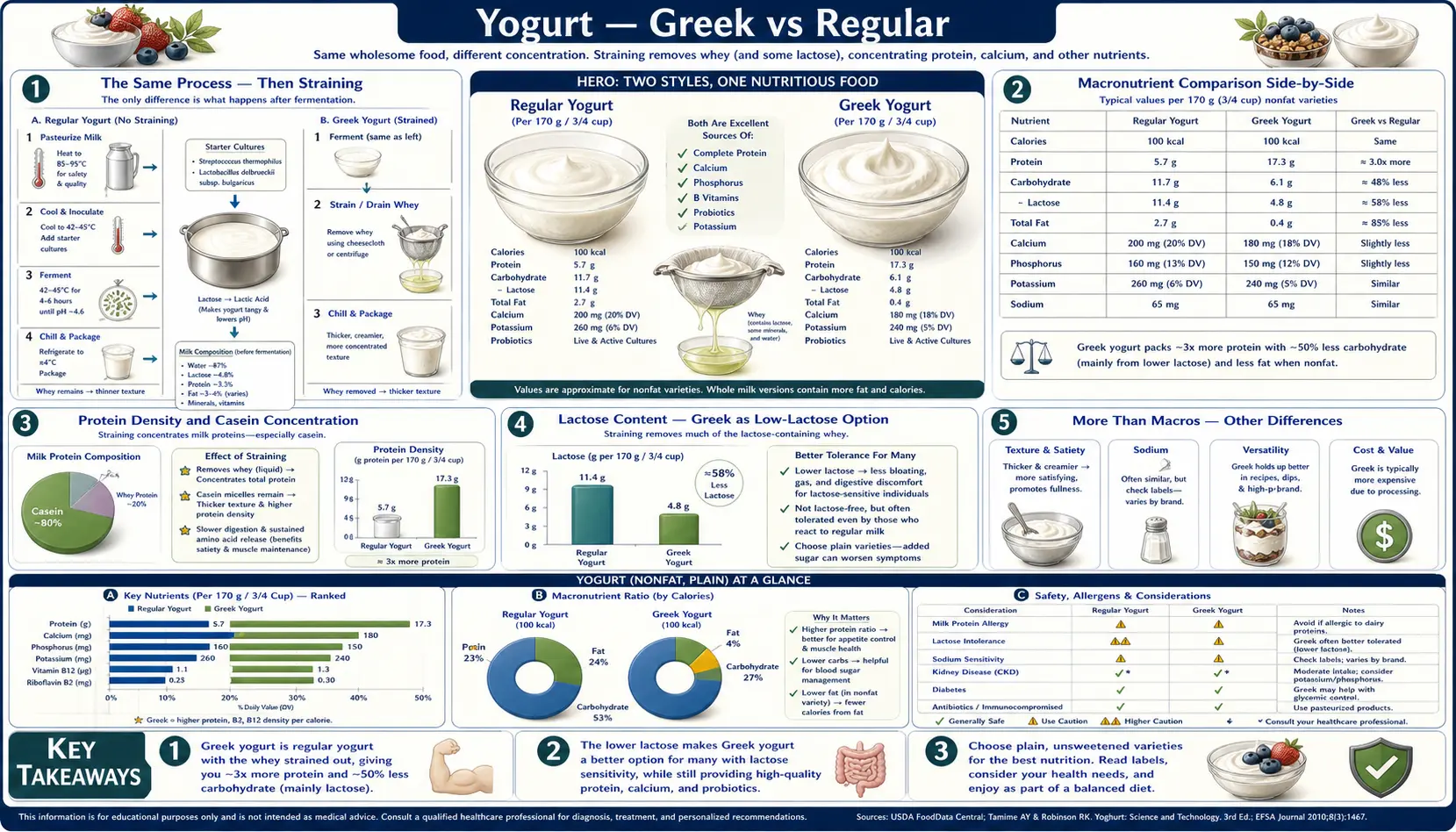
Greek yogurt is not made differently from regular yogurt — it is made identically and then strained. The straining removes whey, lactose, and roughly half the calcium and minerals, while concentrating the casein protein and the milk fat (if present) to roughly twice the density of unstrained yogurt. The result is a more protein-dense, less lactose-laden, slightly more calorically dense food that is closer to fresh cheese than to traditional yogurt. This deep dive walks through the production differences, the macronutrient consequences, the satiety and protein-leverage data, the related Icelandic Skyr and Middle-Eastern labneh styles, the acid-whey waste problem that emerged with the Greek yogurt boom of the 2010s, and the practical guidance for which style fits which clinical goal.
Table of Contents
- The Same Process — Then Straining
- The Macronutrient Comparison (Side-by-Side)
- Protein Density and Casein Concentration
- Lactose Content — Greek as a Low-Lactose Option
- The Calcium Trade-Off in Straining
- Satiety, Protein Leverage, and Snack Selection
- Related Styles — Skyr, Labneh, Bulgarian, Kefir
- The Acid-Whey Waste Problem
- Full-Fat, Low-Fat, and Nonfat Versions
- Choosing by Clinical Goal
- Key Research Papers
- Connections
- Featured Videos
The Same Process — Then Straining
Greek-style strained yogurt begins exactly the same way as traditional yogurt — milk is heated to denature whey proteins (typically 85-90°C for 20-30 minutes), cooled to fermentation temperature (42-43°C), inoculated with the FDA-required starter cultures (Streptococcus thermophilus and Lactobacillus delbrueckii subsp. bulgaricus), and held at fermentation temperature until the pH drops to approximately 4.5.
The single difference comes after fermentation: traditional yogurt is packaged and chilled at this point, while Greek-style yogurt is then strained through cheesecloth (traditional method) or through a multi-stage industrial process using centrifugal separation or membrane ultrafiltration. The straining removes the liquid whey fraction, which contains:
- Water
- Lactose (most of the residual sugar)
- Whey proteins (alpha-lactalbumin, beta-lactoglobulin)
- Water-soluble vitamins (B-complex, riboflavin)
- Soluble calcium and other minerals
- Some lactic acid (this is why Greek yogurt is often less sharp-tangy than traditional)
Traditional cheesecloth straining removes about half the original volume to produce a concentration ratio of about 2:1. Industrial centrifugal separation can achieve higher ratios (2.5-3:1 is common for commercial Greek brands). The result is a thicker, denser, more spoon-stable product. The cultures, casein proteins, and any fat remain — concentrated in proportion to the volume reduction.
One important practical consequence: because Greek yogurt retains the live cultures, all of the probiotic and lactase-delivery effects discussed in the Probiotic Strains and Lactose Tolerance deep-dives apply equally to traditional and Greek yogurts — provided both meet the "live and active cultures" criterion. Straining does not destroy cultures.
The Macronutrient Comparison (Side-by-Side)
Per 6-ounce (170 g) plain unsweetened serving, USDA reference values approximately:
- Plain whole-milk regular yogurt — 138 kcal, 7.9 g protein, 7.4 g fat (4.7 g saturated), 10.6 g carbohydrate (10.6 g sugar as lactose), 275 mg calcium, 0 g added sugar.
- Plain whole-milk Greek yogurt (5% fat) — 161 kcal, 14.6 g protein, 8.5 g fat (5.4 g saturated), 6.0 g carbohydrate (6.0 g sugar as lactose), 184 mg calcium, 0 g added sugar.
- Plain nonfat regular yogurt — 95 kcal, 9.7 g protein, 0.3 g fat, 12.9 g carbohydrate (12.9 g sugar as lactose), 311 mg calcium, 0 g added sugar.
- Plain nonfat Greek yogurt — 100 kcal, 17.3 g protein, 0.7 g fat, 6.1 g carbohydrate (5.9 g sugar as lactose), 187 mg calcium, 0 g added sugar.
- Plain nonfat Icelandic Skyr — 110 kcal, 19.5 g protein, 0.5 g fat, 6.0 g carbohydrate (5.0 g sugar as lactose), 200 mg calcium, 0 g added sugar.
The key patterns:
- Protein roughly doubles in the Greek/Skyr/strained varieties, while lactose roughly halves.
- Calcium drops by approximately one-third in strained yogurts because soluble calcium leaves in the whey. This is partly offset by the increased serving density (Greek yogurt is denser, so a comparable spoonful contains more), but a gram-for-gram comparison shows strained yogurts have less calcium than traditional ones.
- Caloric density rises modestly in strained yogurts, largely tracking the protein and fat increase.
- Fat content scales with the labeled fat type (whole, low-fat, nonfat) in both styles. Nonfat strained yogurts are extremely high-protein-density foods, comparable to lean meat per calorie.
For commercial flavored versions, the carbohydrate column changes dramatically — a 6-ounce strawberry Greek yogurt typically adds 13-18 g added sugar on top of the residual lactose, totaling 18-25 g sugar per serving. This negates much of the metabolic-health rationale for choosing yogurt over other snack options. Plain yogurt with fresh fruit added at home is consistently the cleaner option.
Protein Density and Casein Concentration
The protein concentration in Greek yogurt is concentrated casein. Cow's milk contains roughly 80% casein and 20% whey by protein weight. When whey is strained away, the remaining protein fraction is dominated by casein. This has nutritional consequences that distinguish strained yogurt from whey protein supplements:
- Casein digests slowly — in the acid environment of the stomach, casein forms a soft curd that releases amino acids gradually over 4-6 hours, in contrast to whey's rapid 1-2 hour absorption peak. This makes Greek yogurt a good evening snack for sustained overnight amino-acid availability.
- High BCAA content — casein contains approximately 21% branched-chain amino acids (leucine, isoleucine, valine), supporting muscle protein synthesis. The leucine content of a 6-ounce Greek yogurt is roughly 1.5 g, near the per-meal threshold for maximizing muscle protein synthesis in younger adults (older adults need approximately 2.5-3 g per meal).
- Casein phosphopeptides (CPPs) — gastric and pancreatic proteases release casein phosphopeptides that chelate calcium and increase its solubility in the alkaline small intestine. This partially compensates for the lower absolute calcium in strained yogurt — what calcium is present is highly bioavailable.
- Bioactive peptides — casein digestion releases multiple bioactive peptides, including ACE-inhibitory peptides (mild blood-pressure effect), opioid-receptor-active beta-casomorphins (controversial; the A1 vs A2 beta-casein debate is centered on this), and antimicrobial peptides.
For athletes and older adults seeking to maximize muscle protein synthesis, Greek yogurt is a particularly effective whole-food protein source. The protein density per calorie of nonfat Greek yogurt (approximately 17 g protein in 100 kcal) compares favorably with chicken breast (approximately 25 g protein in 135 kcal) and is achievable without cooking, which makes it logistically attractive for snacks and breakfast.
For more on protein quality and amino acid composition, see the Leucine page and the broader Amino Acids hub.
Lactose Content — Greek as a Low-Lactose Option
The straining process that concentrates casein also removes the lactose-containing whey, dropping lactose content from roughly 10-13 g per 6 oz serving in traditional yogurt to roughly 5-6 g in Greek. Some Greek yogurts strain more aggressively and report lactose content as low as 2-4 g per serving.
For comparison:
- Whole milk (1 cup, 240 mL): 11-13 g lactose
- Traditional yogurt (6 oz): 10-13 g lactose
- Greek yogurt (6 oz): 5-6 g lactose (sometimes 2-4 g)
- Ricotta cheese (1/2 cup): 4-6 g lactose
- Aged hard cheese (1 oz cheddar, parmesan): <0.1 g lactose
- Butter (1 tbsp): essentially zero
The typical threshold for symptoms in lactose-intolerant adults is 12-15 g of lactose in a single sitting (variable across individuals). Greek yogurt is generally well below that threshold, especially considering the additional benefit of in-situ bacterial lactase delivery from the live cultures (see Lactose Tolerance). For most lactose-intolerant individuals, Greek yogurt is tolerated without symptoms in normal serving sizes.
For severely lactose-intolerant individuals or those with full lactase non-persistence (essentially zero adult lactase production), even low-lactose Greek yogurt can occasionally produce symptoms. In these cases, options include very small portions (2-3 oz), lactose-free Greek yogurt (some brands add lactase enzyme during processing), or further-strained labneh.
The Calcium Trade-Off in Straining
Calcium in yogurt exists in two forms: casein-bound calcium (insoluble, in the curd) and soluble ionic calcium (in the whey fraction). The straining process removes the soluble whey calcium, leaving only the casein-bound fraction. The net loss is approximately one-third of the calcium per gram of finished product.
However, this loss is partially compensated in several ways:
- Concentration effect — because Greek yogurt is denser, a typical serving (6 oz of Greek) contains more grams of solid than the same volume of traditional yogurt. On a per-serving basis, the calcium gap is smaller than on a per-gram basis.
- Bioavailability of casein-bound calcium — the casein phosphopeptides released during digestion increase solubility and absorption of the remaining calcium. Studies suggest the casein-bound calcium in Greek yogurt may be more bioavailable per milligram than the soluble calcium lost to whey, partly offsetting the absolute reduction.
- Calcium fortification — many commercial Greek yogurt brands now add calcium back during processing, reaching parity with or exceeding traditional yogurt's calcium content. Check the nutrition facts panel; calcium fortification is now common in the US market.
For individuals using yogurt as their primary calcium source — particularly older adults with osteoporosis risk, postmenopausal women, and adolescents in peak bone-mass-accrual years — the differences favor either consuming a slightly larger serving of Greek yogurt or choosing a calcium-fortified version, rather than reverting to traditional yogurt at the cost of higher lactose and lower protein. See Bone Density and Calcium for the broader discussion of yogurt's role in skeletal health.
Satiety, Protein Leverage, and Snack Selection
One of the most consistently documented advantages of Greek yogurt over traditional yogurt in clinical trials is greater satiety and appetite suppression per calorie consumed. The Ortinau et al. 2014 (Nutrition Journal) trial compared 160-kcal afternoon snacks of Greek yogurt, crackers, or chocolate in adolescent girls and found Greek yogurt produced the longest delay until the next eating episode and the smallest subsequent dinner intake.
The mechanism is the "protein leverage" hypothesis — humans appear to regulate protein intake more strictly than carbohydrate or fat intake, and snacks/meals with higher protein density satisfy hunger drives that snacks/meals with low protein density do not, regardless of caloric load. A 100-kcal serving of nonfat Greek yogurt (17 g protein) provides approximately three times the protein of a 100-kcal serving of fruit or refined-grain crackers.
Additional mechanisms contributing to Greek-yogurt satiety:
- Casein digestion kinetics — the slow gastric curd formation extends time of stomach distension and prolongs the satiation signal
- Texture and oral-processing time — thicker, denser foods require more chewing/spoon-handling time, which correlates with greater within-meal satiation
- Postprandial CCK and GLP-1 release — protein-rich meals stimulate cholecystokinin and glucagon-like peptide-1 release, both of which suppress hunger
The practical implication for weight management: replacing a refined-carbohydrate snack (granola bar, crackers, baked chips) with a 6-oz serving of plain nonfat Greek yogurt typically reduces total daily energy intake by 100-200 kcal in real-world settings, without conscious effort. This effect is one of the better-supported single dietary substitutions for weight management.
The caveat: flavored fruit-on-the-bottom Greek yogurts with 18-24 g added sugar negate much of this advantage. The satiety effect comes from the high protein, not from the yogurt itself, and sugar dilutes that signal. Plain unsweetened Greek yogurt with fresh fruit, vanilla, cinnamon, or a small amount of honey is the recommended preparation.
Related Styles — Skyr, Labneh, Bulgarian, Kefir
Several traditional fermented dairy products are closely related to Greek yogurt:
- Icelandic Skyr — technically a fresh cheese rather than a yogurt under Icelandic tradition, though marketed as yogurt in the US. Made from skim milk with mesophilic cultures (originally including L. delbrueckii subsp. bulgaricus, S. thermophilus, and traditionally also rennet for partial coagulation). Strained more aggressively than Greek yogurt, producing 18-20 g protein per 6 oz. Lower fat than Greek (typically nonfat in commercial versions). The most protein-dense common dairy product.
- Labneh — Middle-Eastern strained yogurt, the closest in tradition to Greek yogurt. Strained to a thicker, more cheese-like consistency (sometimes 3-4:1 ratio). Often shaped into balls and preserved in olive oil. Used as a spread or dip rather than a spoon yogurt. Roughly comparable nutrition to Greek yogurt per gram.
- Bulgarian yogurt — the original "type-specimen" yogurt where L. delbrueckii subsp. bulgaricus was first identified. Unstrained, mildly tart, with a particular floral aroma profile. Closer to traditional yogurt than to Greek in macronutrient density.
- Kefir — technically a different category. Made by inoculating milk with "kefir grains" — a symbiotic culture of approximately 10 yeast and 30+ bacterial species (including Lactobacillus kefiranofaciens, L. acidophilus, L. paracasei, S. thermophilus, and yeasts such as Kluyveromyces marxianus). Drinkable consistency. Higher microbial diversity than yogurt, but also some mild CO2 production and trace alcohol (typically <1% ABV).
- Filmjölk and Viili — Scandinavian fermented milks made with mesophilic cultures at room temperature, producing a mild, viscous, almost stringy texture from exopolysaccharide-producing strains.
- Cottage cheese — a different process entirely (uses rennet and an acid coagulant rather than just bacterial fermentation), but nutritionally similar to Greek yogurt in protein density (12-14 g per 1/2 cup) and used for the same satiety and high-protein-snack purposes.
Skyr is the only one of these likely to be encountered on supermarket shelves alongside Greek yogurt in the US. It is functionally interchangeable with Greek yogurt for protein-density and satiety purposes, sometimes with slightly higher protein and a milder flavor.
The Acid-Whey Waste Problem
The Greek yogurt boom of the 2010s — from approximately 1% of the US yogurt market in 2007 to over 50% by 2015 — created a substantial industrial-waste problem. Every gallon of finished Greek yogurt produces approximately 2-3 gallons of acid whey as a byproduct. Unlike the sweet whey from cheese manufacture (which is the basis of whey protein powder and infant formula manufacture), acid whey is harder to repurpose — it has lower protein content, high lactose, high lactic acid, and a pH of about 4.5 that makes processing difficult.
Disposal options that proved problematic in the early Greek yogurt years:
- Spreading on farmland — led to nitrogen overload and groundwater contamination in upstate New York where many Greek yogurt plants are concentrated
- Discharge to waterways — the high biochemical oxygen demand of acid whey causes algal blooms and fish kills
- Municipal sewer disposal — overwhelmed wastewater treatment infrastructure in plant-adjacent towns
Current industry solutions, evolving since 2014:
- Conversion to animal feed (cattle and pig feed)
- Anaerobic digestion to biogas for plant energy recovery
- Recovery of lactose, lactic acid, and minor proteins (galacto-oligosaccharides, lactoferrin) for food-ingredient streams
- Conversion to lactic acid for bioplastic and pharmaceutical-intermediate manufacture
For most consumers, the acid-whey question is not a direct decision point, but it is one consideration in evaluating the sustainability profile of the Greek yogurt category relative to traditional yogurt, which produces no whey waste. The traditional Greek yogurt of Greece itself was originally made in small quantities by individual households, where the whey was simply consumed as a drink, used in cooking, or fed to livestock — the waste problem only emerged at industrial scale.
Full-Fat, Low-Fat, and Nonfat Versions
Both traditional and Greek yogurts come in full-fat (whole milk), low-fat (typically 2% or 1%), and nonfat varieties. The choice has implications:
- Full-fat (whole milk) yogurt — approximately 3.25% fat in the source milk, 3-5% in finished product. Contains the fat-soluble vitamins (A, D, K2). Some observational evidence (PURE study, Nurses' Health Study secondary analyses) suggests full-fat fermented dairy is associated with lower or neutral cardiovascular risk compared to historical assumptions. Satiety per calorie is comparable to lower-fat versions.
- Low-fat (1-2%) yogurt — the "compromise" option. Some retained fat-soluble vitamin content, somewhat lower calories. Probably the most commonly purchased version.
- Nonfat yogurt — essentially zero fat-soluble vitamins (Vitamins A, D, K2 are removed with the fat fraction). Some brands fortify with Vitamin A and D to restore the loss; check the nutrition facts panel. Protein density per calorie is highest in nonfat Greek yogurt, making it the choice for protein-focused weight management.
The 2010-era nutrition guidance favoring nonfat yogurt has softened in light of dairy-fat-and-cardiovascular research. Current mainstream consensus is that full-fat dairy is not associated with adverse cardiovascular outcomes, and may be slightly protective in some cohorts. The choice between full-fat and nonfat yogurt is therefore mostly a question of calorie management and taste preference rather than disease prevention.
For the related topic of saturated fat in dairy and cardiometabolic risk, see the Atherosclerosis page.
Choosing by Clinical Goal
- Weight management / satiety / appetite control — nonfat or low-fat Greek yogurt, plain unsweetened, with fresh fruit added at home. The protein leverage effect is the primary driver of benefit.
- Calcium for bone density (postmenopausal, adolescent, elderly) — either traditional unsweetened or calcium-fortified Greek yogurt. Traditional has higher per-gram calcium; fortified Greek matches or exceeds it. The lactose tolerance of the individual influences choice.
- Lactose intolerance with desire for dairy benefits — Greek yogurt (lower residual lactose) or any live-culture yogurt (in-situ lactase delivery). Avoid heat-treated yogurts which provide neither benefit.
- Athletic performance / muscle protein synthesis — high-protein Greek yogurt or Icelandic Skyr. Pre-bed dose of casein-rich Greek yogurt provides sustained overnight amino-acid release.
- Probiotic effect / gut microbiome support — either traditional or Greek yogurt with live and active cultures (NYA seal). The straining does not affect probiotic content; choose based on protein/lactose preference.
- Pediatric snack / lunchbox — lower-sugar plain yogurts (traditional or Greek) with fruit added at home are dramatically better than commercial flavored varieties. Whole-milk versions provide useful fat-soluble vitamin and calorie density for growing children.
- Older adults at risk of sarcopenia — Greek or Skyr for the higher protein density per spoonful. Older adults often have reduced appetite and benefit from nutrient-dense rather than volume-dense foods.
Key Research Papers
- Desai NT, Shepard L, Drake MA (2013). Sensory properties and drivers of liking for Greek yogurts. Journal of Dairy Science. — Search PubMed
- Ortinau LC, Hoertel HA, Douglas SM, Leidy HJ (2014). Effects of high-protein vs. high-fat snacks on appetite control, satiety, and eating initiation in healthy women. Nutrition Journal. — Search PubMed
- Wang H et al. (2014). Greek yogurt consumption and dietary patterns of US adults. Journal of Nutrition Education and Behavior. PubMed: Greek yogurt and diet patterns
- Boirie Y et al. (1997). Slow and fast dietary proteins differently modulate postprandial protein accretion. PNAS. — PMID 9405716 (casein vs whey digestion kinetics)
- Res PT et al. (2012). Protein ingestion before sleep improves postexercise overnight recovery. Medicine & Science in Sports & Exercise. — PMID 22330017
- Phillips SM (2014). A brief review of higher dietary protein diets in weight loss: a focus on athletes. Sports Medicine. — PMID 25355188
- Mozaffarian D et al. (2011). Changes in diet and lifestyle and long-term weight gain in women and men. NEJM. — PMID 21696306 (yogurt and weight gain)
- Dehghan M et al. (2018). Association of dairy intake with cardiovascular disease and mortality in 21 countries from five continents (PURE). The Lancet. — PMID 30217460
- Erdman JK (2017). Greek yogurt and its impact on weight management: a systematic review. Journal of Dairy Science. PubMed: Greek yogurt weight review
- Stoyanova LG et al. (2012). Antibacterial metabolites of lactic acid bacteria: their diversity and properties. Applied Biochemistry and Microbiology. PubMed: LAB antibacterial metabolites
- Wang H, Livingston KA, Fox CS, Meigs JB, Jacques PF (2013). Yogurt consumption is associated with better diet quality and metabolic profile in American men and women. Nutrition Research. — PMID 23351406
- Erdmann CD et al. (2014). Acid whey: dispelling the myths. Journal of Dairy Science. PubMed: Acid whey disposal
PubMed Topic Searches
- PubMed: Greek yogurt and satiety
- PubMed: Casein phosphopeptides and calcium
- PubMed: Icelandic Skyr
- PubMed: Protein leverage hypothesis
- PubMed: Full-fat dairy and CVD
Connections
- All Food
- Yogurt Overview
- Yogurt Benefits Hub
- Probiotic Strains
- Lactose Tolerance
- Bone Density and Calcium
- Milk
- Leucine
- Amino Acids Hub
- Calcium
- Vitamin K2
- Type 2 Diabetes
- Osteoporosis
- Probiotics
- Atherosclerosis