Tuna — Benefits Deep Dive
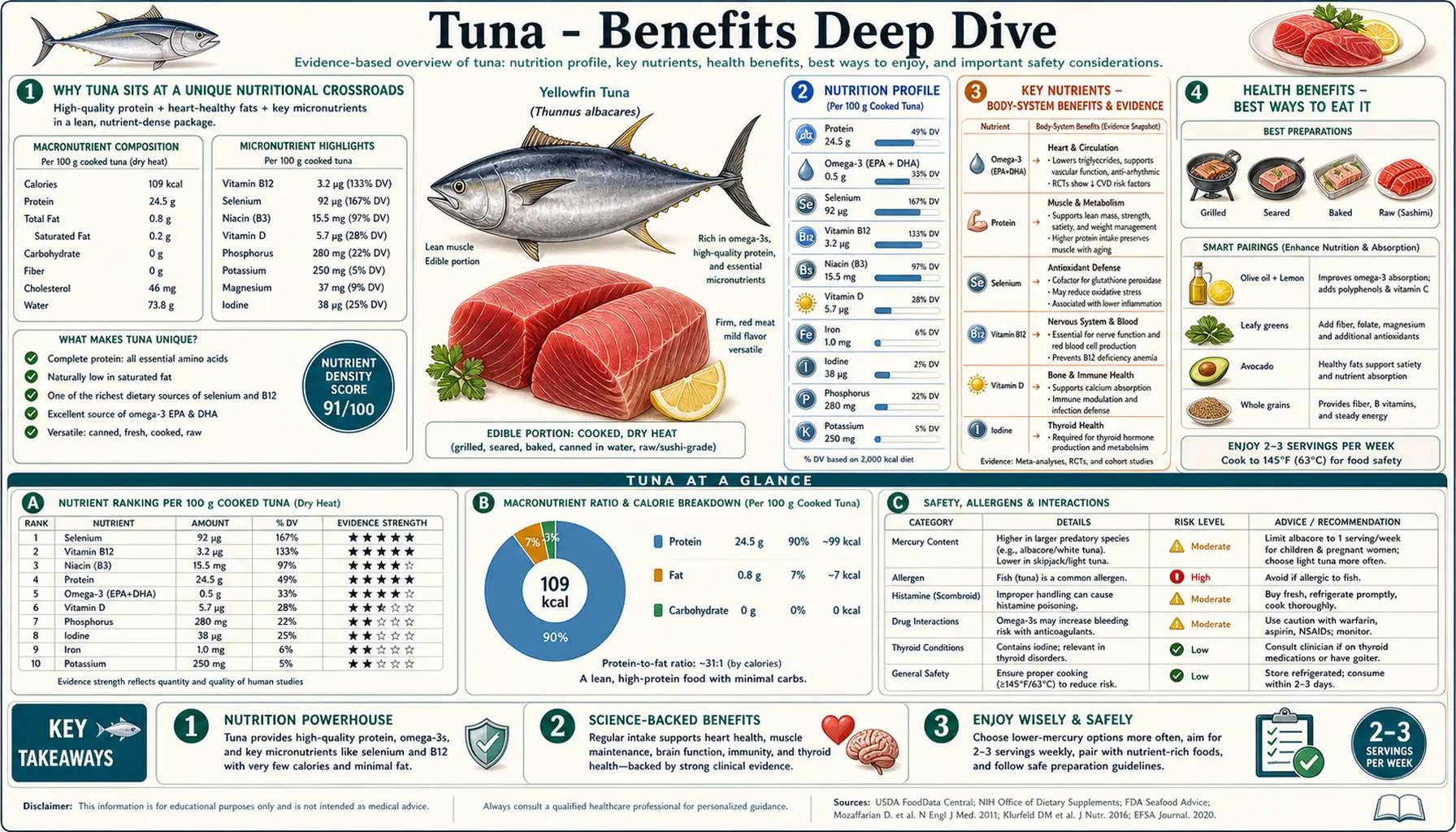
Tuna sits at one of nutrition's most consequential trade-off points: a single 3-oz serving of canned light tuna delivers approximately 22 grams of complete protein, roughly 230 mg of combined EPA and DHA omega-3 fatty acids, and meaningful selenium, B12, and Vitamin D — yet the same serving also carries methylmercury that accumulated up the marine food chain. Four deep-dive pages below dissect the practical questions every tuna-eater needs answered: how the omega-3 benefit weighs against the mercury risk, what makes tuna an unusually clean lean-protein source, why species and processing method (light skipjack vs albacore vs yellowfin vs bluefin) change the calculation by a factor of three or more, and which sustainability certifications actually correlate with low-bycatch fishing methods.
Deep-Dive Articles
Omega-3 vs Mercury
The central trade-off in every can. EPA and DHA cardiovascular and brain benefit weighed against methylmercury neurotoxicity, the FDA / EPA 2021 joint advisory of 8-12 oz/week light tuna for adults and 4 oz/week albacore, why the Faroese and Seychelles cohort studies arrived at different conclusions about prenatal mercury exposure, and the Hair Mercury Test (HMT) as a practical biomarker.
Lean Protein Profile
22 g complete protein per 3-oz serving, PDCAAS of 1.0, leucine content sufficient to trigger muscle protein synthesis, selenium that antagonizes mercury toxicity, B12 (153% DV), niacin, and Vitamin D from cold-water species. Why tuna is one of the highest-quality protein-per-calorie foods available, and how it compares to chicken breast, eggs, and whey.
Light vs Albacore
Skipjack (canned light, ~0.13 ppm mercury, ~230 mg omega-3) vs albacore (canned white, ~0.36 ppm, ~730 mg) vs yellowfin (~0.35 ppm) vs bluefin (~0.69 ppm). FDA testing data, the 3× mercury differential, why albacore concentrates more omega-3 too, and the species-by-species decision tree for pregnant women, children, and adults.
Sustainability
Pole-and-line vs purse seine vs longline. FAD (fish aggregating device) bycatch of dolphins, sea turtles, and sharks. The Marine Stewardship Council (MSC) blue label, Monterey Bay Aquarium Seafood Watch ratings by species and gear type, the collapse of Atlantic bluefin populations, and which brands actually source pole-caught skipjack.
Table of Contents
- Deep-Dive Articles
- Why Tuna Sits at a Unique Nutritional Crossroads
- Research Papers: Omega-3 vs Mercury Balance
- Research Papers: Protein Quality & Micronutrients
- Research Papers: Species, Processing & Mercury Variation
- Research Papers: Sustainability & Fishery Science
- Research Papers: Cross-Cutting (Cardiovascular, Cognitive, Pregnancy)
- External Authoritative Resources
- Connections
- Featured Videos
Why Tuna Sits at a Unique Nutritional Crossroads
Among the protein foods Americans eat regularly, tuna is the most analyzed in the nutritional and toxicological literature for a simple reason: it sits at the intersection of three independently important conversations.
- The omega-3 conversation — EPA and DHA are the only two long-chain omega-3 fatty acids the body uses for membrane phospholipids in the brain, retina, and cardiovascular tissue. Conversion from plant-source alpha-linolenic acid (ALA) is highly inefficient (less than 5% to EPA, less than 0.5% to DHA in most adults). Fatty fish, including tuna, is the dominant dietary source. The American Heart Association and the 2020-2025 Dietary Guidelines for Americans both recommend 8 oz of seafood per week for cardiovascular benefit.
- The methylmercury conversation — tuna, being a long-lived predatory fish, biomagnifies methylmercury from the marine food web. Methylmercury crosses the blood-brain barrier and the placenta, and at high enough exposure causes neurodevelopmental harm in fetuses and young children. The FDA and EPA jointly publish weekly serving recommendations partitioned by fish species and consumer category (adults vs pregnant/lactating women vs children).
- The sustainability conversation — tuna fisheries are global, contested, and uneven. Skipjack stocks (most canned light tuna) are largely healthy and rated "Best Choice" by the Monterey Bay Aquarium Seafood Watch. Bluefin populations — particularly Atlantic bluefin — collapsed to less than 10% of unfished biomass before recent management improved the trajectory. Fishing methods range from highly selective pole-and-line (very low bycatch) to FAD-associated purse seine (high juvenile yellowfin and silky shark bycatch) to longline (high sea turtle, seabird, and shark bycatch). The right answer depends on which species you buy, which brand, and what gear they used.
These three conversations interact. The FDA / EPA mercury advisory and the omega-3 recommendation create a tension that the joint 2021 advisory explicitly addresses: tuna is on the "Good Choices" list (1 serving/week max) for canned light tuna and the "Choices to Avoid" list for bigeye and bluefin during pregnancy. The sustainability picture overlays on top: a pole-caught Pacific skipjack from a MSC-certified fishery is a better choice than a longline-caught yellowfin even if their mercury and omega-3 profiles are similar, because the bycatch externalities differ by an order of magnitude.
The four deep-dive pages explore each axis in turn: the omega-3 vs mercury trade-off, the lean protein and micronutrient profile, the species and processing differences, and the sustainability and fishery picture.
Research Papers: Omega-3 vs Mercury Balance
- FDA / EPA joint advisory on fish consumption for pregnant women and children (2021 update) — PubMed: FDA/EPA fish advisory
- Mozaffarian D, Rimm EB (2006). Fish intake, contaminants, and human health: evaluating the risks and the benefits. JAMA. — PubMed PMID 17047219
- Faroe Islands Children's Health Study (Grandjean P et al.) — methylmercury neurodevelopmental outcomes — PubMed: Faroe cohort
- Seychelles Child Development Study (Davidson PW, Myers GJ) — null association in fish-eating population — PubMed: Seychelles study
- EPA Reference Dose for methylmercury (0.1 µg/kg/day) and derivation — PubMed: EPA MeHg RfD
- Hair mercury as biomarker of methylmercury exposure — PubMed: Hair mercury biomarker
- ALA to EPA / DHA conversion inefficiency in humans — PubMed: ALA to EPA/DHA conversion
- Selenium-mercury antagonism in seafood — PubMed: Selenium-mercury antagonism
- NHANES tuna consumption and blood mercury levels — PubMed: NHANES tuna mercury
- Maternal fish intake and offspring IQ (Hibbeln J et al., ALSPAC cohort, 2007) — PubMed PMID 17307104
Research Papers: Protein Quality & Micronutrients
- PDCAAS protein quality scoring and fish protein — PubMed: PDCAAS and fish
- Leucine threshold for muscle protein synthesis (Phillips SM, 2014) — PubMed: Leucine threshold
- Selenium content of canned tuna and selenoprotein function — PubMed: Selenium in tuna
- Vitamin B12 content of fatty fish and bioavailability — PubMed: B12 in fish
- Vitamin D in fatty fish: tuna, salmon, sardines — PubMed: Vitamin D in fish
- Niacin (B3) content in tuna and metabolic role — PubMed: Niacin in tuna
- Iodine content of marine fish (tuna vs cod vs salmon) — PubMed: Iodine in marine fish
- Taurine content of tuna and cardiovascular role — PubMed: Taurine in tuna
- Histidine content and carnosine biosynthesis — PubMed: Histidine and carnosine
- Tuna in the Mediterranean diet pattern and outcomes — PubMed: Tuna in Mediterranean diet
Research Papers: Species, Processing & Mercury Variation
- FDA mercury levels in commercial fish and shellfish database — PubMed: FDA mercury database
- Skipjack vs albacore vs yellowfin mercury comparison — PubMed: Species mercury comparison
- Bluefin tuna mercury and bioaccumulation — PubMed: Bluefin mercury
- Mercury-omega-3 ratio across tuna species — PubMed: Hg-omega-3 ratio
- Canned vs fresh tuna nutrient and contaminant profile — PubMed: Canned vs fresh
- Age and size of tuna and mercury concentration — PubMed: Size and Hg
- Mercury speciation in tuna (methylmercury vs total) — PubMed: Hg speciation
- Yellowfin and bigeye sashimi-grade mercury survey — PubMed: Sashimi tuna Hg
- Consumer Reports tuna mercury testing (2011, 2017) — PubMed: Consumer Reports tuna
- Tuna mercury variability within a single can (Karimi R et al.) — PubMed: Within-can variability
Research Papers: Sustainability & Fishery Science
- Global tuna stock assessment (IATTC, ICCAT, WCPFC, IOTC pooled) — PubMed: Global tuna assessment
- Atlantic bluefin tuna population collapse and recovery — PubMed: Bluefin recovery
- FAD (fish aggregating device) bycatch of juvenile yellowfin — PubMed: FAD bycatch
- Pole-and-line tuna fishery selectivity and bycatch — PubMed: Pole-and-line
- Longline tuna fishery and sea turtle bycatch — PubMed: Longline turtle bycatch
- Silky shark and oceanic whitetip shark bycatch in tuna fisheries — PubMed: Shark bycatch
- Marine Stewardship Council (MSC) certification impact on fishery practices — PubMed: MSC certification
- Dolphin-safe tuna and the eastern tropical Pacific yellowfin fishery — PubMed: Dolphin-safe tuna
- Climate change impacts on tropical tuna distribution — PubMed: Climate and tuna
- IUU (illegal, unreported, unregulated) fishing in global tuna catch — PubMed: IUU tuna fishing
Research Papers: Cross-Cutting (Cardiovascular, Cognitive, Pregnancy)
- Fish intake and coronary heart disease mortality (Mozaffarian D, 2005) — PubMed: Fish and CHD mortality
- Omega-3 and triglyceride-lowering effect — PubMed: Omega-3 and triglycerides
- DHA and prenatal neurodevelopment — PubMed: DHA and prenatal brain
- Fish consumption and cognitive decline in aging (Morris MC) — PubMed: Fish and cognition
- Fish intake and ischemic stroke risk — PubMed: Fish and stroke
- Mediterranean diet PREDIMED trial and fish intake — PubMed: PREDIMED and fish
- AHA scientific statement on fish and omega-3 (Rimm EB, 2018) — PubMed: AHA fish statement 2018
- Histamine in scombroid (tuna, mackerel) and scombroid poisoning — PubMed: Scombroid poisoning
- Mercury chelation with DMSA in chronic exposure — PubMed: DMSA chelation
- Vitamin D status and fatty fish intake in northern latitudes — PubMed: Vitamin D and fish
External Authoritative Resources
- FDA / EPA — Advice About Eating Fish (2021 update) — the joint advisory with the "Best Choices", "Good Choices", "Choices to Avoid" species lists
- Monterey Bay Aquarium Seafood Watch — Tuna ratings by species and gear
- Marine Stewardship Council — Certified sustainable seafood label
- NIH Office of Dietary Supplements — Omega-3 Fatty Acids Fact Sheet
- American Heart Association — Fish and Omega-3 Recommendations
- PubMed — All research on tuna, mercury, and omega-3
Connections
- All Food
- Tuna (Main Page)
- Omega-3 vs Mercury
- Lean Protein Profile
- Light vs Albacore
- Sustainability & Fishing Methods
- Salmon
- Sardines
- Herring
- Cod
- Omega-3 Fatty Acids
- Mercury (Toxin)
- Selenium
- Vitamin D3
- Vitamin B12