Tuna: Sustainability and Fishing Methods
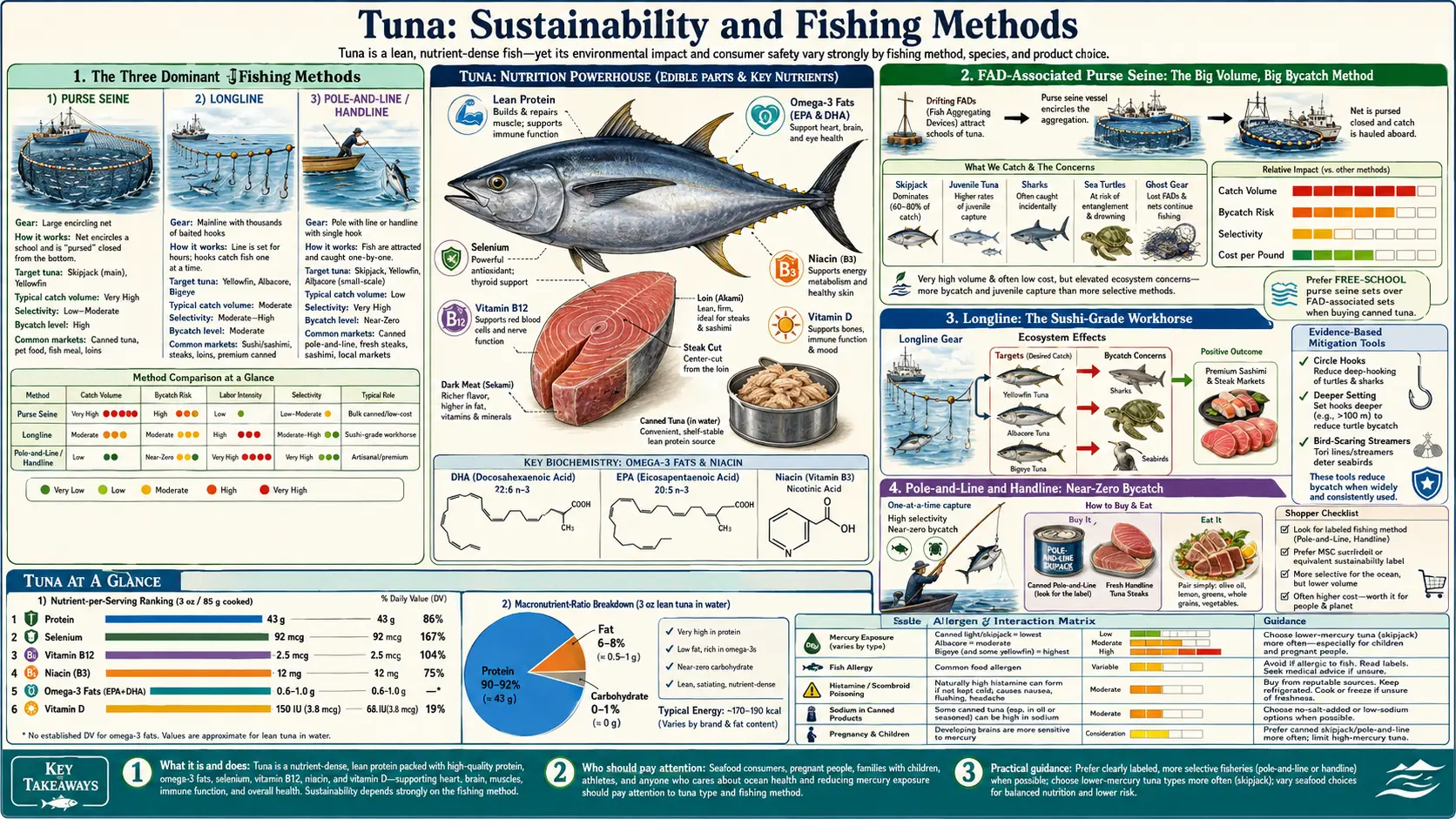
A 165 g can of skipjack tuna can represent radically different fishing footprints depending on how the fish was caught. Pole-and-line skipjack hooked one at a time by Maldivian fishermen has effectively zero bycatch. The same species caught with a purse seine set around a FAD (fish aggregating device) carries an estimated 5-7% bycatch including juvenile yellowfin, juvenile bigeye, silky sharks, and oceanic whitetip sharks (the latter two listed as Critically Endangered by IUCN). Longline-caught yellowfin or bigeye for sashimi grade can incur bycatch of sea turtles, albatrosses, and pelagic sharks at rates that have driven multiple species toward extinction. Two certification schemes — the Marine Stewardship Council blue label and the Monterey Bay Aquarium Seafood Watch rating — translate this complexity into actionable consumer guidance. This deep-dive maps the fishing-method-to-bycatch landscape, explains which brands actually source pole-caught skipjack, and tracks the divergent trajectories of healthy skipjack stocks vs collapsed bluefin stocks.
Table of Contents
- The Three Dominant Fishing Methods
- FAD-Associated Purse Seine: The Big Volume, Big Bycatch Method
- Longline: The Sushi-Grade Workhorse
- Pole-and-Line and Handline: Near-Zero Bycatch
- Stock Status by Species and Ocean
- The Bluefin Collapse and Recovery
- MSC, Seafood Watch, and Dolphin-Safe Labels
- Brand-by-Brand Source Information
- Climate Change and Tuna Distribution Shifts
- Key Research Papers
- Connections
- Featured Videos
The Three Dominant Fishing Methods
Commercial tuna fisheries use one of three principal capture methods, each with very different selectivity and bycatch profiles:
- Purse seine — a vertical wall of net up to 2 km long that is set in a circle around a school of fish, then drawstring-closed at the bottom ("pursed") to enclose the catch. Accounts for ~64% of global tuna catch by weight. Almost all canned tuna in the US is purse-seine-caught. Two sub-types: free-school purse seine (low bycatch) and FAD-associated purse seine (high bycatch).
- Longline — a single main line up to 100 km long with thousands of baited hooks suspended from buoys. Accounts for ~14% of global tuna catch by weight but the dominant method for sashimi-grade yellowfin, bigeye, and bluefin. High bycatch of sea turtles, seabirds, and pelagic sharks.
- Pole-and-line and handline — individual fish caught one at a time on baited hooks attached to bamboo poles (the traditional Maldivian and Indonesian skipjack fishery) or single handlines (Philippines, Indonesia). Accounts for ~10% of global tuna catch. Near-zero bycatch (fish that are not the target are simply released).
The remaining ~12% of global catch comes from troll lines (lures dragged behind a boat — common for Pacific albacore), gillnets (banned in many jurisdictions but still used in some), and miscellaneous artisanal methods.
The bycatch ratio (kg of unwanted species per kg of target tuna) is the most important sustainability metric and varies by an order of magnitude across these methods.
FAD-Associated Purse Seine: The Big Volume, Big Bycatch Method
A FAD (Fish Aggregating Device) is a floating structure — historically a tied bundle of bamboo or netting, now typically a sophisticated buoy with satellite GPS and echo-sounder reporting school size below it — that drifts in the open ocean. Pelagic species, including tuna, instinctively congregate beneath floating objects. A modern industrial tuna fleet deploys 10,000-50,000 satellite-tracked drifting FADs worldwide. When a FAD's echo-sounder reports a sufficiently large school below it, the seiner is dispatched to set the net.
The efficiency is enormous — a single FAD set can yield 100+ tonnes of skipjack. The bycatch is correspondingly significant. The schools that aggregate under FADs are mixed: skipjack of catchable size are joined by juvenile yellowfin, juvenile bigeye, silky sharks (Carcharhinus falciformis, IUCN Vulnerable), oceanic whitetip sharks (Carcharhinus longimanus, IUCN Critically Endangered), mahi-mahi, wahoo, rainbow runners, and various billfish.
The bycatch ratio for FAD-set purse seine is approximately 5-7% by weight (vs ~0.5% for free-school sets and ~0.1% for pole-and-line). The juvenile yellowfin component is particularly damaging because it cuts off the next generation before the fish can reach reproductive maturity; the silky shark component is driving population decline in tropical pelagic shark species.
The RFMOs (Regional Fishery Management Organizations — IATTC for the Eastern Pacific, WCPFC for the Western and Central Pacific, ICCAT for the Atlantic, IOTC for the Indian Ocean) have implemented escalating FAD closures over the last decade. The current WCPFC FAD closure is approximately 3-4 months per year in the equatorial Pacific. Effects on stocks have been measurable; effects on bycatch species have been mixed.
Longline: The Sushi-Grade Workhorse
Longline fishing accounts for most sashimi-grade tuna. The economics: longline allows targeting of large individual fish (yellowfin, bigeye, bluefin) at the depth and temperature where they prefer to feed (typically 100-400 m for bigeye, surface for bluefin during certain seasons), without the schooling-behavior dependence that limits purse seine to surface-aggregating species.
The bycatch problem is severe. The species commonly hooked alongside tuna on a pelagic longline include:
- Sea turtles — loggerhead and leatherback turtles ingest baited hooks while attempting to eat the bait. Mitigation: circle hooks (rather than J-hooks) reduce mortality by ~60-80% because they tend to hook in the jaw rather than the throat. Mandatory in many Atlantic fisheries since 2004.
- Seabirds (albatrosses, petrels) — birds dive on baited hooks during line-setting and are dragged underwater. Multiple albatross species are IUCN Endangered or Critically Endangered largely due to longline bycatch. Mitigation: night-setting, weighted hooks, bird-scaring streamer lines ("tori lines").
- Pelagic sharks — blue sharks, mako sharks, thresher sharks, silky sharks, oceanic whitetips. Some are retained for shark fin trade; most are discarded dead or finned. Mitigation: shark-finning bans in most jurisdictions (often poorly enforced), retention requirements (must land sharks whole rather than finning at sea).
- Marlin and other billfish — striped marlin, blue marlin, sailfish. Many billfish stocks are overfished partly due to longline bycatch.
The total longline bycatch ratio varies widely by region and target species. Atlantic swordfish longliners can have bycatch ratios of 30-50% (more bycatch than target catch by weight). Yellowfin longliners in the Pacific are typically 10-20%.
For the sushi consumer who wants to eat yellowfin or bigeye sustainably, the practical guidance is to look for the Marine Stewardship Council blue label or to consult Seafood Watch ratings — certified longline fisheries have implemented circle hooks, weighted hooks, night-setting, and bycatch monitoring at meaningful rates; uncertified fisheries usually have not.
Pole-and-Line and Handline: Near-Zero Bycatch
Pole-and-line fishing is the oldest commercial tuna method and the gold standard for selectivity. The technique: a bait fish (typically anchovies or sardines, kept live in tanks aboard the vessel) is broadcast over a school of tuna feeding at the surface to trigger a feeding frenzy. Fishermen positioned along the rail of the vessel use 2-4 m bamboo poles with barbless hooks and short lines to flip individual tuna out of the water onto the deck. The barbless hook allows the fish to drop free of the hook on the swing, ready for the next cast.
The Maldives, Indonesia, Japan, and several Pacific island nations operate substantial pole-and-line fleets. The Maldivian skipjack fishery is one of the largest fully MSC-certified pole-and-line tuna fisheries globally.
Sustainability advantages:
- Near-zero bycatch — only fish that take the hook are caught; any non-target species can be released by lifting it over the rail and shaking the barbless hook free
- Size selectivity — the bait-broadcast and pole technique tends to attract larger surface-feeding tuna, avoiding the juvenile recruitment problem of FAD purse seine
- Lower carbon footprint per kg of tuna — vessels are smaller, voyages shorter, and there is no satellite-FAD infrastructure to maintain
- Higher local employment — pole-and-line vessels carry crews of 10-20 for a fraction of the catch volume of an industrial purse seiner with a crew of 30-40, so total employment per tonne of catch is much higher
Disadvantages:
- Higher cost — pole-and-line tuna is typically 20-40% more expensive at retail than purse-seine tuna
- Bait fish footprint — the live bait (anchovies, sardines) is itself a fishery with its own sustainability profile
- Limited scale — pole-and-line cannot meet global tuna demand at current consumption levels; if all tuna were required to be pole-caught, supply would fall ~85%
Pole-and-line brands available in the US include American Tuna, Wild Planet (some lines), Safe Catch (some lines), and the "sourced one-by-one" trader-marketed lines from Whole Foods and similar retailers.
Stock Status by Species and Ocean
The RFMOs publish annual stock assessments for each tuna stock. Current status (as of the 2023-2024 assessment cycle):
- Western and Central Pacific skipjack: Healthy. Biomass above maximum sustainable yield reference point. ~70% of global skipjack catch comes from this stock.
- Eastern Pacific skipjack: Healthy. Stable since 2017 with active FAD closure management.
- Indian Ocean skipjack: Healthy but flagged for caution. Recovery from recent overfishing.
- Atlantic skipjack: Healthy.
- Pacific yellowfin: Healthy at the stock level, but ~30% of the catch is juveniles taken on FAD sets — a recruitment concern that does not yet show in stock biomass numbers.
- Atlantic yellowfin: Slightly overfished. ICCAT implementing tightening quotas.
- Indian Ocean yellowfin: Overfished, no longer overfishing as of 2024 with current quotas.
- Pacific albacore: Healthy. North Pacific and South Pacific stocks both stable.
- Atlantic albacore: Recovering from prior overfishing. Now classified as not overfished and not subject to overfishing.
- Pacific bigeye: Overfished and overfishing continuing in the equatorial Pacific. Heavily impacted by FAD sets that catch juveniles.
- Atlantic bigeye: Overfished, overfishing reduced under recent ICCAT quotas.
- Atlantic bluefin (Western stock, Gulf of Mexico spawning): Severely depleted historically; recovering under strict ICCAT management. Currently classified as "rebuilding".
- Atlantic bluefin (Eastern stock, Mediterranean spawning): Rebuilt from collapse. Currently considered healthy.
- Pacific bluefin: Severely depleted (4% of unfished biomass at 2014 low). Recovering slowly under WCPFC and IATTC quotas; still well below sustainable target.
- Southern bluefin: Overfished, recovering slowly. Listed as Critically Endangered by IUCN.
The headline summary: skipjack populations are doing well; yellowfin and albacore are mostly OK with regional exceptions; bigeye is a problem; bluefin remains a problem despite recovery in some stocks.
The Bluefin Collapse and Recovery
Atlantic bluefin tuna collapsed in the 1990s-2000s due to overfishing for the sushi market. The Western Atlantic stock (which spawns in the Gulf of Mexico) reached approximately 6% of its unfished biomass by 2003. ICCAT quotas had been chronically set above scientific advice, and IUU (illegal, unreported, unregulated) catch may have doubled the official landings. The Eastern Atlantic stock (Mediterranean spawning) faced similar trajectory.
The recovery story is one of the most striking modern fisheries-management success stories. In 2007, ICCAT adopted a strict 15-year recovery plan with tight quotas, electronic vessel monitoring, and improved catch documentation. The Eastern Atlantic stock recovered to its rebuilding target by approximately 2017 and is now classified as healthy. The Western Atlantic stock is recovering more slowly but has been on a rebuilding trajectory since the early 2010s.
Pacific bluefin is a different story. The stock declined precipitously from 1990 to 2014, reaching an estimated 4% of unfished biomass at the bottom. WCPFC and IATTC implemented joint quotas in 2014 that have stabilized the decline; the stock is now slowly increasing but remains far below sustainable target. Aquaculture (ranching wild-caught juveniles in pens for 6-24 months) accounts for a significant fraction of bluefin reaching the market but does not relieve fishing pressure on the wild stock (since the ranched fish are wild-caught juveniles).
Southern bluefin (CCSBT-managed) is the most depleted of the three bluefin species, classified as Critically Endangered by IUCN. The CCSBT quota system has stabilized but not yet meaningfully rebuilt the stock.
The patient-facing implication: bluefin tuna is the only commercial tuna species where consumption choices have meaningful population-level impact. A canned skipjack purchase is taking from a healthy stock; a bluefin sashimi purchase is taking from a depleted-or-recovering stock. The mercury argument and the sustainability argument both point in the same direction here.
MSC, Seafood Watch, and Dolphin-Safe Labels
Three certification or rating schemes dominate consumer-facing sustainability guidance for tuna:
- Marine Stewardship Council (MSC) — blue check label. Independent third-party certification of fisheries against the MSC Fisheries Standard. Audits stock status, ecosystem impact, and management effectiveness. MSC-certified tuna fisheries include the Maldives pole-and-line skipjack, the American Albacore Fishing Association (Pacific troll albacore), and several PNA (Parties to the Nauru Agreement) free-school purse seine skipjack fisheries. MSC certification has been criticized for permitting purse seine fisheries with significant bycatch, but the framework requires bycatch monitoring and reduction commitments.
- Monterey Bay Aquarium Seafood Watch. Rates seafood by species, gear, and ocean region into three categories: Best Choice (green), Good Alternative (yellow), Avoid (red). For tuna specifically: most pole-and-line skipjack ratings are Best Choice; FAD-set purse seine skipjack is typically Good Alternative; longline yellowfin from various regions ranges from Good Alternative to Avoid; longline bigeye is largely Avoid; bluefin is universally Avoid.
- Dolphin-Safe label (Earth Island Institute). Originated in response to the 1980s eastern tropical Pacific yellowfin fishery, where purse seiners set nets around schools of dolphins that swam above schools of yellowfin (the "dolphin set" tactic). Dolphin Safe certification prohibits dolphin sets and requires observer verification. The label is essentially universal on US-marketed canned tuna today. Limitation: Dolphin Safe does not address bycatch of other species (sharks, turtles, seabirds, juvenile tuna) and does not address stock status. A FAD-set purse seine skipjack can be Dolphin Safe certified while having significant other bycatch.
Practical guidance: MSC certification is the most rigorous, Seafood Watch ratings are the most species-specific and granular, and Dolphin Safe is necessary but not sufficient. A purchase that is MSC-certified AND Seafood Watch Best Choice is the strongest sustainability signal.
Brand-by-Brand Source Information
The Greenpeace USA "Carting Away the Oceans" report has periodically ranked US tuna brands on sustainability. As of the most recent ratings:
- Highest-rated brands (pole-and-line or FAD-free purse seine, MSC certified, transparent sourcing): American Tuna (Pacific pole-and-line albacore), Wild Planet (pole-and-line skipjack and troll albacore), Safe Catch (single-fish testing, often pole-caught), Whole Foods 365 (varies by SKU; pole-and-line lines available).
- Mid-tier brands (some FAD-free product lines available, transparency improving): Bumble Bee (introducing "Wild Selections" MSC line alongside conventional), StarKist (similar mixed portfolio), Chicken of the Sea (some sustainably sourced lines).
- Lower-rated (predominantly FAD-set purse seine, limited transparency): Most generic store-brand and budget canned tuna falls in this category.
For an authoritative current ranking, consult Greenpeace USA's most recent "Carting Away the Oceans" report and the Monterey Bay Aquarium Seafood Watch consumer guide. Both are updated periodically and reflect the current sustainability picture.
The cost premium for the highest-rated brands is real — expect to pay $3-5 per can for pole-and-line skipjack vs $1-2 for conventional FAD-purse-seine. For consumers eating 2-3 cans per week, the difference is $10-15 per month — a manageable premium for the bycatch reduction.
Climate Change and Tuna Distribution Shifts
Tropical tuna species (skipjack, yellowfin, bigeye) are responding to ocean warming with measurable distribution shifts. The 2020s have seen accelerated movement of skipjack populations eastward across the equatorial Pacific, with consequences for the small island developing states (Tuvalu, Kiribati, Nauru, Solomon Islands, Federated States of Micronesia, Marshall Islands, Palau, Papua New Guinea) whose Exclusive Economic Zones (EEZs) generate substantial tuna license revenue under the Parties to the Nauru Agreement (PNA) Vessel Day Scheme.
Modeling by Bell et al. (2021) projects that by 2050, the spatial distribution of skipjack will have shifted such that 30% of the current PNA tuna catch will have moved into international waters or into the EEZs of larger states that do not depend on tuna revenue. The geopolitical and food-security implications are significant.
For temperate tuna species (albacore, bluefin), warming is driving range expansion poleward. Atlantic bluefin are now caught regularly in Greenland and Iceland waters where they were essentially absent 30 years ago. Pacific bluefin distributional shifts are less well-characterized but follow similar patterns.
Climate adaptation in fisheries management is an active area of policy development. The PNA Vessel Day Scheme has been adapted to allow for shifting effort distribution; ICCAT and other RFMOs are developing climate-aware quota frameworks.
Key Research Papers
- Pons M et al. (2017). Effects of biological, economic and management factors on tuna and billfish stock status. Fish and Fisheries 18(1):1-21. — PubMed: Tuna stock status
- Gilman E et al. (2014). Performance of regional fisheries management organizations: ecosystem-based governance of bycatch and discards. Fish and Fisheries 15(2):327-351. — PubMed: RFMO bycatch governance
- Dagorn L et al. (2013). Is it good or bad to fish with FADs? What are the real impacts of the use of drifting FADs on pelagic marine ecosystems? Fish and Fisheries 14(3):391-415. — PubMed: FAD impacts
- Hall MA, Roman M (2013). Bycatches and non-tuna catch in the tropical tuna purse seine fisheries of the world. FAO Fisheries and Aquaculture Technical Paper. — PubMed: Purse seine bycatch
- Watson JT et al. (2009). Fishing methods to reduce sea turtle mortality associated with pelagic longlines. Canadian Journal of Fisheries and Aquatic Sciences. — PubMed: Circle hooks and turtle bycatch
- Lewison RL et al. (2014). Global patterns of marine megafauna bycatch in longline fisheries. PNAS 111(14):5271-6. — PubMed PMID 24639512
- Block BA et al. (2005). Electronic tagging and population structure of Atlantic bluefin tuna. Nature 434(7037):1121-7. — PubMed PMID 15858572
- Worm B et al. (2013). Global catches, exploitation rates, and rebuilding options for sharks. Marine Policy 40:194-204. — PubMed: Global shark catch
- Bell JD et al. (2021). Pathways to sustaining tuna-dependent Pacific Island economies during climate change. Nature Sustainability 4:900-910. — PubMed: Climate change and Pacific tuna
- Polacheck T (2006). Tuna longline catch rates in the Indian Ocean: did industrial fishing result in a 90% decline in the abundance of large predatory species? Marine Policy 30(5):470-82. — PubMed: Longline abundance decline
- Hilborn R et al. (2020). Effective fisheries management instrumental in improving fish stock status. PNAS 117(4):2218-2224. — PubMed PMID 31932439
- Selden RL, Pinsky ML (2019). Climate change adaptation and spatial fisheries management. Predicting Future Oceans review chapter. — PubMed: Climate and spatial fisheries
PubMed Topic Searches
- PubMed: Tuna sustainability
- PubMed: FAD purse seine bycatch
- PubMed: Longline bycatch mitigation
- PubMed: Bluefin collapse and recovery
- PubMed: Pole-and-line tuna fishery
Connections
- All Food
- Tuna (Main Page)
- Tuna Benefits Hub
- Omega-3 vs Mercury
- Lean Protein Profile
- Light vs Albacore
- Salmon
- Sardines
- Herring
- Cod
- Anchovies
- Omega-3 Fatty Acids
- Mercury
- Selenium
- Lab Tests