Tuna: Lean Protein Profile
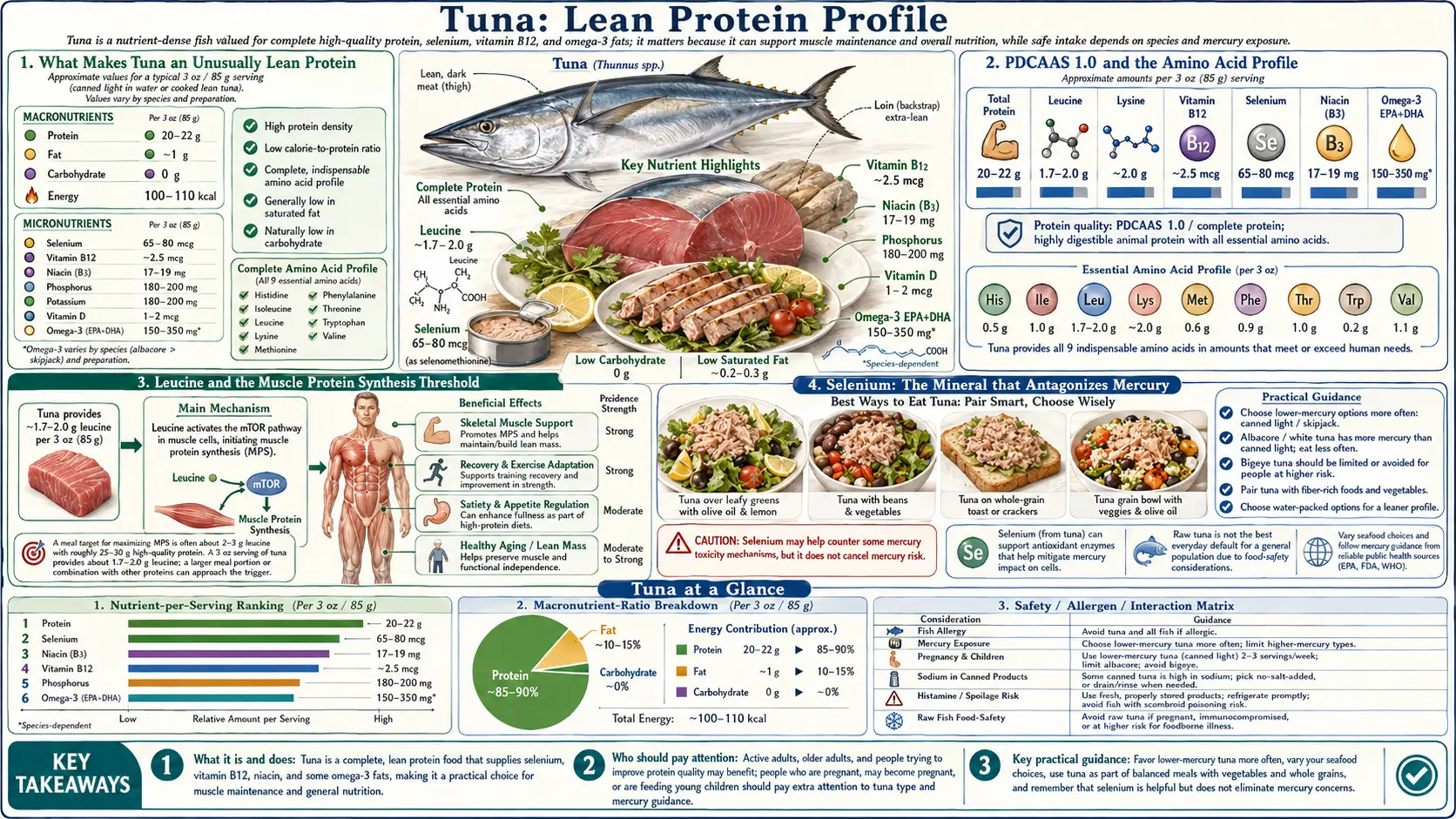
A 3-oz can of light tuna in water delivers 22 grams of complete protein for about 100 calories, with a Protein Digestibility-Corrected Amino Acid Score (PDCAAS) of 1.0 — the maximum possible — and approximately 2.0 g of leucine, comfortably above the 1.7-2.5 g threshold required to maximally stimulate skeletal muscle protein synthesis in a single meal. Per calorie, tuna ranks among the highest-quality protein sources available, ahead of chicken breast, eggs, and even isolated whey protein when measured by leucine-per-calorie. The protein comes packaged with selenium (which directly antagonizes the mercury that came with it), 153% DV of Vitamin B12, 64% DV of niacin, meaningful Vitamin D (in fattier species), iodine, taurine, and histidine. This deep-dive walks through each of these nutrients quantitatively and explains why tuna remains a workhorse food for bodybuilders, dieters, the elderly fighting sarcopenia, and anyone trying to hit a protein target on a calorie budget.
Table of Contents
- What Makes Tuna an Unusually Lean Protein
- PDCAAS 1.0 and the Amino Acid Profile
- Leucine and the Muscle Protein Synthesis Threshold
- Selenium: The Mineral that Antagonizes Mercury
- Vitamin B12 and Niacin
- Vitamin D in Fatty Tuna Species
- Iodine, Taurine, Histidine
- Comparison: Tuna vs Chicken Breast, Eggs, Whey, Salmon
- Clinical Applications: Cutting, Sarcopenia, Postoperative Recovery
- Key Research Papers
- Connections
- Featured Videos
What Makes Tuna an Unusually Lean Protein
The species in the genus Thunnus and related Katsuwonus (skipjack) are uniquely high-performance pelagic predators. They are obligate continuous swimmers (ram ventilators — they suffocate if they stop moving) and maintain partial endothermy through counter-current heat exchange in vascular retes mirabile, which lets them hunt in cold deep water at metabolic rates far above the seawater temperature would normally permit. The muscle that powers all of this is dense, highly vascularized, and protein-dense.
The practical consequence: skipjack and yellowfin flesh is approximately 25% protein and only 1-2% fat by weight. Even "fatty" tuna species (albacore, bluefin) rarely exceed 5-6% fat in the white muscle, with the higher-fat portion concentrated in the belly (toro) and dark muscle near the lateral line. The white meat of all tuna species is among the leanest natural protein sources available, with caloric density driven almost entirely by the protein content itself rather than by accompanying fat or carbohydrate.
Canned tuna sharpens this further. Canned in water, the fat content is essentially what was natively in the fish (~1-2 g per 3-oz serving for skipjack, ~3 g for albacore). Canned in oil, the soaking oil contributes another 5-10 g of fat per serving — usually soybean or olive oil, which changes the macronutrient profile substantially. For dieters tracking calories, water-packed is dramatically more calorie-efficient: 100 kcal for water-packed vs 200 kcal for oil-packed at the same protein delivery.
USDA FoodData Central values for canned light tuna in water (3 oz cooked weight, drained):
- Calories: 99 kcal
- Protein: 21.7 g (87% of calories)
- Fat: 0.7 g
- Carbohydrate: 0 g
- Sodium: 287 mg (varies; low-sodium versions ~50 mg)
By protein density and caloric efficiency, only egg whites, plain chicken breast, low-fat cottage cheese, and isolated whey protein come close.
PDCAAS 1.0 and the Amino Acid Profile
The Protein Digestibility-Corrected Amino Acid Score is the FAO/WHO standard for protein quality, defined as the limiting amino acid's ratio in the protein vs the reference amino acid pattern, multiplied by the true ileal digestibility. The score is capped at 1.0 (any value calculated above 1.0 is reported as 1.0). Tuna protein scores 1.0, the maximum.
The complete amino acid profile of tuna protein (per 100 g cooked, USDA):
- Essential amino acids: Leucine 2.4 g, Lysine 2.7 g, Valine 1.6 g, Isoleucine 1.4 g, Threonine 1.3 g, Phenylalanine 1.2 g, Histidine 1.5 g (notably high), Methionine 0.9 g, Tryptophan 0.3 g
- Non-essential / conditionally essential: Glutamic acid 4.5 g, Aspartic acid 3.0 g, Arginine 1.8 g, Alanine 1.8 g, Glycine 1.4 g, Proline 1.0 g, Serine 1.2 g, Tyrosine 1.0 g, Cysteine 0.3 g, Taurine ~0.2 g
The leucine content is particularly noteworthy. Per 100 g cooked tuna, leucine is approximately 2.4 g — comparable to chicken breast (2.3 g) and slightly higher than eggs (1.1 g per large egg, but eggs are much smaller per piece). Per gram of protein, tuna delivers approximately 9% leucine, near the upper end of natural food proteins. Only isolated whey protein concentrate (10-12% leucine) substantially exceeds this.
For an essential-amino-acid abundance overview and per-AA deep dives, see Amino Acids.
Leucine and the Muscle Protein Synthesis Threshold
Muscle protein synthesis (MPS) is the anabolic process by which skeletal muscle incorporates amino acids into new contractile and structural protein. MPS is regulated primarily by leucine acting through the mTORC1 signaling pathway: leucine binds the cytosolic sensor Sestrin2, which releases inhibition of GATOR2, which activates Rag GTPases, which recruit mTORC1 to the lysosomal surface where it is activated by Rheb.
The dose-response of MPS to leucine is sigmoidal with a threshold: below approximately 0.7-3 g of leucine per meal (the exact value depends on age and population), MPS is sub-maximally stimulated; above the threshold, MPS reaches a ceiling and further leucine does not increase the response. Stuart Phillips and colleagues at McMaster University have characterized this threshold extensively. The current consensus (Phillips 2014, 2016):
- Young adults: 1.7-2.5 g leucine per meal is sufficient for maximal MPS
- Older adults (anabolic resistance): 2.5-3.0 g leucine per meal — ~50% more than young adults need
- Per-meal protein target derived from this: 0.4 g protein per kg body weight, 3-4 times per day, with the highest-quality protein source available at each meal
A single 3-oz serving of canned light tuna delivers approximately 2.0 g of leucine — right at the young-adult threshold. A 4-oz serving (one large pouch or one and a half cans) delivers ~2.7 g, sufficient for older adults. This is why tuna shows up so frequently in clinically tested high-protein dietary patterns for sarcopenia (involuntary loss of muscle mass with aging), post-bariatric surgery, and post-hospital deconditioning: it delivers above-threshold leucine in a calorie-efficient, shelf-stable, inexpensive package.
For broader context on sarcopenia prevention and muscle health, see Geriatrics.
Selenium: The Mineral that Antagonizes Mercury
A 3-oz serving of canned tuna provides approximately 60-90 µg of selenium — 110-160% of the adult RDA (55 µg). This is one of the most concentrated dietary sources of selenium in the American food supply, exceeded only by Brazil nuts (~95 µg per single nut), some organ meats, and some other ocean fish.
Selenium serves three principal functions:
- Selenoprotein synthesis — selenium is incorporated as selenocysteine into approximately 25 human selenoproteins, including the four glutathione peroxidase isoforms (cellular antioxidant defense), three thioredoxin reductases (redox regulation), three iodothyronine deiodinases (thyroid hormone activation), and selenoprotein P (selenium transport).
- Methylmercury antagonism — selenium has the highest binding affinity for mercury of any biological element; the mercury-selenium binding constant is roughly 10^45. Dietary selenium intercepts methylmercury before it can inhibit selenoenzymes. The selenium content of nearly all ocean fish (including tuna) exceeds the mercury content on a molar basis, which is the basis for the "selenium health benefit value" framework discussed in detail in Omega-3 vs Mercury.
- Thyroid function support — the iodothyronine deiodinases that convert thyroxine (T4) to active triiodothyronine (T3) are all selenoproteins. Selenium deficiency impairs T4 → T3 conversion and is implicated in Hashimoto's thyroiditis and other autoimmune thyroid disorders.
The upper limit for selenium intake is 400 µg/day. Selenium toxicity (selenosis) presents as garlic breath, brittle hair and nails, gastrointestinal upset, and at extreme exposures peripheral neuropathy. Several cans of tuna per day combined with Brazil nut snacking can push intake into the borderline-high range, but ordinary 2-3 cans per week is well within safety. For more on selenium, see Selenium.
Vitamin B12 and Niacin
Tuna is one of the densest dietary sources of Vitamin B12 (cobalamin) outside of organ meats. A 3-oz serving delivers approximately 2.5-9.0 µg of B12 (varies by species and processing; albacore is at the high end, skipjack at the lower end) — that is 100-375% of the adult RDA of 2.4 µg.
Vitamin B12 has two enzymatic functions in humans:
- As methylcobalamin, it serves as the cofactor for methionine synthase, which converts homocysteine to methionine using a methyl group donated by 5-methyl-tetrahydrofolate. B12 deficiency raises serum homocysteine (a cardiovascular risk marker) and traps folate in the methyl form (the "methyl folate trap").
- As adenosylcobalamin, it serves as the cofactor for methylmalonyl-CoA mutase, which converts methylmalonyl-CoA to succinyl-CoA in the metabolism of odd-chain fatty acids and certain amino acids. B12 deficiency elevates serum methylmalonic acid (MMA), the most sensitive biomarker of B12 status.
Clinical B12 deficiency presents as megaloblastic anemia (folate-only repletion will resolve the anemia but allow the neurological damage to progress) and as subacute combined degeneration of the spinal cord (a dorsal-column and lateral-column demyelinating syndrome). The conditions most likely to produce B12 deficiency are vegan diets without supplementation, pernicious anemia (autoimmune destruction of gastric intrinsic factor), atrophic gastritis (common in the elderly), Helicobacter pylori infection, and chronic use of metformin or proton pump inhibitors.
For all of these populations, regular tuna consumption provides a meaningful safety margin. Two cans per week reliably maintains B12 status in healthy adults. For more, see Vitamin B12.
Niacin (Vitamin B3) content in tuna is also unusually high — approximately 10-13 mg per 3-oz serving, or 63-81% of the 16 mg adult RDA. Niacin is the precursor to NAD+ and NADP+, the principal redox cofactors in cellular metabolism. Pharmacologic doses of niacin (1-3 g/day) reduce LDL-cholesterol, lower lipoprotein(a), and raise HDL-cholesterol, though clinical outcome trials (AIM-HIGH, HPS2-THRIVE) failed to show cardiovascular benefit when added to statin therapy.
Vitamin D in Fatty Tuna Species
Vitamin D is concentrated in the fatty muscle of cold-water ocean fish. Among tuna species:
- Bluefin tuna: 690 IU per 3 oz (highest of any tuna species, exceeds all other commonly eaten fish except wild salmon)
- Albacore: 130 IU per 3 oz canned
- Yellowfin: ~60 IU per 3 oz
- Skipjack (canned light): 25-40 IU per 3 oz
For comparison, the adult RDA for Vitamin D is 600 IU (15 µg) for ages 1-70 and 800 IU (20 µg) for age 71+. A bluefin sashimi meal could meet a day's requirement on its own; a can of light tuna contributes only a few percent. The omega-3-fortified canned tuna products that have appeared in the last several years often add Vitamin D as well, bringing standard skipjack up to 50-100 IU per serving.
Vitamin D deficiency is one of the most common subclinical nutrient deficiencies in the developed world (especially at northern latitudes). For comprehensive coverage, see Vitamin D3.
Iodine, Taurine, Histidine
Iodine: Tuna provides approximately 17-50 µg of iodine per 3-oz serving — substantially less than seaweed-based foods (a single sheet of nori or wakame can have 50-500 µg), but enough to make a meaningful contribution to the 150 µg adult RDA. Iodine is the substrate for thyroid hormone synthesis (T4 has four iodine atoms; T3 has three). The selenium that comes with tuna directly supports the selenoenzyme deiodinases that activate T3 from T4, making tuna a synergistic source of both thyroid-relevant nutrients.
Taurine: An amino sulfonic acid (not a standard alpha-amino acid in protein) that is highly concentrated in heart, brain, retina, and skeletal muscle. Tuna provides approximately 150-200 mg of taurine per 3-oz serving — modest compared to scallops or octopus (~800 mg/serving) but meaningful given typical Western daily intakes of ~150 mg/day. Taurine supports cardiovascular function (modulates intracellular calcium handling in cardiomyocytes), bile acid conjugation (taurocholic acid), and osmotic regulation. Pharmacologic supplementation (1.5-3 g/day) has shown blood pressure reduction in mildly hypertensive patients and improved exercise tolerance in heart failure.
Histidine: An essential amino acid that is also the precursor to histamine and to the dipeptide carnosine (beta-alanyl-histidine), which acts as an intramuscular pH buffer. Tuna is unusually histidine-rich (~1.5 g per 100 g cooked, vs ~0.6 g for chicken breast). The histidine pool in tuna is one factor in why scombroid fish (tuna, mackerel, mahi-mahi) can cause "scombroid poisoning" if improperly refrigerated — bacterial histidine decarboxylase converts the abundant histidine to histamine, which is heat-stable and not destroyed by cooking. Fresh, properly refrigerated tuna is fine; abuse-temperature-stored tuna is a histamine bomb.
For a per-amino-acid deep dive, see the Amino Acids hub.
Comparison: Tuna vs Chicken Breast, Eggs, Whey, Salmon
Per 25 g of protein delivered (a standard per-meal protein target for a 70-kg adult):
- Canned light tuna (water-packed): 115 kcal, 0.8 g fat, 2.3 g leucine, 70 µg selenium, 3 µg B12, 230 mg omega-3, ~40 µg mercury
- Chicken breast, skinless cooked: 130 kcal, 2.7 g fat, 2.6 g leucine, 22 µg selenium, 0.3 µg B12, <50 mg omega-3, 0 µg mercury
- Whole eggs (4 large): 280 kcal, 18 g fat, 2.2 g leucine, 65 µg selenium, 1.8 µg B12, 75 mg omega-3, 0 µg mercury
- Whey protein isolate (~28 g powder): 110 kcal, 0.5 g fat, 2.8 g leucine, trace selenium and B12, 0 mg omega-3, 0 µg mercury
- Wild salmon, cooked: 175 kcal, 8 g fat, 2.2 g leucine, 40 µg selenium, 4 µg B12, 1,800 mg omega-3, ~5 µg mercury
Tuna's comparative advantages: lowest calorie per gram of protein among whole foods (only whey isolate beats it, and that requires powder mixing), highest selenium of any common protein, very high B12, meaningful omega-3 (~5× chicken). Comparative disadvantages: mercury content (chicken, eggs, whey have none), lower omega-3 than salmon. The right answer for any meal depends on which axis matters most for that meal.
For broader food comparisons, see Salmon, Eggs, and Beef.
Clinical Applications: Cutting, Sarcopenia, Postoperative Recovery
- Cutting / fat loss diets: Tuna's leucine-per-calorie ratio is essentially unbeatable in the natural food category. Bodybuilders preparing for competition lean heavily on canned tuna in the final 8-12 weeks of a cut for exactly this reason. Practical caution: rotate species to spread mercury exposure, and consider hair mercury testing if eating 5+ cans per week for an extended cut.
- Sarcopenia prevention (age 60+): The European Society for Clinical Nutrition and Metabolism (ESPEN) recommends 1.0-1.2 g protein/kg/day for healthy older adults (vs the standard 0.8 g/kg/day RDA), with 25-30 g protein per meal containing at least 2.5-3 g of leucine. A 4-oz serving of canned tuna at each of three daily meals meets the per-meal threshold. The Mediterranean diet, which features regular fatty fish consumption, has shown reduced incidence of sarcopenia in longitudinal cohort studies.
- Postoperative and post-hospitalization recovery: Catabolic states from surgery, trauma, or acute illness can require 1.5-2.0 g protein/kg/day. Tuna's shelf-stable, ready-to-eat, no-preparation-required format is practical for patients discharged with deconditioning. The omega-3 content may modestly reduce postoperative inflammation.
- Diabetes (Type 2) and metabolic syndrome: The omega-3 in fatty fish improves insulin sensitivity modestly, and the high protein content blunts post-meal glucose excursions when combined with carbohydrate. Two servings of fatty fish per week is part of the ADA dietary pattern guidance.
- Pregnancy and lactation (within mercury limits): Tuna provides DHA for fetal brain development plus protein, B12, and selenium during a high-demand period. Stay within the 12-oz light / 4-oz albacore weekly cap.
- Vegetarian-leaning omnivores who include fish: Two cans of tuna per week reliably maintains B12 status that pure plant-based diets cannot deliver without supplementation.
Key Research Papers
- Schaafsma G (2000). The Protein Digestibility-Corrected Amino Acid Score. Journal of Nutrition 130(7):1865S-7S. — PubMed PMID 10867064
- Phillips SM (2014). A brief review of higher dietary protein diets in weight loss: a focus on athletes. Sports Medicine 44 Suppl 2:S149-53. — PubMed PMID 25355188
- Moore DR et al. (2015). Protein ingestion to stimulate myofibrillar protein synthesis requires greater relative protein intakes in healthy older versus younger men. J Gerontol A Biol Sci Med Sci 70(1):57-62. — PubMed PMID 25056502
- Bauer J et al. (2013). Evidence-based recommendations for optimal dietary protein intake in older people: a position paper from the PROT-AGE Study Group. JAMDA 14(8):542-59. — PubMed PMID 23867520
- Rayman MP (2012). Selenium and human health. Lancet 379(9822):1256-68. — PubMed PMID 22381456
- Ralston NVC, Raymond LJ (2010). Dietary selenium's protective effects against methylmercury toxicity. Toxicology 278(1):112-23. — PubMed PMID 20561558
- Stabler SP (2013). Vitamin B12 deficiency. NEJM 368(2):149-60. — PubMed PMID 23301732
- Bouillon R et al. (2019). Skeletal and extraskeletal actions of vitamin D: current evidence and outstanding questions. Endocrine Reviews 40(4):1109-1151. — PubMed PMID 30321335
- Schaffer S, Kim HW (2018). Effects and Mechanisms of Taurine as a Therapeutic Agent. Biomol Ther (Seoul) 26(3):225-241. — PubMed PMID 29631391
- Hill CA et al. (2007). Influence of beta-alanine supplementation on skeletal muscle carnosine concentrations and high intensity cycling capacity. Amino Acids 32(2):225-33. — PubMed PMID 16868650
- Cruz-Jentoft AJ et al. (2019). Sarcopenia: revised European consensus on definition and diagnosis (EWGSOP2). Age and Ageing 48(1):16-31. — PubMed PMID 30312372
- Houston MC (2018). The role of magnesium, vitamin D and tuna omega-3 in cardiovascular disease. Curr Opin Cardiol review. — PubMed: Tuna and cardiovascular review
PubMed Topic Searches
- PubMed: Tuna protein quality
- PubMed: Leucine MPS threshold
- PubMed: Selenium in tuna
- PubMed: B12 and Vitamin D in tuna
- PubMed: Sarcopenia and protein
Connections
- All Food
- Tuna (Main Page)
- Tuna Benefits Hub
- Omega-3 vs Mercury
- Light vs Albacore
- Sustainability
- Amino Acids Hub
- Leucine
- Selenium
- Vitamin B12
- Vitamin D3
- Salmon
- Eggs
- Beef
- Geriatrics
- Omega-3 Fatty Acids