Tuna: History and Origins
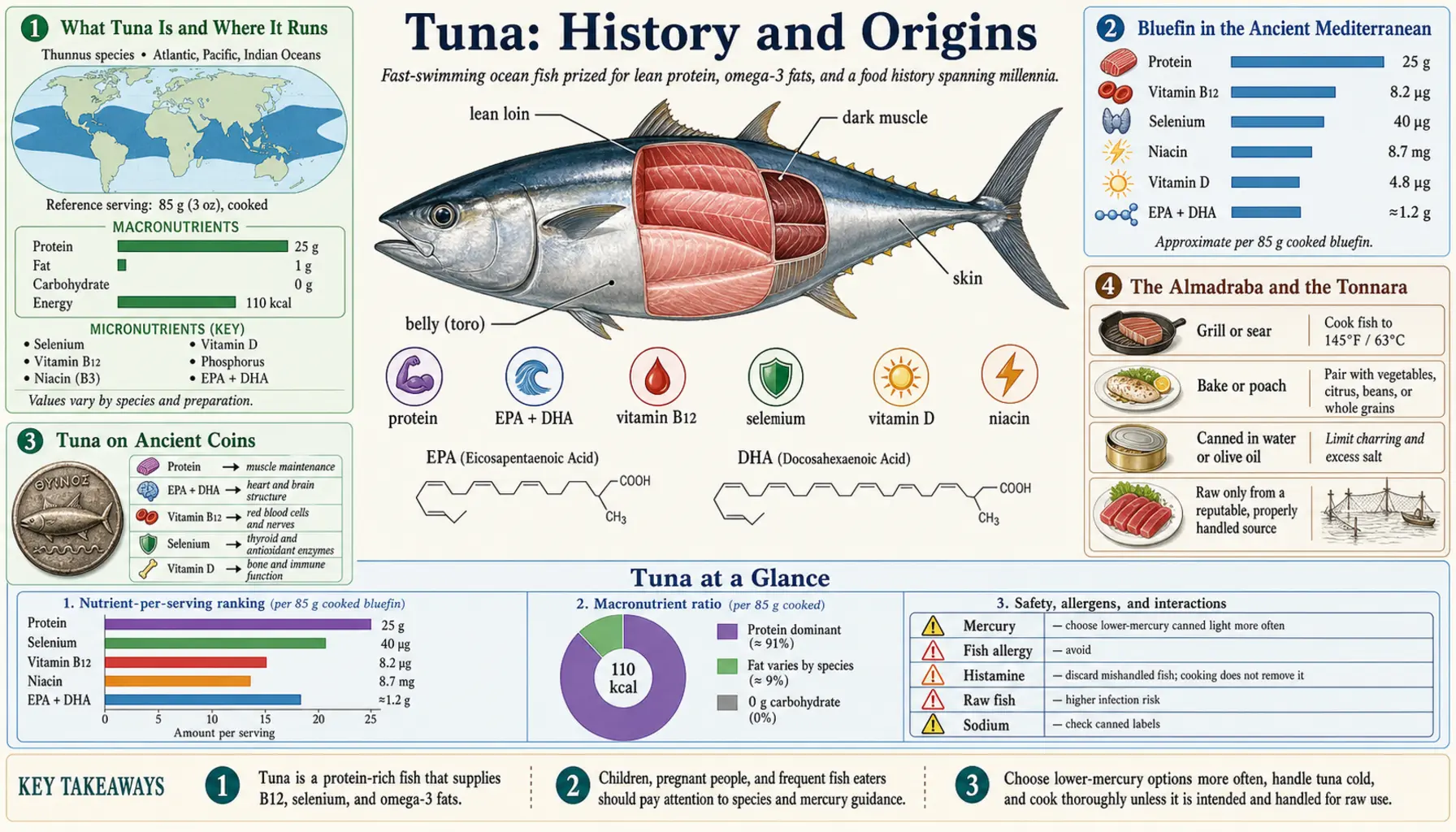
Tuna is one of the few foods that has been, all at once, a luxury of antiquity and the cheapest protein on a modern shelf. The giant Atlantic bluefin has migrated through the Strait of Gibraltar and along the coasts of the Mediterranean for thousands of years, and for almost as long people have strung nets across its path to trap it — the great fixed traps the Spanish call the almadraba and the Italians the tonnara. Ancient cities stamped the tuna onto their coins; the Romans salted it and shipped it across an empire. Then, in the early twentieth century, a sardine shortage on the California coast turned a once-lowly fish into canned "chicken of the sea," and tuna became a global staple eaten by billions. Today the same species splits into two worlds: a cheap canned commodity caught by industrial fleets, and a premium sushi-grade bluefin that can sell for millions of dollars a single fish — with serious overfishing concerns shadowing the whole story. This page traces the documented record, naming popular tradition as tradition and flagging approximate dates as approximate.
Table of Contents
- What Tuna Is and Where It Runs
- Bluefin in the Ancient Mediterranean
- Tuna on Ancient Coins
- The Almadraba and the Tonnara
- Salted Tuna and Garum: A Roman Trade Good
- The Birth of Canned Tuna
- Purse Seines and the Global Commodity
- The Premium Bluefin and the Sushi Boom
- Overfishing, Collapse, and Recovery
- Research Papers and References
- Connections
- Featured Videos
What Tuna Is and Where It Runs
"Tuna" is not one fish but a group of fast, powerful, warm-bodied ocean fish in the tribe Thunnini, most of them in the genus Thunnus. The species that matter to this history span an enormous range of size and value. At the top sits the Atlantic bluefin (Thunnus thynnus), a giant that can exceed 3 metres and 400 kilograms and is the prize of both ancient traps and modern sushi markets. Alongside it are the Pacific bluefin and southern bluefin, the smaller yellowfin and bigeye (mainstays of the fresh and frozen trade), albacore (the pale-fleshed "white" tuna of premium cans), and skipjack, the small, abundant species that fills most of the world's tins of "light" tuna.
Unlike most fish, tunas are partly warm-blooded: a network of blood vessels lets them retain muscle heat, so they can cruise faster and range into colder water than their relatives. They are also long-distance migrants. Atlantic bluefin feed across the cold North Atlantic but return to spawn in warm seas — above all the Mediterranean and the Gulf of Mexico — and it is precisely this predictable migration that made them catchable in antiquity. Every spring the bluefin pour through the Strait of Gibraltar into the Mediterranean, hugging the coasts as they go. People who learned the timing and the routes could intercept them in vast numbers at a few chokepoints, and the whole early history of tuna as food grows out of that single seasonal fact.
Tuna was never domesticated. For nearly its entire history with humanity it has been a wild harvest — hunted, not farmed — which is why its story is also, inescapably, a story about how much of a wild animal people can take before the supply gives out. (Modern bluefin "ranching," in which wild-caught fish are fattened in pens, is a recent twist on an ancient hunt, not true domestication.)
Bluefin in the Ancient Mediterranean
Tuna has been a Mediterranean food since antiquity. The annual bluefin migration was important enough to the ancient Greeks that their writers described it directly: Aristotle discussed the tuna and its movements in his History of Animals in the fourth century BC, and later the Roman naturalist Pliny the Elder wrote about tuna in his Natural History in the first century AD. Greek and Roman authors knew the fish, knew roughly when and where it ran, and treated its capture as a recognised industry rather than a novelty.
The catching method that defines the ancient tuna fishery is the fixed trap: a maze of anchored nets set across the migration route, steering the fish through a series of chambers into a final enclosure where they are taken. Long-standing tradition across the western Mediterranean credits the origins of organised tuna trapping to the Phoenicians, the great seafaring traders of the eastern Mediterranean who founded colonies along the coasts of North Africa and Iberia (including Gadir, modern Cádiz) by the early first millennium BC, with the Romans continuing and industrialising the practice. This Phoenician attribution is widely repeated in regional and culinary histories; the firmly documented core is simpler and not in doubt — that large-scale tuna trapping and tuna processing were already well established around the Strait of Gibraltar and in the central Mediterranean in classical antiquity.
What made this fishery so valuable was the sheer concentration of protein it delivered in a few weeks each year — a successful trap could take far more large fish in a single season than could ever be eaten fresh. As with herring in the north, that abundance created its own problem — tuna spoils quickly — and the solution, as the next sections show, was salt.
Tuna on Ancient Coins
One of the most vivid pieces of evidence that tuna mattered to ancient economies is stamped in metal. The Greek city of Cyzicus, on the Sea of Marmara (in modern Turkey), built much of its wealth on the tuna that ran through the nearby straits, and it made the fish the badge of its money. The famous electrum staters of Cyzicus — coins of a natural gold-and-silver alloy, struck from around the sixth century BC — characteristically carry a tunny fish as the city's civic type, often shown beneath the feet of whatever figure the coin depicts. For generations the tunny was, in effect, the Cyzicene mint-mark, advertising the source of the city's prosperity on a currency traded across the Greek world.
At the western end of the sea, the Phoenician-founded city of Gadir (Cádiz, in southern Spain) did much the same. Bronze coins minted at Gadir in roughly the second to first centuries BC, under Punic (Carthaginian) cultural influence, famously show two bluefin tuna on the reverse, flanking the head of a god on the obverse. The tuna on these coins are an unambiguous statement of what underpinned the local economy: the bluefin runs of the Gulf of Cádiz and the Strait of Gibraltar, the same waters that still host the almadraba today.
Read together, the coins of Cyzicus and Gadir bracket the ancient Mediterranean from east to west and tell a single story in pictures: in city after city, the wealth that paid for public life came, in significant part, from the tuna.
The Almadraba and the Tonnara
The ancient fixed trap never disappeared; it became one of the longest-lived fishing technologies in the world, and it survives, much reduced, to this day. In Spain it is the almadraba; in Italy and Sicily, the tonnara. Both are elaborate systems of nets anchored along the bluefin's spring migration, forming a corridor of chambers that funnel the fish toward a final enclosure. The climactic harvest — when the floor of the last chamber is hauled up and the massed tuna are taken — is known in Sicily as the mattanza.
The vocabulary records the trap's layered history. The Spanish word almadraba comes from the Andalusi Arabic al-maḍraba, meaning roughly "the place to strike," a reminder that the technique was refined and transmitted during the centuries of Islamic rule in Iberia and the central Mediterranean; the Italian mattanza, by contrast, is borrowed from the Spanish matanza ("slaughter"). Historians generally describe the trap as an ancient Mediterranean practice — commonly traced in regional tradition to the Phoenicians and Romans — that was carried into Iberia, Sicily, and Sardinia and elaborated under Arab and later Spanish influence. In Andalusia the right to run the traps became so lucrative that the Dukes of Medina-Sidonia held a monopoly on the Andalusian almadrabas from roughly the twelfth to the nineteenth century, a span of control that shows just how valuable the seasonal tuna harvest remained for more than half a millennium.
The greatest of the Italian traps became industrial concerns in their own right. The famous Tonnara di Favignana, in the Egadi Islands off western Sicily, was developed from 1859 and, after the wealthy Florio family took it over (Ignazio Florio acquired it in 1878), grew into one of the largest tuna operations in the Mediterranean — trapping bluefin in May and June and then cooking and canning the catch on site, before finally closing in 1977 and reopening as a museum. These traps were the bridge between the ancient hunt and the modern food industry: the same nets that the Phoenicians' successors had strung across the migration now fed a cannery.
Salted Tuna and Garum: A Roman Trade Good
Before the can, there was the salt vat. Because trapped tuna arrived in gluts that could never be eaten fresh, the ancient Mediterranean preserved it by salting, and the Romans turned that craft into a major export industry. Along the coasts of southern Spain and North Africa stood purpose-built fish-salting factories — the Latin cetariae — where large fish such as tuna were cleaned, cut, and layered with salt in stone tanks to make salsamenta (salted fish) and the celebrated Roman fish sauce garum.
The best-studied example is the Roman town of Baelo Claudia, near modern Tarifa on the Strait of Gibraltar, whose ruins preserve a row of salting factories with their stone vats still visible. Active from roughly the second century BC into the fifth century AD, Baelo Claudia processed the bluefin that ran past its very doorstep into salted fish and sauce for export. It was far from unique: scholars estimate there were on the order of hundreds of fish-salting installations around the Roman Mediterranean and Atlantic coasts, and the region around Cádiz in particular was famed for the quality of its garum, shipped in sealed amphorae to Gaul, Italy, and the eastern provinces.
This matters because it shows that, two thousand years before the can conquered the supermarket, tuna was already a preserved, branded, long-distance trade commodity. The Roman salt-vat and the twentieth-century tin answer exactly the same question — how to turn a brief, perishable glut of tuna into food that keeps and travels — separated only by the technology of the seal.
The Birth of Canned Tuna
For all its ancient pedigree, the thing most people now picture when they hear "tuna" — the can — is barely more than a century old, and it began almost by accident on the coast of Southern California. Through the late nineteenth century the great Pacific canning industry around San Pedro and Terminal Island ran on sardines. When the sardines failed, the canneries faced ruin and went looking for a substitute. The pivotal moment came during a down season around 1903, when Albert P. Halfhill of the Southern California Fish Company (the firm traced its origins to an 1893 cannery on Terminal Island) began experimenting with other fish to keep his plant running.
Halfhill's insight was about how tuna behaves when you cook it. He found that steaming the pale-fleshed albacore turned its meat white and mild — remarkably like cooked chicken — rather than the dark, strong-tasting flesh people associated with tuna. He canned his first albacore in commercial form in roughly 1907–1908 (sources differ slightly on the exact first year), and to sell this unfamiliar product he reached for a brilliant comparison, marketing it as "chicken of the sea." Halfhill is generally credited as the first to apply that phrase to canned tuna; it later became, separately, a famous brand name. East Coast buyers, who received the first shipments, treated it as a sensation.
The timing made tuna a global staple. A sealed can of cooked tuna was cheap, shelf-stable, protein-rich, and clean-tasting, and it arrived just as urban populations and grocery distribution were expanding. Within a decade the California coast hosted a cluster of canneries and brand names — the ancestors of today's familiar labels — and canned tuna spread from a regional curiosity to a worldwide pantry item. The once-lowly fish that the Romans had salted in vats was now, in tin, one of the most democratic foods on earth.
Purse Seines and the Global Commodity
As canned tuna's market exploded, the fishing that supplied it industrialised to match. The decisive tool of the modern tuna fishery is the purse seine: an enormous net set in a circle around a school of fish, then drawn closed at the bottom like a drawstring purse, scooping up the entire shoal at once. Coupled in the second half of the twentieth century with spotter aircraft, power blocks, and refrigerated "super-seiners" that could roam tropical oceans for weeks, purse seining allowed catches on a scale the old traps could never approach. The bulk of the world's skipjack and much of its yellowfin — the species that fill the cans — are taken this way, above all across the vast tuna grounds of the western and central Pacific.
This industrial harvest is what made tuna genuinely global and genuinely cheap, but it carried real ecological costs that became impossible to ignore. Setting nets around floating objects and dolphin pods (tuna often swim beneath dolphins) led, in the eastern Pacific, to the deaths of large numbers of dolphins in tuna nets — the controversy that, from the late 1980s, produced the now-ubiquitous "dolphin-safe" labelling and changes in fishing practice. Modern purse-seine fisheries are also scrutinised for bycatch of sharks, turtles, and juvenile tuna, especially when nets are set on fish-aggregating devices. The story of industrial tuna is thus double-edged: an extraordinary engine of affordable nutrition, and a recurring lesson in the side-effects of catching ocean life by the shoal.
The Premium Bluefin and the Sushi Boom
While canned skipjack became the cheapest of foods, a parallel and opposite market grew around the most expensive tuna of all: the giant bluefin, prized in Japan for sushi and sashimi. This is a strikingly modern development. For much of history the fatty bluefin was not especially valued in Japan and was sometimes treated as a low-grade fish; its transformation into the supreme luxury of the sushi counter — especially the prized fatty belly cuts known as toro — took hold in the later twentieth century, as Japanese tastes shifted and a clever trade network arose to fly fresh Atlantic and Pacific bluefin to Tokyo. By the 1970s and 1980s, fish that North American fishermen had once struggled to sell were being air-freighted to Japan at prices that stunned everyone involved.
The symbol of this premium market is the New Year auction at Tokyo's central fish market (historically Tsukiji, since 2018 its successor, Toyosu), where a single prize bluefin can sell for headline-grabbing sums as a publicity coup for the buyer. The numbers have become genuinely staggering: at the first auction of 2026, a 243-kilogram bluefin sold for about 510 million yen — roughly 3.2 million US dollars, a record, bought by the operator of a well-known sushi chain. Such prices are partly theatre, but they sit atop a real and enormous global trade in which bluefin is, fish for fish, by far the most valuable tuna on the market. That very value is the engine of the conservation crisis described next: when one animal can be worth a small fortune, the pressure to catch every last one is immense.
Overfishing, Collapse, and Recovery
The combination of industrial fishing power and sky-high bluefin prices brought the giant tuna to the edge. Across the late 1990s and early 2000s, reported and unreported catches of Atlantic bluefin in the East Atlantic and Mediterranean ran to tens of thousands of tonnes a year — far beyond what scientists judged sustainable — and the eastern stock fell steeply. By the late 2000s conservationists warned openly that the species was being fished toward commercial, and possibly biological, collapse, and there were high-profile (ultimately unsuccessful) attempts to restrict the international trade in bluefin through wildlife treaties.
The body responsible for managing Atlantic tuna is the International Commission for the Conservation of Atlantic Tunas (ICCAT), and the bluefin crisis became its defining test. After stark warnings from its own scientists about a possible near-term collapse, ICCAT adopted a recovery plan in 2006 with tighter quotas, a shorter fishing season, larger minimum sizes to protect juveniles, and stronger controls against illegal catch. Enforcement improved over the following years, and — in one of the more hopeful stories in modern fisheries — the eastern Atlantic and Mediterranean bluefin stock rebounded, with scientific assessments showing it recovering strongly through the 2010s and rebuilt above key sustainability benchmarks by around 2022. The Pacific bluefin, also heavily depleted, has likewise been recovering under stricter international limits, though from a low base.
The honest summary is that the picture is mixed and still moving. The bluefin recovery is real and is widely credited to firmer, science-based international management, yet bluefin remains a fish under close watch, and other tuna stocks vary in health by species and ocean — some well-managed, others overfished. The arc of tuna's long history is therefore unusually complete: from a wild migration trapped on a Phoenician-era beach, through Roman salt vats and a twentieth-century can, to industrial fleets and million-dollar fish — and now to a hard-won, still-fragile attempt to make sure the great fish keeps running through the Strait of Gibraltar for the centuries to come.
Research Papers and References
The list below gathers peer-reviewed and scholarly work on the history, archaeology, and conservation of tuna fishing, together with curated PubMed topic-search links and reputable historical and fisheries resources. Historical and culinary claims in the article — the antiquity of the Mediterranean traps, the ancient coins, the Roman salting trade, and the rise of canning — are presented as history rather than as medical advice, and traditional attributions (such as the Phoenician origin of the traps) are flagged in the text as tradition. Author names, titles, and journals are given as plain text; only the stable DOI, PMID, or archive link is hyperlinked, and each opens in a new tab.
- Di Natale A. The ancient distribution of the bluefin tuna fishery: how coins can improve our knowledge. Collective Volume of Scientific Papers ICCAT. 2014;70(6):2828-2844. — ICCAT (PDF)
- Fromentin JM, Powers JE. Atlantic bluefin tuna: population dynamics, ecology, fisheries and management. Fish and Fisheries. 2005;6(4):281-306. — doi:10.1111/j.1467-2979.2005.00197.x
- MacKenzie BR, Mosegaard H, Rosenberg AA. Impending collapse of bluefin tuna in the northeast Atlantic and Mediterranean. Conservation Letters. 2009;2(1):26-35. — doi:10.1111/j.1755-263X.2008.00039.x
- Bernal M, Stratoudakis Y, Wood S, et al. A history of industrial sardine and tuna fisheries and processing in the Iberian Atlantic. (Fisheries-history review.) — PubMed: bluefin tuna overfishing and recovery
- Galimberti A, et al. DNA barcoding and seafood substitution: detecting species fraud in canned and fresh tuna products. — PubMed: tuna species identification and labelling
- Roman fish-salting (cetariae), salsamenta, and garum production in the western Mediterranean — PubMed: Roman fish-salting and garum archaeology
- Almadraba and tonnara trap fisheries: history, sustainability, and cultural heritage — PubMed: almadraba and tonnara trap fisheries
- Pacific bluefin tuna stock status, fishing pressure, and rebuilding measures — PubMed: Pacific bluefin tuna stock and rebuilding
- Purse-seine tuna fisheries, fish-aggregating devices, dolphin bycatch, and "dolphin-safe" policy — PubMed: purse-seine tuna fisheries and bycatch
External Authoritative Resources
- Wikipedia — Almadraba (the Spanish tuna trap)
- Wikipedia — Tonnara di Favignana and the Florio plant
- ICCAT — International Commission for the Conservation of Atlantic Tunas
- Encyclopaedia Britannica — Tuna