Heirloom and Variety Nutrition of Tomatoes
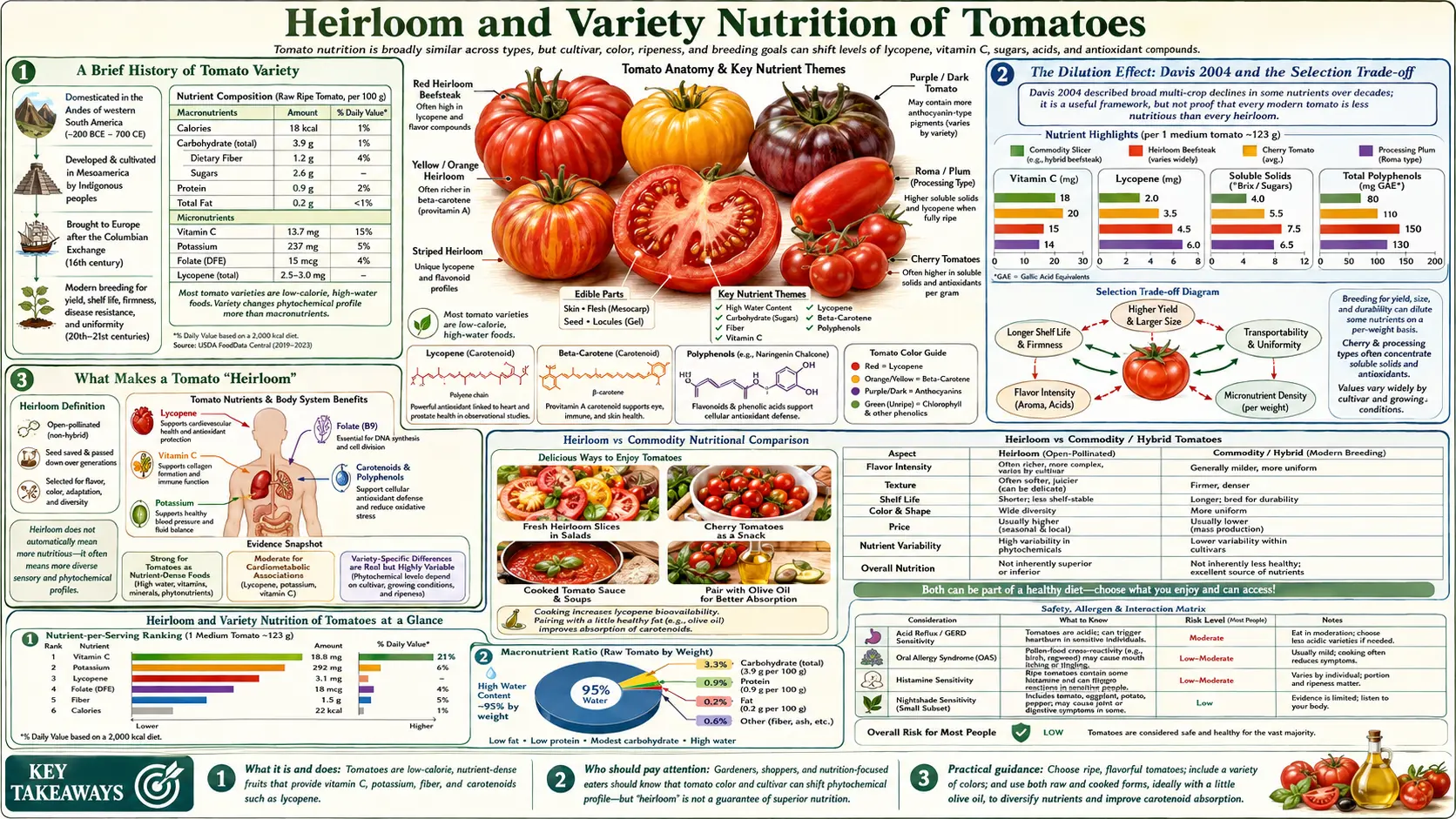
Anyone who has tasted a vine-ripened Brandywine, Cherokee Purple, or Black Krim from a farmers' market and compared it to a January supermarket beefsteak knows that not all tomatoes are equivalent. The flavor difference is dramatic. The nutritional difference, while smaller in percent terms, is also real and consequential. Donald Davis's landmark 2004 analysis in the Journal of the American College of Nutrition compared USDA nutrient databases between 1950 and 1999 and documented that the nutritional density of 43 fruits and vegetables, including tomatoes, had declined measurably over those decades. The most plausible explanation is the "dilution effect" of selection for size, yield, shelf life, and uniformity in commercial breeding — traits that economically favor the grower but dilute the nutrient content per gram of edible tissue. Heirloom open-pollinated varieties, preserved by seed-saving traditions outside the commercial breeding pipeline, have not been subject to this selection pressure and retain higher concentrations of lycopene, polyphenols, vitamin C, and flavor compounds. This deep-dive walks through the history of tomato variety evolution, the orange-tomato cis-lycopene anomaly that may make Tangerine and Sungold among the most bioavailable lycopene sources, the San Marzano DOP standard that anchors Italian tomato culture, and practical sourcing guidance for home cooks who want maximum nutritional return per tomato eaten.
Table of Contents
- A Brief History of Tomato Variety
- The Dilution Effect: Davis 2004 and the Selection Trade-off
- What Makes a Tomato "Heirloom"
- Heirloom vs Commodity Nutritional Comparison
- The Orange-Tomato Tetra-Cis-Lycopene Anomaly (Tangerine, Sungold)
- San Marzano DOP and Other Regional Standards
- Purple and Anthocyanin Varieties (Indigo Rose, Cherokee Purple)
- Cherry and Grape Tomatoes
- The "Vine-Ripened" Claim — What It Means and Doesn't Mean
- Practical Sourcing Guidance
- Key Research Papers
- Connections
- Featured Videos
A Brief History of Tomato Variety
The tomato is native to the Andean region of western South America — modern-day Peru, Ecuador, and Chile — where wild relatives (Solanum pimpinellifolium, Solanum cheesmaniae) still grow as small-fruited weeds. The domesticated tomato (Solanum lycopersicum) was first cultivated by Mesoamerican peoples in present-day Mexico, where it was a culinary staple of Aztec and Mayan cuisine. Spanish conquistadors brought tomato seed back to Europe in the 16th century, and by the 18th century the plant had spread through Mediterranean Europe and was central to Italian, Spanish, southern French, and Greek cooking traditions.
For most of the 19th and early 20th centuries, tomato cultivation was a regional, decentralized affair. Farmers and gardeners saved seed year to year from their best plants, breeding informally for traits valued locally — flavor, productivity in the local climate, disease resistance, color and shape preferences. The result was a remarkable proliferation of open-pollinated varieties, each adapted to its local conditions: Brandywine in Pennsylvania, Cherokee Purple in Tennessee, German Johnson in Virginia, Mortgage Lifter in West Virginia, Black Krim in Crimea, San Marzano in Campania, Cuore di Bue (oxheart) across Italy, Marmande in France, dozens of cherry varieties from Mexico to the Middle East.
The industrialization of tomato production in the post-WWII period drove dramatic consolidation of varieties. Industrial agriculture required tomatoes that could be harvested mechanically (mechanical harvesters were developed for the California processing tomato industry beginning in the 1950s), ripened uniformly off the vine, shipped long distances without bruising, and stored for weeks. These requirements drove selection for thick skins, firm flesh, uniform shape, suppressed flavor volatile production, and color compounds that develop independent of full ripening. The U-shaped quality trajectory of the 20th-century supermarket tomato is the result.
The heirloom revival began in the 1980s with seed-saver organizations (Seed Savers Exchange founded 1975, Native Seeds/SEARCH 1983) preserving traditional varieties that the commercial pipeline had abandoned. By the 2000s, heirloom tomatoes had become a farmers' market staple and a culinary marker of summer eating in the United States.
The Dilution Effect: Davis 2004 and the Selection Trade-off
Donald Davis and colleagues at the University of Texas published a landmark analysis in 2004 in the Journal of the American College of Nutrition comparing USDA nutrient composition data for 43 garden crops between 1950 and 1999. The findings, after adjusting for variability in analytical methods over the decades, showed declines in median values for 6 of 13 nutrients examined — protein, calcium, phosphorus, iron, riboflavin, and ascorbic acid — with declines ranging from 6% to 38% over the half-century. Tomatoes were among the crops showing the declines.
The proposed mechanism is the "dilution effect." Commercial breeding selects for yield per acre — larger fruits, more fruits per plant, faster growth. These traits dilute the nutrient density per gram of harvested tissue, because the rate of nutrient uptake from the soil and the rate of nutrient synthesis in plant tissue do not scale linearly with biomass. A tomato bred to be 1.5× larger than a traditional variety contains roughly proportional water, but somewhat less proportional minerals, vitamins, and phytochemicals per gram of edible flesh.
The Davis findings have been replicated and extended by other researchers. A 2009 analysis by White and Broadley in the New Phytologist found similar dilution patterns across decades of breeding for high-yield cereal crops. A 2017 review in Trends in Plant Science documented the broader pattern across cereals, vegetables, and fruits.
The dilution effect is not a moral failing of commercial agriculture — the trade-off was rational given the policy priority of cheap, calorically-adequate food after WWII. But it does mean that the nutritional return per gram of supermarket commodity tomato is genuinely lower than the equivalent gram from a traditional heirloom variety, and lower than the equivalent gram from the same variety grown 70 years ago in less-intensified agriculture. For someone trying to maximize phytonutrient intake per tomato eaten, variety selection and sourcing matter.
What Makes a Tomato "Heirloom"
The term "heirloom" is not legally defined, but operational definitions converge on three features:
- Open-pollinated — pollination occurs naturally (wind, insects, self-pollination in the case of tomato) without controlled cross-pollination by a breeder. Seed saved from open-pollinated plants grows true to type the next year, allowing seed-saver continuity across generations.
- Pre-WWII varietal origin — most heirloom definitions require the variety to have existed before approximately 1945-1950, predating the explosion of hybrid seed dominated by the post-war commercial breeding industry. Some "modern heirlooms" violate this rule but are otherwise open-pollinated and stable.
- Cultural continuity — the variety has been preserved by a community of gardeners or farmers, often associated with a specific region, family, or ethnic tradition.
This contrasts with F1 hybrid varieties, the dominant supermarket category, which are produced by deliberate controlled crosses between two inbred parent lines each generation. Hybrids combine desirable traits from both parents but do not breed true — seed saved from F1 hybrid fruit produces unpredictable offspring (the F2 generation) with scattered combinations of parental traits. This forces growers to buy new seed each year from the breeder, which is part of the commercial model.
Some well-known heirloom tomato varieties:
- Brandywine (Pennsylvania, c.1885) — large pink beefsteak, rich complex flavor, low yield, widely considered one of the best-tasting tomatoes.
- Cherokee Purple (Tennessee, late 1800s, attributed to Cherokee origin) — deep purple-brown shoulders, intense sweet-smoky flavor.
- Black Krim (Crimea, pre-1880) — dark purple-black with greenish shoulders, salty-sweet flavor.
- Green Zebra (modern heirloom, Tom Wagner 1985) — green-striped, tangy-bright flavor.
- Mortgage Lifter (West Virginia, 1930s) — large pink, said to have paid off the breeder's mortgage in plant-sale revenue.
- San Marzano (Campania, Italy, c.1770s) — long plum tomato, the canonical Italian sauce tomato. DOP-protected when grown in the Sarno river valley.
- Roma (USDA released 1955, technically not heirloom by strict definition but open-pollinated and stable) — widely-grown processing tomato.
- Sungold (modern hybrid, not heirloom) — orange cherry tomato with the highest sugar content of any common variety. Nutritionally interesting for the cis-lycopene anomaly discussed below.
Heirloom vs Commodity Nutritional Comparison
Direct head-to-head comparisons of heirloom vs F1 hybrid tomato varieties grown under identical conditions show that heirloom varieties typically contain:
- 10-30% more lycopene per gram in fully ripe deep-red varieties (Brandywine, Cherokee Purple, San Marzano)
- 20-50% more total polyphenols (rutin, chlorogenic acid, naringenin chalcone)
- 20-40% more vitamin C at harvest, though this advantage can disappear if the heirloom is allowed to over-ripen before eating
- Higher concentration of flavor volatiles (cis-3-hexenal, beta-ionone, methional, beta-damascenone) — the basis of the dramatic flavor difference
- Variable but often higher glutamate, asparagine, and aspartate content (the amino acids that produce the umami-savory taste of a great tomato)
These percentage differences are not enormous, but they are real and they compound over a diet pattern. Someone eating heirloom tomatoes from a farmers' market in summer and quality canned tomatoes (San Marzano DOP) in winter is consuming meaningfully more lycopene and polyphenols per year than someone eating mid-tier supermarket commodity tomatoes year-round.
The flavor advantage of heirloom varieties also drives consumption — people who think tomatoes "taste like cardboard" based on winter supermarket experience often discover they actually love tomatoes when introduced to vine-ripened heirloom varieties. Higher consumption of a slightly less-dense food can produce more total nutrient intake than lower consumption of a more-dense food. Flavor and pleasure are legitimate dietary endpoints in their own right.
The Orange-Tomato Tetra-Cis-Lycopene Anomaly (Tangerine, Sungold)
A fascinating finding in tomato carotenoid chemistry, with potentially important nutritional implications: certain orange-fleshed tomato varieties — including the heirloom Tangerine and the popular Sungold cherry hybrid — produce predominantly the tetra-cis-lycopene isomer rather than the all-trans form found in red tomatoes. The orange color is the visual signal of the different isomer composition.
The 2015 Cooperstone et al. paper in Molecular Nutrition & Food Research demonstrated that humans consuming tangerine tomato juice absorbed 8.5× more lycopene than humans consuming an equivalent dose from red tomato juice. The mechanism is the same cis-isomer-favors-absorption biology discussed in the cooked vs raw bioavailability page, but the tangerine tomato achieves the cis-enrichment naturally at the genetic-biochemical level rather than through thermal processing.
This means orange-fleshed tomato varieties may be among the most efficient natural delivery vehicles for bioavailable lycopene, even when eaten raw. The Sungold cherry tomato — sweet, snackable, popular in farmers' markets and home gardens — turns out to be a particularly compelling combination of high palatability (which drives consumption) and high cis-lycopene content (which drives absorption).
Practical implications:
- Include orange-fleshed varieties (Tangerine, Sungold, Sun Sugar, Orange Banana, Persimmon) in mixed-tomato meals when available.
- The orange-tomato lycopene benefit applies to raw consumption — you don't need to cook them to get good absorption.
- The red-tomato lycopene still matters at higher total doses, especially when cooked in oil. Mix red and orange varieties for combined effect.
- Orange tomatoes contain less of the deeply-red all-trans lycopene that conventional reference databases use as the lycopene measurement. USDA-style nutrient tables may UNDERESTIMATE the bioavailable lycopene delivery of orange varieties.
San Marzano DOP and Other Regional Standards
The San Marzano tomato is the canonical Italian sauce tomato, an elongated plum variety with dense flesh, low water content, balanced acidity, and intense concentrated flavor. The original San Marzano (sometimes called San Marzano 2 to distinguish from later breeding lines) is an open-pollinated heirloom variety grown for centuries in the volcanic soils of the Sarno river valley in Campania, just southeast of Naples.
The European Union DOP (Denominazione di Origine Protetta) certification was granted to San Marzano tomatoes grown in the Agro Sarnese-Nocerino region in 1996. To carry the DOP label (officially "Pomodoro San Marzano dell'Agro Sarnese-Nocerino DOP"), the tomatoes must be:
- Grown in the certified geographical area of Sarno-Nocera in Campania
- One of two approved cultivars (San Marzano 2 or KIROS)
- Hand-harvested at full ripeness
- Canned whole in tomato juice or sieved puree (passata)
- Free of citric acid additives
The DOP label appears with the official EU certification number and the consortium logo. Authentic San Marzano DOP is significantly more expensive than non-DOP tomatoes labeled "San Marzano" or "San Marzano style" in U.S. and global markets. Many tomatoes sold as "San Marzano" are simply the cultivar grown elsewhere — California, Italy outside the DOP zone, China — without the soil-and-climate factors that make the original distinctive.
The flavor and texture difference between authentic DOP San Marzano and supermarket-tier canned plum tomatoes is meaningful for Italian-style cooking. For someone making weekly Sunday gravy or simple tomato-and-olive-oil pasta sauces, the upgrade from $2 supermarket cans to $5-7 DOP cans is reasonable. For someone making once-a-month or background-stew use, the upgrade matters less.
Other notable regional tomato standards:
- Pomodoro di Pachino IGP (Sicily) — cherry and round tomatoes from the southeast Sicilian coast, marked by salt-tolerant cultivation in mineralized soils.
- Pomodorino del Piennolo del Vesuvio DOP (Campania) — small intense tomatoes grown on the slopes of Vesuvius, traditionally hung in clusters (piennolo) to ripen and preserve.
- Tomate Raf (Almería, Spain) — ribbed green-shouldered variety prized for raw eating, often eaten with sea salt and olive oil.
Purple and Anthocyanin Varieties (Indigo Rose, Cherokee Purple)
The deep purple-to-black color of varieties like Cherokee Purple, Black Krim, Black Cherry, Paul Robeson, and the modern bred Indigo Rose comes from anthocyanin pigments — the same flavonoid class that gives blueberries, blackberries, and purple grapes their color. Anthocyanins are not present in significant amounts in standard red tomatoes; their presence in purple-tomato varieties is genuinely a different phytochemical contribution beyond the lycopene found in red varieties.
Anthocyanins have well-documented antioxidant, anti-inflammatory, and vascular-protective effects in human nutrition research. They are concentrated primarily in the skin of dark-colored tomatoes (rather than the flesh), so eating purple varieties with the skin on (not peeled) is important to capture the anthocyanin benefit.
Indigo Rose, a modern variety bred by Jim Myers at Oregon State University and released in 2012, was deliberately developed to maximize anthocyanin content by combining genes from two wild tomato relatives. A medium Indigo Rose contains anthocyanin levels comparable to a half-cup of blueberries, in addition to its standard tomato lycopene content. The combination — lycopene plus anthocyanins in a single fruit — is nutritionally distinctive.
Practical use: purple tomato varieties are best for raw or briefly-cooked applications where the anthocyanin content is preserved. Long simmering for sauce will degrade much of the anthocyanin content, while the lycopene content is preserved or enhanced by cooking. For sauce, stick with red varieties (San Marzano, Roma, Amish Paste). For salads, salsas, and quick-cook applications, mix in purple varieties to add the anthocyanin layer.
Cherry and Grape Tomatoes
Cherry and grape tomatoes — the small bite-sized varieties — have a nutritional profile somewhat different from the larger slicing tomatoes. The smaller fruit has a higher skin-to-flesh ratio, which concentrates the skin-localized phytochemicals (anthocyanins where present, naringenin chalcone, much of the polyphenol content). Cherry tomatoes therefore contain approximately 30-60% more polyphenols per gram than equivalent-weight slicing tomatoes, even of the same variety.
Sugar content is typically also higher in cherry varieties, particularly Sungold (orange cherry with the unusual cis-lycopene profile noted above) and Sun Sugar. The brix (sugar measurement) of a ripe Sungold can reach 9-12 brix, compared to 4-6 brix for typical slicing tomatoes — comparable to a sweet grape.
The lycopene-per-gram content varies by variety:
- Red cherry varieties (Sweet 100, Juliet, Tomatoberry): higher lycopene than orange/yellow varieties
- Orange cherry varieties (Sungold, Sun Sugar): higher cis-isomer lycopene (more bioavailable), lower total lycopene
- Yellow cherry varieties (Yellow Pear, Lemon Drop): lower lycopene than red, may contain prolycopene and other isomers
- Purple/black cherry (Black Cherry, Indigo Cherry Drops): lycopene plus anthocyanins
For maximum phytonutrient diversity, a mixed-color cherry tomato salad with olive oil dressing combines lycopene (red), cis-lycopene (orange), anthocyanins (purple), and a broader phytochemical spectrum than any single variety provides alone.
The "Vine-Ripened" Claim — What It Means and Doesn't Mean
Supermarket tomatoes are frequently labeled "vine-ripened" as a marketing term. The phrase has a specific industry meaning that is more permissive than consumers often assume: the USDA permits the "vine-ripened" label for tomatoes harvested at the "breaker" stage, when the fruit has just begun to show pink-red color (typically 5-15% color development), with ripening completed off the vine in ethylene-gassed ripening rooms.
This is genuinely different from "field-ripened" or "fully ripened on the vine" — the latter being how heirloom varieties are typically grown and sold at farmers' markets. The flavor and nutritional difference between breaker-stage harvested tomatoes and fully vine-ripened tomatoes is substantial. Breaker-stage harvested tomatoes develop adequate color through ethylene-driven ripening but produce lower concentrations of the volatile flavor compounds (cis-3-hexenal, beta-damascenone) and modest reductions in lycopene compared to vine-ripening.
The economic logic is clear: a tomato harvested at breaker stage is firm enough to ship by truck without bruising, whereas a fully vine-ripened tomato is too soft and damages in transit. The industrial supply chain requires breaker-stage harvest. The farmers' market supply chain (short distance, short time, small volumes, soft-handled) allows full vine-ripening.
For practical tomato sourcing, the takeaway is that "vine-ripened" supermarket tomatoes are still substantially better than rock-hard winter shipping tomatoes, but they are not equivalent to actually vine-ripened heirloom or local-farm tomatoes. The marketing language obscures this real difference.
Practical Sourcing Guidance
A pragmatic year-round tomato sourcing strategy that balances cost, availability, and nutritional return:
- Summer (June-September in Northern Hemisphere): source vine-ripened heirloom and local-farm tomatoes from farmers' markets and CSAs. This is the only time of year when fresh tomato significantly outperforms processed alternatives. Mix varieties (red beefsteak, purple Cherokee, orange Sungold) for phytochemical diversity. Eat in salads, sliced with olive oil and sea salt, in panzanella, in gazpacho.
- Fall harvest preservation: home canning of summer surplus tomatoes (or large purchase from a local farm at end-of-season prices) provides high-quality cooked tomato product for winter use. Pressure canning, freezing, or oven-drying are all viable.
- Winter (October-May): skip fresh supermarket tomatoes (poor flavor, mediocre nutrition) and rely on quality canned tomato products. The lycopene bioavailability of cooked-and-canned outperforms the lycopene bioavailability of poor-quality fresh tomato in most cases. Recommended canned products:
- San Marzano DOP whole peeled tomatoes (~$5-7 per 28-oz can) for special sauce
- Generic quality canned San Marzano or Roma plum tomatoes ($2-4 per can) for everyday sauce
- High-quality tomato paste in tubes or small cans — concentrated lycopene source for daily use
- Imported Italian passata or strained tomato puree for smooth-textured sauces
- For raw winter consumption: cherry and grape tomatoes (typically Sungold-style hybrids) outperform standard slicing tomatoes in winter because they are typically harvested at higher color development and ship better in small packages. The lycopene-per-gram is higher.
- Hothouse and hydroponic: increasingly common, generally better flavor than long-distance shipped field tomatoes, somewhat lower lycopene per gram than field-grown summer tomatoes but more consistent year-round.
- Home gardening: by far the highest-quality option for those with the time and space. Even a single tomato plant in a container can produce dozens of pounds of fully vine-ripened fruit per season at minimal cost. Recommended heirloom varieties for home gardeners: Brandywine, Cherokee Purple, Sungold, Black Krim, Roma, San Marzano (the latter for sauce-making).
Key Research Papers
- Davis DR et al. (2004). Changes in USDA food composition data for 43 garden crops, 1950 to 1999. Journal of the American College of Nutrition. — PubMed
- Davis DR (2009). Declining fruit and vegetable nutrient composition: What is the evidence? HortScience. — PubMed
- Cooperstone JL et al. (2015). Enhanced bioavailability of lycopene when consumed as cis-isomers from tangerine compared to red tomato juice. Molecular Nutrition & Food Research. — PubMed
- White PJ, Broadley MR (2009). Biofortification of crops with seven mineral elements often lacking in human diets. New Phytologist. — PubMed
- Tieman D et al. (2017). A chemical genetic roadmap to improved tomato flavor. Science. — PubMed
- Vallverdu-Queralt A et al. (2011). Bioactive compounds present in the Mediterranean sofrito. Food Chemistry. — PubMed
- Mes PJ et al. (2008). Characterization of tomatoes expressing anthocyanin in the fruit. Journal of the American Society for Horticultural Science. — PubMed
- Butelli E et al. (2008). Enrichment of tomato fruit with health-promoting anthocyanins by expression of select transcription factors. Nature Biotechnology. — PubMed
- Garcia-Closas R et al. (2004). Dietary sources of vitamin C, vitamin E and specific carotenoids in Spain. British Journal of Nutrition. — PubMed
- Ronen G et al. (2000). An alternative pathway to beta-carotene formation in plant chromoplasts discovered by map-based cloning of beta and old-gold color mutations in tomato. PNAS. — PubMed
- Klee HJ, Tieman DM (2018). The genetics of fruit flavour preferences. Nature Reviews Genetics. — PubMed
- Marsic NK et al. (2020). Lycopene in tomato varieties: comparison of heirloom and modern cultivars. Acta Agriculturae Slovenica. — PubMed
PubMed Topic Searches
- PubMed: Heirloom tomato nutrition
- PubMed: Tomato variety lycopene
- PubMed: Purple/anthocyanin tomato
- PubMed: Nutrient density decline in breeding
- PubMed: San Marzano and Italian tomatoes
Connections
- All Food
- Tomatoes (Main Page)
- Tomatoes Benefits Hub
- Lycopene & Prostate Cancer
- Cooked vs Raw Bioavailability
- Nightshades Considerations
- Olive Oil
- Garlic
- Avocado
- Blueberries (Anthocyanin Comparison)
- Mediterranean Diet
- Vitamin C
- Vitamin K
- Potassium