Tomatoes: History and Origins
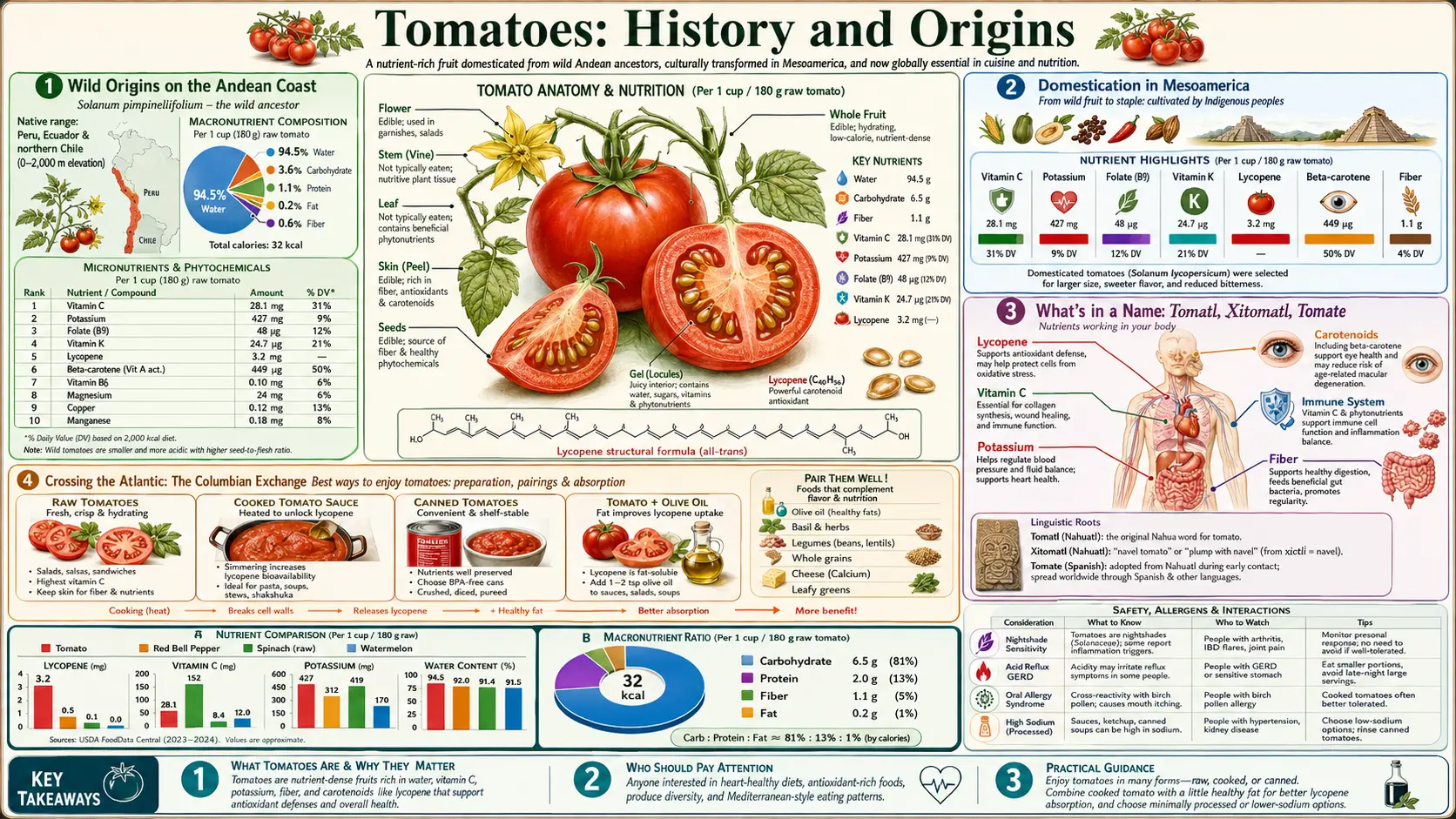
Few foods have travelled as far, or been so badly misunderstood along the way, as the tomato. Its wild ancestors were small, pea-sized berries growing on the dry Pacific slopes of western South America — the coastal Andes of what is now Ecuador and Peru. It was not the peoples of the Andes but those of Mesoamerica, above all the Aztecs and their neighbours, who turned that wild plant into a kitchen vegetable; the very word "tomato" descends from their Nahuatl tomatl. Carried back to Europe by Spanish ships in the sixteenth century as part of the Columbian Exchange, the tomato was first written about by an Italian botanist in 1544, grown for decades mainly as a curiosity and an ornamental, and widely suspected of being poisonous because it is a member of the nightshade family. Only slowly — and most decisively in southern Italy, in the kitchens and on the flatbreads of Naples — did it become the beloved staple it is today. This article follows that journey, and where a popular story (such as the famous tale of acidic tomatoes leaching lead from pewter plates) is widely repeated but disputed by scholars, it says so plainly rather than presenting folklore as fact.
Table of Contents
- Wild Origins on the Andean Coast
- Domestication in Mesoamerica
- What's in a Name: Tomatl, Xitomatl, Tomate
- Crossing the Atlantic: The Columbian Exchange
- First European Mention: Mattioli, 1544
- The Long Fear: A Nightshade Suspected of Poison
- Triumph in Italy: Naples and Pizza
- A Worldwide Staple
- Research Papers and References
- Connections
- Featured Videos
Wild Origins on the Andean Coast
The cultivated tomato, Solanum lycopersicum, belongs to a small group of wild relatives native to western South America. Its closest wild ancestor is generally agreed to be Solanum pimpinellifolium, the currant or red-fruited wild tomato, whose tiny berries — roughly the size of a pea or a small currant — grow on sprawling vines along the arid Pacific-facing coast and lower slopes of the Andes, in the region spanning modern Ecuador and Peru (extending into northern Chile). These are tough, sun-loving plants suited to dry, well-drained ground, and the same heat-and-drought hardiness still shows in the garden tomato today.
Genetic and morphological studies place the tomato firmly in this corner of South America as its centre of wild diversity. The genus Solanum is enormous and includes the potato, the eggplant, the peppers' cousins, and a number of genuinely toxic nightshades; the tomato's membership in this family is the thread that runs through much of its later, fearful European reputation. It is worth being precise about the geography, because it is often muddled: the wild plant comes from South America, but the food we recognise as the tomato was not made there.
Botanists usually trace the line from the wild S. pimpinellifolium to a semi-domesticated cherry-type form, S. lycopersicum var. cerasiforme, and finally to the large-fruited cultivated tomato. The details of that sequence — how much happened in South America versus farther north, and how directly — remain an active area of genomic research, and recent studies suggest the path was more tangled than a simple straight line. What is not in doubt is the starting point: a small wild berry of the western South American coast.
Domestication in Mesoamerica
The decisive step — turning a wild weed into a crop — took place not in the Andes but far to the north, in Mesoamerica, the region of present-day Mexico and Central America. There, over a long period, indigenous farmers selected larger, fleshier, more useful fruits until the tomato became a true cultivated plant. By around 500 BC the tomato was already being grown in southern Mexico and probably neighbouring areas, and by the time of the Aztec Empire it was a thoroughly domesticated food sold in markets and cooked in many forms.
Our richest early description comes from the Spanish Franciscan friar Bernardino de Sahagún, who in the sixteenth century recorded the goods on sale in the great market of the Aztec capital, Tenochtitlan (the site of modern Mexico City). He described a remarkable diversity of tomatoes — large and small, leaf tomatoes and sweet tomatoes, fruits ranging in colour from the brightest red to deep yellow — evidence that Mesoamerican growers had already developed many distinct varieties long before any European saw the plant. The Aztecs combined tomatoes with chillies and ground squash seeds to make some of the earliest recorded sauces, a culinary lineage that survives in the salsas of Mexico today.
It is important to separate the tomato from the tomatillo, a related but different plant (Physalis species, the husk tomato) that the Aztecs also grew and that figures in their cooking. The two share a Nahuatl-derived name-root and a region, but they are distinct fruits. The plant that conquered the world's kitchens is the true tomato, Solanum lycopersicum, domesticated by the peoples of Mesoamerica from a South American wild ancestor — a two-continent origin story that is easy to get wrong and worth stating carefully.
What's in a Name: Tomatl, Xitomatl, Tomate
The word tomato is itself a fragment of history. It comes, by way of the Spanish tomate, from the Nahuatl word tomatl — the language of the Aztecs. The element tomatl is often glossed as referring to a plump, swelling fruit, and it was applied broadly to several round, juicy nightshade fruits, including what we now call the tomatillo.
For the specific red fruit we mean by "tomato," the Aztecs had a more precise term: xitomatl (sometimes rendered jitomate, a word still used for the tomato in central Mexico). When Spanish speakers borrowed the word, they simplified it to tomate, and from Spanish it passed into the other European languages. In English the form shifted to "tomato," its ending most likely reshaped to echo "potato" — another New World Solanum crop that had reached Europe a little earlier.
The naming matters because it preserves, in a single everyday word, the plant's true cultural origin. Long before any botanist in Italy or any gardener in England encountered it, the tomato was already named, classified into varieties, and cooked by the peoples of Mesoamerica. Every time the word is spoken it carries a trace of Nahuatl across five centuries and two hemispheres.
Crossing the Atlantic: The Columbian Exchange
The tomato reached the rest of the world as part of the great biological reshuffling that historians call the Columbian Exchange — the transfer of plants, animals, people, and diseases between the Americas and the Old World that followed the voyages of Columbus. The fall of Tenochtitlan to the forces of Hernán Cortés in 1521 opened the floodgates for this exchange, and within a few decades Spanish ships had carried tomato seeds back across the Atlantic to Europe.
By the 1540s the tomato was being grown in Europe, where it took readily to the warm, dry climate of the Mediterranean — conditions not unlike the sunny coasts where its wild ancestors thrived. Spain and Italy, with their southern latitudes, were among the first places it became established. From these Mediterranean footholds the plant gradually spread north, though acceptance as food would lag far behind cultivation as a curiosity.
It is a striking feature of the tomato's early European career that the plant arrived as an exotic novelty rather than a recognised vegetable. Botanists grew it in physic and curiosity gardens; the wealthy sometimes raised it as an ornamental for its handsome fruit. The leap from admiring the tomato to eating it freely would take, in much of Europe, the better part of two centuries — and the reasons for that long hesitation are a story in themselves.
First European Mention: Mattioli, 1544
The earliest known mention of the tomato in European literature appears in 1544, in the writings of the Italian physician and botanist Pietro Andrea Mattioli. In his commentary on the classical herbal of Dioscorides, Mattioli described the newly arrived fruit as a kind of mala insana — that is, a new sort of eggplant (aubergine) — brought to Italy. He noted that it ripened to a blood-red or golden colour, that it could be divided into segments, and that it was eaten in the same way as eggplant: cooked and seasoned with salt, pepper, and oil.
About a decade later, in a revised edition of his work circa 1554, Mattioli gave the fruit the Italian name by which Italy still knows it: pomi d'oro, or "golden apples." This is the direct ancestor of the modern Italian word for tomato, pomodoro. The name almost certainly reflects the yellow or golden-fruited varieties that were among the first to reach and flourish in Italy, rather than the deep-red types more familiar today.
Mattioli's account is valuable on two counts. First, it fixes a firm, documented date for the tomato's appearance in the European record. Second, it shows that from the very beginning Europeans struggled to categorise the plant, slotting it in beside the already-known and somewhat distrusted eggplant. That association — an unfamiliar nightshade, cousin to plants of ill repute — helped set the stage for the suspicion that would dog the tomato for generations.
The Long Fear: A Nightshade Suspected of Poison
For roughly two hundred years much of Europe, and especially Britain and its North American colonies, regarded the tomato with deep suspicion. The plant belongs to the nightshade family (Solanaceae), which includes genuinely poisonous species such as deadly nightshade (belladonna), and its leaves and stems do in fact contain toxic alkaloids — though the ripe fruit does not. To wary herbalists the family resemblance alone was reason enough for caution. The most influential English voice was the herbalist John Gerard, whose celebrated Herball of 1597 judged the whole plant to be, in his words, of "ranke and stinking savour" and regarded it as unwholesome. Gerard's verdict carried great weight, and largely on its account the tomato was treated as unfit to eat in Britain for well over two centuries.
One particular explanation for the "poison" reputation is repeated almost everywhere: the claim that wealthy Europeans who ate tomatoes fell ill or died because the fruit's acidity leached toxic lead from the pewter plates common in aristocratic households — with the tomato wrongly blamed for what was really lead poisoning. This story should be treated as a popular but disputed hypothesis, not settled fact. It is plausible-sounding and frequently retold, but it is not well documented in the historical record, and scientists have challenged it: Joe Schwarcz of McGill University's Office for Science and Society, for example, has argued that the amount of lead a tomato could actually leach from a pewter plate would be trivial and not enough to harm anyone. The honest position is that Europeans' fear of the tomato is real and well attested, but this specific lead-and-pewter mechanism for it is a commonly-cited explanation that remains debated.
A second famous anecdote — that one Robert Gibbon Johnson publicly ate a basketful of tomatoes on the courthouse steps of Salem, New Jersey, around 1820 to prove they were harmless — is likewise best treated as legend. The tale is colourful and often repeated, but historians regard the dramatic details as apocryphal and unsupported by contemporary evidence. What is genuinely true is the broad arc: a long period of suspicion, rooted in the tomato's nightshade kinship and reinforced by authorities like Gerard, gradually giving way as people in fact ate the fruit without harm.
Triumph in Italy: Naples and Pizza
While northern Europe held back, the tomato found its true home in the warm south — above all in southern Italy, and most famously in Naples. There the fruit was embraced far earlier and more wholeheartedly than elsewhere; the first surviving Italian recipes using tomatoes appear in a Neapolitan cookbook of 1692, drawing on Spanish influence. Cheap, productive, and thriving in the Campanian sun, the tomato became a food of ordinary people rather than a botanical curiosity.
It was among the poor of the Naples area, in the eighteenth century, that one of the world's most famous foods took shape. Working people had long eaten plain yeasted flatbread; now they began topping it with the abundant local tomato, and the dish we know as pizza began to emerge. The simplest classic style, pizza marinara — flatbread dressed with tomato, garlic, oregano, and olive oil — embodies this humble, tomato-led origin. (Despite the name, the marinara carries no seafood; the word points to its association with seafaring folk and the port city, not to fish.)
From these Neapolitan beginnings the tomato's reputation was transformed. What had been an ornamental oddity and a suspected poison became the defining ingredient of an entire cuisine — the sauces, the pasta dressings, the pizzas that the world now thinks of as quintessentially Italian, even though the plant itself had crossed an ocean to get there. The San Marzano plum tomato grown in the volcanic soil near Naples became especially prized for sauce, cementing the region's tie to the fruit.
A Worldwide Staple
From its Italian and Mediterranean strongholds the tomato spread across the globe, helped along by emigration, trade, and the simple fact that it grows readily in a wide range of climates. In North America it shed its poisonous reputation over the course of the nineteenth century and became a garden and market mainstay; canning and, later, the rise of commercial ketchup and processed tomato products turned it into one of the most consumed vegetables (botanically a fruit) on earth. Across Asia, Africa, and the Middle East it was absorbed into countless local cuisines, so completely that many regional dishes built around the tomato now feel timeless despite the plant's relatively recent arrival.
Today the tomato is grown on every inhabited continent and ranks among the world's most important horticultural crops, valued fresh, dried, juiced, and processed. Its modern reputation has come almost full circle from the old fear: it is now prized as a healthful food, a leading dietary source of the carotenoid lycopene and of vitamin C, and a familiar emblem of the much-studied Mediterranean diet. That nutritional and clinical story — what the tomato actually does for health — is the subject of the companion Tomatoes Benefits articles and the main Tomatoes page. This history is concerned only with how a pea-sized wild berry from the Andean coast became, by way of Aztec gardens, Spanish galleons, suspicious herbalists, and Neapolitan flatbread, a fruit that the whole world now takes for granted.
Research Papers and References
The list below combines peer-reviewed sources on the origin, domestication, and genetics of Solanum lycopersicum with reputable food-history references and curated PubMed topic-search links. Historical primary sources (the herbal of Pietro Andrea Mattioli, the writings of Bernardino de Sahagún, and John Gerard's Herball) are named in the article as historical sources rather than as modern citations. Author names, titles, and journals are given as plain text; only the stable DOI, PMID, or archive link is hyperlinked, and each opens in a new tab.
- Blanca J, Montero-Pau J, Sauvage C, et al. Genomic variation in tomato, from wild ancestors to contemporary breeding accessions. BMC Genomics. 2015;16:257. — doi:10.1186/s12864-015-1444-1 (also PMID: 25880392)
- Razifard H, Ramos A, Della Valle AL, et al. Genomic evidence for complex domestication history of the cultivated tomato in Latin America. Molecular Biology and Evolution. 2020;37(4):1118-1132. — doi:10.1093/molbev/msz297 (also PMID: 31912142)
- Blanca J, Cánovas-Vázquez A, Casals J, et al. Variation revealed by SNP genotyping and morphology provides insight into the origin of the tomato. PLOS One. 2012;7(10):e48198. — doi:10.1371/journal.pone.0048198 (also Search PubMed)
- Bauchet G, Causse M. Genetic diversity in tomato (Solanum lycopersicum) and its wild relatives. In: Genetic Diversity in Plants. InTech; 2012. — doi:10.5772/33073
- The Tomato Genome Consortium. The tomato genome sequence provides insights into fleshy fruit evolution. Nature. 2012;485(7400):635-641. — doi:10.1038/nature11119 (also PMID: 22660326)
- Solanum lycopersicum — origin, domestication, and history PubMed: tomato domestication and origin
- Solanum pimpinellifolium — wild ancestor of the cultivated tomato PubMed: Solanum pimpinellifolium wild tomato
- Tomato lycopene and the Mediterranean diet PubMed: tomato lycopene and health
External Authoritative Resources
- Encyclopædia Britannica — Tomato: description, cultivation, and history
- Encyclopaedic overview — Tomato (Solanum lycopersicum)
- University of Kansas, American Indian Health — Foods Indigenous to the Western Hemisphere: Tomatoes
Connections
- All Food
- Tomatoes
- Tomatoes Benefits
- Lycopene
- Mediterranean Diet Foundations
- Beets: History and Origins
- Pomegranate