Tomatoes — Benefits Deep Dive
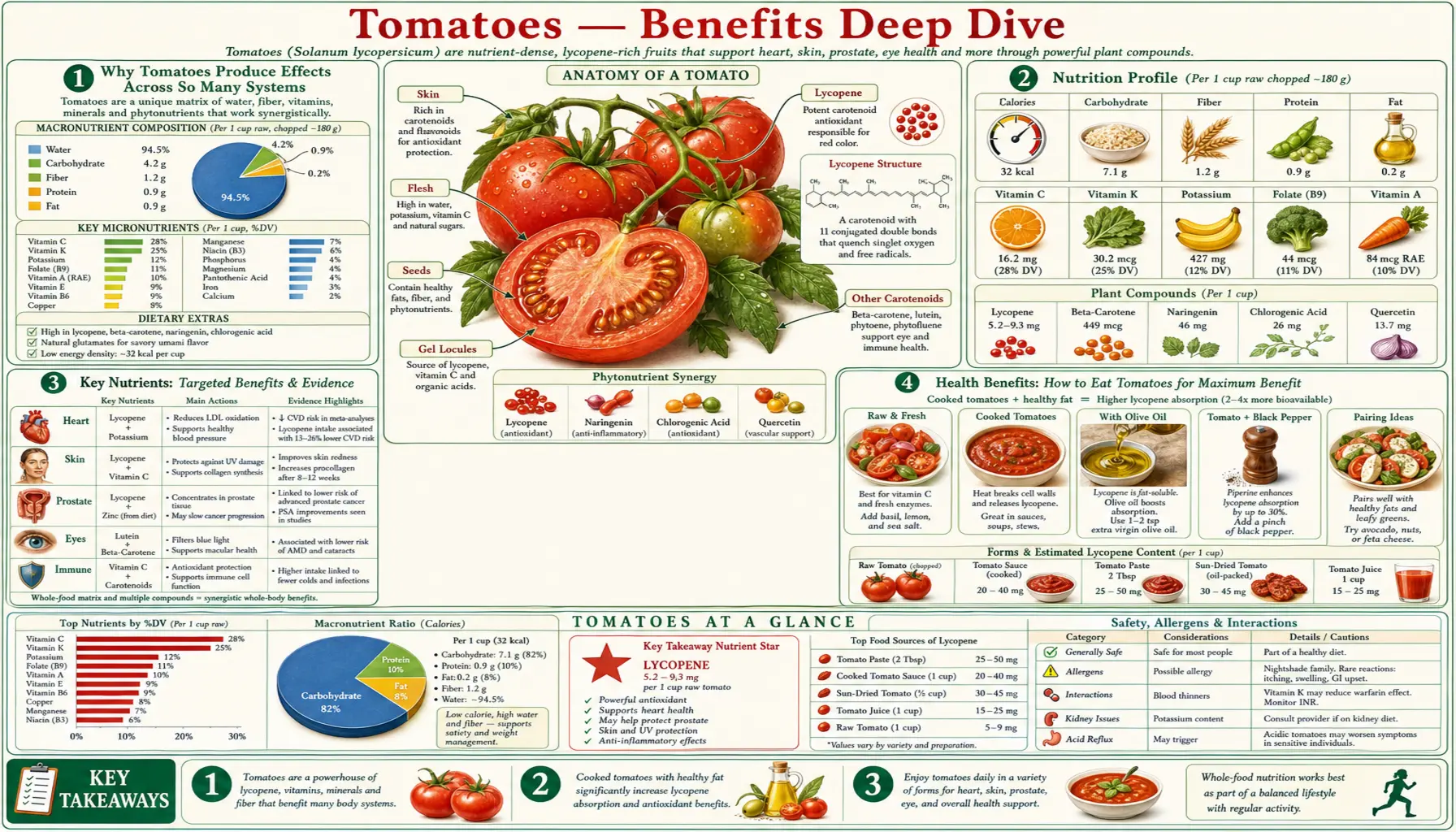
The tomato (Solanum lycopersicum) is one of the few common foods that combines an unusually concentrated single phytochemical — lycopene — with a near-universal place in the global diet. A century of epidemiology and an unbroken thread of mechanistic biology link cooked tomato intake to reduced risk of advanced and lethal prostate cancer, lower cardiovascular event rates, improved endothelial function, and meaningful protection against UV-induced skin damage. Four sub-articles below explore the most consequential branches of the tomato literature: the prostate-lycopene connection that drove the first major scientific interest in the food, the counterintuitive cooking-and-fat rule that triples bioavailability, the nightshade-family questions raised by patients with autoimmune or inflammatory conditions, and the genuine nutritional differences between commodity hybrid and heirloom open-pollinated varieties.
Deep-Dive Articles
Lycopene & Prostate Cancer
The Giovannucci Harvard Health Professionals Follow-up Study finding that 2+ servings of tomato sauce per week was associated with a 35% lower risk of advanced prostate cancer, the EPIC-Oxford cohort confirmation, the SELECT and MTOPS controlled-trial nuances, mechanism through prostate tissue lycopene concentration, IGF-1 axis modulation, and why the dietary signal outperforms isolated supplement trials.
Cooked vs Raw Bioavailability
The Stahl & Sies thermal cis-isomerization discovery: cooking converts all-trans lycopene to the 5-cis and 13-cis isomers absorbed 2-3× more efficiently. Why olive oil triples plasma lycopene response, why the Mediterranean trio (cooked tomato + olive oil + garlic) is mechanistically synergistic, and how Italian-American dietary patterns inadvertently optimized lycopene delivery generations before the science existed.
Nightshades Considerations
Steroidal glycoalkaloid biology (tomatine, solanine), the AIP / Wahls / Paleo nightshade-elimination protocols, the actual evidence base for nightshade sensitivity in rheumatoid arthritis and inflammatory bowel disease, the difference between green/ripe tomato alkaloid load, lectin questions, and a structured elimination-and-reintroduction protocol for patients who suspect a personal sensitivity.
Heirloom & Variety Nutrition
The USDA / Davis 2004 finding that nutrient density of commodity tomatoes dropped roughly 30% from 1950 to 1999 (the "dilution effect" of selection for size and yield), why heirloom varieties (Brandywine, Cherokee Purple, Black Krim) retain higher polyphenol content, the orange-tomato tetra-cis-lycopene anomaly, San Marzano DOP standards, and practical sourcing guidance.
Table of Contents
- Deep-Dive Articles
- Why Tomatoes Produce Effects Across So Many Systems
- Research Papers: Lycopene and Prostate Cancer
- Research Papers: Cardiovascular Disease
- Research Papers: Skin Photoprotection
- Research Papers: Bioavailability and Processing
- Research Papers: Nightshade Sensitivity and Glycoalkaloids
- External Authoritative Resources
- Connections
- Featured Videos
Why Tomatoes Produce Effects Across So Many Systems
The tomato is interesting nutritionally not because it is exceptionally calorie-dense or protein-rich — it is neither — but because it is the dominant dietary source of lycopene, the deep-red acyclic carotenoid that gives tomatoes, watermelon, pink grapefruit, and guava their color. Approximately 80% of dietary lycopene intake in the United States comes from tomatoes and tomato products. No other common food comes close.
Lycopene is unusual among the carotenoids in three respects, each of which maps to a distinct category of clinical effect:
- Highest singlet-oxygen quenching capacity of any common carotenoid — lycopene's 11 conjugated double bonds give it roughly twice the singlet-oxygen quenching ability of beta-carotene and ten times that of alpha-tocopherol. This is the mechanism behind the prostate cancer prevention signal (prostate tissue concentrates lycopene and is especially vulnerable to oxidative DNA damage) and the cardiovascular and skin photoprotection effects.
- Unique tissue distribution favoring prostate, testes, adrenal, and skin — unlike beta-carotene which distributes broadly, lycopene concentrates in specific tissues including the prostate (the highest concentration in the male body), testes, adrenal glands, liver, and skin. The tissue selectivity is why the strongest epidemiologic signal is for advanced prostate cancer, not all cancers, and why skin photoprotection is measurable in supplementation trials.
- Counterintuitive cooking effect — raw tomatoes contain predominantly all-trans lycopene, which is poorly absorbed (typical absorption efficiency 10-30%). Heat treatment isomerizes the all-trans form to the 5-cis and 13-cis isomers, which are absorbed 2-3× more efficiently and which preferentially accumulate in human tissues. Cooked tomato in fat (the canonical Mediterranean form) is therefore a mechanistically optimized lycopene delivery vehicle — a Sunday-sauce simmered in olive oil delivers 3-4× more bioavailable lycopene per gram than the equivalent weight of raw fresh tomato.
The therapeutic complication is that the dietary signal does not transfer cleanly to isolated lycopene supplements. The SELECT trial and other randomized controlled trials of purified lycopene capsules for prostate cancer prevention have been largely negative. This is the same pattern seen for beta-carotene (ATBC and CARET trials) and vitamin E — isolated supplement doses do not reproduce the food-matrix effect, which depends on the cocktail of co-occurring phytochemicals (phytoene, phytofluene, beta-carotene, gamma-carotene, naringenin chalcone, rutin, chlorogenic acid) and on the fat-soluble carrier matrix of the meal.
The fourth deep-dive page addresses the variety question: not all tomatoes are nutritionally equivalent. Commodity hybrid varieties have been selected for color uniformity, shelf life, and yield per acre, with measurable losses in lycopene density, polyphenol content, and flavor compounds compared to heirloom and traditional regional varieties. The third deep-dive page addresses the nightshade question — whether the small dose of steroidal glycoalkaloids in the Solanaceae family matters clinically for patients with autoimmune or inflammatory bowel conditions, and how to test that hypothesis rigorously for an individual patient.
Research Papers: Lycopene and Prostate Cancer
- Giovannucci E et al., Intake of carotenoids and retinol in relation to risk of prostate cancer (HPFS, JNCI 1995) — PubMed: Giovannucci HPFS 1995
- Giovannucci E, A review of epidemiologic studies of tomatoes, lycopene, and prostate cancer (Exp Biol Med 2002) — PubMed: Giovannucci review 2002
- EPIC cohort lycopene intake and prostate cancer — PubMed: EPIC lycopene prostate
- Health Professionals Follow-up Study advanced prostate cancer meta-analysis — PubMed: HPFS advanced prostate
- SELECT trial lycopene and prostate cancer null result interpretation — PubMed: SELECT trial
- Chen L et al., Oxidative DNA damage in prostate cancer patients on lycopene intervention — PubMed: Lycopene oxidative DNA damage
- Lycopene and IGF-1 axis modulation in prostate cancer — PubMed: Lycopene and IGF-1
- Prostate tissue lycopene concentration vs serum — PubMed: Prostate tissue lycopene
- Kucuk O et al., Lycopene supplementation prior to radical prostatectomy — PubMed: Kucuk prostatectomy trial
- Lycopene and prostate cancer biochemical recurrence — PubMed: Lycopene and BCR
Research Papers: Cardiovascular Disease
- Sesso HD et al., Plasma lycopene and other carotenoids in relation to cardiovascular disease (Women's Health Study) — PubMed: Sesso WHS lycopene
- Kuopio Ischaemic Heart Disease Risk Factor Study lycopene and stroke — PubMed: Kuopio lycopene stroke
- Lycopene and LDL oxidation resistance — PubMed: Lycopene LDL oxidation
- Tomato extract and endothelial function in pre-hypertension — PubMed: Tomato endothelial function
- Lycopene supplementation and blood pressure meta-analysis — PubMed: Lycopene blood pressure meta-analysis
- Tomato consumption and serum lipid profile — PubMed: Tomato and lipid profile
- Mediterranean diet cardiovascular protection PREDIMED trial — PubMed: PREDIMED Mediterranean diet
- Lycopene and inflammatory markers (CRP, IL-6) — PubMed: Lycopene inflammation
- Lycopene and atherosclerotic plaque carotid intima-media thickness — PubMed: Lycopene carotid IMT
- Tomato juice and platelet aggregation (Fruitflow / water-soluble tomato concentrate) — PubMed: Fruitflow tomato platelet
Research Papers: Skin Photoprotection
- Stahl W et al., Dietary tomato paste protects against UV-light-induced erythema in humans (J Nutr 2001) — PubMed: Stahl tomato paste UV
- Aust O et al., Supplementation with tomato-based nutrient complex protects against UV-induced erythema — PubMed: Aust tomato UV
- Lycopene and matrix metalloproteinase (MMP-1) suppression in UV-irradiated skin — PubMed: Lycopene MMP-1 skin
- Carotenoid skin accumulation and minimum erythema dose (MED) — PubMed: Carotenoid MED
- Tomato-rich diet and skin photoaging biomarkers — PubMed: Tomato photoaging
- Lycopene as singlet oxygen quencher mechanism — PubMed: Lycopene singlet oxygen
- Beta-carotene and lycopene in skin photoprotection comparative — PubMed: BC vs lycopene skin
- Tomato extract and skin elasticity, density measurement — PubMed: Tomato skin elasticity
Research Papers: Bioavailability and Processing
- Stahl W, Sies H, Uptake of lycopene and its geometrical isomers is greater from heat-processed than from unprocessed tomato juice (J Nutr 1992) — PubMed: Stahl & Sies heat processing
- Gartner C et al., Lycopene is more bioavailable from tomato paste than from fresh tomatoes — PubMed: Gartner tomato paste
- Cis-trans isomerization of lycopene during processing — PubMed: Cis-trans isomerization
- Olive oil enhancement of lycopene absorption — PubMed: Olive oil lycopene absorption
- Avocado fat and carotenoid absorption from salad — PubMed: Avocado and carotenoids
- Lycopene plasma response after standardized tomato meal — PubMed: Lycopene plasma kinetics
- Tomato pulp particle size and lycopene release — PubMed: Tomato particle size
- Mixed-meal effects on carotenoid absorption (review) — PubMed: Mixed-meal carotenoids
Research Papers: Nightshade Sensitivity and Glycoalkaloids
- Friedman M, Tomato glycoalkaloids: role in the plant and in the diet (J Agric Food Chem) — PubMed: Friedman tomatine review
- Alpha-tomatine bioavailability and human metabolism — PubMed: Tomatine bioavailability
- Solanine glycoalkaloid intestinal permeability — PubMed: Solanine intestinal permeability
- Childers N, Nightshades and arthritis observational reports — PubMed: Childers nightshade arthritis
- Autoimmune protocol (AIP) elimination diet evidence base — PubMed: AIP elimination diet
- Lectin content of nightshade vegetables — PubMed: Lectins in nightshades
- Green tomato glycoalkaloid concentration vs ripe — PubMed: Green vs ripe glycoalkaloid
- Histamine content of tomato and intolerance — PubMed: Tomato histamine
External Authoritative Resources
- Linus Pauling Institute — Carotenoids (including lycopene)
- National Cancer Institute — Antioxidants and Cancer Prevention
- NIH Office of Dietary Supplements — Dietary Reference Intakes
- USDA FoodData Central — Tomato nutrient composition
- PubMed — All research on lycopene and tomatoes
Connections
- All Food
- Tomatoes (Main Page)
- Lycopene & Prostate Cancer
- Cooked vs Raw Bioavailability
- Nightshades Considerations
- Heirloom & Variety
- Olive Oil
- Garlic
- Vitamin C
- Vitamin K
- Potassium
- Prostate Cancer
- Cardiology
- Dermatology