Sweet Potatoes — Benefits Deep Dive
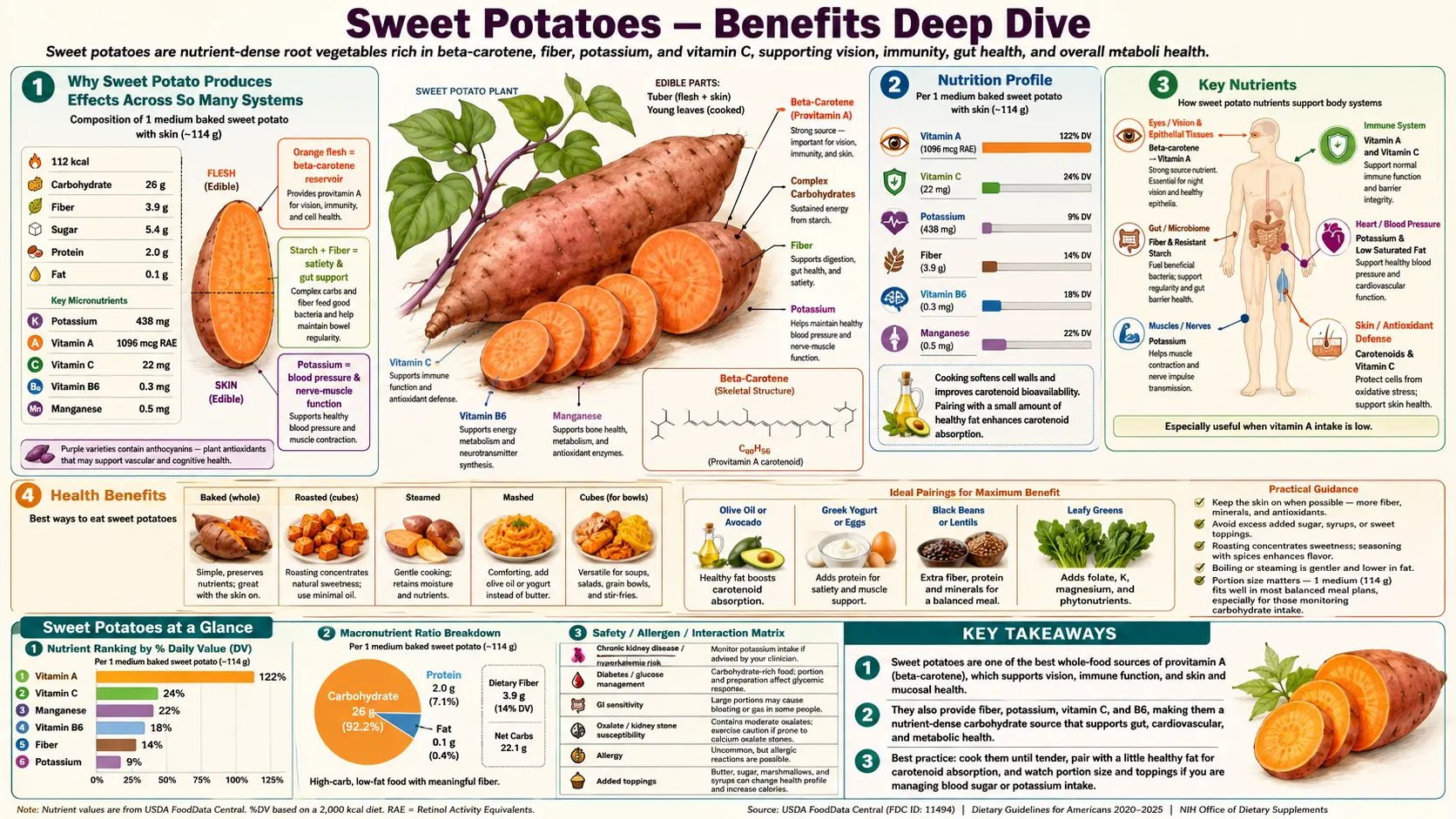
The sweet potato (Ipomoea batatas) is botanically unrelated to the common potato and nutritionally distinct from nearly every other starchy staple. A single medium orange-flesh sweet potato delivers roughly four times the daily provitamin A requirement of an adult, sustained complex-carbohydrate energy with a glycemic load substantially lower than equivalent white potato, fiber that ferments to short-chain fatty acids in the colon, and a uniquely high concentration of skin-targeted carotenoids that deposit in the dermis to produce measurable photoprotection. Purple-flesh cultivars (Stokes Purple, Okinawan, Ayamurasaki) add a separate polyphenol class — anthocyanin glycosides — with antioxidant and vascular benefits that orange varieties do not provide. This four-page deep dive walks through the four largest benefit domains: the beta-carotene-to-vision pathway, the glycemic-index distinction from white potato, the orange-vs-purple cultivar comparison, and the skin nutrient density that makes sweet potato consumption a measurable dietary intervention for skin health.
Deep-Dive Articles
Beta-Carotene and Vision
Why orange sweet potato is the single most concentrated dietary source of beta-carotene in the human food supply (roughly 11,000 µg per 100 g, ~4× the next most concentrated common food), the BCMO1 enzyme that converts plant beta-carotene to retinol on demand, the rhodopsin visual cycle and how dietary beta-carotene becomes 11-cis-retinal in the rod cells, the night-blindness reversal trials, and the unique cooking effects (boiling versus baking versus roasting) on bioavailability.
Glycemic Index
The myth that all starchy roots spike blood sugar identically. Boiled sweet potato has a glycemic index of approximately 44 (low), versus 78 (high) for baked white potato — a 34-point gap explained by amylose:amylopectin ratio, dietary fiber, polyphenol-mediated alpha-amylase inhibition, and cell-wall integrity. How cooking method (boiling versus baking versus roasting) shifts the glycemic response by up to 30 points on the same tuber, and the cooled-resistant-starch effect when sweet potato is refrigerated and reheated.
Purple vs Orange Cultivars
The two pigment systems are nutritionally distinct, not interchangeable. Orange-flesh cultivars (Beauregard, Garnet, Jewel) provide beta-carotene; purple-flesh cultivars (Stokes Purple, Okinawan, Ayamurasaki) provide anthocyanin glycosides (peonidin-3-glucoside, cyanidin-3-glucoside) with measurable cardiovascular, neurovascular, and antioxidant benefits. The Okinawan longevity literature, the Stokes Purple ORAC measurements, and the practical recommendation to eat both colors across the week.
Skin Nutrient Density
The dietary carotenoid→dermal-deposition pathway and the photoprotection it produces. Stahl and Sies skin-yellowness studies (carotenoid skin index rises measurably within 4 weeks of beta-carotene-rich diet), the minimal-erythemal-dose increase from sustained orange-vegetable intake, the role of retinoic acid signaling in keratinocyte differentiation, and why oral nutrition complements (but does not replace) topical sunscreen.
Table of Contents
- Deep-Dive Articles
- Why Sweet Potato Produces Effects Across So Many Systems
- Research Papers: Beta-Carotene and Vision
- Research Papers: Glycemic Index and Metabolic Effects
- Research Papers: Purple Cultivars and Anthocyanins
- Research Papers: Skin and Carotenoid Deposition
- Research Papers: Cross-Cutting (Composition, Cooking, Cultivars)
- External Authoritative Resources
- Connections
- Featured Videos
Why Sweet Potato Produces Effects Across So Many Systems
Most starchy staples are nutritionally narrow — they deliver carbohydrate energy and modest amounts of a handful of micronutrients. Sweet potato is an outlier because it simultaneously occupies four nutritional niches that are usually filled by separate foods: it is a high-quality carbohydrate energy source with a low glycemic index, it is the densest common dietary source of provitamin A carotenoid, it is one of the highest-fiber starchy roots in the food supply, and (in purple-flesh cultivars) it is a competitive source of dietary anthocyanins. Each of these four properties maps to a distinct category of clinical effect.
- Provitamin A density — orange sweet potato provides roughly 11,000 µg of beta-carotene per 100 g, more than carrot (~8,300 µg), kale (~5,400 µg), or spinach (~5,600 µg). After BCMO1-mediated central cleavage to retinal, this drives the vision-protective effect and the epithelial-maintenance effect on skin and mucosa.
- Low glycemic load relative to other starchy staples — the combination of resistant starch, dietary fiber, polyphenol-mediated alpha-amylase inhibition, and intact plant-cell-wall structure produces a postprandial glucose response substantially below white potato, white rice, or white bread. This drives the metabolic-tolerance benefit that makes sweet potato a usable carbohydrate for people with insulin resistance and type 2 diabetes.
- Anthocyanin pigments (purple cultivars only) — purple-flesh sweet potatoes contain 100–500 mg of anthocyanins per 100 g, comparable to blueberries, with the dominant species being peonidin-3-glucoside and cyanidin-3-glucoside. This is a separate molecular class from beta-carotene and drives distinct vascular, neuroprotective, and antioxidant effects.
- Fermentable fiber — the 3–4 g of dietary fiber per medium sweet potato is heavily fermentable (pectins, resistant starch, cellulose) and feeds the colonic microbiome, producing short-chain fatty acids (butyrate, propionate, acetate) that signal to the gut epithelium, the liver, and (via the vagus and circulating SCFAs) the central nervous system.
The therapeutic complication is small: sweet potato is among the few starchy foods with essentially no significant downsides for the general population. Oxalate content is moderate (sweet potato has ~6 mg oxalate per 100 g, similar to carrot, much lower than spinach at ~970 mg) so calcium-oxalate stone formers do not need to restrict. The carbohydrate load (~20 g per 100 g cooked) does require accounting in diabetic diets, but the low glycemic index makes the same gram of carbohydrate metabolically gentler than carbohydrate from white potato. For people taking thyroid medication, the goitrogen content is negligible. For the rare person with a true Solanaceae sensitivity, sweet potato is reassuringly outside that family (it is in Convolvulaceae, the morning-glory family).
Research Papers: Beta-Carotene and Vision
- Orange sweet potato as a biofortified vehicle for Vitamin A in deficient populations — PubMed: Orange sweet potato biofortification
- Mozambique trial: orange sweet potato increases serum retinol in children — PubMed: Mozambique sweet potato trial
- Beta-carotene to retinol conversion ratio in sweet potato matrix — PubMed: Sweet potato beta-carotene bioavailability
- 11-cis-retinal and the rhodopsin visual cycle — PubMed: 11-cis-retinal rhodopsin cycle
- BCMO1 enzyme and beta-carotene central cleavage to retinal — PubMed: BCMO1 central cleavage
- HarvestPlus orange sweet potato adoption and night blindness reduction — PubMed: HarvestPlus night blindness
- Cooking method effects on beta-carotene retention in sweet potato (boiling vs baking vs frying) — PubMed: Cooking method retention
- Xerophthalmia reduction with orange-fleshed sweet potato intervention — PubMed: Xerophthalmia reduction
- Provitamin A carotenoid content variability across sweet potato cultivars — PubMed: Cultivar variability
- Dietary fat co-ingestion and carotenoid absorption from sweet potato — PubMed: Fat co-ingestion
Research Papers: Glycemic Index and Metabolic Effects
- Glycemic index of boiled vs baked vs roasted sweet potato — PubMed: Sweet potato GI by cooking method
- International tables of glycemic index and glycemic load values (Atkinson, Foster-Powell, Brand-Miller) — PubMed: International GI tables
- Caiapo (white-skinned sweet potato extract) and type 2 diabetes glycemic control — PubMed: Caiapo diabetes trial
- Resistant starch formation in cooled sweet potato and starchy foods — PubMed: Resistant starch retrogradation
- Amylose to amylopectin ratio in sweet potato cultivars and glycemic response — PubMed: Amylose amylopectin ratio
- Sweet potato polyphenols and alpha-amylase / alpha-glucosidase inhibition — PubMed: Sweet potato alpha-amylase inhibition
- Dietary fiber composition and fermentability in sweet potato — PubMed: Sweet potato fiber composition
- Short-chain fatty acid production from sweet potato fiber fermentation — PubMed: Sweet potato SCFA production
- Postprandial glycemic response to sweet potato vs white potato (comparative) — PubMed: Sweet vs white postprandial
- Sweet potato leaf phenolics and antidiabetic effects in animal models — PubMed: Sweet potato leaf phenolics
Research Papers: Purple Cultivars and Anthocyanins
- Anthocyanin composition of purple-flesh sweet potato (peonidin and cyanidin glycosides) — PubMed: Purple sweet potato anthocyanins
- Antioxidant capacity (ORAC) of purple vs orange sweet potato — PubMed: ORAC purple vs orange
- Okinawan diet, purple sweet potato, and longevity (Willcox et al.) — PubMed: Okinawan longevity
- Purple sweet potato anthocyanins and blood pressure in clinical trials — PubMed: PSP anthocyanin and BP
- Stability of purple sweet potato anthocyanins through cooking and digestion — PubMed: PSP anthocyanin stability
- Purple sweet potato extract and hepatoprotection against oxidative stress — PubMed: PSP hepatoprotection
- Anthocyanin transport across the blood-brain barrier (general) — PubMed: Anthocyanin BBB transport
- Purple sweet potato anthocyanins and gut microbiota modulation — PubMed: PSP gut microbiota
- Comparative phenolic profiles of orange, yellow, white, and purple sweet potato — PubMed: Cultivar phenolic profiles
- Anthocyanin anti-inflammatory mechanisms (NF-kappaB modulation) — PubMed: Anthocyanin NF-kB
Research Papers: Skin and Carotenoid Deposition
- Stahl and Sies: dietary carotenoids and skin photoprotection — PubMed: Stahl-Sies carotenoid photoprotection
- Skin yellowness (CIE b*) as marker of dietary carotenoid intake — PubMed: Skin yellowness biomarker
- Minimal erythemal dose (MED) increase with sustained carotenoid intake — PubMed: MED and carotenoids
- Retinoic acid and keratinocyte differentiation — PubMed: RA keratinocyte differentiation
- Stephen and Whitehead: facial carotenoid coloration and perceived health — PubMed: Stephen facial carotenoid
- Beta-carotene supplementation and erythema reduction (meta-analysis) — PubMed: Beta-carotene erythema meta-analysis
- Skin carotenoid concentration measured by resonance Raman spectroscopy — PubMed: Skin carotenoid Raman
- Vitamin A and wound healing (epithelial differentiation) — PubMed: Vitamin A wound healing
- Carotenoid skin deposition kinetics after dietary intervention — PubMed: Skin deposition kinetics
- Beta-carotene oxidative breakdown products under high UV / smoking — PubMed: Beta-carotene pro-oxidant
Research Papers: Cross-Cutting (Composition, Cooking, Cultivars)
- USDA FoodData Central: sweet potato nutrient composition — PubMed: USDA composition
- Ipomoea batatas taxonomy and Convolvulaceae family classification — PubMed: Ipomoea batatas taxonomy
- Sweet potato origin, domestication, and global spread — PubMed: Sweet potato origins
- Oxalate content of sweet potato vs spinach and other greens — PubMed: Sweet potato oxalate
- Sweet potato vine and leaf nutritional value (overlooked vegetable) — PubMed: Sweet potato leaves
- Beta-carotene heat stability and isomerization during cooking — PubMed: Beta-carotene isomerization
- Sweet potato storage protein (sporamin) and antioxidant activity — PubMed: Sporamin
- Sweet potato glycoprotein and immunomodulatory effects in vitro — PubMed: Sweet potato glycoprotein
- Sweet potato beta-cryptoxanthin and provitamin A activity — PubMed: Beta-cryptoxanthin
- Sweet potato vs cassava vs yam vs taro: comparative tropical staple nutrition — PubMed: Tropical staple comparison
External Authoritative Resources
- USDA FoodData Central — Sweet potato, raw, unprepared — full nutrient profile per 100 g
- HarvestPlus — Orange Sweet Potato Biofortification Program
- Linus Pauling Institute — Carotenoids Micronutrient Information Center
- NIH Office of Dietary Supplements — Vitamin A Fact Sheet (Health Professionals)
- PubMed — All research on sweet potato (Ipomoea batatas)
Connections
- All Food
- Sweet Potatoes (Main Page)
- Sweet Potato for Vision (Beta-Carotene)
- Sweet Potato Glycemic Index
- Purple vs Orange Cultivars
- Skin Nutrient Density
- Vitamin A
- Vitamin A Benefits Deep Dive
- Beta-Carotene vs Preformed Retinol
- Vitamin A for Vision & Eye Health
- Vitamin A for Skin
- Kale
- Type 2 Diabetes
- Macular Degeneration
- Acne