Sweet Potatoes: History and Origins
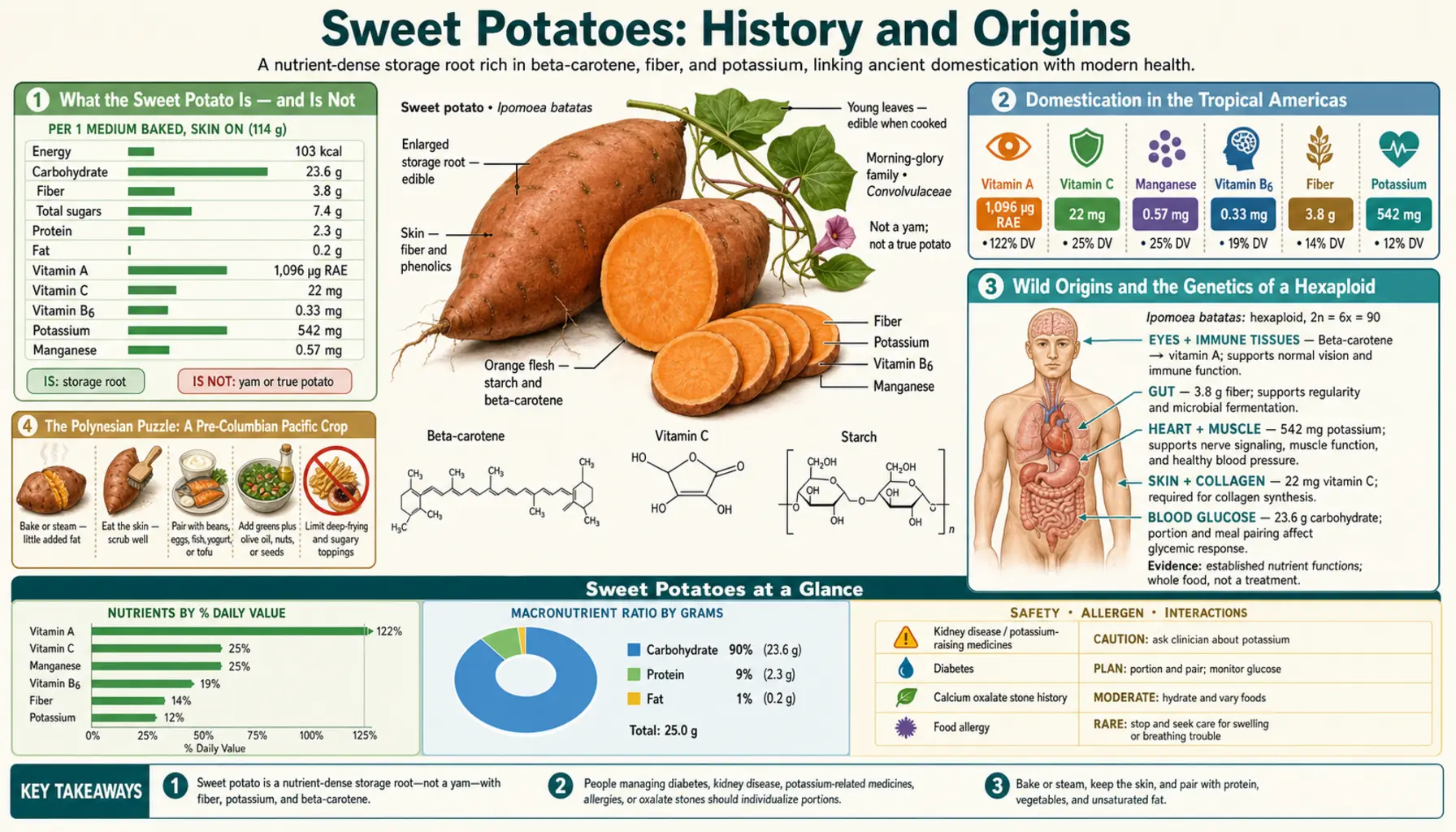
The sweet potato (Ipomoea batatas) is an American plant with one of the most genuinely puzzling histories of any food crop. It was domesticated in the tropical Americas thousands of years ago, and there it might have stayed until European ships carried it around the world after 1492 — except that the sweet potato was already growing in the islands of Polynesia, on the far side of the Pacific Ocean, before any European arrived. How it got there is one of the most famous unsolved questions in the study of plants and human migration, and this article presents it honestly as an open, actively debated problem rather than a settled story. Along the way we trace where the plant was first farmed, how Spanish and Portuguese traders spread it across Africa and Asia (where in China it became a crop that fed millions through famine), and why — despite its name — the sweet potato is neither a true yam nor a relative of the common potato. Where a claim is firmly established we say so; where it is contested among scientists, we say that too.
Table of Contents
- What the Sweet Potato Is — and Is Not
- Domestication in the Tropical Americas
- Wild Origins and the Genetics of a Hexaploid
- The Polynesian Puzzle: A Pre-Columbian Pacific Crop
- Human Contact or Floating Seeds? An Unresolved Debate
- The Columbian Exchange: Spread Across the Old World
- A Famine Buffer: The Sweet Potato in China
- From Subsistence Staple to Modern Crop
- Research Papers and References
- Connections
- Featured Videos
What the Sweet Potato Is — and Is Not
The sweet potato is the swollen, starchy storage root of Ipomoea batatas, a trailing vine in the family Convolvulaceae — the morning glory family. Its closest garden relatives are not other root vegetables at all but the ornamental morning glories and the weedy bindweeds, and anyone who has seen a sweet potato vine flower will recognize the familiar funnel-shaped morning-glory bloom. The part we eat is a true root that thickens underground to store sugars and starch, which is why a forgotten sweet potato sprouts a tangle of vines rather than the eyes of a potato.
Two persistent confusions are worth clearing up at once, because both are baked into the plant's common names. First, the sweet potato is not a true yam. True yams belong to the genus Dioscorea, in an entirely separate plant family (Dioscoreaceae), and are monocots — a deep evolutionary division from the dicot sweet potato. The orange-fleshed sweet potatoes sold as "yams" in much of the United States are a marketing label, not a botanical fact; genuine Dioscorea yams are large, bark-skinned tropical tubers grown widely in West Africa and Asia. Second, the sweet potato is not closely related to the common potato. The ordinary potato (Solanum tuberosum) is a member of the nightshade family (Solanaceae) and is a stem tuber — a swollen underground stem — rather than a root.
The shared word "potato" is an accident of European naming. When Spanish explorers met the sweet potato in the Caribbean, they borrowed the Indigenous Taíno word batata. Later, encountering the unrelated Andean tuber, they applied the closely similar word patata to it as well, and English speakers eventually settled "potato" on the Andean plant — so the name that began with the sweet potato ended up attached to a different species. The two foods sit in completely different branches of the plant kingdom and merely share a tangled history of names.
Domestication in the Tropical Americas
The sweet potato is, beyond serious doubt, a plant of the American tropics. It was first brought into cultivation somewhere in the warm lowlands stretching from Central America down into northwestern South America — broadly the region between the Yucatán Peninsula of Mexico and the Orinoco basin of Venezuela, with the Peru–Ecuador area featuring centrally in the genetic story. Exactly which corner of this belt saw the first domestication is still discussed, and genetic work has pointed at times toward a Central American center (some studies highlight the Yucatán region) and at times toward South America. What is not in dispute is that this was an American achievement, made by Indigenous farmers long before any contact with the wider world.
The crop is genuinely ancient. Domesticated sweet potatoes are generally accepted to have been present in the Americas at least about 5,000 years ago, and some of the oldest direct archaeological evidence comes from the dry coast of Peru, where preservation is exceptional. Desiccated remains identified as sweet potato from Peruvian sites have been reported with ages in the range of roughly 4,500 years before present for clearly cultivated material, and considerably older plant remains — on the order of 8,000 to 10,000 years before present — have been recovered, though the very oldest finds are harder to tie definitively to a fully domesticated crop. Taken together, the record places the sweet potato among the early cultivated plants of the Americas, alongside maize, beans, and the common potato.
By the time Europeans arrived, Indigenous peoples across the tropical Americas grew many distinct varieties, and the plant was a dietary mainstay in parts of the Caribbean and South America. Christopher Columbus and his crew encountered it on the very first voyages of the 1490s — among the earliest American foods Europeans tasted — which is precisely why the Taíno name traveled back to Europe with it.
Wild Origins and the Genetics of a Hexaploid
Untangling the sweet potato's ancestry has been unusually hard, because the cultivated plant is a hexaploid — it carries six sets of chromosomes rather than the usual two. This genetic complexity, combined with the way sweet potato varieties have been moved around and crossed for centuries, has produced conflicting family trees in different studies and kept the question of origins alive far longer than for most crops.
The modern consensus, supported by detailed genomic work, is that the sweet potato's closest living wild relative is Ipomoea trifida, a wild morning glory of the American tropics, and that the crop arose through autopolyploidy — a multiplication of chromosome sets within that lineage — rather than by hybridizing two different species. A large 2018 phylogenetic study by Pablo Muñoz-Rodríguez and colleagues, published in Current Biology, concluded that I. trifida is indeed the sweet potato's nearest relative and that no other surviving species appears to have contributed to its origin, helping to reconcile some of the earlier contradictions in the data.
This deep genetic backdrop matters for the historical chapter that follows. Because the cultivated sweet potato and its wild relatives share so much DNA and because their lineages diverged long ago, geneticists trying to read the timing of the plant's spread across the Pacific have arrived at startlingly different answers — and those differences sit at the heart of the sweet potato's most famous controversy.
The Polynesian Puzzle: A Pre-Columbian Pacific Crop
Here is the fact that makes the sweet potato extraordinary. When European explorers reached the islands of Polynesia in the seventeenth and eighteenth centuries, they found the sweet potato already there — established, named, and woven into local agriculture across a vast triangle of the Pacific that includes New Zealand, Hawaii, and the islands of central Polynesia. Yet the sweet potato is an American plant. For it to be growing in Polynesia before sustained European contact, it had to have crossed thousands of kilometers of open ocean from the Americas in pre-Columbian times. How that happened is the unresolved question.
One striking clue is linguistic. The word for sweet potato across much of Polynesia is kumara (Māori kūmara; reconstructed as something like Proto-Polynesian kumala), and this closely resembles words for the plant in the Quechua and Aymara languages of the Andes — recorded in forms such as k'umar or cumar. To many researchers, a shared name on both sides of the Pacific is hard to explain unless people carried the plant, and its name, across the ocean. This is the kind of evidence that has long been read as a fingerprint of direct human contact between South America and Polynesia.
The case for pre-Columbian human transfer also draws on genetics. A 2013 study in the Proceedings of the National Academy of Sciences by Caroline Roullier and colleagues, working with historical herbarium specimens collected on early European voyages, reported strong support for a prehistoric transfer of sweet potato from the Peru–Ecuador region of South America into Polynesia. Their findings fit what is sometimes called the "tripartite hypothesis": an early, pre-Columbian introduction of the sweet potato into Oceania from South America, followed centuries later by separate European-era introductions along two documented routes (one from the Caribbean and one from Mexico across the Pacific). On this reading, the Polynesian sweet potato is a genuine relic of ancient ocean-crossing contact.
Human Contact or Floating Seeds? An Unresolved Debate
For decades the sweet potato was treated as the single best botanical evidence that Polynesians and South Americans met before Columbus. But the question is not settled, and in recent years a serious scientific challenge has emerged. The honest state of the field is that this is a genuinely open and debated problem, with reputable researchers on both sides.
The challenge came most forcefully from the same 2018 Current Biology study by Muñoz-Rodríguez and colleagues mentioned above. Analyzing whole-genome and chloroplast data, they argued that the Polynesian sweet potato lineage diverged from its South American relatives an extraordinarily long time ago — on the order of a hundred thousand years or more, far earlier than any humans reached the remote Pacific. If that timing is correct, the plant could not have been carried by people, because there were no people in Polynesia to carry it. Instead, they proposed that the sweet potato (or a wild ancestor) reached the Pacific by natural long-distance dispersal — seeds or plant material floating across the ocean, or carried by birds — in pre-human times. On this view, the sweet potato is not evidence of human contact at all.
That conclusion has not gone unchallenged. Critics point out that natural dispersal struggles to explain the linguistic evidence: a wild seed drifting ashore would not arrive carrying an Andean-sounding name, yet the resemblance between Polynesian kumara and Quechua/Aymara k'umar is real and specific. Some researchers also question whether the deep divergence times truly rule out a later human introduction, given how complex the sweet potato's polyploid genome is and how much its varieties have been reshuffled over time. Archaeological work in New Zealand and elsewhere, including studies that bring together Māori traditional knowledge with scientific dating, continues to investigate when and how the kūmara actually arrived at Polynesia's southern margins.
So where does this leave us? With an honest we do not yet know. The two leading hypotheses — pre-Columbian human contact versus natural pre-human dispersal — both have credible evidence and serious advocates, and they cannot both be fully right. Other lines of inquiry, including ancient DNA from people as well as plants, may eventually tip the balance. For now, the pre-Columbian presence of the sweet potato in Polynesia is a firmly established fact; the explanation for it is one of the most fascinating unresolved questions in the history of food.
The Columbian Exchange: Spread Across the Old World
Whatever the truth about its earlier Pacific journey, the sweet potato's great global expansion came after 1492, as part of the vast movement of plants, animals, and people between hemispheres that historians call the Columbian Exchange. Spanish ships carried the sweet potato eastward across the Atlantic to Europe, where it was grown in the warmer south (it reached Spain relatively early and even appeared, as a costly delicacy, in Tudor England). But Europe's climate suited it poorly, and the sweet potato never became a major European staple the way the common potato eventually would.
Its real conquest was of the tropics and subtropics, and here the Portuguese and Spanish maritime empires were the engines of dispersal. Portuguese traders, operating along the routes of their seaborne network, helped carry the sweet potato to the coasts of Africa, to India, and onward into Southeast Asia over the sixteenth century. Spanish ships running the trans-Pacific galleon trade between Mexico and Manila brought American crops, the sweet potato among them, into the Philippines and the wider Pacific. Within roughly a century of Columbus, a plant that had been confined to the American tropics (and, mysteriously, parts of Polynesia) was being grown across a broad band of the warm Old World.
The reasons for its rapid adoption were practical. The sweet potato is hardy and productive, tolerates poor soils where grain crops fail, needs little tending, and yields a great deal of food and calories per area of land. For farmers in monsoon Asia and tropical Africa, it slotted in as a reliable subsistence crop and an insurance against the failure of rice or millet — a role it still plays in many regions today.
A Famine Buffer: The Sweet Potato in China
Nowhere did the imported sweet potato matter more than in China, where it arrived in the late sixteenth century and went on to help feed an enormous and growing population. The most widely repeated account credits a merchant named Chen Zhenlong, who is said to have encountered the sweet potato while trading in Luzon (in the Spanish-controlled Philippines) and to have brought planting material back to Fujian province around 1593. As the traditional story goes, a drought struck Fujian soon after, and the crop was promoted to provincial officials as famine relief — with striking success. As with many such founding tales, the neat details deserve some caution, but the broad outcome is firmly documented: the sweet potato took hold in southern China during the late Ming period and spread quickly.
The timing could hardly have been better. The late sixteenth and seventeenth centuries brought cold, erratic weather and repeated harvest failures to China — part of the climatic downturn often called the Little Ice Age — and the upheavals surrounding the fall of the Ming dynasty in the 1640s. The sweet potato, able to grow on hillsides and marginal ground unsuited to rice, became a crucial buffer against famine, keeping people alive where the staple grain could not. Together with two other American imports, maize and the common potato, it expanded the amount of land that could feed people.
Historians have long connected these New World crops to China's dramatic population growth over the following centuries, as the country's numbers climbed steeply between roughly 1500 and 1900. The sweet potato is not the sole cause of that expansion — population history has many drivers — but it is fair to say the humble "earth-egg" or "earth-melon," as it was variously called in Chinese, earned a permanent place in the country's diet and remains a staple and comfort food there to this day.
From Subsistence Staple to Modern Crop
From these scattered beginnings the sweet potato became one of the world's most important food crops by sheer tonnage, grown across Asia, Africa, the Americas, and the Pacific. China today produces the lion's share of the global harvest, but the plant is a dietary anchor across sub-Saharan Africa and a beloved food in places as varied as Japan, the southern United States, and the islands of Polynesia, where the kūmara remains culturally central to the Māori and other peoples.
The plant's journey has also been shaped, in the modern era, by nutrition and public health. Breeding programs have promoted orange-fleshed sweet potato varieties rich in beta-carotene (a precursor of vitamin A) as a tool against vitamin-A deficiency in regions where it causes childhood blindness and death — a deliberate, contemporary chapter in a very old story of the plant feeding people in hard places. That nutritional dimension, and the evidence behind it, is covered on the companion Sweet Potatoes Benefits articles and on the main Sweet Potatoes page; this history is concerned with how the crop came to be grown and eaten around the world.
Tracing that history honestly means holding two things at once: a firm backbone of established fact — an American origin thousands of years deep, a post-Columbian spread across the Old World, a starring role as a famine food in China — and, threaded through it, one of the great open mysteries of human and botanical history in the pre-Columbian Pacific. That mixture of the settled and the unsolved is exactly what makes the sweet potato's past worth knowing.
Research Papers and References
The list below combines peer-reviewed studies on the origin, genetics, and Pacific dispersal of Ipomoea batatas with reputable references and curated PubMed topic-search links. The two most directly relevant primary studies — the 2013 PNAS paper supporting pre-Columbian human transfer and the 2018 Current Biology paper arguing for natural dispersal — are both cited in full so readers can weigh the competing evidence for themselves. Author names, titles, and journals are given as plain text; only the stable DOI, PMID, or archive link is hyperlinked, and each opens in a new tab.
- Roullier C, Benoit L, McKey DB, Lebot V. Historical collections reveal patterns of diffusion of sweet potato in Oceania obscured by modern plant movements and recombination. Proceedings of the National Academy of Sciences USA. 2013;110(6):2205-2210. — doi:10.1073/pnas.1211049110 (also PMID: 23341603) — supports pre-Columbian transfer (tripartite hypothesis).
- Muñoz-Rodríguez P, Carruthers T, Wood JRI, et al. Reconciling Conflicting Phylogenies in the Origin of Sweet Potato and Dispersal to Polynesia. Current Biology. 2018;28(8):1246-1256.e12. — doi:10.1016/j.cub.2018.03.020 (also PMID: 29657119) — argues for natural long-distance, pre-human dispersal.
- Roullier C, Duputié A, Wennekes P, et al. Disentangling the origins of cultivated sweet potato (Ipomoea batatas (L.) Lam.). PLOS ONE. 2013;8(5):e62707. — doi:10.1371/journal.pone.0062707 (also PMID: 23723970)
- Denham T. Ancient and historic dispersals of sweet potato in Oceania (commentary). Proceedings of the National Academy of Sciences USA. 2013;110(6):1982-1983. — doi:10.1073/pnas.1221569110 (also PMID: 23355678)
- Yen DE. The Sweet Potato and Oceania: An Essay in Ethnobotany. Bishop Museum Press; 1974. — The classic ethnobotanical study underpinning the tripartite hypothesis. WorldCat record
- Sweet potato (Ipomoea batatas) — origin, domestication, and genetics — PubMed: Ipomoea batatas origin and domestication
- Pre-Columbian sweet potato dispersal to Polynesia and the Pacific — PubMed: sweet potato dispersal to Polynesia
- Sweet potato and the Columbian Exchange in Asia and Africa — PubMed: sweet potato Columbian Exchange history
External Authoritative Resources
- Encyclopaedic overview — sweet potato (Ipomoea batatas)
- Encyclopaedic overview — sweet potato cultivation in Polynesia (the kumara debate)
- Encyclopaedia Britannica — sweet potato (plant, description, uses)