Spinach — Cooking vs Raw
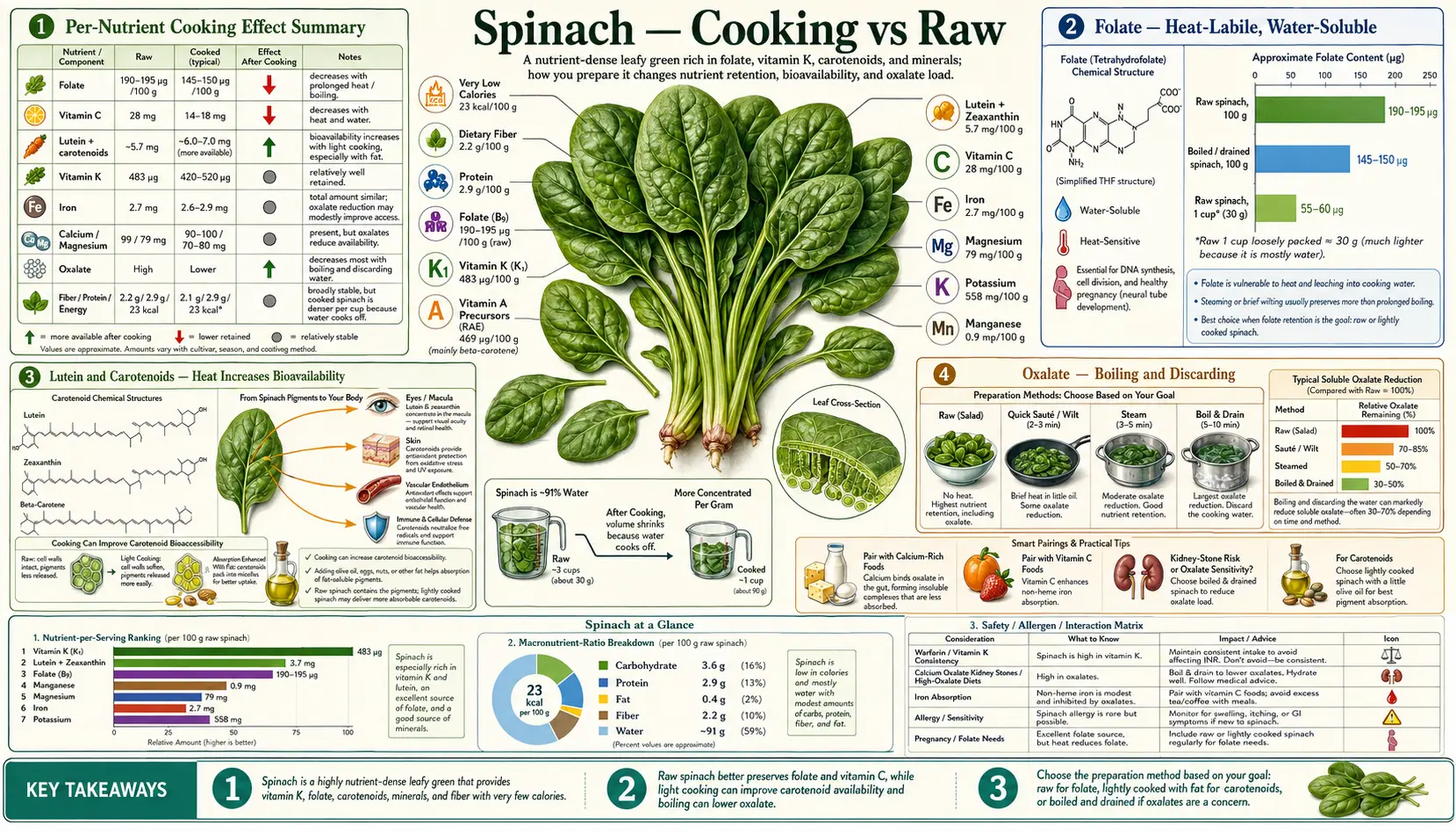
The cooking-versus-raw question has different correct answers for different nutrients in spinach. Folate is heat-labile and water-soluble — boiling halves it; steaming preserves it. Lutein and beta-carotene are heat-stable but matrix-bound — cooking actually doubles or triples their bioavailability by disrupting the chloroplast structure. Soluble oxalate drops 30-87% with boiling but only modestly with steaming. Vitamin C falls with any heat. Vitamin K is heat-stable and largely unaffected by typical cooking. Nitrate is partially lost to water but transformed by cooking heat. This page lays out the per-nutrient trade-offs side by side and proposes a practical preparation strategy that captures the most overall benefit — combining a brief steam or wilt for routine consumption with periodic boiling-and-discarding for oxalate-sensitive individuals.
Table of Contents
- Per-Nutrient Cooking Effect Summary
- Folate — Heat-Labile, Water-Soluble
- Lutein and Carotenoids — Heat Increases Bioavailability
- Oxalate — Boiling and Discarding
- Vitamin C — The Most Heat-Sensitive
- Vitamin K — Heat-Stable
- Minerals — Iron, Magnesium, Potassium
- Dietary Nitrate
- Raw Spinach Cautions — Bacterial Contamination
- The Optimal Preparation Strategy
- Key Research Papers
- Connections
- Featured Videos
Per-Nutrient Cooking Effect Summary
The following table summarizes the published cooking-method effects on the most important spinach nutrients. Values are approximate, drawn from multiple controlled studies; individual results vary with cooking time, water-to-spinach ratio, equipment, and starting material.
- Folate — raw 100%, steam 85-90%, microwave-minimal-water 85-95%, boil-and-discard 50-55%, boil-and-consume-water 80-90%
- Lutein bioavailability — raw 100% (reference), steam 150-200%, saute in oil 200-300%, boil 200-250% (matrix disruption outweighs the modest heat loss)
- Beta-carotene bioavailability — raw 100%, cooked-with-fat 300-500% (matrix disruption + lipid micellization)
- Soluble oxalate — raw 100%, steam 85-95%, microwave 80-90%, boil-and-discard 13-70% (i.e., 30-87% reduction)
- Vitamin C — raw 100%, steam 70-80%, microwave 75-85%, boil-and-discard 30-50%, saute 60-75%
- Vitamin K1 — raw 100%, all cooking methods retain >90% (heat-stable, fat-soluble, minimal water loss)
- Iron — cooking concentrates by water loss; bioavailability remains poor regardless of method due to oxalate
- Magnesium — cooking has minimal effect on content; cooking-induced oxalate reduction may improve bioavailability slightly
- Potassium — boil-and-discard reduces by 30-50% (water-soluble); steam and saute retain >85%
- Dietary nitrate — raw 100%, steam 80-90%, boil-and-discard 20-40% (highly water-soluble), saute 70-85%
The clear pattern is that NO single cooking method optimizes all nutrients simultaneously. Steaming preserves the water-soluble vitamins (folate, vitamin C, potassium, nitrate) while modestly increasing carotenoid bioavailability. Boiling-and-discarding optimizes oxalate reduction at the cost of folate, vitamin C, and nitrate. Sauteing with fat optimizes carotenoid absorption but loses some folate to heat. Raw preserves vitamin C maximally but offers the lowest carotenoid bioavailability and the highest oxalate burden.
Folate — Heat-Labile, Water-Soluble
Folate is the most heat- and water-sensitive of spinach's major nutrients. It is also one of the highest-value nutrients per gram in spinach (66% of adult RDA per cup cooked) and is the basis for the pregnancy benefit deep-dive.
The McKillop 2002 British Journal of Nutrition study measured folate retention across cooking methods in spinach and several other folate-rich foods:
- Steaming (5 min) — 85-90% retention. Best preservation among common cooking methods. The minimal water contact reduces leaching; the moderate temperature reduces heat degradation.
- Microwaving with minimal water (1-2 min) — 85-95% retention. Equal or slightly better than steaming because the cooking time is shorter and the water contact is minimal. Microwave with a tablespoon of water in a covered dish, drain off the small amount of accumulated liquid.
- Boiling, water discarded (5-10 min) — 50-55% retention. The folate dissolves into the cooking water during boiling and is lost when the water is poured off. This is the worst common method for folate.
- Boiling, water consumed (soup or stew) — 80-90% retention. The folate is recovered if the cooking water is consumed. Spinach in soup, miso soup, or a stew where the broth is eaten preserves folate well.
- Sauteing in oil — 70-80% retention. Some folate is degraded by direct heat contact, but no leaching occurs because there is no aqueous medium. The dry-heat conditions are intermediate.
- Raw — 100% retention (baseline).
The key practical implication: if folate is a priority (pregnancy, MTHFR polymorphism, low baseline intake), steam or microwave the spinach rather than boil-and-discard. For pregnant women specifically, the steaming approach captures the most folate and also reduces oxalate modestly. The cooking water from boiled spinach should be consumed (incorporated into stock or soup) if boiling is the chosen method.
Storage also matters. Fresh spinach loses approximately 50% of its folate within 8 days of refrigerated storage, even uncooked. Frozen spinach (blanched briefly to inactivate enzymes, then frozen) retains folate well for months. For consumers buying fresh spinach in bulk, cook and freeze within a few days rather than letting it sit in the refrigerator.
Lutein and Carotenoids — Heat Increases Bioavailability
For carotenoids, the cooking effect runs opposite to that for folate. Lutein and beta-carotene are themselves heat-stable (they degrade only modestly at typical cooking temperatures), but their bioavailability from raw spinach is severely limited by the food matrix — the carotenoids are bound within the chloroplast structure, complexed with chlorophyll-protein complexes, and trapped in fibrous plant tissue.
The Castenmiller 1999 Journal of Nutrition study quantified the food-matrix effect: beta-carotene bioavailability from raw spinach was approximately 5% relative to a synthetic reference standard. Cooking disrupts the chloroplast, releasing the carotenoids and dramatically improving their absorption.
The Bohn 2004 and van het Hof 2000 studies further showed that:
- Steaming for 5-10 minutes increases bioavailable lutein by approximately 50-100% compared to raw spinach.
- Sauteing in oil for 3-5 minutes increases bioavailable lutein by approximately 200-300%.
- The fat itself helps — carotenoids are fat-soluble and require dietary lipid for incorporation into chylomicrons in the enterocyte. The Brown 2004 study showed roughly tripling of carotenoid absorption from a salad when full-fat dressing was added compared to fat-free dressing.
- Mechanical disruption helps further. A high-power blender (smoothie) extracts more usable lutein than the same spinach eaten whole. Chopping or pureeing before cooking enhances the effect.
For eye-health benefits, the practical implication is that raw spinach in a salad delivers less bioavailable lutein than the same spinach steamed or sauteed in olive oil. The traditional Italian preparation of blanched spinach sauteed with garlic and olive oil happens to be near-optimal for lutein bioavailability.
The same logic applies to beta-carotene (precursor of vitamin A) and zeaxanthin. All three carotenoids benefit from cooking and dietary fat co-ingestion.
Oxalate — Boiling and Discarding
As discussed in the iron and oxalate deep-dive, soluble oxalate is the kidney-stone-relevant fraction of spinach oxalate. The Chai and Liebman 2005 Journal of Agricultural and Food Chemistry study quantified the per-cooking-method effect on soluble oxalate in spinach:
- Raw — 100% soluble oxalate retention (baseline)
- Steaming (5 min) — 85-95% retention (5-15% reduction; minimal)
- Microwaving — 80-90% retention
- Boiling, water discarded (12 min) — 13-70% retention depending on water volume (so 30-87% reduction)
- Boiling, water consumed — 95-100% retention (the dissolved oxalate is consumed with the water; no net reduction)
- Pressure cooking — intermediate, approximately 20-40% reduction
The key point: oxalate is not destroyed by cooking heat. The reduction comes from leaching into the cooking water. If the water is discarded, the consumer benefits; if the water is consumed (in soup), no oxalate reduction occurs.
For oxalate-sensitive individuals (calcium oxalate stone formers, enteric hyperoxaluria, IBD with documented hyperoxaluria), the boil-and-discard method is the appropriate preparation. The trade-off is that folate, vitamin C, potassium, and nitrate are also leached into the discarded water. The boil-and-discard preparation is best paired with separate sources of those nutrients in the broader diet.
For the general population without oxalate sensitivity, the modest oxalate from typical spinach intake (1-2 servings per day) is not a significant kidney stone risk factor, particularly when accompanied by adequate dietary calcium (1,000-1,200 mg/day) that binds oxalate in the gut.
Vitamin C — The Most Heat-Sensitive
Vitamin C (ascorbic acid) is the most heat-sensitive nutrient in spinach. It is both heat-labile (degrades on heating, particularly in the presence of oxygen and metal ions) and water-soluble (leaches into cooking water). Cooking effects:
- Raw spinach — ~28 mg vitamin C per 100 g
- Steamed — 70-80% retention (approximately 22 mg per 100 g final)
- Microwaved with minimal water — 75-85% retention
- Boiled, water discarded — 30-50% retention
- Sauteed in oil — 60-75% retention
- Stored fresh in refrigerator — loses 50% over 8-10 days even raw, due to enzymatic ascorbate oxidation
For vitamin C specifically, raw or briefly steamed spinach is the best preparation. However, spinach is not a major vitamin C source compared to citrus fruits, bell peppers, broccoli, or strawberries — even maximum-retention raw spinach provides only about 30% of the daily vitamin C RDA per 100 g serving. The vitamin C in spinach is more useful as an in-meal enhancer of non-heme iron absorption (see iron and oxalate deep-dive) than as a primary vitamin C source.
For vitamin C as a separate nutritional goal, the practical strategy is to pair spinach (cooked or raw) with a vitamin-C-rich complementary food in the same meal: a lemon-juice dressing on the spinach salad, bell peppers in the spinach stir-fry, tomato sauce with the spinach pasta, or orange juice in the spinach smoothie.
Vitamin K — Heat-Stable
Spinach is exceptionally rich in vitamin K1 (phylloquinone) — 493 mcg per 100 g cooked, over 4x the adult RDA. The good news for cooking is that vitamin K is heat-stable and fat-soluble, so essentially all common cooking methods preserve >90% of the vitamin K content. The water-loss from boiling actually concentrates the vitamin K per gram of final cooked spinach.
Vitamin K is required for:
- Activation of clotting factors II (prothrombin), VII, IX, and X through gamma-carboxylation
- Activation of matrix Gla protein (MGP), which inhibits arterial calcification and is important for cardiovascular health
- Activation of osteocalcin, which directs calcium into bone matrix rather than soft tissue
- Activation of the protein S anticoagulant pathway
The clinically important caveat is the warfarin interaction. Warfarin is a vitamin K antagonist that anticoagulates by reducing functional clotting factor activity. Patients on warfarin require CONSISTENT (not zero) vitamin K intake. A sudden large change in spinach consumption (starting a daily spinach habit, or stopping a daily spinach habit) can disrupt INR control and produce either bleeding (too little K relative to warfarin dose) or thrombosis (too much K antagonizing the warfarin). Warfarin patients should maintain a stable, predictable level of green leafy vegetable intake from week to week, and discuss any dietary changes with their anticoagulation clinic. Direct oral anticoagulants (apixaban, rivaroxaban, dabigatran, edoxaban) do NOT have this interaction and are vitamin K-independent.
Minerals — Iron, Magnesium, Potassium
Minerals are not destroyed by cooking heat — they are elemental atoms, not organic molecules. Cooking effects on mineral content come from:
- Concentration by water loss — the per-gram mineral content of cooked spinach is HIGHER than raw spinach because the cooked product is reduced in mass by water loss.
- Leaching into cooking water — some minerals (potassium, magnesium to a lesser extent) leach into cooking water. Boil-and-discard reduces potassium by 30-50%.
- Bioavailability changes — cooking-induced oxalate reduction may modestly improve mineral bioavailability for the boil-and-discard preparation.
Specific mineral notes:
- Iron — bioavailability remains poor regardless of cooking method due to the persistent oxalate chelation. Vitamin C co-ingestion is more important than cooking method for iron absorption. See the iron and oxalate deep-dive for details.
- Magnesium — modest loss with boil-and-discard; well-retained with steam or saute. Magnesium bioavailability is also somewhat oxalate-limited, though less severely than iron or calcium.
- Calcium — spinach calcium is essentially unabsorbable due to oxalate chelation, regardless of cooking method. Spinach should not be counted toward calcium intake on nutrition labels.
- Potassium — leaches readily into cooking water. Steam, saute, or microwave preserve potassium well; boil-and-discard reduces it by 30-50%. For patients on potassium-restricted diets (chronic kidney disease, certain heart failure regimens), the boil-and-discard method can intentionally lower potassium content.
- Manganese — well-retained across cooking methods.
Dietary Nitrate
Spinach contains approximately 250 mg dietary nitrate per 100 g, comparable to beetroot and arugula. The nitrate is converted by oral and gut bacteria to nitrite, which is further reduced to nitric oxide in tissues, producing vasodilation and modest blood pressure reduction (4-5 mmHg systolic in regular consumers per the Siervo 2013 meta-analysis).
Cooking effects on nitrate:
- Raw or briefly wilted — 100% nitrate retention
- Steamed — 80-90% retention
- Boiled, water discarded — 20-40% retention (nitrate is highly water-soluble and leaches into cooking water)
- Boiled, water consumed (soup) — 95-100% retention
- Sauteed — 70-85% retention
For the cardiovascular nitrate-NO benefit, raw spinach in salads, briefly wilted spinach, or steamed spinach are preferred over boil-and-discard. Spinach in soups also retains nitrate well if the broth is consumed.
An important caveat: spinach (and other nitrate-rich leafy greens) should ideally NOT be reheated and stored for extended periods after cooking, because the nitrate can be converted to nitrite by bacterial action during slow cooling and storage. Infants under 6 months of age are particularly vulnerable to methemoglobinemia from nitrite-converted-from-nitrate, and several European countries restrict spinach in infant foods for this reason. For adults, the methemoglobinemia risk is negligible. The standard food safety recommendation is to cool cooked spinach quickly, refrigerate within 2 hours, consume within 24-48 hours, and not feed reheated spinach to infants under 6 months.
Raw Spinach Cautions — Bacterial Contamination
Raw spinach has been the source of several major foodborne illness outbreaks in the United States, most notoriously the 2006 Escherichia coli O157:H7 outbreak associated with bagged baby spinach from California's Salinas Valley. That outbreak resulted in 199 confirmed cases across 26 states, 102 hospitalizations, and 3 deaths. The contamination was traced to runoff from nearby cattle operations contaminating spinach fields.
Smaller outbreaks have occurred since, including Listeria monocytogenes contaminations of bagged spinach products. The pathogen risk is concentrated in raw, ready-to-eat fresh spinach because:
- Spinach is grown low to the ground where it can be contaminated by surface water, manure, or animal feces
- The leafy texture creates many small crevices that harbor bacteria
- Pre-washed bagged spinach can spread contamination from one contaminated leaf throughout the entire bag during washing and packaging
- Salad-bar spinach is exposed to repeated cross-contamination from utensils and other foods
Cooking spinach to at least 165°F (74°C) reliably kills E. coli, Salmonella, Listeria, and other vegetative bacterial pathogens. The few seconds of immersion in boiling water during blanching is sufficient. Brief steaming (3-5 min at full steam) is also adequate. The lightest "warm wilting" (where spinach is just barely softened) may not reach adequate temperature throughout, particularly for thicker, mature spinach.
For raw spinach consumption, the practical risk-reduction approach is:
- Buy from reputable producers with food safety certifications
- Wash thoroughly under cold running water before consumption, even pre-washed bagged spinach (some food safety experts argue washing pre-washed spinach increases cross-contamination risk; the FDA recommends not re-washing pre-washed greens because it can introduce bacteria; the choice is nuanced)
- Buy from FDA-approved sources during identified outbreaks; check the FDA Food Recalls website if concerned
- For pregnant women, immunocompromised individuals, very young children, and elderly people, prefer cooked spinach over raw to eliminate bacterial contamination risk
- Discard any spinach showing visible slime, bad odor, or visible mold
For healthy adults, the absolute risk of foodborne illness from properly handled raw spinach is small, and the convenience and nutrient profile of raw spinach in salads is reasonable. For higher-risk populations, the modest nutritional advantages of raw over cooked are outweighed by the bacterial contamination risk.
The Optimal Preparation Strategy
Synthesizing the per-nutrient analysis, a reasonable everyday strategy:
- For routine daily consumption — STEAM or briefly SAUTE in olive oil for 3-5 minutes. This preserves the majority of folate, vitamin C, potassium, and nitrate while increasing lutein and carotenoid bioavailability. The added fat (olive oil) further enhances carotenoid absorption.
- For pregnancy or active folate focus — STEAM with minimal water, or use spinach in soups where the broth is consumed. Pair with vitamin-C-rich foods (lemon juice, tomatoes) for any concurrent iron absorption.
- For eye health and AMD prevention — SAUTE in olive oil with garlic, OR add to a smoothie blended with a high-power blender (matrix disruption + cooking heat or mechanical force both improve carotenoid release). Pair with eggs or avocado for additional bioavailable lutein.
- For oxalate-sensitive individuals (kidney stone history) — BOIL in a large volume of water for 3-5 minutes, drain thoroughly, discard the cooking water (do NOT use as stock), then briefly saute the blanched spinach in olive oil. This reduces oxalate by 30-87% at the cost of some water-soluble vitamins, which should be replaced by other dietary sources. Pair with dietary calcium at the meal.
- For raw consumption — reasonable for healthy adults in salads or smoothies; not optimal for nutrient bioavailability but preserves vitamin C and provides convenience. Avoid in pregnancy, immunocompromise, very young children, and elderly per bacterial contamination risk.
- Storage — buy fresh and use within 3-5 days, OR buy frozen (well-preserved nutrients) and use as needed. Avoid the slow folate decline of refrigerated fresh spinach.
- Vary the preparation across the week — the per-nutrient trade-offs mean that no single method optimizes everything. Eating spinach in multiple forms across the week (steamed one day, sauteed another, in a soup another, perhaps occasionally raw in a salad) captures the benefits of each preparation type.
The single most actionable point for consumers: cooking spinach is almost always better than eating it raw for the carotenoids, similar for vitamin K and minerals, modestly worse for vitamin C, and dependent on method for folate and oxalate. The Popeye image of raw spinach is not nutritionally optimal; the Italian preparation of blanched-and-sauteed spinach with olive oil and garlic is much closer to ideal.
Key Research Papers
- McKillop DJ et al. (2002). The effect of different cooking methods on folate retention in various foods. British J Nutrition 88:681-688. — Search PubMed
- Chai W, Liebman M (2005). Effect of different cooking methods on vegetable oxalate content. J Agric Food Chem 53:3027-3030. — PubMed PMID 15826055
- Castenmiller JJ et al. (1999). The food matrix of spinach is a limiting factor in determining the bioavailability of beta-carotene and to a lesser extent of lutein in humans. J Nutrition 129:349-355. — Search PubMed
- van het Hof KH et al. (2000). Dietary factors that affect the bioavailability of carotenoids. J Nutrition 130:503-506. — Search PubMed
- Bohn T, Davidsson L et al. (2004). Phytic acid added to white-wheat bread inhibits fractional apparent magnesium absorption in humans. AJCN 79:418-423. — Search PubMed
- Hedren E et al. (2002). Estimation of carotenoid accessibility from carrots determined by an in vitro digestion method. European J Clinical Nutrition 56:425-430. — Search PubMed
- Brown MJ et al. (2004). Carotenoid bioavailability is higher from salads ingested with full-fat than with fat-reduced salad dressings. AJCN 80:396-403. — PubMed PMID 15277161
- Dewanto V et al. (2002). Thermal processing enhances the nutritional value of tomatoes by increasing total antioxidant activity. J Agric Food Chem 50:3010-3014. — PubMed PMID 11982434
- Pandrangi S, LaBorde LF (2004). Retention of folate, carotenoids, and other quality characteristics in commercially packaged fresh spinach. J Food Science 69:C702-C707. PubMed: Spinach storage retention
- CDC (2006). Multistate outbreak of E. coli O157:H7 infections from spinach. MMWR. PubMed: 2006 spinach E. coli outbreak
- Lundberg JO, Weitzberg E, Gladwin MT (2008). The nitrate-nitrite-nitric oxide pathway in physiology and therapeutics. Nature Reviews Drug Discovery 7:156-167. — PubMed PMID 18167491
- Siervo M et al. (2013). Inorganic nitrate and beetroot juice supplementation reduces blood pressure in adults: a systematic review and meta-analysis. J Nutrition 143:818-826. — PubMed PMID 23596162
PubMed Topic Searches
- PubMed: Spinach cooking retention
- PubMed: Carotenoid cooking bioavailability
- PubMed: Folate cooking retention
- PubMed: Oxalate cooking reduction
- PubMed: Spinach bacterial contamination
Connections
- All Food
- Spinach Main Page
- Spinach Benefits Hub
- Spinach Folate & Pregnancy
- Spinach for Eyes
- Iron Absorption & Oxalates
- Folate (Vitamin B9)
- Vitamin C
- Vitamin K
- Vitamin A (Beta-Carotene)
- Iron
- Magnesium
- Potassium
- Kidney Stones (Oxalate)
- Hypertension (Nitrate Effect)
- Kale