Kimchi Lactobacillus Strains
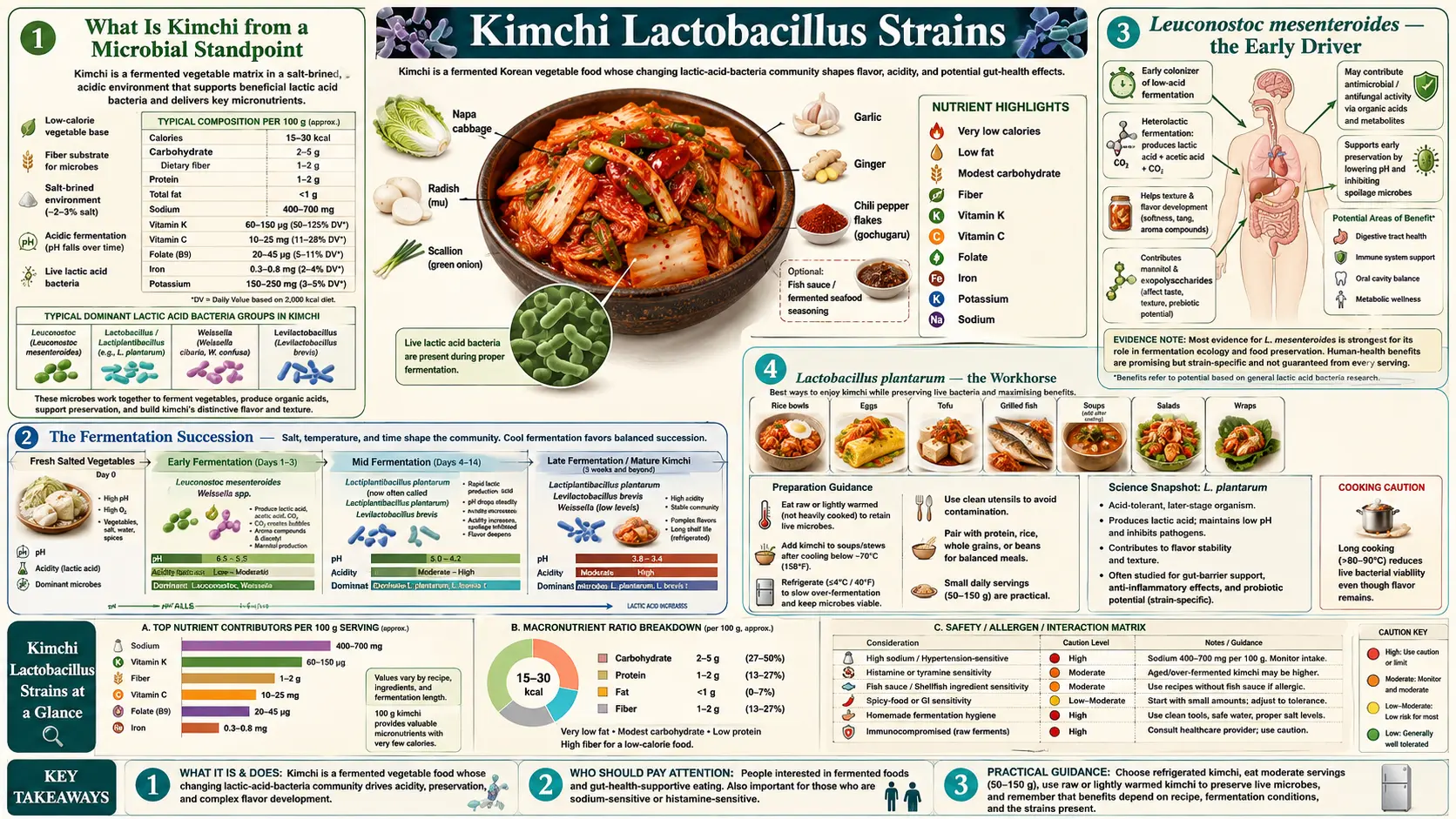
Kimchi is not a single-species fermentation. It is a reproducible ecological succession — a community of lactic acid bacteria that arrives in a predictable sequence on the salted cabbage substrate and shapes the flavor, the safety, and the live-bacteria load of the finished food. Leuconostoc mesenteroides dominates the early stage, producing CO2, mannitol, and dextran that give young kimchi its characteristic effervescence and slight sweetness. Lactobacillus plantarum and Lactobacillus sakei dominate the mature stage, dropping the pH below 4.5 and producing the sharp, sour flavor of fully fermented kimchi. Weissella koreensis and Weissella confusa coexist throughout. This page walks through which species do what, the viability of these bacteria through the stomach to the gut, and the candidate strains that have advanced from kimchi isolation to randomized controlled trials as standalone probiotics.
Table of Contents
- What Is Kimchi from a Microbial Standpoint
- The Fermentation Succession
- Leuconostoc mesenteroides — the Early Driver
- Lactobacillus plantarum — the Workhorse
- Lactobacillus sakei — the Cold-Tolerant Dominant
- Weissella koreensis and W. confusa
- Viability Through Gastric Transit
- Documented Effects on the Human Gut Microbiome
- Kimchi-Derived Candidate Probiotic Strains
- Practical Guidance for Patients
- Key Research Papers
- Connections
- Featured Videos
What Is Kimchi from a Microbial Standpoint
Kimchi is a spontaneous lactic acid fermentation of salted, seasoned vegetables — no starter culture is added. The bacteria that drive the fermentation come from three sources: the cabbage and other vegetables themselves (which carry an established epiphytic microbial community), the seasoning ingredients (chili powder, garlic, ginger, scallion, fermented seafood), and the air and equipment of the kitchen or fermentation room. The salt added in the initial brining step (typically 2-3% by weight) selects for halotolerant lactic acid bacteria and against the more salt-sensitive spoilage organisms that would otherwise dominate.
This is fundamentally different from yogurt fermentation, where commercial yogurt is inoculated with defined strains of Streptococcus thermophilus and Lactobacillus delbrueckii subsp. bulgaricus, or from kefir, where the kefir grain itself is a defined symbiotic community. Kimchi is closer to wild sourdough bread fermentation or to spontaneous wine fermentation — the microbial outcome is shaped by substrate, salt, temperature, and time, with the same species reproducibly emerging across batches but the exact strains varying.
This wild-fermentation character has both advantages and limitations. The advantage is microbial diversity — finished kimchi reproducibly contains 5-15 species of lactic acid bacteria, far more than the 2 species in commercial yogurt. The limitation is that the precise strain composition cannot be specified or reproduced batch-to-batch, which has slowed the regulatory pathway for kimchi-as-medical-food.
The Fermentation Succession
The microbial succession in kimchi has been mapped in detail by metagenomic and culture-based studies. The simplified picture, for kimchi fermented at typical refrigerator-to-room-temperature ranges (5-20°C):
- Day 0 (post-salting, pre-fermentation) — pH 5.6-6.2, mixed epiphytic flora dominated by aerobic and facultative organisms (Pseudomonas, Erwinia, Pantoea, Enterobacter). Total LAB count is low (103-104 CFU/g).
- Days 1-3 (early fermentation) — Leuconostoc mesenteroides and other heterofermentative LAB take over, producing CO2, mannitol, lactic acid, acetic acid, and ethanol. pH drops from ~5.5 to ~4.5. The aerobic flora is suppressed as O2 is consumed. Total LAB count rises to 107-108 CFU/g.
- Days 3-7 (mid fermentation, "young kimchi") — pH 4.2-4.5, peak Leuconostoc activity, characteristic fizzy-sweet-tangy flavor. This is the stage Koreans call mat-i-deulda — "the flavor has set in." Many traditional cooks consider this the ideal eating stage.
- Days 7-21 (late fermentation, "ripe kimchi") — homofermentative Lactobacillus plantarum and L. sakei dominate. pH drops to 4.0 or below. Leuconostoc declines (acid-sensitive). Mannitol is consumed by the Lactobacillus species. Flavor becomes sharper and more sour.
- Beyond 21 days (over-fermented kimchi) — pH 3.5-3.9, dominated by acid-tolerant L. sakei and L. brevis. Texture softens as pectin hydrolyzes. This stage is typically used in cooked dishes (kimchi jjigae stew, kimchi bokkeumbap fried rice) rather than eaten raw.
The succession is temperature-dependent. Cold fermentation (the traditional underground onggi jar at ~0-5°C through Korean winter) compresses the early stages, extends the Leuconostoc-dominant phase to weeks, and preserves the mat-i-deulda stage for months. Warm fermentation (above 20°C) accelerates everything — ripe stage can be reached in 48 hours, but the kimchi is also more prone to over-souring and softening.
Leuconostoc mesenteroides — the Early Driver
Leuconostoc mesenteroides is a Gram-positive, catalase-negative, heterofermentative lactic acid bacterium. "Heterofermentative" means it produces multiple end products from glucose metabolism — lactic acid, ethanol or acetate, CO2, and (uniquely among the kimchi LAB) mannitol from fructose reduction. The CO2 is responsible for the characteristic "kimchi burp" — the gas release when a jar of young kimchi is opened. Mannitol contributes the slightly cooling, sweet aftertaste of mat-i-deulda kimchi (about 50% as sweet as sucrose, with a negative heat of solution that creates a perceived cooling sensation).
Leuconostoc is also responsible for the slight ropy, mucilaginous texture sometimes seen in early-stage kimchi brine — it produces dextran (a high-molecular-weight glucose polymer) from sucrose, a property exploited industrially in the production of clinical dextran plasma expanders. In kimchi this dextran is at low concentration and is consumed as fermentation progresses.
The clinical interest in L. mesenteroides as a probiotic has been more limited than for the Lactobacillus species, primarily because it is acid-sensitive and does not survive gastric transit well in viable form. However, several Leuconostoc strains isolated from kimchi have been studied for their bacteriocin production — the small antimicrobial peptides that suppress competitor organisms during fermentation. Leucocin A from kimchi-isolated L. mesenteroides has documented activity against Listeria monocytogenes and has been studied as a natural food preservative.
Lactobacillus plantarum — the Workhorse
Lactobacillus plantarum (recently reclassified as Lactiplantibacillus plantarum in the 2020 LAB taxonomic revision, though most clinical literature still uses the original name) is the most metabolically versatile species in the kimchi community. It is homofermentative (produces almost exclusively lactic acid from glucose), acid-tolerant down to pH 3.5, salt-tolerant up to 6-8% NaCl, and able to ferment a wide range of plant sugars including pentoses.
This metabolic flexibility makes L. plantarum the dominant species in mature kimchi (alongside L. sakei at lower temperatures) and the workhorse strain for many other plant-based fermentations including sauerkraut, sourdough, olive curing, and silage. From a probiotic standpoint, L. plantarum is well-studied:
- Gastric and bile-acid survival — L. plantarum typically survives simulated gastric transit at >50% viability and bile-acid exposure at >70% viability, well above the threshold considered probiotically meaningful
- Mucin binding and colonization — specific surface adhesins allow transient colonization of the gut epithelium for days to weeks after exposure
- Immune modulation — in vitro and animal studies show TLR2 signaling, Treg induction, and reduced pro-inflammatory cytokine production
- Antimicrobial activity — produces plantaricins (a family of class IIb bacteriocins) active against many Gram-positive pathogens
Several specific L. plantarum strains isolated from kimchi have advanced to commercial probiotic products and randomized clinical trials, particularly for atopic dermatitis (where Treg induction is the proposed mechanism) and metabolic syndrome.
Lactobacillus sakei — the Cold-Tolerant Dominant
Lactobacillus sakei (now Latilactobacillus sakei) is the species that dominates traditional cold-fermented kimchi — the kind made in the autumn kimjang ritual and stored underground in onggi jars through Korean winter. Its name comes from sake, the Japanese rice wine, where it was first characterized as a fermentation-driver. L. sakei is unusual among LAB for its strong cold-tolerance and its preference for ribose-containing substrates (it can use the nucleotide sugars released from autolyzed plant cells).
From the clinical-probiotic standpoint, L. sakei is the kimchi-derived strain with the most published intervention literature. Multiple controlled trials have examined specific L. sakei strains for:
- Atopic dermatitis in children — some strains have shown SCORAD score reductions in 8-12 week supplementation trials
- Chronic rhinosinusitis — nasal application of L. sakei strains has been studied for displacement of Staphylococcus aureus from the nasal microbiome
- Atopic march and allergic sensitization — immunomodulatory effects on Th2 responses
- Body composition and weight — some trials show modest reductions in visceral adiposity at 12-week treatment durations
The kimchi-natural source of L. sakei has been a successful "discovery pipeline" for the probiotic industry — commercial isolates initially characterized from finished kimchi have been deposited in culture collections (KCCM, KCTC in Korea; DSM, ATCC internationally) and licensed for product development. The pattern is similar to the way many commercial yogurt strains trace back to traditional Bulgarian and Caucasian dairy fermentations.
Weissella koreensis and W. confusa
Weissella koreensis was first isolated from kimchi in 2002 and named for its country of origin. Together with Weissella confusa and other Weissella species, it persists throughout the kimchi fermentation timeline, generally as a minor but consistent member of the community at 105-107 CFU/g. Like Leuconostoc, Weissella is heterofermentative and contributes to the gas, acetate, and mannitol production that characterizes young kimchi.
The Weissella genus has been controversial as a probiotic candidate. Several species have been associated with opportunistic infection in immunocompromised patients (rare bloodstream infections following central-line use), and the genus is therefore not on the European Food Safety Authority Qualified Presumption of Safety (QPS) list as of the current review. Kimchi-derived Weissella koreensis strains have not been associated with infection in healthy consumers despite Korean populations consuming kimchi at 100+ g per day for many generations, but the regulatory caution is real for isolated-strain probiotic products. Most current product development focuses on Lactobacillus and Bifidobacterium rather than Weissella.
Viability Through Gastric Transit
For a food-source bacterium to function as a probiotic, it must survive the journey from mouth to gut: brief exposure to oral microbes, transit through the highly acidic stomach (pH 1.5-3.5 in the fasting state, pH 3-5 in the postprandial state), exposure to bile acids and pancreatic enzymes in the duodenum, and finally arrival at the small-intestinal and colonic absorptive surfaces. The standard probiotic-viability benchmark is that ≥106 CFU should arrive viable at the small intestine per dose.
Kimchi LAB perform reasonably well on this benchmark, with important caveats:
- L. plantarum — typically 30-60% gastric survival, 50-80% bile-acid survival. Net delivery from a 50 g serving of well-fermented kimchi: approximately 107-108 viable CFU to the gut, well above the probiotic threshold.
- L. sakei — similar profile to L. plantarum, with strain variation
- Leuconostoc mesenteroides — substantially poorer survival, often <10% gastric survival due to acid sensitivity. The CFU that arrive at the gut are dominated by the Lactobacillus species.
- Weissella — intermediate survival, strain-dependent
Kimchi consumption with a meal (rather than on an empty stomach) substantially improves bacterial survival, because the buffering effect of food raises gastric pH toward the postprandial 3-5 range and the cabbage matrix itself provides physical protection for embedded bacteria. This is consistent with the traditional Korean meal pattern of kimchi as a side dish (banchan) eaten with rice and other courses, never on its own.
For more on the broader probiotic concept and the Lactobacillus genus in general, see our Probiotics page.
Documented Effects on the Human Gut Microbiome
Several intervention studies have measured gut microbiome composition before and after kimchi supplementation in human volunteers. The reproducible findings:
- Transient increase in fecal Lactobacillus — multiple-day kimchi consumption modestly raises fecal Lactobacillus counts. The effect is transient (largely gone within 1-2 weeks of stopping) and represents added input rather than stable colonization by kimchi-derived strains.
- No significant disruption of overall microbiome diversity — in contrast to antibiotic exposure or large prebiotic doses, kimchi consumption does not produce major shifts in Shannon diversity or beta-diversity between subjects. The native microbiome is robust to this input.
- Modest increase in SCFA-producing bacteria — some studies show small but reproducible increases in butyrate-producing genera (Roseburia, Faecalibacterium) after several weeks of kimchi consumption, possibly mediated by the fermentable fiber substrate rather than the live bacteria.
- Reduction in Enterobacteriaceae in some studies — consistent with the broader pattern of fermented-food consumption reducing potentially pathogenic Enterobacteriaceae representation
The honest summary is that kimchi consumption produces measurable but modest gut microbiome effects in healthy adults — less dramatic than concentrated probiotic supplements at 1010+ CFU per dose, but with the advantage of being a sustainable dietary pattern rather than a time-limited intervention. The long-term cumulative effect in populations with lifelong daily kimchi consumption is harder to study but plausibly larger.
Kimchi-Derived Candidate Probiotic Strains
Several specific strains isolated from kimchi have advanced to commercial probiotic products with supporting clinical trial data:
- L. sakei proBio-65 / proBio-M9 — isolated from kimchi, studied in atopic dermatitis
- L. sakei CJLS03 — studied for nasal Staphylococcus aureus displacement
- L. plantarum CJLP243 / CJLP55 — multiple strains in the CJ Cheiljedang research portfolio, isolated from kimchi, studied in atopic dermatitis and allergic rhinitis
- L. plantarum Ln4 — kimchi-derived strain studied for anti-obesity effects in animal and pilot human studies
- L. brevis KB290 — isolated from suguki (a related Japanese fermented turnip rather than kimchi proper, but related kimchi-style LAB)
- Weissella cibaria CMU — kimchi-related Weissella studied for oral biofilm modulation rather than gut effects
These commercial strains are sold as standalone capsules or in functional yogurts and beverages, predominantly in Korea, Japan, and increasingly in North America. Their clinical effect sizes are typically modest and indication-specific — useful adjuncts in some conditions, not transformative monotherapies.
Practical Guidance for Patients
- Choose ripened, not fresh kimchi for the live-bacteria benefit — "fresh kimchi" (the unripened salad-like preparation often sold as geotjeori) contains the seasonings but minimal lactic acid bacteria. Look for kimchi that has been refrigerator-fermented for at least 1 week, with visible gas pressure when the jar is opened and a clearly sour taste.
- Avoid pasteurized kimchi if the goal is probiotics — some commercial kimchi products in supermarket cold cases are pasteurized for shelf stability, which kills the live bacteria. Read labels; if it says "pasteurized" or has a shelf life of months at refrigeration, the live-LAB load is gone. Authentic kimchi has a relatively short refrigerated shelf life (2-4 weeks at peak quality, longer at degraded quality) precisely because it is alive.
- Eat with meals, not alone — gastric buffering substantially improves bacterial survival to the gut, consistent with the traditional Korean meal pattern
- Start with small servings if not previously consumed — 30-50 g per meal initially. The capsaicin and the fiber load can produce GI upset in patients not adapted to spicy fermented food. Increase gradually.
- Consider home fermentation for sodium control — commercial kimchi is often higher in sodium than necessary. Home fermentation with 1.5-2% salt (instead of the commercial 2.5-3%) produces a slightly slower fermentation but a meaningfully lower sodium product. See the Sodium and Vegetable Trade-off page for the trade-offs.
- Pregnancy, immunocompromise, advanced liver disease — the same general cautions that apply to any live-bacteria food apply to kimchi. Live LAB are generally regarded as safe (the QPS-listed species do not cause infection in immunocompetent hosts), but central-line patients and severe neutropenia patients should consult their clinical team before regular consumption of any live-fermented food.
Key Research Papers
- Jung JY et al. (2011). Metagenomic analysis of kimchi, a traditional Korean fermented food. Applied and Environmental Microbiology. — PubMed
- Lee JS et al. (2002). Weissella koreensis sp. nov., isolated from kimchi. International Journal of Systematic and Evolutionary Microbiology. — PubMed
- Cho J et al. (2006). Microbial population dynamics of kimchi, a fermented cabbage product. FEMS Microbiology Letters. — PubMed
- Park EJ et al. (2012). Bacterial community analysis during fermentation of ten representative kinds of kimchi. Food Microbiology. — PubMed
- Han K et al. (2015). Contrasting effects of fresh and fermented kimchi consumption on gut microbiota composition and metabolic syndrome parameters. Journal of Medicinal Food. — PubMed
- Park KY et al. (2014). Health benefits of kimchi (Korean fermented vegetables) as a probiotic food. Journal of Medicinal Food. — PubMed
- Kim B et al. (2018). Lactobacillus plantarum Ln4 attenuates diet-induced obesity, insulin resistance, and changes in hepatic mRNA levels associated with glucose and lipid metabolism. Nutrients. — PubMed
- Park S et al. (2008). Antiobesity effect of kimchi fermented with Weissella koreensis OK1-6 as starter in high-fat-diet-induced obese C57BL/6J mice. Journal of Applied Microbiology. — PubMed
- Won TJ et al. (2011). Modulation of Th1/Th2 balance by Lactobacillus strains isolated from kimchi via stimulation of macrophage cell line J774A.1 in vitro. Journal of Food Science. — PubMed
- Lim SM et al. (2017). Effects of Lactobacillus sakei on chronic atopic dermatitis: randomized controlled trial. Journal of Functional Foods. — PubMed
- Zheng J et al. (2020). A taxonomic note on the genus Lactobacillus: description of 23 novel genera. International Journal of Systematic and Evolutionary Microbiology. — PubMed
- Park S et al. (2016). Effect of Lactobacillus plantarum CJLP55 on clinical characteristics and gut microbiota in subjects with mild to moderate acne vulgaris: a randomized, double-blind, placebo-controlled trial. — PubMed
PubMed Topic Searches
- PubMed: Kimchi Lactobacillus probiotic
- PubMed: L. sakei probiotic clinical
- PubMed: L. plantarum kimchi isolation
- PubMed: Weissella koreensis
- PubMed: Leuconostoc in kimchi fermentation
Connections
- All Food
- Kimchi Overview
- Kimchi Benefits Hub
- Sulforaphane and Cabbage
- Sodium and Vegetable Trade-off
- Korean Tradition and Variants
- Probiotics
- Fermented Foods
- Sauerkraut
- Yogurt
- Kefir
- Atopic Dermatitis
- Irritable Bowel Syndrome
- SIBO
- Cabbage
- Garlic