Kimchi: History and Origins
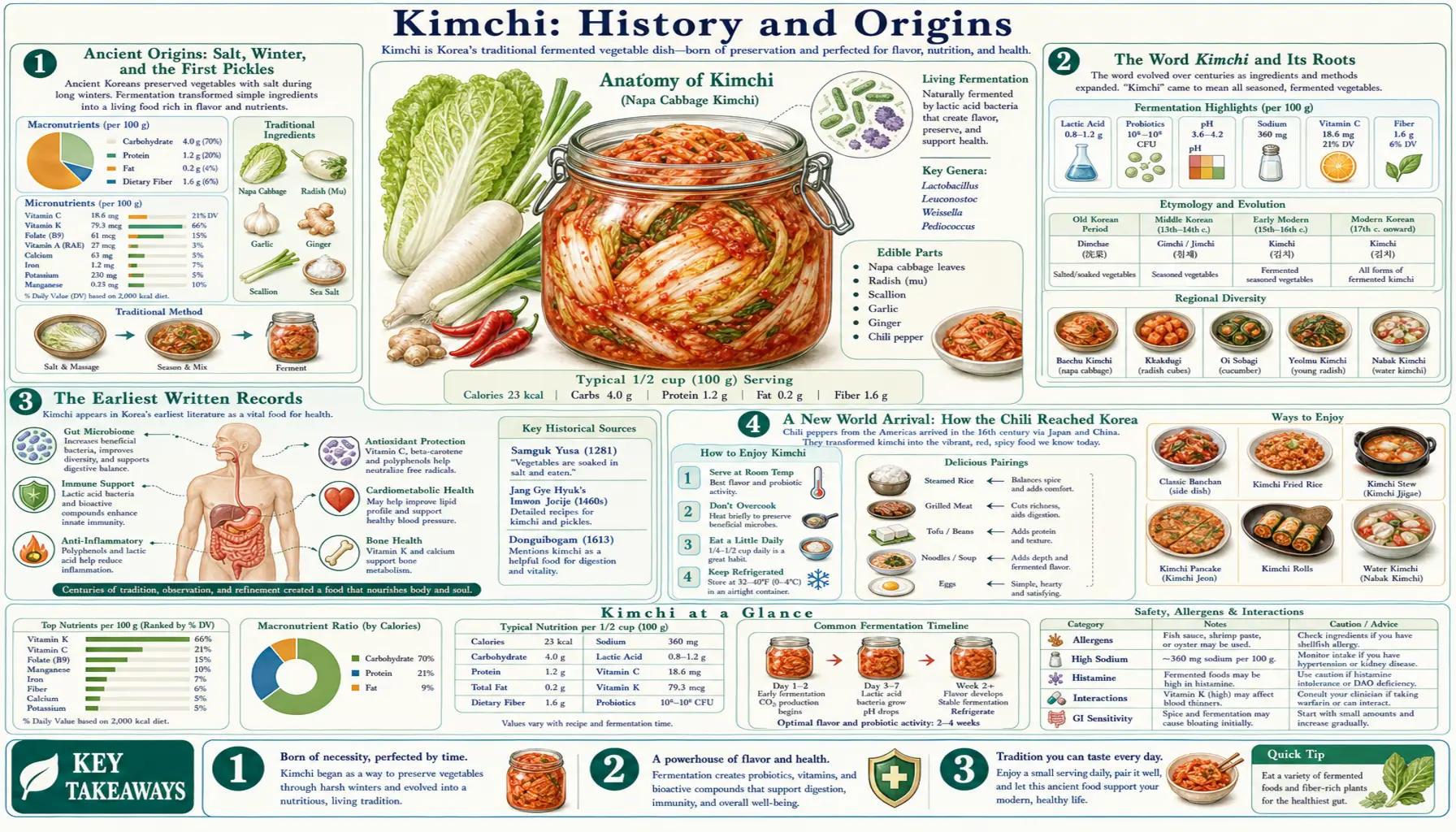
Kimchi began not as a recipe but as a solution to a hard problem: how to keep eating vegetables through a long, freezing Korean winter when nothing grows in the ground. For roughly two thousand years, the people of the Korean peninsula answered that problem by salting and souring whatever the autumn harvest gave them — radishes first, later cabbages — storing the result in buried earthenware jars to ferment slowly through the cold months. What we picture today as kimchi, scarlet with chili and pungent with garlic, is in fact a relatively recent chapter: the fiery red pepper at its heart is a New World plant that did not reach Korea until the age of trans-oceanic trade, and the napa cabbage now most associated with it became common only in the late nineteenth century. This article traces what the written record actually supports — the earliest texts, the meaning of the word itself, the genuinely debated arrival of the chili, and the communal winter ritual that UNESCO recognized in 2013 — and is careful to mark where history shades into legend or scholarly dispute.
Table of Contents
- Ancient Origins: Salt, Winter, and the First Pickles
- The Word “Kimchi” and Its Roots
- The Earliest Written Records
- A New World Arrival: How the Chili Reached Korea
- The Rise of Napa Cabbage
- Buried Jars and the Kimjang Tradition
- Cultural Meaning: A Food That Became an Identity
- From the Peninsula to the World
- Research Papers and References
- Connections
- Featured Videos
Ancient Origins: Salt, Winter, and the First Pickles
Kimchi is best understood first as a technology of survival, not a dish. Korea's winters are long and bitter, and for most of the peninsula's history there was no way to grow or buy fresh vegetables from late autumn until spring. Salt-pickling solved this. By packing vegetables in salt or brine, early Koreans drew out water, suppressed the microbes that cause spoilage, and let beneficial lactic-acid bacteria sour the food into something that would keep for months. Versions of this same trick — preserving the harvest by controlled fermentation — appear independently in many cultures, from European sauerkraut to Japanese pickles, which is part of why kimchi belongs to a much larger human story of fermented foods.
The earliest Korean pickles were far plainer than modern kimchi. The original vegetable was most often the radish, a hardy local crop, simply salted or steeped in brine; cabbage and other vegetables joined later. There was, crucially, no chili and no bright red color — that defining ingredient was still half a world away, in the Americas, and would not arrive for many centuries. Historians of Korean food therefore describe these first preparations as a kind of ancestral kimchi: recognizably the same idea of salted, fermented winter vegetables, but without the seasoning that makes today's version instantly identifiable.
Just how old this practice is cannot be pinned to a single year, because it predates the texts that would have recorded it. Scholars generally place the roots of Korean vegetable fermentation in the Three Kingdoms period (conventionally 57 BCE–668 CE) or earlier, making the broad tradition roughly two thousand years old. As with most ancient foodways, the honest statement is that the practice is genuinely very old and clearly pre-dates written history; precise founding dates and any single “first kimchi” are not recoverable, and no one person invented it.
The Word “Kimchi” and Its Roots
The name itself carries the history. “Kimchi” descends from a Sino-Korean term written with characters that mean, in effect, “soaked” or “steeped” vegetables — a direct description of pickling vegetables in brine. Linguists trace a chain of older forms, commonly rendered as chimchae or dimchae (from the Sino-Korean reading of 沈菜, “submerged vegetables”), which over centuries of sound change in Korean softened and contracted into the modern word kimchi. The terms chimchae and dimchae are the spellings most widely found in Joseon-era documents.
Behind that Korean lineage sits an even older East Asian root. Classical Chinese texts used the character jeo (菹) for a fermented or pickled vegetable, a word that appears in works as ancient as the Classic of Poetry. Early Korean writers, working in classical Chinese, borrowed this same vocabulary before native Korean names settled into place. The takeaway is not that kimchi is “Chinese” — the dish as a Korean tradition is its own thing — but that the concept of pickled vegetables, and the words for it, belong to a shared and very old East Asian heritage that Korea developed in its own distinctive direction.
The Earliest Written Records
Because the practice is older than the records, the first written evidence comes long after kimchi-style pickling was already established. The frequently cited early reference is the Samguk Sagi (“History of the Three Kingdoms,” compiled in 1145), which mentions the pickle jar used to ferment vegetables — an indirect but telling sign that fermented vegetables were a normal part of the diet by that time.
The clearest early literary glimpse comes from the Goryeo dynasty (918–1392). The scholar-poet Yi Gyu-bo (1168–1241), in a set of verses on garden vegetables preserved in his collected works (the Dongguk Isang Gukjip), describes pickled radish — noting that radish steeped in brine makes a fine side dish to carry one through the summer and winter months. This thirteenth-century poem is one of the most direct early descriptions of seasonal vegetable pickling on the peninsula, and it shows two things at once: that radish, not cabbage, was the classic kimchi vegetable of the era, and that Koreans were already thinking in terms of pickling for specific seasons — the seed of the later kimjang winter-storage tradition.
From the Joseon dynasty (1392–1910) onward the documentation becomes abundant. A long line of agricultural manuals, household encyclopedias, and cookbooks records pickling methods in increasing detail, charting how the dish grew more elaborate over time. The single most important change recorded in these Joseon texts is the arrival of a new ingredient that would transform kimchi's color, flavor, and identity: the chili pepper.
A New World Arrival: How the Chili Reached Korea
The defining feature of modern kimchi — its fiery red color and heat — comes from chili pepper, and the chili is not native to Asia at all. Chili peppers (Capsicum) were domesticated in the Americas and were entirely unknown across the Old World until after Christopher Columbus's voyages of the 1490s. They then spread astonishingly fast along the new global trade routes of the sixteenth century — the great biological reshuffling historians call the Columbian Exchange — carried by Portuguese and Spanish traders to Africa, India, Southeast Asia, China, Japan, and finally Korea. In other words, the chili that now seems so essential to Korean food is a relative newcomer, and a New World immigrant.
The mainstream account holds that chili peppers reached Korea around the late sixteenth or early seventeenth century, most likely via Portuguese trade through Japan, in the same era as the Japanese invasions known as the Imjin War (1592–1598). One of the earliest Korean texts to mention the plant, the encyclopedic Jibong Yuseol compiled by Yi Su-gwang in 1614, refers to it as a foreign, “southern barbarian” pepper and even warns of its strong potency — exactly the way a society describes a plant it regards as new and exotic, not ancient and familiar. This treatment of the chili as a foreign arrival is a key piece of evidence for the late-introduction view.
It is worth being candid that the timing is genuinely debated among Korean food historians. A minority scholarly position — argued, for example, by Dae Young Kwon, Dai Ja Jang and colleagues in a 2015 review — contends that a Korean red pepper existed on the peninsula far earlier and that kimchi's spiced character is older than the Imjin War narrative allows. This page treats the late-introduction, Columbian-Exchange account as the better-supported mainstream view, while noting honestly that the alternative position exists and that the exact date the chili entered Korea is not settled.
What is not seriously disputed is the timeline of the chili entering kimchi specifically. Even after the pepper arrived, it took time to become a standard kimchi seasoning. Korean documents describing kimchi made with red pepper appear from the eighteenth century — notably the expanded farm-and-household manual Jeungbo Sallim Gyeongje of 1766 — and the spicy, crimson kimchi we know today only became widespread during the later Joseon period, in the eighteenth and nineteenth centuries. For most of kimchi's two-thousand-year history, then, it was a white or pale, salty-sour pickle, not a red one.
The Rise of Napa Cabbage
The second signature ingredient of the most famous kimchi — the broad, pale-green napa (Chinese) cabbage, called baechu in Korean — is also a latecomer to the leading role. For most of the tradition's history the headline vegetables were radish and other crops; the dense, heading napa cabbage that defines baechu-kimchi only became the dominant kimchi vegetable at the end of the nineteenth century, once improved heading cultivars suited to Korean conditions became widely available. Late-nineteenth-century Korean cookbooks, such as the Siuijeonseo, are among the texts that document cabbage kimchi in something close to its modern form.
This matters for understanding what kimchi “really” is. The dish that most of the world now pictures — quartered napa cabbage coated in red chili paste — is essentially a product of the last few centuries, combining a sixteenth-to-seventeenth-century New World pepper with a nineteenth-century cabbage. The far older and deeper tradition is the broader one: the act of salting and fermenting the autumn vegetable harvest, in whatever form, to survive the winter. Both statements are true at once, and keeping them straight is the key to telling kimchi's history honestly. It is also why white, chili-free baek-kimchi is not a modern “mild” novelty but, in spirit, the closer descendant of the oldest kimchi of all.
Buried Jars and the Kimjang Tradition
How kimchi was stored is as much a part of its history as what went into it. The classic vessel is the onggi — a breathable, glazed earthenware crock. Traditionally these jars were packed with the autumn's kimchi and buried up to their necks in the ground, often in the yard or in a dedicated pit, where the surrounding earth held them at a cool, stable temperature through the winter. This was, in effect, a pre-industrial root cellar tuned for fermentation: cold enough to slow the souring to a gentle crawl, steady enough to keep the kimchi from freezing solid or spoiling. The porous walls of the onggi let gases escape while the kimchi matured. (So central is this idea of cool, steady storage that modern Korean households often own a dedicated kimchi refrigerator engineered to reproduce the buried-jar climate.)
The communal autumn event of making the winter's kimchi is called kimjang (also spelled gimjang). In late autumn, families and whole neighborhoods would gather to process enormous quantities of cabbage and radish at once — salting, seasoning, and packing batch after batch — so that every household had enough kimchi to last until spring. Kimjang is intensely social and is traditionally a moment of cooperation and sharing, with recipes and techniques handed down within families, frequently from mother-in-law to daughter-in-law. In 2013, UNESCO inscribed “Kimjang, making and sharing kimchi in the Republic of Korea” on its Representative List of the Intangible Cultural Heritage of Humanity, recognizing the practice not merely as cooking but as a living expression of Korean communal identity.
Cultural Meaning: A Food That Became an Identity
Few foods are as bound up with a national identity as kimchi is with Korea. Eaten at virtually every meal as banchan (a side dish) and worked into countless cooked dishes — stews, fried rice, pancakes — kimchi is less a single recipe than a constant presence at the Korean table. Its sheer variety reflects that ubiquity: there are well over a hundred documented regional and seasonal types, varying with local vegetables, climate, and the availability of salted seafood, from the cabbage baechu-kimchi of the center to radish kkakdugi, water-based mul-kimchi, and the white baek-kimchi that omits chili.
The communal, hand-to-hand nature of kimjang gave kimchi a meaning beyond nourishment: it became a marker of belonging, family memory, and continuity. A household's particular kimchi recipe is a small inheritance; the autumn ritual of making it together is a reaffirmation of community. This is exactly the cultural weight UNESCO pointed to in 2013. It is also why kimchi has at times become a focus of national pride and even cross-border dispute over its origins — a reminder that a food this central to daily life carries an emotional charge far larger than the sum of its ingredients.
One historical note deserves a clear label as modern folklore rather than documented history: the widely repeated story that during outbreaks of respiratory illness, kimchi-eating populations were somehow protected by the dish. Such claims have circulated but are not established science; they belong to kimchi's reputation and lore, not to its verified medical record. Genuine, evidence-based discussion of kimchi's nutrition and health effects is kept to the companion Kimchi Benefits articles and the main Kimchi page, where the research is weighed carefully; this history makes no medical claims.
From the Peninsula to the World
For most of its long life, kimchi was eaten almost entirely by Koreans, at home. Its journey into global kitchens is a story of the twentieth and twenty-first centuries. Korean migration carried kimchi abroad; the dish's profile rose further with the worldwide spread of Korean cuisine and culture in recent decades. A small but symbolically striking milestone came in the 2000s, when kimchi even traveled to space: a specially developed, shelf-stable version was prepared for Korean astronaut Yi So-yeon's 2008 spaceflight, a vivid sign of how completely the food is identified with Korean identity.
In parallel, kimchi became an unusually well-studied traditional food. Sustained scientific interest — much of it driven by Korean research institutions — has examined its fermentation microbiology and its effects on health, and modern interest in the gut microbiome has drawn fresh attention to kimchi alongside other living, fermented foods such as kefir, yogurt, and natto. That modern research is the subject of the companion pages; the thread worth holding onto here is the continuity. The same essential act — salting the autumn harvest and letting friendly bacteria sour it into something that lasts — runs unbroken from a buried earthenware jar two thousand years ago to a refrigerated tub on a supermarket shelf today. Knowing that history is the best way to understand what kimchi has always been: a brilliant, communal answer to the simple human problem of keeping food, and people, through the winter.
Research Papers and References
The list below combines peer-reviewed historical and food-science reviews of kimchi with curated PubMed topic-search links into the ethnographic and fermentation literature. Historical primary texts named in the article — the Samguk Sagi, Yi Gyu-bo's Dongguk Isang Gukjip, the Jibong Yuseol, the Jeungbo Sallim Gyeongje, and the Siuijeonseo — are cited within the text as historical sources, not as modern references. Author names, titles, and journals are given as plain text; only the stable DOI, PMC, or institutional link is hyperlinked, and each opens in a new tab.
- Surya R, Nugroho D. Kimchi throughout millennia: a narrative review on the early and modern history of kimchi. Journal of Ethnic Foods. 2023;10:5. — doi:10.1186/s42779-023-00171-w · PMC10068239
- Jang DJ, Chung KR, Yang HJ, Kim KS, Kwon DY. Discussion on the origin of kimchi, representative of Korean unique fermented vegetables. Journal of Ethnic Foods. 2015;2(3):126-136. — doi:10.1016/j.jef.2015.08.005
- Patra JK, Das G, Paramithiotis S, Shin HS. Kimchi and other widely consumed traditional fermented foods of Korea: a review. Frontiers in Microbiology. 2016;7:1493. — doi:10.3389/fmicb.2016.01493 · PMC5039233
- UNESCO Intangible Cultural Heritage. Kimjang, making and sharing kimchi in the Republic of Korea (inscribed 2013, Representative List). — ich.unesco.org — element 00881
- Kimchi history and origin — PubMed: kimchi history and origin
- Kimchi fermentation microbiology and lactic-acid bacteria — PubMed: kimchi fermentation microbiology
External Authoritative Resources
- UNESCO — Kimjang, making and sharing kimchi
- Journal of Ethnic Foods — History of kimchi (open access)
- PubMed — All research on kimchi