Kimchi Korean Tradition and Variants
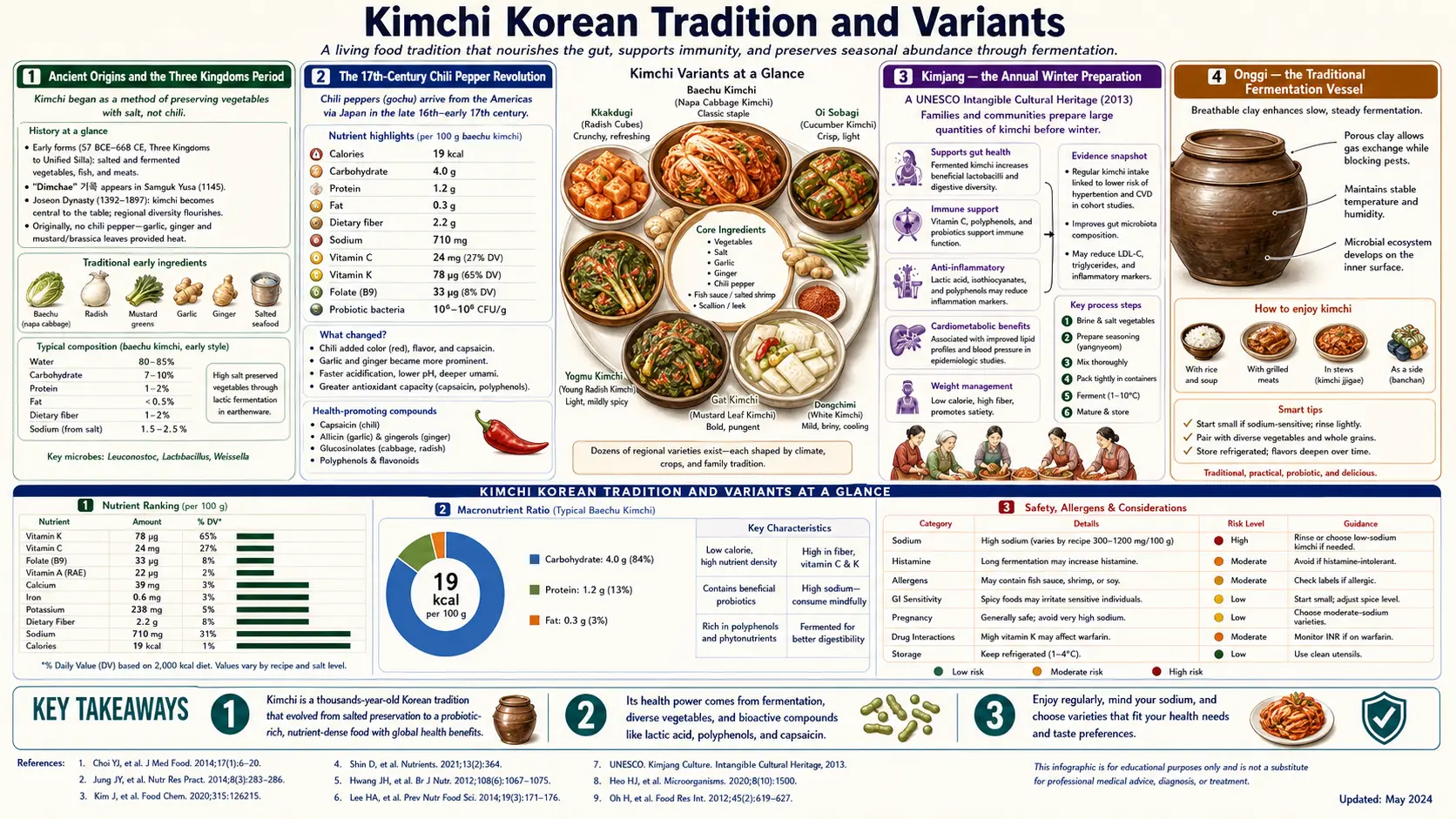
Kimchi is one of the oldest continuously prepared fermented foods in the world — written references go back to the 13th century in the Dongguk Yi Sang-guk Jip, and the underlying technique of salt-fermenting wild vegetables in earthenware vessels goes back to the Three Kingdoms period roughly 2,000 years ago. The kimchi most Westerners know — bright red, chili-spiked napa cabbage — is the modern form, dating only to the 17th century when chili pepper arrived in Korea from the Americas via Japanese trade. Before that, kimchi was white or amber, flavored with garlic, ginger, scallion, fermented seafood, and sometimes the seeds and leaves of Asian wild herbs. This page covers the historical evolution, the annual kimjang winter-preparation festival (UNESCO Intangible Cultural Heritage), and the major regional Korean variants — from baechu kimchi to dongchimi water kimchi to the seafood-rich southern Jeolla styles — that the global "kimchi is Korean cabbage" stereotype flattens out.
Table of Contents
- Ancient Origins and the Three Kingdoms Period
- The 17th-Century Chili Pepper Revolution
- Kimjang — the Annual Winter Preparation
- Onggi — the Traditional Fermentation Vessel
- Baechu Kimchi (Napa Cabbage Kimchi)
- Kkakdugi (Radish Cube Kimchi)
- Dongchimi (White Water Kimchi)
- Nabak Kimchi (Pink Water Kimchi)
- Oi Sobagi (Stuffed Cucumber Kimchi)
- Regional Styles: Pyeongan, Hamgyeong, Jeolla, Gyeongsang, Jeju
- Korean-American and Diaspora Variants
- Key Research Papers
- Connections
- Featured Videos
Ancient Origins and the Three Kingdoms Period
The Korean peninsula has had a long agricultural and culinary tradition of preserving vegetables for the harsh winter, when fresh produce was unavailable for 4-5 months of the year. The earliest preserved Korean vegetables, going back to the Three Kingdoms period (57 BCE - 668 CE), were not what we would now call kimchi — they were simple salt-preserved or brine-pickled mountain vegetables, similar to other northeast Asian pickling traditions. The technique was almost certainly shared with the parallel Chinese tradition of sui (acid-pickled vegetables) and the Japanese tsukemono tradition.
By the Goryeo dynasty (918-1392 CE), Korean kimchi had developed its characteristic features: lactic acid fermentation in earthenware vessels, the use of garlic, ginger, and scallion as seasonings, the addition of fermented fish sauce or salted seafood for umami, and the practice of preparing large quantities in the autumn for winter consumption. The 13th-century text Dongguk Yi Sang-guk Jip by Yi Gyu-bo describes radish kimchi and references the established kimjang practice. Notably, this is all pre-chili kimchi — white or amber in color, sometimes tinged with garlic or with Asian pepper (cheoncho — Sichuan pepper / prickly ash), but not red.
The vegetables used in Goryeo and early Joseon kimchi were primarily Korean radish (mu), mustard greens, eggplant, cucumber, and various wild mountain vegetables. Napa cabbage (which has come to dominate modern kimchi) was a later introduction from China and did not become the primary kimchi vegetable until the late 19th century.
The 17th-Century Chili Pepper Revolution
Chili pepper (Capsicum annuum) is a New World plant, originating in Central and South America. It reached Korea via Portuguese and Spanish traders, then via Japanese intermediaries during the Imjin War (1592-1598), when Japanese forces under Toyotomi Hideyoshi invaded the Korean peninsula. The earliest documented Korean reference to chili pepper is from 1614 (the Jibong yuseol encyclopedia by Yi Su-gwang), which describes it as a recently-introduced spicy plant.
The integration of chili pepper into kimchi was not instantaneous. Through the 17th and early 18th centuries, chili was a curiosity rather than a staple. By the late 18th century, chili-spiked kimchi recipes appear in Korean cookbooks alongside the older white styles. By the 19th century, chili-red kimchi was dominant in central and southern Korea, with the northern regions retaining more of the older white kimchi traditions (still visible today in Pyeongyang-style mul kimchi).
The chili pepper changed kimchi in several important ways:
- The red color — the visual identity that now defines kimchi globally
- Capsaicin's antimicrobial effect — chili extends the fermentation timeline and inhibits some spoilage organisms, allowing somewhat lower salt levels than were required for pre-chili kimchi
- Capsaicin's effects on the bacterial community — LAB are largely tolerant to capsaicin, while many competing microbes are inhibited; this selects more strongly for the desired lactic acid fermentation
- Carotenoid contribution — chili pepper contains beta-carotene, capsanthin, and other carotenoid pigments with antioxidant properties
- Sensory complexity — the heat, the slight sweetness of red chili, and the deep red color all contribute to modern kimchi's distinctive sensory profile
The chili pepper used in kimchi is specifically gochugaru — Korean-style sun-dried red pepper, coarsely ground or flake-form, with a characteristic moderate heat (Scoville range 1,500-10,000, similar to a mild jalapeño on the lower end and a moderately spicy fresh chili on the higher end). The variety, sun-drying technique, and grind size all affect kimchi flavor; substituting cayenne or other non-Korean chili produces a recognizably different result.
Kimjang — the Annual Winter Preparation
Kimjang is the annual ritual of preparing a large quantity of kimchi in late autumn (typically November in central Korea) to last through the winter. Historically, when fresh vegetables were unavailable from December through March, kimjang was essential to Korean dietary survival — a single family might prepare 100-200 heads of cabbage at once, equivalent to several hundred kilograms of finished kimchi, all stored in onggi jars buried in the ground to maintain near-freezing fermentation temperatures.
Kimjang is recognized as a UNESCO Intangible Cultural Heritage of Humanity (inscribed 2013), specifically as "Kimjang, making and sharing kimchi in the Republic of Korea." The recognition emphasizes not just the food preparation but the social and family dimensions: kimjang is traditionally a collective effort involving extended family, neighbors, and sometimes whole village communities, with the resulting kimchi shared across household lines and with elderly or food-insecure neighbors.
The kimjang timing is calibrated by tradition to the period after the first frost has sweetened the cabbage but before sustained subzero temperatures freeze the prepared vegetables. The exact week varies by latitude — northern Korean families kimjang earlier (early November), southern families later (late November to early December). Specialized kimjang refrigerators (kimchi naengjango) are now standard in Korean kitchens and have replaced the underground onggi storage for many urban families.
The modern reality is that most Koreans now eat factory-produced kimchi most of the time, with home kimjang reserved for special occasions or families that maintain the tradition by choice. The traditional skills of selecting cabbage, balancing seasonings, judging fermentation, and managing onggi-temperature regimes have become endangered, which is part of why UNESCO recognition was sought.
Onggi — the Traditional Fermentation Vessel
Onggi are the traditional Korean breathing earthenware jars used for fermenting kimchi, soybean pastes, soy sauce, and rice wine. They are made from coarse iron-rich clay fired at high temperatures (1,100-1,200°C) without glazing the exterior. The result is a porous wall structure that allows gradual gas exchange — CO2 produced by fermentation can escape, oxygen entry is slow, and the interior maintains a slightly alkaline microclimate from the clay that buffers some of the acid production.
This is mechanistically different from non-porous fermentation vessels (glass jars, glazed ceramic, stainless steel). The onggi's slow gas exchange and slight buffering produces a measurably different microbial succession and a longer mat-i-deulda peak quality plateau. Studies comparing kimchi fermented in onggi vs glass jars at controlled temperatures show modest but reproducible differences in LAB community composition and in final sensory attributes.
Traditional kimjang practice was to bury the onggi jars in the ground up to the neck, with straw insulation on top. The earth provides thermal stability (the underground temperature in central Korea remains in the 0-5°C range through most of the winter), which is the slow-fermentation condition that produces the highest-quality finished kimchi. This is the original "cold-fermented kimchi" technique that modern kimchi refrigerators try to replicate electronically.
Baechu Kimchi (Napa Cabbage Kimchi)
Baechu kimchi is the napa cabbage kimchi that dominates modern Korean cuisine and is what most Westerners encounter as "kimchi" without qualifier. Napa cabbage (baechu, Brassica rapa subsp. pekinensis) is salted in halves or quarters, the leaves separated and the seasoning paste rubbed between each layer, then reassembled and packed into fermentation jars.
The standard seasoning includes: gochugaru (Korean red chili powder), grated garlic, grated ginger, scallion (often whole-leaf, not chopped), Korean radish (julienned and added to the paste), fermented seafood (saeujeot — salted shrimp; aekjeot or jeotgal — anchovy or other fish sauce), sometimes apple or pear (sweetness and amylase), sometimes glutinous rice paste (binding the seasoning to the cabbage leaves).
Within baechu kimchi there are stylistic variations. Geotjeori is fresh, unfermented baechu kimchi eaten same-day as a salad. Mat-kimchi is chopped (rather than whole-leaf) baechu kimchi, more convenient as a side dish. Pogi kimchi is whole-cabbage kimchi, where the cabbage is left in halves and the seasoning is applied to intact leaves — this is the form most traditionally associated with kimjang.
Kkakdugi (Radish Cube Kimchi)
Kkakdugi is made from Korean radish (mu) cut into approximately 1.5-2 cm cubes, salted briefly, then seasoned with gochugaru, garlic, ginger, scallion, and often fermented seafood. The fermentation is faster than baechu kimchi due to the smaller cut size and the higher sugar content of Korean radish — ready in 3-5 days at room temperature, peak quality at 1-2 weeks refrigerated.
Kkakdugi has a distinctively crunchy, slightly sweet bite that contrasts with the leafy chewiness of baechu kimchi. It is traditionally served with hearty Korean soups (sulleongtang, gomtang, seolleongtang — the long-simmered beef-bone broths) and is one of the standard banchan side dishes at Korean restaurants. The radish's diuretic and digestive properties (Korean radish contains diastase, an amylase enzyme that aids starch digestion) make it a natural pairing with rice-heavy meals.
Korean radish for kkakdugi is different from the daikon radish more familiar in Japanese cuisine. Korean mu is shorter, fatter, with more pungent and slightly sweeter flesh and a more distinct green coloration on the upper third near the leaves. Substituting daikon produces a different texture and flavor profile, though the technique transfers.
Dongchimi (White Water Kimchi)
Dongchimi is a white (non-chili) water kimchi made from whole or thick-sliced Korean radish, garlic, ginger, scallion, sometimes pear or apple, and a clear or lightly cloudy brine. The brine itself is consumed alongside the vegetables — traditionally served as a refreshing accompaniment to oily or rich winter dishes, with the cold tangy broth providing a palate cleanser. Dongchimi is the original style of "noodle soup broth" in winter cold-noodle dishes like dongchimi-guksu.
Dongchimi is one of the older, pre-chili kimchi traditions that survives in essentially its historical form. Northern Korean (Pyeongyang and the rest of what is now North Korea) cuisine retains a stronger tradition of white kimchi varieties, and dongchimi is part of that lineage. The flavor is bright, slightly fizzy from the CO2 of Leuconostoc-dominated fermentation, mildly sour, with the aromatic underpinning of garlic and ginger.
Dongchimi has a substantially lower sodium content than red chili kimchi because the cabbage and radish are consumed without the bulk of the salt — though the brine itself does contain salt, the consumed volume is much smaller than the equivalent cabbage portion in red kimchi. This makes dongchimi a sensible variant for hypertensive consumers or anyone moderating sodium intake.
Nabak Kimchi (Pink Water Kimchi)
Nabak kimchi is a hybrid between dongchimi and red baechu kimchi — a water kimchi with a light pink-to-red brine from a small addition of gochugaru. The vegetables are thinly sliced rather than chunked: napa cabbage in 2x3 cm flakes, radish in thin squares, plus scallion, garlic, and ginger. The brine is lightly seasoned with gochugaru, occasionally with a small amount of fermented seafood for umami.
Nabak kimchi is traditionally a spring and summer kimchi — lighter and more refreshing than the substantial autumn-winter baechu kimchi, with the watery character matching warm-weather appetites. It is closely associated with Korean royal court cuisine and is often featured at formal Korean meal services as a transitional or palate-cleansing course.
Oi Sobagi (Stuffed Cucumber Kimchi)
Oi sobagi is a summer kimchi made from Korean cucumber. The cucumbers are partially split lengthwise into four cuts (without separating the segments), salted briefly, then stuffed with a paste of julienned Korean chives (buchu), gochugaru, garlic, ginger, and a small amount of fermented seafood. The stuffed cucumbers are packed tightly into a jar and fermented for a short period — typically 1-2 days at room temperature and another 3-5 days refrigerated.
Oi sobagi is a fast-fermenting kimchi (cucumber's high water content and low fiber accelerate the process) and is best eaten within 1-2 weeks of peak fermentation — the texture degrades as the cucumber over-softens, unlike cabbage which holds its structural integrity for months. This makes it specifically a summer kimchi, eaten fresh through the summer rather than stored.
Regional Styles: Pyeongan, Hamgyeong, Jeolla, Gyeongsang, Jeju
Korean kimchi has marked regional variation, reflecting climate, available ingredients, and historical trade patterns:
- Pyeongan (northwest, including Pyeongyang) — lighter seasoning, less chili, more emphasis on water kimchi (dongchimi, mul kimchi). Cold winters traditionally allowed less salt, lighter fermentation, and longer storage windows. The Pyeongyang naengmyeon cold-noodle dish is typically served with dongchimi-style broth from this region.
- Hamgyeong (northeast) — cold mountainous region, traditionally relied heavily on dried fish and pollock for protein. Kimchi here often features whitebait, dried pollock, or pacific saury as seasoning ingredients alongside the standard chili/garlic/ginger.
- Gyeongsang (southeast, including Busan) — coastal access produces seafood-heavy kimchi styles. The hot, humid summers traditionally required heavier salt and stronger seasoning to manage fermentation safety. Gyeongsang kimchi tends to be the spiciest and saltiest among Korean regional styles.
- Jeolla (southwest) — widely considered Korea's culinary capital, particularly for kimchi. Jeolla kimchi makes heavy use of fermented seafood (jeotgal) for deep umami complexity. The southern coastal location provides abundant fresh seafood ingredients, and the historical wealth of the region supported elaborate kimchi traditions.
- Jeju Island — subtropical climate and limited cabbage cultivation traditionally meant Jeju kimchi was lighter, often made from local radish (jocheong) or chive varieties, with seafood seasoning from the island's diving-women (haenyeo) tradition
- Seoul / Gyeonggi (central) — the "national standard" baechu kimchi most often seen abroad, balancing the regional extremes. Less seafood-heavy than Jeolla, less spicy than Gyeongsang, less light than Pyeongan.
Korean-American and Diaspora Variants
Korean-American and Korean-Canadian communities, like other diaspora cuisines, have developed distinctive kimchi variations adapted to local ingredients and tastes. Notable patterns:
- Vegan kimchi — substitutes for fermented seafood including soy sauce, miso, mushroom-derived umami, kelp, and pear/apple for sweetness. The fermentation and flavor are recognizably kimchi-like though distinguishable from the seafood-based original.
- Lower-spice "American kimchi" — reduced gochugaru for tolerance to less spice-acclimated palates
- Mixed-vegetable kimchi — using locally-available vegetables (collard greens, mustard greens, daikon as napa substitute, even sliced jicama or chayote in some Latin-American-Korean fusion preparations)
- "Kimchi" as a flavor profile — kimchi-flavored snacks, kimchi tacos (originating in Los Angeles), kimchi grilled cheese, kimchi mayo, etc. These are derivative products that capture the flavor without being fermented kimchi per se.
- Commercial brands — Korean-American brands like Mother-in-Law's, Cleveland Kitchen, Wildbrine, and many smaller producers offer raw-fermented (live-LAB) kimchi adapted to local tastes and dietary patterns. Quality varies; the best small-producer brands rival or exceed mass-market Korean imports for live-bacteria content and flavor.
Key Research Papers
- Cheigh HS, Park KY (1994). Biochemical, microbiological, and nutritional aspects of kimchi (Korean fermented vegetable products). Critical Reviews in Food Science and Nutrition. — PubMed
- Kim DS et al. (2017). Compositions of kimchi as a representative Korean fermented vegetable food. Journal of Ethnic Foods. — PubMed
- Patra JK et al. (2016). Kimchi and other widely consumed traditional fermented foods of Korea: a review. Frontiers in Microbiology. — PubMed
- Park KY et al. (2014). Health benefits of kimchi (Korean fermented vegetables) as a probiotic food. Journal of Medicinal Food. — PubMed
- Lee CH (1997). Lactic acid fermented foods and their benefits in Asia. Food Control. — PubMed
- Choi IH et al. (2008). Influence of cabbage cultivar on the quality of kimchi during long-term storage. Journal of Food Quality. — PubMed
- Hong SP et al. (2016). Comparative analysis of kimchi prepared with different starter cultures. Food Science and Biotechnology. — PubMed
- Park EJ et al. (2012). Bacterial community analysis during fermentation of ten representative kinds of kimchi with barcoded pyrosequencing. Food Microbiology. — PubMed
- Hwang SW et al. (2011). Microbial diversity of dongchimi (Korean watery kimchi) determined by culture-dependent and culture-independent methods. Journal of Microbiology and Biotechnology. — PubMed
- Jang DJ et al. (2015). Discussion on the origin of kimchi: representative of Korean unique fermented vegetables. Journal of Ethnic Foods. — PubMed
- Pederson CS (1960). Sauerkraut. Advances in Food Research. (Comparative reference for Brassica fermentation traditions.) — PubMed
- Kim B et al. (2011). Quality characteristics of dongchimi added with various ingredients. Korean Journal of Food Preservation. — PubMed
PubMed Topic Searches
- PubMed: Kimchi traditional Korean fermented
- PubMed: Kimjang winter preparation
- PubMed: Onggi earthenware fermentation
- PubMed: Dongchimi water kimchi
- PubMed: Kkakdugi radish kimchi
Connections
- All Food
- Kimchi Overview
- Kimchi Benefits Hub
- Lactobacillus Strains
- Sulforaphane and Cabbage
- Sodium and Vegetable Trade-off
- Sauerkraut
- Miso
- Tempeh
- Yogurt
- Kefir
- Garlic
- Ginger
- Cabbage
- Korean Ginseng
- Fermented Foods