Kefir — Benefits Deep Dive
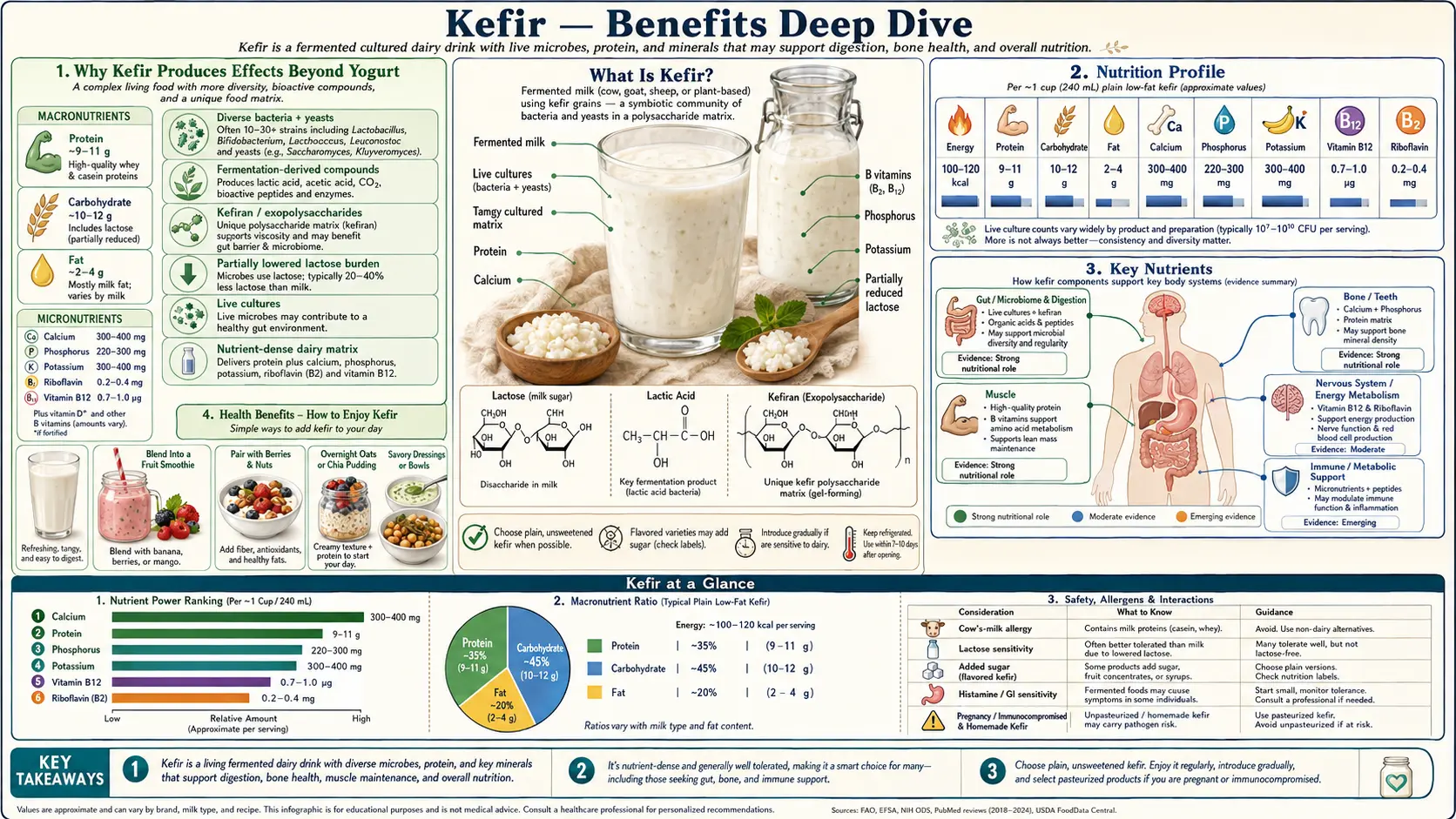
Kefir is the most microbially diverse fermented dairy product in widespread use, typically harboring 30 to 60 distinct species of lactic acid bacteria, acetic acid bacteria, and yeasts coexisting in a stable symbiotic matrix called the kefir grain. Where commercial yogurt typically delivers two or three strains at 108-109 CFU/g, traditional kefir delivers an entire micro-ecosystem at 109-1010 CFU/g. Four benefit pages below explore the specific mechanisms behind kefir's outsized clinical effects — the unmatched probiotic species count, the gut-microbiome-and-immune axis that links kefir consumption to reduced inflammation and infection susceptibility, the distinction between dairy-based milk kefir and the dairy-free tibicos (water kefir) variant, and the step-by-step home fermentation process that produces a vastly more potent product than commercial supermarket kefir.
Deep-Dive Articles
Probiotic Diversity
Why kefir contains 30-60 microbial species while commercial yogurt typically contains only two or three. The named genera — Lactobacillus kefiranofaciens, Lactobacillus kefiri, Lactococcus lactis, Leuconostoc mesenteroides, Acetobacter species, and yeasts Saccharomyces cerevisiae, Kluyveromyces marxianus, and Candida kefyr. The bacterial-yeast symbiosis embedded in the polysaccharide matrix (kefiran). Why home-fermented kefir vastly outperforms commercial pasteurized kefir on species count and viable CFU/g.
Gut Microbiome & Immune
The mechanism by which kefir microbes interact with the gut-associated lymphoid tissue (GALT), short-chain fatty acid production by resident Bifidobacterium and Faecalibacterium, regulation of Th17/Treg balance via butyrate signaling on the GPR43 receptor, bacteriocin production that selectively suppresses pathobionts, the documented reduction in H. pylori burden, evidence for symptom reduction in irritable bowel syndrome, and the Th1-skewing effect that supports antiviral immunity.
Tibicos Water vs Milk Kefir
The dairy-free alternative for lactose-intolerant, casein-sensitive, vegan, and Whole30 populations. Tibicos (water kefir, sugary kefir, tibi, California bees) ferments sucrose-water with lemon and dried fruit, producing a lightly carbonated, low-alcohol probiotic beverage. Comparison of species composition, viable CFU/g, sugar content, fermentation time, grain morphology, and clinical evidence base relative to dairy-based milk kefir.
Make at Home
Step-by-step home fermentation: sourcing live grains (not freeze-dried starter), the 1 tablespoon grains per 1-2 cups whole milk ratio, 18-36 hour room-temperature ferment, the plastic-or-wood-only utensil rule, cold secondary fermentation for additional B-vitamin synthesis and reduced lactose, troubleshooting (over-ferment, slow ferment, grain die-off, kahm yeast), and grain maintenance over multi-year periods. Equipment list and start-up cost (under $40).
Table of Contents
- Deep-Dive Articles
- Why Kefir Produces Effects Beyond Yogurt
- Research Papers: Probiotic Diversity
- Research Papers: Microbiome & Immune
- Research Papers: Tibicos / Water Kefir
- Research Papers: Fermentation, Bioactives, Kefiran
- Research Papers: Cross-Cutting (Clinical Trials, Safety)
- External Authoritative Resources
- Connections
- Featured Videos
Why Kefir Produces Effects Beyond Yogurt
Yogurt and kefir are both fermented dairy products, and both deliver live lactic acid bacteria. The clinical literature has been more enthusiastic about kefir than about yogurt for three structural reasons that distinguish kefir as a probiotic delivery vehicle.
- Species count an order of magnitude higher. Commercial yogurt is required by federal definition to contain Lactobacillus delbrueckii subsp. bulgaricus and Streptococcus thermophilus — just two species. Even probiotic-enhanced yogurts typically add only one or two extra strains (Bifidobacterium animalis subsp. lactis in Activia, Lactobacillus acidophilus in others). Traditional kefir made from live grains contains 30 to 60 microbial species across multiple genera, including yeasts, embedded in a complex polysaccharide matrix called kefiran. See our Probiotic Diversity page for the full taxonomic breakdown.
- Yeast component that yogurt entirely lacks. Kefir contains both lactic acid bacteria and yeasts living in stable symbiosis — the yeasts produce CO2 (the characteristic effervescence), ethanol (0.5-2% in extended ferments), and B-vitamins (B12, biotin, folate) that the bacteria do not produce. The yeasts also produce metabolites that selectively favor the lactic acid bacteria. Yogurt has no yeast component, which is why it lacks effervescence and produces a different post-ingestion flora.
- Higher viable CFU and broader colonization. Home-fermented kefir routinely delivers 109-1010 colony-forming units per gram, several orders of magnitude higher than typical commercial probiotics. The dose alone explains some of the clinical advantage, but research also suggests that several kefir-derived strains (notably Lactobacillus kefiri and Lactobacillus kefiranofaciens) transiently colonize the human gut more reliably than typical yogurt strains.
The therapeutic translation has been studied across a number of conditions. Randomized trials in Helicobacter pylori eradication consistently show that kefir as adjunct to triple-antibiotic therapy improves eradication rates and reduces antibiotic-associated diarrhea. Trials in irritable bowel syndrome show symptom reduction. Trials in lactose intolerance show that even severely intolerant subjects often tolerate kefir well because the resident lactose-fermenting bacteria and yeasts dramatically reduce lactose content over the fermentation period. Trials in metabolic syndrome and post-antibiotic recovery have shown more modest but generally favorable effects. Detailed mechanism walkthrough on our Gut Microbiome and Immune page.
The practical complication is that commercial kefir sold in supermarkets has almost always been heavily pasteurized after fermentation and re-inoculated with a small subset of laboratory-grown strains — typically 3 to 7 strains, never the full grain ecosystem. The species count and viable CFU of commercial kefir are dramatically lower than fresh home-fermented kefir from live grains. This is the main reason the home-fermentation route described on our Make at Home page produces meaningfully different clinical effects than buying kefir at the grocery store.
Research Papers: Probiotic Diversity
- Garrote GL et al. Microbial composition of kefir grains and metagenomic analysis — PubMed: Kefir microbial composition
- Marsh AJ et al. Sequence-based analysis of kefir grain microbiota — PubMed: Marsh sequencing analysis
- Nielsen B et al. Lactobacillus kefiranofaciens and kefir grain polysaccharide — PubMed: L. kefiranofaciens
- Witthuhn RC et al. Yeast community in kefir grains — PubMed: Kefir yeast community
- Chen YP et al. Strain-specific identification of Lactobacillus kefiri — PubMed: L. kefiri identification
- Plessas S et al. Microbiology and biochemistry of kefir, koumiss, and other ethnic fermented dairy products — PubMed: Ethnic fermented dairy
- Walsh AM et al. Microbial succession and flavor production in the fermented dairy beverage kefir — PubMed: Microbial succession in kefir
- Hsieh HH et al. Lactobacillus kefiranofaciens M1 isolated from milk kefir grains and inflammatory bowel disease — PubMed: L. kefiranofaciens M1
- Pogacic T et al. Microbiota of kefir grains and their interactions — PubMed: Kefir grain microbiota
- Korsak N et al. Short communication: Evaluation of the microbiota of kefir samples using metagenetic analysis — PubMed: Metagenetic analysis
Research Papers: Microbiome & Immune
- Bekar O et al. Kefir improves the efficacy and tolerability of triple therapy in eradicating Helicobacter pylori — PubMed: Kefir and H. pylori eradication
- Yilmaz I et al. Effect of administering kefir on the changes in fecal microbiota and symptoms of inflammatory bowel disease — PubMed: Kefir IBD trial
- Adiloglu AK et al. The effect of kefir consumption on human immune system: A cytokine study — PubMed: Kefir cytokine study
- Vinderola CG et al. Effects of the oral administration of kefir on the immune system in mice — PubMed: Kefir immune mice
- Bourrie BCT, Willing BP, Cotter PD. The microbiota and health-promoting characteristics of the fermented beverage kefir — PubMed: Bourrie kefir review
- de Moreno de LeBlanc A et al. Anti-inflammatory effect of kefir-isolated Lactobacillus kefiri P-IF in a model of inflammatory bowel disease — PubMed: L. kefiri anti-inflammatory
- Hertzler SR, Clancy SM. Kefir improves lactose digestion and tolerance in adults with lactose maldigestion — PubMed: Kefir and lactose tolerance
- Maeda H et al. Structural characterization and biological activities of an exopolysaccharide kefiran — PubMed: Kefiran biological activity
- Liu JR et al. The anti-allergenic properties of milk kefir and soymilk kefir — PubMed: Kefir anti-allergic
- Carasi P et al. Impact of kefir-derived Lactobacillus kefiri on the mucosal immune response and gut microbiota — PubMed: L. kefiri mucosal immunity
Research Papers: Tibicos / Water Kefir
- Laureys D, De Vuyst L. Microbial species diversity, community dynamics, and metabolite kinetics of water kefir fermentation — PubMed: Water kefir diversity
- Gulitz A et al. The microbial diversity of water kefir — PubMed: Gulitz water kefir
- Marsh AJ et al. Sequence-based analysis of the microbial composition of water kefir — PubMed: Marsh water kefir
- Lynch KM et al. Application of a water kefir granule in fermentation of fruit juice — PubMed: Water kefir fruit juice
- Pidoux M. The microbial flora of sugary kefir grain (the gingerbeer plant): Biosynthesis of the grain from Lactobacillus hilgardii — PubMed: Sugary kefir biosynthesis
- Fels L et al. Structural characterization of the exopolysaccharide produced by Lactobacillus hilgardii TMW 1.828 isolated from water kefir — PubMed: Hilgardii EPS
- Bueno RS et al. Production of healthy beverages by fermentation of plant matrices with water kefir grains — PubMed: Water kefir plant matrix
- Magalhaes KT et al. Microbial communities and chemical changes during fermentation of sugary Brazilian kefir — PubMed: Brazilian sugary kefir
- Diosma G et al. Yeasts from kefir grains: isolation, identification, and probiotic characterization — PubMed: Kefir yeast probiotic
- Verce M et al. A combined metagenomics and metatranscriptomics approach to unravel water kefir community functionality — PubMed: Water kefir metatranscriptomics
Research Papers: Fermentation, Bioactives, Kefiran
- Rodrigues KL et al. Antimicrobial and healing activity of kefir and kefiran extract — PubMed: Kefiran antimicrobial
- Powell JE et al. Characterization of bacteriocins from kefir-derived Lactobacillus — PubMed: Kefir bacteriocins
- Liu JR et al. Antimutagenic and antioxidant properties of milk-kefir and soymilk-kefir — PubMed: Kefir antioxidant
- Quiros A et al. Angiotensin-converting enzyme inhibitory activity of peptides derived from caprine kefir — PubMed: Kefir ACE inhibitors
- Sharifi M et al. Kefir: a powerful probiotic with anticancer properties — PubMed: Kefir anticancer review
- Chen YP et al. Hypocholesterolemic effects of kefir in cholesterol-fed hamsters — PubMed: Kefir cholesterol
- Punaro GR et al. Kefir administration reduced progression of renal injury in STZ-diabetic rats — PubMed: Kefir diabetic nephropathy
- Ostadrahimi A et al. Effect of probiotic fermented milk (kefir) on glycemic control and lipid profile in type 2 diabetic patients — PubMed: Kefir T2D glycemic
- Cenesiz S et al. The effects of kefir on functional constipation in adults — PubMed: Kefir and constipation
- Hamet MF et al. Selection of EPS-producing Lactobacillus strains isolated from kefir grains — PubMed: Kefir EPS selection
Research Papers: Cross-Cutting (Clinical Trials, Safety)
- Rosa DD et al. Milk kefir: nutritional, microbiological and health benefits — PubMed: Rosa kefir review
- Prado MR et al. Milk kefir: composition, microbial cultures, biological activities, and related products — PubMed: Prado kefir composition
- Bourrie BCT et al. Traditional kefir reduces weight gain and improves plasma and liver lipid profiles — PubMed: Bourrie traditional kefir
- St-Onge MP et al. Kefir consumption does not alter plasma lipid levels or cholesterol fractional synthesis rates — PubMed: St-Onge kefir lipids
- Toscano M et al. Effect of Lactobacillus rhamnosus HN001 and Bifidobacterium longum BB536 on the healthy gut microbiota composition — PubMed: Probiotic healthy gut
- Farnworth ER. Kefir: a complex probiotic — PubMed: Farnworth kefir review
- Otles S, Cagindi O. Kefir: a probiotic dairy-composition, nutritional and therapeutic aspects — PubMed: Otles kefir review
- Friques AG et al. Chronic administration of the probiotic kefir improves the endothelial function in spontaneously hypertensive rats — PubMed: Kefir hypertension
- Nielsen B, Gurakan GC, Unlu G. Kefir: a multifaceted fermented dairy product — PubMed: Multifaceted dairy
- Ahmed Z et al. Kefir and health: a contemporary perspective — PubMed: Ahmed kefir review
External Authoritative Resources
- Frontiers in Microbiology — Kefir: A Symbiotic Yeasts-Bacteria Community with Alleged Healthy Capabilities
- FDA — Standards for Fermented Milk Products (21 CFR 131)
- WHO / FAO — Probiotics in Food (Health and Nutritional Properties Guidelines)
- USDA — Standards for Cultured Milk Products
- PubMed — All research on kefir (3,000+ papers)
Connections
- All Food
- Kefir (Main Page)
- Kefir Probiotic Diversity
- Kefir Gut Microbiome and Immune
- Tibicos Water vs Milk Kefir
- Make Kefir at Home
- Yogurt
- Milk
- Probiotics
- Irritable Bowel Syndrome
- SIBO
- H. pylori Infection
- Immune Boosting
- Fermented Foods
- Calcium