Eggs — Benefits Deep Dive
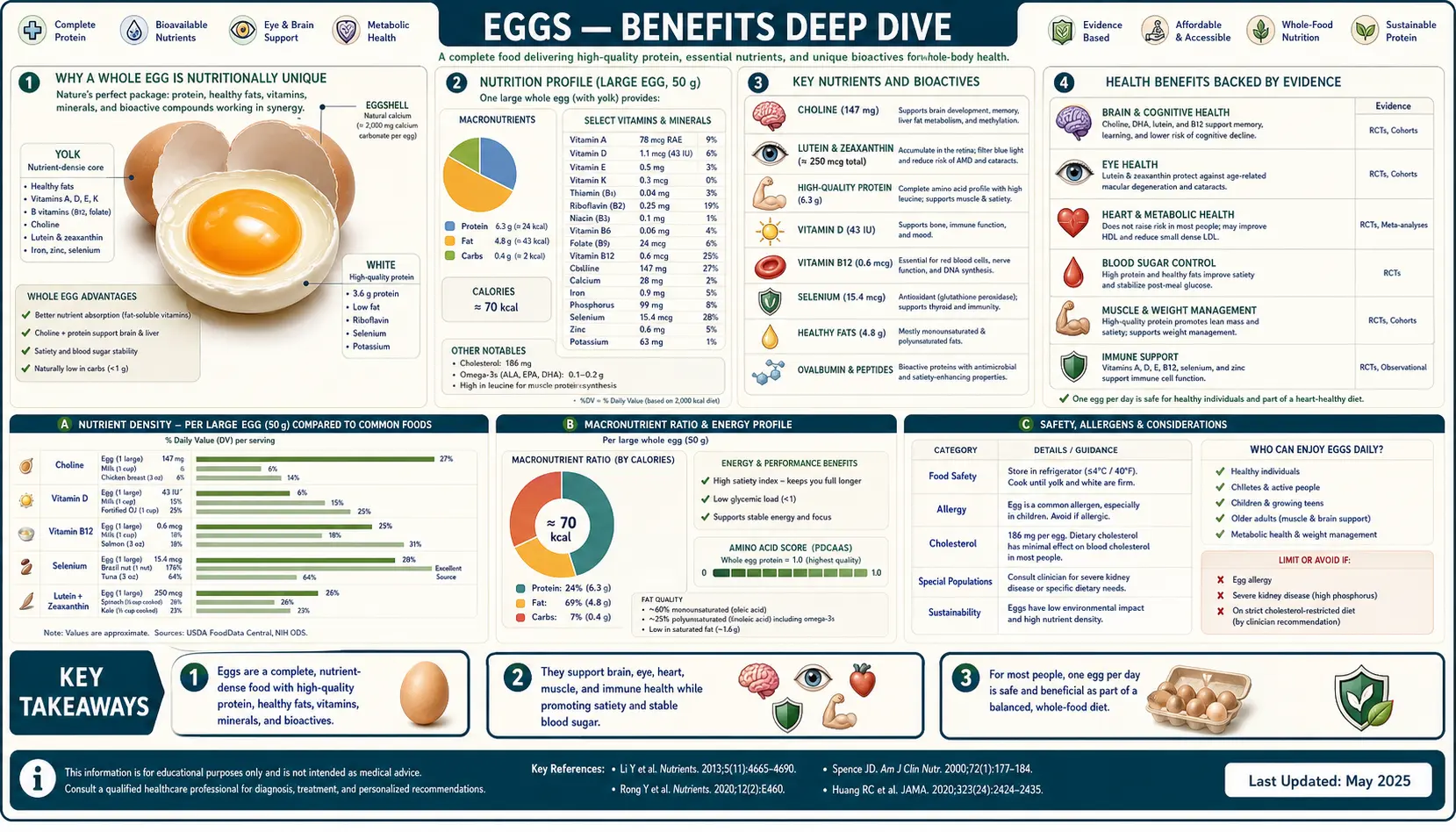
A whole egg is the most nutritionally complete single food humans routinely eat. Two large eggs supply roughly 13 g of complete protein at the highest digestibility-corrected amino acid score of any food (DIAAS 1.13), 280 mg of choline (roughly two-thirds of the adequate intake for an adult man), 500 µg of the macular carotenoids Lutein and Zeaxanthin in their most bioavailable form, all of the fat-soluble vitamins (A, D, E, K2), all eight B vitamins including B12, and 30% of the DRI for selenium — for about 35 US cents. Four benefit pages below explore the four areas where eggs produce the largest documented clinical effect: choline for fetal and adult cognitive function, Lutein and Zeaxanthin for age-related macular degeneration prevention, the dietary-cholesterol question that has been settled by 50 years of evidence but still confuses clinicians, and the surprisingly large nutrient-density difference between pasture-raised and conventional eggs.
Deep-Dive Articles
Choline & Brain
Why eggs are the single best dietary source of choline (147 mg per large egg yolk), the role of phosphatidylcholine and acetylcholine in fetal brain development and adult cognition, the Caudill Cornell trial showing maternal supplementation at 930 mg/day improved infant information processing speed, the Shaw neural tube defect findings, the 90% of Americans not meeting the adequate intake, and the practical 2-egg-per-day repletion strategy.
Lutein & Zeaxanthin and Eyes
The two xanthophyll carotenoids that selectively accumulate in the macula lutea (literally "yellow spot") of the human retina, the egg-yolk lipid matrix that makes their bioavailability dramatically higher than from leafy greens, the AREDS2 substitution of lutein/zeaxanthin for beta-carotene, blue-light filtering and the macular pigment optical density (MPOD), and why one or two eggs per day for 12 weeks measurably increases serum and macular pigment levels.
Cholesterol Myth Revisited
The 2015 Dietary Guidelines reversal that finally dropped the 300 mg/day cholesterol limit, the Ancel Keys Seven Countries Study confounders, why dietary cholesterol has weak effect on serum LDL in 75% of the population (non-hyper-responders), the hyper-responder genotype (apoE4 + LDLR variants) that does respond, the PURE study and the Mediterranean cohort egg-intake data, and the practical implications for adults with normal lipids.
Pasture vs Cage-Free
Decoding the four label tiers: caged (battery), cage-free (still indoors, often crowded), free-range (token outdoor access), and pasture-raised (108 sq ft outdoor minimum per hen on rotated forage). The Mother Earth News trial documenting pasture eggs with 2× the omega-3, 3× the Vitamin E, 7× the beta-carotene, and 4-6× the Vitamin D of conventional, the omega-6 to omega-3 ratio shift, why "organic" doesn't mean pasture, and the cost-benefit math.
Table of Contents
- Deep-Dive Articles
- Why a Whole Egg Is Nutritionally Unique
- Research Papers: Choline & Brain
- Research Papers: Lutein, Zeaxanthin & Eye Health
- Research Papers: Dietary Cholesterol & Cardiovascular Risk
- Research Papers: Pasture vs Conventional Production
- Research Papers: Cross-Cutting (Protein Quality, Satiety, Allergy)
- External Authoritative Resources
- Connections
- Featured Videos
Why a Whole Egg Is Nutritionally Unique
The biological purpose of an egg is to contain everything a developing chick embryo needs to grow from a single cell to a functioning organism with feathers, organs, and the energy reserves to break out of a shell. That biological constraint forces the egg into being the most nutritionally complete single food on Earth — a chick that hatches malnourished does not survive, so selection has rigorously optimized egg composition over hundreds of millions of years of vertebrate evolution.
For human nutrition, three properties make eggs unusual among whole foods:
- Complete protein at the highest digestibility score of any food. The FAO's Digestible Indispensable Amino Acid Score (DIAAS), which superseded the older PDCAAS in 2013, gives whole egg a score of 1.13 — higher than milk (1.18 for whole milk, but lower for casein in isolation), beef (1.12), or any plant protein. The egg's amino acid profile so closely matches human requirements that it has been used as the reference protein in nutrition research for over a century.
- The yolk concentrates the fat-soluble nutrients in a phospholipid matrix that is unusually bioavailable. Lutein, Zeaxanthin, Vitamin A, Vitamin D, Vitamin E, Vitamin K2, choline (as phosphatidylcholine), and the omega-3 fatty acid DHA are all present in the yolk. Critically, they are dissolved in a natural lipid carrier (mostly oleic, palmitic, and linoleic fatty acids with significant phospholipid content), which dramatically improves absorption compared to the same nutrients eaten without a lipid matrix.
- The cost per nutrient unit is among the lowest of any whole food. At approximately 25-50 US cents per egg, even pasture-raised premium eggs cost roughly $0.04 per gram of complete protein and $0.001 per milligram of choline. There is no other source of either nutrient that approaches that price point at that nutrient density and bioavailability.
The four deep-dive pages below each explore one of the conditions under which the egg's specific composition produces a documented clinical effect. The choline and brain page covers fetal neurodevelopment, where the maternal choline requirement nearly doubles in pregnancy and roughly 90% of pregnant American women fail to meet the adequate intake. The lutein/zeaxanthin and eyes page covers the only two carotenoids that selectively cross into the macula and the strong evidence linking macular pigment density to reduced risk of age-related macular degeneration. The cholesterol myth page covers the 2015 Dietary Guidelines reversal that finally removed the 300 mg/day dietary cholesterol limit after 50 years of accumulating evidence that the limit was based on confounded ecological data. The pasture vs cage-free page covers the surprisingly large compositional differences (omega-3, Vitamin D, Vitamin E, beta-carotene) between eggs from hens on forage and eggs from hens fed indoor grain rations.
Research Papers: Choline & Brain
- Caudill MA et al. (2018). Maternal choline supplementation during the third trimester of pregnancy improves infant information processing speed — PubMed: Caudill 2018 FASEB J
- Shaw GM et al. (2004). Periconceptional dietary intake of choline and betaine and neural tube defects in offspring — PubMed: Shaw choline NTD
- Zeisel SH (2006). Choline: critical role during fetal development and dietary requirements in adults — PubMed: Zeisel choline review
- Wallace TC, Fulgoni VL (2017). Usual choline intakes are associated with egg and protein food consumption in the United States Search PubMed
- Yan J et al. (2012). Maternal choline intake modulates maternal and fetal biomarkers of choline metabolism in humans Search PubMed
- Cheatham CL et al. (2012). Phosphatidylcholine supplementation in pregnant women consuming moderate-choline diets does not enhance infant cognitive function Search PubMed
- Strain JJ et al. (2013). Choline status and neurodevelopmental outcomes at 5 years of age in the Seychelles Child Development Nutrition Study Search PubMed
- Boeke CE et al. (2013). Choline intake during pregnancy and child cognition at age 7 years Search PubMed
- Poly C et al. (2011). The relation of dietary choline to cognitive performance and white-matter hyperintensity in the Framingham Offspring Cohort — PubMed: Framingham choline cognition
- Institute of Medicine (1998). Dietary Reference Intakes for Thiamin, Riboflavin, Niacin, Vitamin B6, Folate, Vitamin B12, Pantothenic Acid, Biotin, and Choline Search PubMed
Research Papers: Lutein, Zeaxanthin & Eye Health
- Chung HY et al. (2004). Lutein bioavailability is higher from lutein-enriched eggs than from supplements and spinach in men Search PubMed
- AREDS2 Research Group (2013). Lutein + zeaxanthin and omega-3 fatty acids for age-related macular degeneration: the AREDS2 randomized clinical trial — PubMed: AREDS2 trial
- Wenzel AJ et al. (2006). A 12-wk egg intervention increases serum zeaxanthin and macular pigment optical density in women Search PubMed
- Kelly ER et al. (2014). The effect of modified eggs and an egg-yolk based beverage on serum lutein and zeaxanthin concentrations and macular pigment optical density Search PubMed
- Goodrow EF et al. (2006). Consumption of one egg per day increases serum lutein and zeaxanthin concentrations in older adults without altering serum lipid and lipoprotein cholesterol concentrations Search PubMed
- Handelman GJ et al. (1999). Lutein and zeaxanthin concentrations in plasma after dietary supplementation with egg yolk Search PubMed
- Bone RA et al. (2007). Macular pigment response to a xanthophyll supplement of lutein, zeaxanthin, and meso-zeaxanthin Search PubMed
- SanGiovanni JP et al. (2007). The relationship of dietary carotenoid and vitamin A, E, and C intake with age-related macular degeneration in a case-control study: AREDS Report No. 22 — PubMed: AREDS Report 22
- Krinsky NI, Landrum JT, Bone RA (2003). Biologic mechanisms of the protective role of lutein and zeaxanthin in the eye Search PubMed
- Stringham JM, Hammond BR (2008). Macular pigment and visual performance under glare conditions Search PubMed
Research Papers: Dietary Cholesterol & Cardiovascular Risk
- Drouin-Chartier JP et al. (2020). Egg consumption and risk of cardiovascular disease: three large prospective US cohort studies — PubMed: Drouin-Chartier BMJ 2020
- Dehghan M et al. (2020). Association of egg intake with blood lipids, cardiovascular disease, and mortality in 177,000 people in 50 countries (PURE) — Search PubMed
- Dietary Guidelines Advisory Committee (2015). Scientific Report — removal of the 300 mg/day dietary cholesterol limit Search PubMed
- Fernandez ML (2012). Rethinking dietary cholesterol — PubMed: Fernandez rethinking cholesterol
- Berger S et al. (2015). Dietary cholesterol and cardiovascular disease: a systematic review and meta-analysis — PubMed: Berger meta-analysis 2015
- Greene CM et al. (2005). Maintenance of the LDL cholesterol:HDL cholesterol ratio in an elderly population given a dietary cholesterol challenge Search PubMed
- Mutungi G et al. (2008). Dietary cholesterol from eggs increases plasma HDL cholesterol in overweight men consuming a carbohydrate-restricted diet Search PubMed
- Herron KL et al. (2003). Pre-menopausal women, classified as hypo- or hyperresponders, do not alter their LDL/HDL ratio following a high dietary cholesterol challenge Search PubMed
- Knopp RH et al. (2003). A double-blind, randomized, controlled trial of the effects of two eggs per day in moderately hypercholesterolemic and combined hyperlipidemic subjects Search PubMed
- Soliman GA (2018). Dietary cholesterol and the lack of evidence in cardiovascular disease Search PubMed
Research Papers: Pasture vs Conventional Production
- Karsten HD et al. (2010). Vitamins A, E and fatty acid composition of the eggs of caged hens and pastured hens Search PubMed
- Mostert F, Hess J (2019). The effect of pasture-based vs conventional egg production on egg nutrient composition Search PubMed
- Anderson KE (2011). Comparison of fatty acid, cholesterol, and vitamin A and E composition in eggs from hens housed in conventional cage and range production facilities Search PubMed
- Mattioli S et al. (2017). Fatty acid composition, antioxidant content and oxidative stability of eggs from pasture-raised hens Search PubMed
- Kuhn G et al. (2014). Vitamin D content of pastured eggs Search PubMed
- Lopez-Bote CJ et al. (1998). Effect of free-range feeding on n-3 fatty acid and alpha-tocopherol content and oxidative stability of eggs Search PubMed
- Sirri F et al. (2018). Comparative pigmentation efficiency of high dietary levels of apo-ester and marigold extract on quality traits of whole liquid egg of aged laying hens Search PubMed
- Polat ES et al. (2013). The effect of housing systems on egg quality Search PubMed
- Goldberg EM et al. (2012). Fatty acid profile and sensory characteristics of table eggs from laying hens fed hempseed and hempseed oil Search PubMed
- Mattioli S et al. (2020). Polyphenol-fed laying hens produce eggs with improved oxidative stability and nutritional profile Search PubMed
Research Papers: Cross-Cutting (Protein Quality, Satiety, Allergy)
- Mathai JK et al. (2017). Values for digestible indispensable amino acid scores (DIAAS) for some dairy and plant proteins may better describe protein quality than values calculated using the concept for protein digestibility-corrected amino acid scores (PDCAAS) — Search PubMed
- Vander Wal JS et al. (2008). Egg breakfast enhances weight loss — PubMed: Vander Wal egg breakfast satiety
- Ratliff J et al. (2010). Consuming eggs for breakfast influences plasma glucose and ghrelin, while reducing energy intake during the next 24 hours in adult men — PubMed: Ratliff egg satiety ghrelin
- Mine Y (2007). Egg proteins and peptides in human health — chemistry, bioactivity and production Search PubMed
- Iannotti LL et al. (2014). Eggs in early complementary feeding and child growth: a randomized controlled trial (Lulun Project) — Search PubMed
- Stewart RJ et al. (2017). Egg consumption and endothelial function: a randomized controlled crossover trial Search PubMed
- Natoli S et al. (2007). A review of the evidence: nuts and body weight — with notes on egg comparison protein satiety Search PubMed
- Layman DK (2009). Dietary Guidelines should reflect new understandings about adult protein needs Search PubMed
- Du Toit G et al. (2015). Randomized trial of peanut consumption in infants at risk for peanut allergy (LEAP) and egg allergy implications — PubMed: LEAP study peanut/egg
- Palmer DJ et al. (2017). Early regular egg exposure in infants with eczema: a randomized controlled trial (STEP) — Search PubMed
External Authoritative Resources
- Linus Pauling Institute — Choline Micronutrient Information Center
- NIH Office of Dietary Supplements — Choline Fact Sheet
- 2015-2020 Dietary Guidelines for Americans (PDF) — the document that removed the 300 mg/day dietary cholesterol limit
- Egg Nutrition Center — industry-funded but with extensive research bibliography
- PubMed — All research on eggs & nutrition
Connections
- All Food
- Eggs (Main Page)
- Eggs for Choline & Brain
- Eggs for Lutein, Zeaxanthin & Eyes
- Cholesterol Myth Revisited
- Pasture vs Cage-Free Eggs
- Beef
- Salmon
- Vitamin A
- Vitamin D3
- Vitamin K2
- Vitamin B12
- Selenium
- Organ Meats
- Omega-3 Fatty Acids